
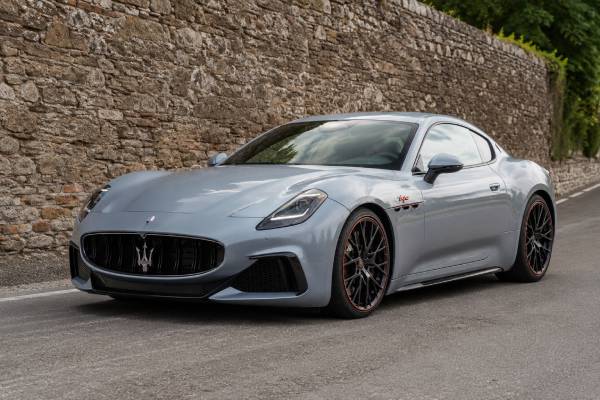
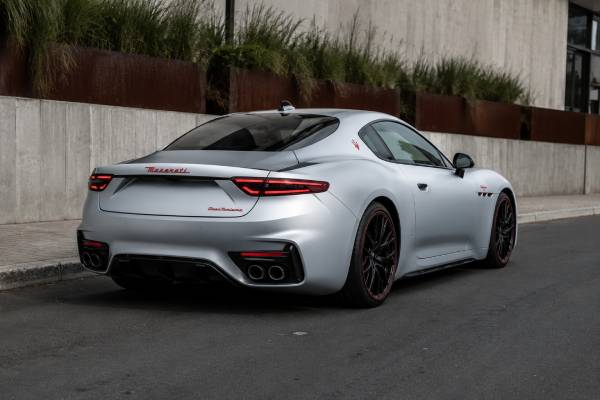
The 2023 Maserati GranTurismo PrimaSerie 75th Anniversary Launch Edition is the collector-focused debut specification of the second-generation M189 GranTurismo. Maserati produced 300 PrimaSerie cars across four configurations: 75 Trofeo examples in Grigio Lamiera, 75 Trofeo examples in Nero Cometa, and two equivalent 75-car Folgore color groups. The 550 hp assignment covered here is the twin-turbo Nettuno V6 Trofeo, not the battery-electric Folgore. It combines all-wheel drive, an eight-speed automatic, air suspension, rear-biased handling, four full-size seats, and a 0–100 km/h claim of roughly 3.5 seconds with anniversary graphics, dedicated color treatment, and numbered exclusivity. The edition is historically important because it reopened the GranTurismo story after the V8 M145 and introduced a platform engineered from the outset for both combustion and electric power. It is also a complex modern luxury car whose value depends on software status, complete launch-edition trim, warranty history, tire and brake condition, 12-volt battery health, and evidence of correct dealer service. This guide explains the PrimaSerie’s production structure, Nettuno engineering, road behavior, ownership priorities, and the checks required before buying one.
Table of Contents
- The Numbered Return of Maserati Grand Touring
- Nettuno, AWD, and M189 Technical Foundation
- Three Hundred Cars, Four Launch Configurations
- Anniversary Details and Zero-Compromise Packaging
- Trofeo Speed With Real Four-Seat Comfort
- Software, Air Suspension, and Modern Service Needs
- Buying a Complete PrimaSerie Trofeo
The Numbered Return of Maserati Grand Touring
The PrimaSerie is the ceremonial first chapter of the M189 generation. It celebrates 75 years since the 1947 A6 1500 Gran Turismo and marks Maserati’s return to a dedicated four-seat coupe after M145 production ended in 2019.
The gap mattered. The original GranTurismo had become closely associated with a naturally aspirated Ferrari-derived V8, hydraulic steering, and Pininfarina styling. Maserati could not simply repeat that formula under new emissions, safety, connectivity, and electrification requirements. The M189 began as a clean-sheet architecture developed to support two very different powertrains while maintaining a low roofline and useful rear seats.
The Trofeo PrimaSerie uses the 3.0-liter twin-turbo Nettuno V6 in 550 hp form. It is faster than any standard road-going V8 GranTurismo, yet its character is different. Torque arrives much earlier, all-wheel drive manages launch traction, the eight-speed automatic shifts without the interruption of an old single-clutch transaxle, and air suspension broadens the comfort range.
Maserati made 300 PrimaSerie examples in total, divided into four groups of 75. Half used the Trofeo combustion powertrain and half used the Folgore electric system. The “75th Anniversary” theme therefore refers both to GranTurismo heritage and to the number produced in each color-and-powertrain configuration.
For the Trofeo, the principal launch colors were Grigio Lamiera and Nero Cometa. Dedicated graphics, 75th Anniversary emblems, special wheel-center details, contrast accents, and cabin embroidery distinguish the edition. Market allocations varied. North America, for example, received a defined group of Grigio Lamiera Trofeo cars for the 2024 model year even though the global launch story began in 2023.
The edition’s collecting case is stronger than a simple option package because the production structure is documented and tied to a major generation change. Still, not every PrimaSerie will age equally. A complete, original, carefully serviced car with all launch materials should command more confidence than one with replaced wheels, missing badges, cosmetic damage, unresolved software faults, or an unclear import history.
The right way to view it is as both a first-year high-performance car and a limited edition. First-year technology demands close attention to updates and campaigns. Limited-edition status demands preservation of details that may be hard to replace. A buyer must evaluate both sides rather than letting the anniversary story obscure the mechanical and electronic condition.
Nettuno, AWD, and M189 Technical Foundation
The PrimaSerie Trofeo combines a 550 hp Nettuno V6 with an eight-speed automatic and electronically managed all-wheel drive. Its performance comes from early torque, traction, active chassis control, and low mass relative to its size rather than a large-displacement engine.
| Item | Specification |
|---|---|
| Engine | 2,992 cc 90-degree twin-turbo V6 Nettuno |
| Combustion system | Maserati Twin Combustion with pre-chamber and conventional spark ignition |
| Output | 550 hp at 6,500 rpm |
| Torque | 650 Nm from approximately 3,000 rpm |
| Transmission | Eight-speed torque-converter automatic |
| Drive | Electronically controlled all-wheel drive with rear-biased calibration |
| Suspension | Double wishbone front, multi-link rear, air springs, adaptive dampers |
| Brakes | Large ventilated performance discs with multi-piston front calipers |
| Wheels and tires | 20-inch front and 21-inch rear staggered fitment |
| Length | 4,959 mm |
| Width | 1,957 mm excluding mirrors |
| Height | 1,353 mm |
| Wheelbase | 2,929 mm |
| 0–100 km/h | Approximately 3.5 seconds |
| Top speed | Approximately 320 km/h |
Nettuno’s defining feature is its pre-chamber combustion concept. A small chamber above each main combustion chamber uses a dedicated spark plug and connecting holes to send jets of burning mixture into the cylinder. A second spark plug supports conventional combustion under conditions where that is more suitable. The design promotes fast, stable combustion and allows high specific output.
Two turbochargers provide 650 Nm at relatively low engine speed, so the Trofeo accelerates with much less waiting than an old F136 V8. The engine still revs to make peak power at 6,500 rpm, but the strongest everyday impression is broad mid-range thrust. Cooling, oil quality, ignition health, and software calibration are important because high cylinder pressure and turbocharger heat place greater demands on service discipline.
The eight-speed automatic supports relaxed cruising and rapid manual shifts. All-wheel drive gives the front axle torque when needed while preserving a rear-driven feel in normal conditions. Launch control coordinates engine, transmission, differential, and tire slip. It should be used only after the car is fully warm and on a suitable surface; repeated launches add heat and load to driveline components.
The multi-material body uses extensive aluminum with magnesium and high-strength steel in selected areas. This keeps combustion models below the mass expected of a large AWD luxury coupe. Air springs and adaptive dampers control ride height and body motion. Electronic vehicle-dynamics software coordinates powertrain, braking, steering, and stability functions more deeply than on the M145.
Staggered 20/21-inch wheels reduce sidewall height, making tire quality and wheel condition critical. The rear tires are broad and expensive. Incorrect matching, low pressures, or large tread-depth differences can affect AWD behavior as well as handling. Replacement should follow Maserati’s size, load, speed, and homologation guidance.
Three Hundred Cars, Four Launch Configurations
The PrimaSerie production plan is precise: four specifications of 75 cars each, totaling 300. For the 550 hp Trofeo, the two core configurations are Grigio Lamiera and Nero Cometa; the other 150 cars are Folgore EVs in Rame Folgore and Blu Inchiostro.
The Trofeo color groups use contrasting graphics and details to emphasize the body’s surfaces. Grigio Lamiera has an industrial metallic character, while Nero Cometa creates a darker, more formal appearance. Red or other dedicated accent treatments appear in badges, wheel centers, stitching, and exterior identifiers depending on configuration and market.
The 75th Anniversary logo is integrated into seats and exterior details rather than limited to a loose plaque. The Trident, fender, hub, and trunk treatments should correspond with factory images and build data. Because small emblems can be damaged or removed during detailing, buyers should confirm availability before assuming replacement is easy.
Market specification can alter lighting, emissions hardware, driver-assistance equipment, radio functions, charging ports for devices, and warranty coverage. Some cars are described as 2023 globally and 2024 in a national model-year system. Build date, VIN, original invoice, and import documents explain the difference.
A strong provenance file should contain:
- the original order or purchase invoice identifying PrimaSerie;
- VIN-specific factory configuration;
- certificate, numbered material, or delivery package supplied in that market;
- all manuals, keys, accessories, and emergency equipment;
- software-update and campaign records;
- itemized service invoices;
- documentation for wheel, tire, paint, glass, or body repairs;
- retained original parts after any reversible personalization.
Fuoriserie personalization can complicate authenticity assessment. Maserati’s customization program allowed unusual materials and color details, so a nonstandard-looking feature may still be factory correct. The build record should settle the question. Aftermarket wrapping or painted accents should be disclosed and examined for hidden damage.
The PrimaSerie is mechanically close to a regular Trofeo, which is an advantage for service and a limitation for speculative value. Owners can obtain normal drivetrain and chassis support, but the edition-specific cosmetics may be scarce. The preservation priority should therefore be the irreplaceable trim and documentary package, while maintaining the mechanical systems to standard Trofeo requirements.
Anniversary Details and Zero-Compromise Packaging
The M189’s engineering achievement is that both Nettuno and Folgore versions retain the same low coupe silhouette and four-seat mission. The PrimaSerie decorates that architecture without disturbing its clean proportions.
Maserati Centro Stile developed the body around a long hood, four distinct fender peaks, a low roof, and the Trident on the rear pillar. The form references previous GranTurismos but avoids a retro copy. Vertical headlamp elements connect it visually with the MC20, while the grille remains a clear combustion-model identifier.
The multi-material shell required different joining and manufacturing methods for aluminum, magnesium, and steel. Strategic reinforcement protects occupant space while keeping the roof at 1,353 mm. The 2,929 mm wheelbase provides genuine rear seating, although access still requires folding the front seats.
Airflow supports cooling and stability. Front openings feed the Nettuno’s heat exchangers and brakes; a managed underbody reduces lift; rear shaping keeps the car stable near its high claimed maximum speed. Inspect the low front edge, shutters or ducts, undertrays, and wheel-arch liners after curb or road impact. Missing aero panels can affect thermal behavior and noise.
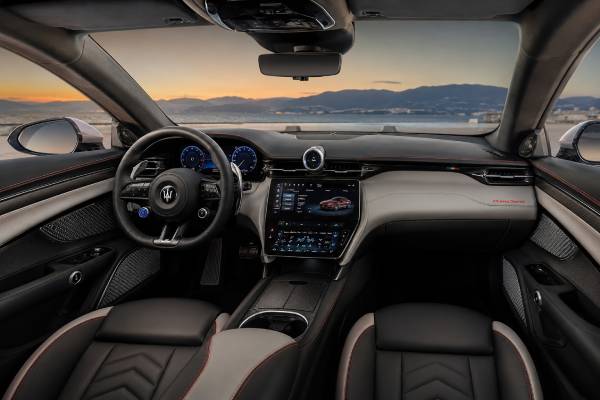
The cabin replaces the M145’s traditional analog layout with a digital instrument panel, Maserati Intelligent Assistant infotainment, a lower comfort display, and a digital interpretation of the central clock. A head-up display may be fitted. The interface reduces physical switches but makes software health central to ownership.
Sonus faber supplies a 14-speaker 860-watt system as standard in many specifications and an available 19-speaker 1,195-watt arrangement. Test every speaker and input. A high-end audio option is less valuable when a software glitch, damaged amplifier, or water entry disables part of it.
PrimaSerie embroidery, 75th logos, contrast stitching, and special surface treatments make the cabin distinctive. Photograph these items when taking ownership. Use gentle, material-appropriate cleaning; aggressive chemicals can damage printed logos, coated leather, carbon trim, and metallic thread.
The V6 sound is shaped by intake, combustion, exhaust valves, and cabin tuning. It is deeper and more forceful under boost than the old V8 but less naturally melodic at high rpm. That difference is not a defect. The M189’s engineering brief prioritizes performance, emissions, efficiency, and broad torque while retaining an audible mechanical identity.
Trofeo Speed With Real Four-Seat Comfort
The PrimaSerie Trofeo is exceptionally fast yet easier to drive smoothly than the old MC Stradale. All-wheel-drive traction, early torque, the eight-speed gearbox, and air suspension make its performance accessible without removing the sense of a rear-led grand tourer.
Comfort or GT-oriented modes keep throttle, shifts, exhaust, damping, and ride height suitable for distance. The gearbox moves through ratios quietly and the engine supplies effortless passing torque. The low-profile tires still report sharp road edges, but the air springs prevent the car from feeling needlessly rigid.
Sport and Corsa settings increase response and reduce intervention. Paddle shifts become faster, dampers tighten, exhaust behavior changes, and torque distribution supports more active cornering. Corsa is most appropriate on dry, open roads or a circuit where tire temperature and surface quality are known.
Launch control can produce the quoted 3.5-second 0–100 km/h time under suitable conditions. The system manages wheel slip more consistently than a driver could in a rear-drive V8 predecessor. Performance still depends on tire state, fuel, temperature, altitude, and surface. Repeated demonstrations can overheat the powertrain and accelerate tire wear.
Steering is electrically assisted but calibrated with steady effort. It communicates less granular texture than the M145’s hydraulic system, yet the front end responds more quickly and the body is better controlled. The car’s width remains noticeable in towns and narrow roads.
The brake pedal should feel firm and linear. Regenerative blending is not involved in the combustion Trofeo, so response is conventional hydraulic friction braking. Large wheels expose discs to stone damage and cosmetic corrosion. Vibration or steering pull requires inspection rather than software speculation.
AWD gives strong exit traction, but physics still applies. Front tires can saturate if the driver enters too fast, and aggressive throttle can move balance rearward. Smooth trail braking and progressive power allow the active systems to work with the driver. Stability controls should remain enabled on public roads.
Four full-size seats, usable luggage space, modern climate control, and strong audio make the car a credible transcontinental coupe. Rear access and headroom depend on occupant size, but the seats are far more than emergency cushions. The PrimaSerie’s key success is that its speed does not destroy the GranTurismo mission.
Software, Air Suspension, and Modern Service Needs
The primary ownership risks are not old-car corrosion or a dry clutch; they are software integration, low-voltage battery condition, turbocharged-engine service, air-suspension health, expensive wheels and tires, and incomplete campaign history. Warranty and dealer diagnostics carry real value.
Follow official time and mileage requirements for engine oil, filters, brake fluid, coolant, spark plugs, and driveline fluids. Use only approved oil because pre-chamber combustion, turbo bearings, emissions systems, and variable controls depend on correct viscosity and additive performance. Repeated short trips should not be treated as gentle use.
Inspect for oil or coolant residue around turbo plumbing, hoses, reservoirs, undertrays, and heat exchangers. A healthy engine should start cleanly, idle evenly, build boost without hesitation, and maintain stable temperature. Whistling, smoke, misfire, coolant loss, or repeated check-engine events deserve immediate diagnosis.
The eight-speed automatic and AWD system should engage smoothly, shift consistently, and remain free of shudder or warning messages. Ask whether software updates or adaptations were performed and whether any fluid service is due under the exact market schedule. Launch-count data may not be available to a buyer, so tire wear and owner history provide useful context.
Air suspension should raise, lower, and level the car evenly. After overnight parking, one corner should not sit visibly low. Listen for compressor overrun and inspect air lines, struts, ride-height sensors, adaptive dampers, and front-lift or elevated-mode operation where fitted. A fault can affect alignment and tire wear as well as comfort.
Load-test the 12-volt battery. Modern modules can generate a cascade of warnings when voltage falls, particularly after storage or showroom use. Confirm charging-system operation and use the correct battery-support procedure during software updates. Replacing the battery may require registration or calibration.
Check for open recalls, service campaigns, and infotainment updates by VIN. Test every driver-assistance feature, camera, sensor, display, touchscreen, phone connection, key, seat, window, mirror, climate function, audio channel, and lighting element. Intermittent faults should be documented while warranty coverage remains.
Inspect 20/21-inch wheels for inner damage and tires for age, sidewall cuts, uneven wear, and correct matched specification. Large tread-depth differences can stress AWD logic. Measure brakes and check for track heat, lip wear, or vibration. Brake and tire replacement can create a large first-year bill.
Edition trim needs separate care. Record the condition of badges, embroidery, wheel centers, and paint. Use authorized or highly qualified repairers after body damage because sensor calibration, mixed-material joining, paint matching, and aero reassembly require model-specific procedures.
Buying a Complete PrimaSerie Trofeo
Buy the PrimaSerie only after confirming that it is one of the 150 Trofeo launch cars and that its edition details, software, warranty, and service status are complete. A normal Trofeo with added graphics should not receive the same valuation.
Obtain the factory build sheet, original invoice, delivery-market record, and any certificate or numbered package. Match VIN, color configuration, anniversary logos, seat embroidery, wheels, center caps, trim, and options. Clarify whether the car is globally described as 2023 but nationally titled as 2024.
A pre-purchase inspection should use current Maserati diagnostic equipment and include:
- A cold start, road test, and hot restart.
- Full module fault scan and software-version review.
- Confirmation of completed recalls and service campaigns.
- Air-suspension height and leak-down assessment.
- Wheel, tire, brake, underbody, and cooling inspection.
- Paint-depth and mixed-material repair assessment.
- Verification of every PrimaSerie item and accessory.
| Area | Strong evidence | Warning sign |
|---|---|---|
| Authenticity | Factory PrimaSerie data, correct color group, complete anniversary details | Added badges, missing documents, inconsistent trim |
| Software and warranty | Current updates, closed campaigns, transferable coverage | Recurring warnings, unclear update history, lapsed support |
| Powertrain | Clean operation, stable temperature, smooth AWD and shifts | Misfire, smoke, coolant loss, shudder, drivetrain messages |
| Chassis | Level air suspension, straight wheels, matched tires | Overnight sag, compressor overrun, impact damage, uneven wear |
| Body and cabin | Original mixed-material repair history and all functions working | Poor paint match, sensor faults, damaged logos, water entry |
Drive in several modes. Confirm smooth low-speed behavior, full-throttle acceleration without warning lights, straight braking, stable ride height, and quiet operation over rough surfaces. Test driver assistance in safe conditions. A short dealer-lot loop is insufficient for heat-related or network faults.
Review ownership costs before negotiating. Tires, brakes, insurance, annual dealer service, software diagnosis, wheel repair, and air-suspension components are premium items. A remaining factory or approved extended warranty can be more valuable than a small discount.
Avoid cars with missing edition components, undocumented accident repair, persistent electrical warnings, mismatched tires, air-suspension sag, heavy launch or track evidence without service records, or an import status that prevents local support. Minor stone chips are normal; uncertainty in mixed-material structure or control modules is not.
The ideal PrimaSerie Trofeo is complete enough to collect and healthy enough to use. Preserve its dedicated trim, maintain its software and battery, and exercise the powertrain over proper journeys. It then fulfills the purpose of the launch edition: connecting 75 years of Maserati grand touring with a faster, more technical, but still genuinely four-seat future.
PrimaSerie value will also depend on how clearly the car remains connected to its launch configuration. Store the delivery covers, charging or emergency accessories supplied for the market, presentation materials, and any special packaging separately from routine luggage. Photograph the logos, stitching, wheel centers, and paint under neutral light before they age. If a badge or trim piece is damaged, document the replacement and retain the original. These small steps create a reliable record for a future buyer and reduce dependence on memory when launch-edition parts begin to disappear from normal dealer stock.
A dealer should also confirm whether any launch-edition accessory is linked to the VIN in parts systems before the sale closes.
References
- New Maserati GranTurismo 2022
- Maserati celebrates the GranTurismo at Milan Design Week 2023
- Maserati Brings Limited Edition GranTurismo PrimaSerie to North America 2023
- Maserati Guides & Documentation 2026 (Owner Documentation)
- Maserati TechInfo 2026 (Technical Information)
Disclaimer
This article is for informational purposes and is not a substitute for professional diagnosis, repair, or inspection. Specifications, torque values, service intervals, software procedures, and equipment vary by VIN and market; verify all critical details against official Maserati documentation for the individual vehicle.
Please share this guide on Facebook, X/Twitter, or a Maserati community if it helped you evaluate the PrimaSerie 75th Anniversary Trofeo.