
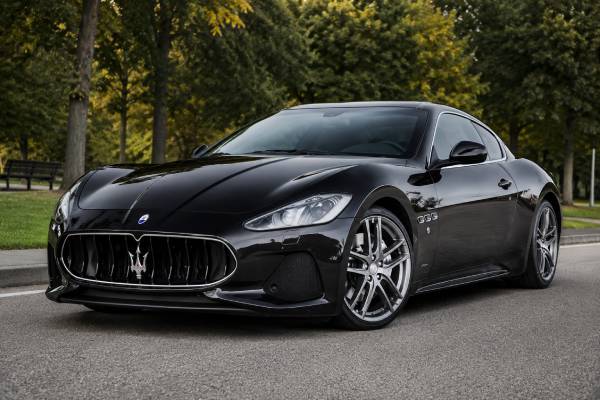
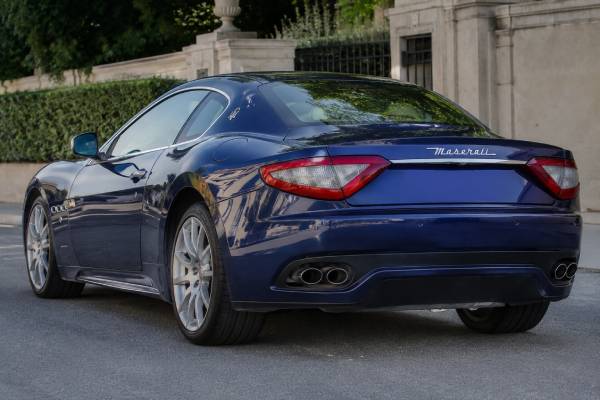
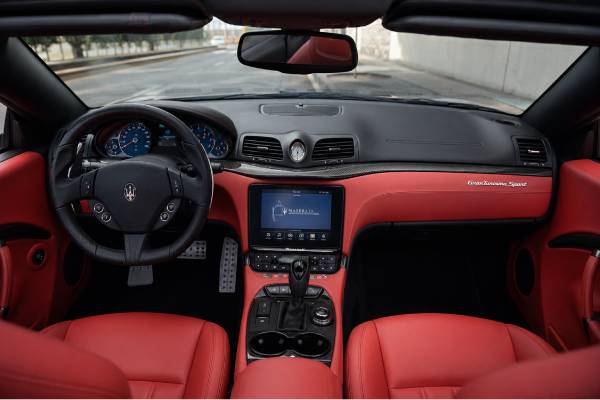
The Maserati GranTurismo Sport turned the M145 coupe into its most complete road-going form. Introduced in 2012 with a 460 hp version of the naturally aspirated 4.7-liter F136 V8, it replaced the earlier GranTurismo S while preserving a choice between a smooth ZF automatic and the faster, more involving MC Shift rear transaxle in markets where both were offered. It also brought a more assertive nose, LED lighting details, revised seats, Sport Skyhook damping, stronger performance, and the operatic exhaust note that defines the late V8 GranTurismo. The model remained in the range through 2019, receiving a significant exterior and infotainment update for model year 2018. That long run creates meaningful differences between early and late cars, but condition is more important than styling generation. A healthy Sport is a fast, comfortable four-seat grand tourer with steering feel and engine response that modern turbocharged coupes rarely match. A neglected one can require costly suspension, brake, cooling, transmission, electrical, and interior work. This guide explains the specification, production changes, driving character, known ownership risks, and the exact checks that separate a rewarding example from a deceptively inexpensive project.
Table of Contents
- The Road-Focused Peak of the M145
- 4.7 V8 and Two Driveline Layouts
- Early Sport, Late Sport, and Factory Choices
- MC-Influenced Design With Real Usability
- Grand-Touring Comfort With a 7,000-rpm Finish
- Service Needs That Change With the Gearbox
- Choosing a Sport You Will Actually Drive
The Road-Focused Peak of the M145
The GranTurismo Sport is the best all-round M145 for many owners because it combines the 460 hp engine and sharper MC-inspired details with four real seats and everyday road manners. It sits below the MC Stradale in intensity but above the original 4.2 and 440 hp S models in development and performance.
Maserati launched the Sport at the 2012 Geneva Motor Show. The 4.7-liter engine gained low-friction measures and revised calibration to produce 460 hp and 520 Nm. Claimed performance depended on transmission: roughly 4.7 seconds from 0–100 km/h and 300 km/h for MC Shift, or 4.8 seconds and 298 km/h for the automatic. Those differences are small on paper, but the transmission layouts produce distinct personalities.
The model addressed a useful gap. The MC Stradale was more aggressive, initially had two seats, and used a harder-edged setup. The Sport retained rear accommodation, richer trim, Skyhook adaptive damping, and long-distance comfort while adopting a stronger visual identity. It could cross countries quietly and still feel theatrical on a mountain road.
Production continued until the original GranTurismo ended in 2019. Early cars have the 2012 facelift with a revised front bumper, darkened headlamp treatment, side skirts, and a reshaped rear. Model-year-2018 cars received a larger hexagonal grille inspired by the Alfieri concept, revised rear aero treatment, and an 8.4-inch touchscreen with Apple CarPlay and Android Auto. Mechanical output remained 460 hp.
This span means the word “Sport” does not describe one identical specification. Transmission availability varied by country and year. Wheels, carbon packages, interior trim, audio, and suspension details differ. Special editions also used Sport foundations. Buyers should read VIN build data rather than assume that a late registration guarantees late-model equipment.
The Sport’s present reputation rests on the F136 engine. It lacks the low-rpm torque and efficiency of newer turbo engines, yet offers immediate throttle response and a rising, naturally aspirated power delivery. Its sound is not a decorative extra; it shapes how the driver uses the gearbox and makes modest-speed journeys engaging. That emotional strength explains why well-kept late cars remain desirable after faster replacements arrived.
4.7 V8 and Two Driveline Layouts
Every GranTurismo Sport uses the 4,691 cc F136 Y V8, but buyers must identify whether the car has MC Shift or MC Auto Shift. The former is a single-clutch automated manual at the rear; the latter is a conventional ZF torque-converter automatic mounted with the engine.
| Item | Specification |
|---|---|
| Engine | 4,691 cc 90-degree naturally aspirated V8 |
| Output | 460 hp at 7,000 rpm |
| Torque | 520 Nm at 4,750 rpm |
| Transmissions | Six-speed MC Shift transaxle or six-speed ZF MC Auto Shift |
| Drive | Rear-wheel drive with limited-slip differential |
| Suspension | Double wishbones; Sport Skyhook adaptive damping |
| Brakes | Brembo ventilated discs; dual-cast front rotors with six-piston calipers |
| Wheels | 20-inch staggered alloys, design dependent on year and option |
| Wheelbase | 2,942 mm |
| Length | Approximately 4,881 mm before detail model-year changes |
| Fuel capacity | 86 liters |
| 0–100 km/h | About 4.7 seconds MC Shift; 4.8 seconds automatic |
| Top speed | About 300 km/h MC Shift; 298 km/h automatic |
The engine uses aluminum construction, dual overhead camshafts, four valves per cylinder, variable valve timing, port injection, and wet-sump lubrication. Peak figures arrive relatively high in the rev range. Below 3,000 rpm the car is tractable rather than explosive; above 4,500 rpm it develops urgency and a harder exhaust note. Clean oil and stable cooling are essential because sustained heat and age attack seals, hoses, mounts, and wiring.
MC Shift places the gearbox and differential at the rear, helping create a rear-biased weight distribution. An electrohydraulic system operates the dry clutch and shifts a conventional gearset. It is quick and dramatic in its fastest mode but does not creep like an automatic. Repeated low-speed slipping shortens clutch life.
MC Auto Shift uses the proven ZF six-speed with a torque converter. It is smoother in traffic, easier on steep driveways, and better suited to regular touring. Sport mode sharpens its strategy and paddle response. It does not have the same dry-clutch wear calculation, though fluid, pan, valve body, adaptations, mounts, and cooling still deserve maintenance.
Double wishbones give accurate wheel control, and Sport Skyhook continuously changes damper force. The chassis is heavy, but the long wheelbase and hydraulic steering produce stability and clear load build-up. Dual-cast front rotors reduce unsprung mass compared with a one-piece design. Correct tires are critical; mixed brands, old rubber, or bent wheels can make a sound car feel nervous.
Early Sport, Late Sport, and Factory Choices
The major buying split is between 2012–2017 cars and the model-year-2018 update, followed by transmission and option differences. The later infotainment is more useful, while earlier cars preserve the more delicate original Pininfarina nose.
Early Sports feature a black grille, revised front bumper with improved brake cooling, LED daytime-running lights integrated into the headlamp units, sculpted side skirts, and oval exhaust outlets. The cabin introduced redesigned front and rear seats, including a more supportive profile that also improved rear access. The steering wheel and trim could be specified in leather, Alcantara, wood, or carbon combinations.
For 2018, Maserati simplified the range around Sport and MC trims. The Sport adopted the larger Alfieri-inspired grille and a reworked lower front area. The rear bumper gained a more defined diffuser treatment. Inside, the old multimedia system gave way to an 8.4-inch touchscreen, a new center console, rotary control, and modern phone integration. These changes improve daily usability, but the system should be tested for camera, audio, touch, Bluetooth, and USB operation.
Common factory choices included multiple 20-inch wheel styles, brake-caliper colors, carbon exterior packages, carbon or wood interior trim, contrast stitching, perforated leather, Alcantara, premium audio, and different headliner materials. Certain markets bundled options. A seller’s list should be checked against the original build sheet because later wheel swaps and carbon additions are common.
MC Shift cars are often rarer and may command enthusiast interest, but rarity is market-specific. Automatic cars are more numerous in North America and generally easier to sell to drivers who use the rear seats or travel in traffic. A rare transmission is not automatically valuable if the clutch is near replacement or the hydraulic system has faults.
Special editions, including the 2017 anniversary Sport Special Edition and regional final-run cars, require their own documentation. A black wheel, plaque, or red stitching alone does not prove a limited specification. Preserve original invoices, option records, manuals, keys, tool kit, and any removed factory parts.
MC-Influenced Design With Real Usability
The Sport’s design works because its performance details sharpen the original Pininfarina body without sacrificing elegance or four-seat function. It looks more purposeful than a 4.2, yet less overtly track-focused than an MC Stradale.
The long hood and pushed-back cabin create classic grand-tourer proportions. Three vents behind each front wheel, a low Trident grille, frameless glass, and muscular rear haunches make the car recognizable from any angle. The Sport bumper directs more air toward cooling and brakes, while side skirts reduce visual height. The rear lip and underbody shaping favor high-speed stability rather than conspicuous downforce devices.
The engine sits behind the front axle as far as packaging allows. With MC Shift, moving the transmission rearward changes both balance and response. Automatic cars carry more driveline mass forward but remain composed because of the long wheelbase and careful suspension geometry. Neither version is light; the engineering goal is controlled mass, not denial of it.
Inside, four sculpted seats and a useful trunk distinguish the GranTurismo from two-seat exotics. The driving position is supportive, the analog instruments are easy to read, and the central clock reinforces Maserati tradition. Late touchscreen cars feel more contemporary, though the surrounding switchgear still reflects the model’s 2007 origins.
Material condition reveals storage quality. Leather shrinks or dries when neglected, Alcantara becomes polished, headliners sag, and soft-touch coatings can turn sticky. Carbon clear coat can cloud near door sills and handles. Frameless windows must drop and reseal correctly when doors open. Water leaks, wind noise, or reluctant glass movement need prompt attention.
Sound is engineered through intake, combustion, and valved exhaust rather than digital enhancement. Normal mode keeps the car suitable for distance. Sport opens the exhaust more readily and changes powertrain and damper behavior. Aftermarket systems can add volume but may cause drone, warning faults, poor fit, or lost originality. A healthy factory exhaust already provides ample character.
Grand-Touring Comfort With a 7,000-rpm Finish
The Sport feels special at legal speeds because the engine, steering, and chassis communicate progressively. Its performance is fast enough to demand respect, but the reward comes from building revs and carrying balanced speed rather than relying on instant turbo torque.
The automatic starts smoothly and suits city use. Normal mode shifts early, while Sport holds gears, quickens response, and lets the exhaust speak. Paddles give useful control before overtakes or corners. The gearbox is slower than a modern dual-clutch transmission, but its smoothness matches the GT mission.
MC Shift requires technique. Lift slightly during slower shifts, avoid creeping on the clutch, and use decisive throttle when moving away. At high revs in the quickest mode, shifts become sharp and theatrical. The system creates a stronger mechanical connection, but it can be tiring in stop-start traffic and expensive when driven carelessly.
Hydraulic steering has substantial but natural weight. The front end communicates grip, and the long wheelbase gives the car calm rotation. On narrow roads the width is always present. Smooth braking, an early turn-in, and a measured throttle let the chassis settle; abrupt inputs expose mass and tire load.
Skyhook provides a broad usable range. The softer setting absorbs motorway joints and broken surfaces better than the 20-inch wheels suggest. Sport reduces body movement but does not transform the car into a lightweight coupe. Leaking or tired dampers can create float followed by harsh impacts, so poor ride should not be accepted as normal.
Brake response is strong when rotors, pads, fluid, tires, and suspension are healthy. Repeated hard stops generate heat because of vehicle weight. Vibration may come from deposits, corrosion, worn arms, or wheel runout, not merely “warped discs.” Track use demands fresh fluid, suitable pads, and conservative cooling laps.
The rear seats are genuinely useful, front seats support long journeys, and highway stability is excellent. Low-speed visibility and turning circle require care. Fuel use is high and the 86-liter tank is expensive to fill, but range is reasonable during steady touring. The Sport’s defining talent is switching from calm travel to a 7,000-rpm crescendo without feeling like two unrelated cars.
Service Needs That Change With the Gearbox
The Sport is maintainable when serviced proactively, but the wrong gearbox assumptions can create major bills. Establish transmission type first, then inspect the engine, cooling, suspension, brakes, tires, battery, and cabin as connected systems.
For every car, insist on a cold start. Listen for persistent timing or cam-variator rattle, check idle stability, and watch for smoke. Inspect cam-cover and front-cover areas for oil leakage. Engine mounts commonly soften, producing vibration or a thump during engagement. Oil should be changed by time as well as mileage with the correct specification.
Cooling checks should include radiator and condenser blockage, fans, hoses, expansion tank, thermostat behavior, water-pump area, and dried residue. The temperature gauge must remain stable in traffic with air conditioning on. Any history of overheating deserves deeper investigation.
MC Shift cars need a Maserati-capable diagnostic report showing clutch position and wear interpretation, plus records for clutch, release bearing, pump, accumulator, actuator, hydraulic fluid, and calibration. Slow selection, neutral drops, excessive shudder, or warning messages are not normal. Low-speed driving style strongly affects life, so mileage alone cannot predict replacement timing.
Automatic cars need smooth cold and hot engagement. Fluid and pan service can be sensible despite old lifetime-fill language, provided a specialist uses correct fluid, temperature, and procedure. Investigate flares, bangs, delayed Reverse, leaks, or recurring adaptations. Differential and mounts require separate attention.
Inspect Skyhook dampers for leakage and scan their controller. Check control arms, bushes, ball joints, tie rods, anti-roll-bar links, wheel bearings, ride height, wheel straightness, and inner tire wear. Use matched, age-correct performance tires. Measure brake rotors and pads; inspect inner faces, calipers, hoses, parking brake, and fluid age.
A weak battery can trigger many unrelated warnings. Load-test it, verify alternator output, and scan all modules. Check window indexing, parking sensors, locks, keys, seats, climate control, infotainment, audio, lights, and trunk release. A maintainer helps stored cars but should not conceal parasitic drain or a failed battery.
Parts and specialist labor remain available, but edition-specific trim, carbon, electronic modules, and adaptive dampers can be costly. Annual service records are more reassuring than low mileage with long gaps. Reversible upgrades are preferable; retain original components and avoid improvised wiring.
Choosing a Sport You Will Actually Drive
Choose the transmission, production phase, and condition that fit real use. An automatic late car may be better for regular touring; an early MC Shift may be more memorable on open roads. The wrong choice becomes frustrating even when the specification looks desirable online.
Verify the VIN, build date, engine, transmission, original market, paint, interior, wheels, suspension, and options. Compare documents, labels, and diagnostic identity. For 2018–2019 cars, confirm the updated touchscreen and body details are factory correct. For any special edition, demand the associated build evidence.
A specialist pre-purchase inspection should include:
- A stone-cold start and hot restart.
- Full module scan with clutch data where applicable.
- Lift inspection of leaks, cooling, suspension, brakes, tires, exhaust, and underbody.
- Paint-depth and carbon-condition assessment.
- Road testing in normal and Sport modes at low and higher temperatures.
- Review of invoices, campaigns, keys, manuals, and mileage progression.
| Factor | Better evidence | Reason to pause |
|---|---|---|
| History | Continuous itemized invoices and annual attention | Stamp-only history, long gaps, repeated unresolved faults |
| MC Shift | Good engagement, credible clutch data, hydraulic records | Shudder, slow selection, neutral events, no diagnostic access |
| Automatic | Smooth operation and documented fluid care | Delayed engagement, flare, harsh hot shifts |
| Chassis | Dry dampers, quiet joints, straight wheels, matched tires | Knocks, wandering, edge wear, warning lights |
| Body and cabin | Consistent paint, intact carbon, complete working equipment | Poor repairs, dampness, missing trim, hacked electronics |
Do not let a warm engine, cleared dashboard, or new battery replace diagnosis. Do not accept mixed tires because tread is deep. Avoid cars with overheating history, unexplained transmission warnings, structural repairs, missing undertrays, or sellers who resist inspection. Cosmetic wear can be priced; uncertain major systems are harder to contain.
Budget for immediate baseline work. Fluids, filters, tires, battery, alignment, brake service, mounts, and one suspension repair can arrive together. Keep a reserve after purchase rather than spending the entire budget on the newest year or rarest color.
The most satisfying Sport is not necessarily the lowest-mileage car. It is the example that starts cleanly, reaches temperature correctly, shifts as its transmission should, rides without knocks, stops straight, scans cleanly, and has evidence of consistent care. Buy that car in the body and transmission form you enjoy, and the GranTurismo Sport can still deliver a rare combination: naturally aspirated drama, real passenger space, elegant design, and cross-country comfort.
The long production run also makes ownership strategy important. An early 2012–2014 MC Shift car suits an enthusiast who values the transaxle layout and is prepared to learn its low-speed technique. A 2018–2019 automatic suits frequent touring, modern phone use, and urban traffic. Mid-cycle cars can offer the best purchase price while retaining the 460 hp engine and mature chassis. Rather than ranking these phases universally, match the car to annual mileage, traffic conditions, passenger use, and access to a workshop that understands the chosen transmission. A rarely driven MC Shift is not automatically safer than a regularly serviced automatic, and a newer touchscreen does not compensate for weak dampers or neglected cooling.
When comparing two candidates, estimate the cost of returning each to the same mechanical baseline. Include tires of one approved model, brake measurements, all fluids, battery, alignment, mount condition, suspension play, and either clutch diagnostics or automatic service evidence. Add a separate allowance for cosmetic work and missing original parts. This equalized comparison often shows that the apparently more expensive car is cheaper to own. It also prevents a desirable color or low odometer from hiding several systems that are all approaching replacement together.
A final test should include the intended passengers and luggage. Rear-seat access, child-seat fit, trunk loading, cabin noise, and ride quality can matter more in ownership than the small acceleration difference between gearboxes. Check garage width and ramp angle too; the long doors, low nose, and broad turning circle can make an otherwise ideal car awkward at home. These practical checks prevent buyers from choosing a specification they admire but rarely use.
A seat and luggage trial can also reveal squeaks, weak easy-entry motors, or trim damage that a solo road test misses.
That practical fit should be confirmed before purchase, not assumed from brochure dimensions.
References
- Geneva premiere for the new Maserati GranTurismo Sport 2012
- Maserati GranTurismo Sport world debut at Geneva 2012
- Maserati GranTurismo model Year 2018 makes its world debut in New York 2017
- Maserati Guides & Documentation 2026 (Owner Documentation)
- Maserati TechInfo 2026 (Technical Information)
Disclaimer
This article is for informational purposes and is not a substitute for professional diagnosis, repair, or inspection. Specifications, torque values, service intervals, and procedures vary by VIN, market, transmission, model year, and equipment; verify critical details in the official service documentation for the individual car.
Please share this article on Facebook, X/Twitter, or a Maserati community if it helped you evaluate the GranTurismo Sport.