
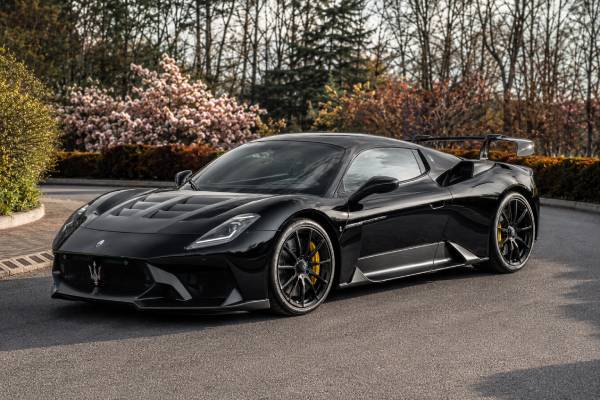
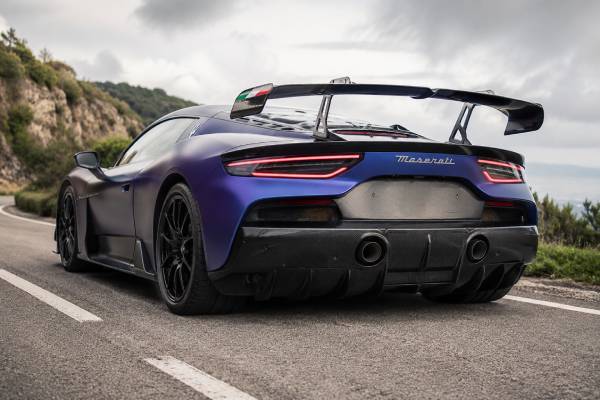
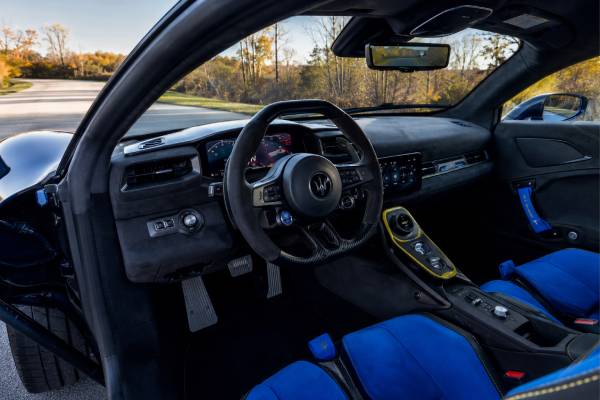
The 2025 Maserati GT2 Stradale Edizione Corse is a 16-car special series built on the most track-focused road version of the MC20 platform. The standard GT2 Stradale already raises Nettuno output to 640 CV, cuts approximately 60 kg from the MC20, adds competition-derived aerodynamics, and reaches 100 km/h in about 2.8 seconds. Edizione Corse adds a selected-market collector package tied to Maserati’s successful return to GT racing, with items such as a titanium exhaust, center-lock wheels, carbon-fiber cabin trim, Maserati Corse exterior branding, a commemorative engine-bay plaque, and a fitted cover.
Its low production and racing narrative make authentication as important as mechanical inspection. A normal GT2 Stradale cannot become an Edizione Corse through accessories alone, and several components may have road-use or market-specific restrictions. Buyers should verify the exact VIN, factory configuration, exhaust homologation, numbered plaque, original equipment, and all accompanying Sparco or Maserati materials. The car also demands specialist attention to center-lock hardware, carbon bodywork, aero surfaces, brakes, tires, and track history. This guide explains its origin, specification, production content, engineering, performance, service requirements, and purchase checks.
Table of Contents
- Why Sixteen Edizione Corse Cars Were Built
- 640-CV GT2 Stradale Technical Foundation
- Edition Equipment, Numbering, and Market Status
- Race-Derived Aero, Exhaust, and Cockpit
- Road Speed and Circuit Behavior
- Track-Led Maintenance and Storage
- Authenticating and Buying Edizione Corse
Why Sixteen Edizione Corse Cars Were Built
Edizione Corse was limited to 16 cars to celebrate Maserati’s results after returning to closed-wheel competition with the GT2 race car. The number corresponds to the podium tally highlighted for the 2024 campaign, making the series a direct competition commemoration rather than a cosmetic trim level.
The road from MC20 to Edizione Corse began with the production coupe’s carbon monocoque and Nettuno engine. Maserati then developed the track-only GT2 for the GT2 European Series, revising cooling, aerodynamics, suspension, brakes, safety equipment, and controls for racing. That competition car won early and restored Maserati to a category in which the MC12 GT1 had once been dominant.
GT2 Stradale translated selected racing lessons back to a road-legal car. It retained the MC20 passenger cell and eight-speed dual-clutch concept but used more aggressive aero, a reduced-mass specification, new seating and controls, and a 640-CV engine calibration. Edizione Corse sits above that model as a very small commemorative specification.
The edition should not be confused with the GT2 race car. It remains a road-derived vehicle with registration, road lighting, airbags, climate control, and other homologation requirements. Nor is it the same as a standard GT2 Stradale ordered with optional carbon and center-lock wheels. Factory records must identify the special series.
Production of 16 makes each car rare enough that individual provenance matters. Some may have been allocated only to selected countries, retained by dealers, displayed at events, or sold with a racing-experience package. First registration can therefore occur later than the nominal 2025 model year. Build date, invoice, warranty start, and registration should be considered separately.
The edition’s racing accessories can also create confusion. A helmet, suit, shoes, gloves, balaclava, bag, or academy experience may have been optional or supplied as part of a market package rather than physically installed in the car. A missing accessory affects completeness but does not necessarily disprove the chassis. The build and sales documents should clarify what accompanied the individual example.
The strongest collector argument is the combination of three limits: the MC20-derived platform’s short original lifecycle, GT2 Stradale’s specialized production, and Edizione Corse’s 16-car run. That combination increases the importance of originality. Track use is not automatically negative, because the model was designed for it, but undocumented damage, consumable wear, or non-homologated changes can sharply reduce confidence.
640-CV GT2 Stradale Technical Foundation
Edizione Corse uses the GT2 Stradale’s 2,992 cc twin-turbo Nettuno V6 with 640 CV, approximately 10 CV more than the MC20. Maserati combined the added output with a roughly 60-kg weight reduction, revised aero, and track-oriented chassis calibration.
| Specification | GT2 Stradale Edizione Corse |
|---|---|
| Engine | 2,992 cc, 90-degree, twin-turbo V6 |
| Maximum power | 640 CV (approximately 631 hp) |
| Peak torque | Approximately 730 Nm, market specification dependent |
| Transmission | Eight-speed dual-clutch |
| Drive | Rear-wheel drive with electronic limited-slip differential |
| Structure | Carbon-fiber monocoque and aluminum subframes |
| Claimed 0–100 km/h | Approximately 2.8 seconds |
| Claimed top speed | Approximately 324–325 km/h |
| Approximate dry weight | About 1,365 kg, depending on final specification |
| High-speed downforce | Up to approximately 500 kg at 280 km/h |
Nettuno retains its pre-chamber combustion layout, twin spark plugs, direct and port injection, dry sump, and two turbochargers. The 640-CV calibration extracts a modest output increase, but track performance also depends on cooling, response, transmission logic, and mass. Engine or gearbox software should remain factory-correct unless a documented update applies.
The eight-speed dual-clutch transaxle sends power to the rear wheels. Revised drive modes and a relocated selector support a more focused cabin. Launch control delivers the quickest standing start, but repeated launches are mechanically demanding and unnecessary during a sales demonstration.
The carbon monocoque comes from the MC20 architecture and provides the stiff foundation for the aero and suspension changes. Lightweight body and cabin components reduce mass. Exact equipment can raise or lower the final figure, so a quoted 1,365-kg dry weight should not be treated as a certified curb weight for every car.
GT2-derived aerodynamic parts include a deep front splitter, enlarged openings, vented front fenders or wheel arches, a louvered hood, shaped side elements, a large fixed rear wing, and an aggressive diffuser. Their combined purpose is cooling and downforce, not only appearance. Underbody panels and wing settings should remain correct.
Suspension tuning is firmer and more adjustable in intent than a normal MC20. Braking hardware is designed for repeated high-energy stops, often with carbon-ceramic discs. Center-lock forged wheels reduce hardware and speed wheel changes, but require precise tools, torque procedure, locking checks, and technician training.
Tires are critical to every published performance claim. They must be the approved size and specification, correctly heat-cycled if used on track, free from pickup or flat spots, and replaced for age as well as tread. A mixed or non-approved set can compromise stability under high aero load.
Edition Equipment, Numbering, and Market Status
A genuine Edizione Corse should be identified through the VIN and factory build data, then matched to its special plaque, exterior markings, wheels, exhaust, cabin trim, cover, and any supplied racing kit. No single accessory is conclusive on its own.
Published edition content includes a titanium exhaust, center-lock alloy wheels, carbon-fiber interior finishing, Maserati Corse logos, a tailored indoor cover, and a commemorative plaque in the engine bay. Cars may have specific color and upholstery combinations, such as Nero Essenza with blue-accented Alcantara, but individual build documents remain the authority.
The engine-bay plaque deserves close inspection. Confirm its wording, number, finish, fasteners, and location against verified original examples. A plaque can be copied, so Maserati’s chassis record must establish that the car left the factory as Edizione Corse. Do not remove it merely to inspect the back; preserve the component and use non-invasive documentation.
Center-lock wheels are visible and valuable but may also be optional on other GT2 Stradales. Check casting or forging markings, finish, dimensions, center-lock nuts, safety devices, and original tool kit. Incorrect refinishing or mixed nuts can create both authenticity and safety concerns.
The titanium exhaust may be homologated differently by market. Some racing exhaust configurations are intended for circuit use only and may not comply with road noise or emissions laws. Ask for the original road-legal system, control electronics, certification, and installation invoices. Never assume that “factory supplied” means “legal on every public road.”
Maserati Corse exterior logos should have correct placement and finish. Inspect them before paint-protection film hides edges. Carbon cabin components should match the announced package, and seats, belts, steering wheel, paddles, and trim should agree with the build sheet.
An optional Sparco package has been described with a helmet, racing suit, gloves, balaclava, shoes, bag, and participation in a Maserati track academy. Sizes may have been tailored to the first owner, reducing practical value for a later buyer while retaining collector interest. Photograph and inventory every item.
Some cars may have covered only delivery or display mileage. Such condition is attractive but creates time-based concerns: old fuel, battery deterioration, tire flat spots, brake corrosion, dried seals, and skipped service. A delivery-mileage car is not maintenance-free.
Market status must be checked before import. Lighting, exhaust, emissions, safety labels, radio equipment, and registration eligibility vary. A track-focused limited edition can be difficult or impossible to register in a country that did not originally receive it. Obtain legal advice before purchase, not after shipment.
Race-Derived Aero, Exhaust, and Cockpit
The Edizione Corse’s design is dominated by functional aerodynamic surfaces and a driver-centered cockpit, while its special exhaust and markings intensify the racing connection. Damage or incorrect adjustment to these components can change both value and high-speed behavior.
The front splitter projects close to the ground and generates load while directing air toward the floor. Hood and fender vents release pressure and heat. Side inlets feed the engine and cooling systems. At the rear, the fixed wing and diffuser work together to increase stability at speed.
Inspect carbon parts for chips, cracks, crushed mounting points, delamination, poor clearcoat, and incorrect fasteners. A splitter can be repaired cosmetically while its mounts remain weakened. Wing supports should be secure and symmetrical. If the wing has adjustable positions, settings must match official road or track guidance rather than an owner’s guess.
The claimed high-speed downforce figure is meaningful only when the entire aero system is intact and at the intended ride height. Lowering springs, missing floor panels, different tires, or a changed wing angle can upset front-to-rear balance. Alignment and corner weights should be checked after curb or track incidents.
A titanium exhaust reduces mass and changes sound. Inspect welds, brackets, heat shielding, valves, sensors, and nearby carbon. Track operation can produce extreme temperatures. Discoloration may be normal for titanium, but cracks, loose mounts, melted trim, or warning codes are not.
The cockpit uses exposed carbon and Alcantara to reduce glare and improve grip. Racing-style seats place the driver firmly, and large paddles support manual shifts. The drive-mode selector is positioned for quick access. Depending on specification, harness compatibility or roll-related equipment may be present, but road seat belts and airbags must remain functional.
Check seat shells for cracks and mounts for movement. Inspect Alcantara for matting, perspiration staining, and incorrect cleaning. Confirm that any harness is approved, in date where applicable, and installed to suitable anchorage. A harness without proper rollover and seat compatibility can increase injury risk.
The car still includes road systems such as climate control, cameras, infotainment, and lighting. Track simplification does not excuse failed electronics. Scan all modules, test every control, and verify that removal of a road exhaust or other component has not generated permanent faults.
Paint protection is sensible because the wide tires and aero openings expose surfaces to debris. Film should not cover cracks or lift special decals. Track rubber and brake dust can stain matte or porous finishes, so cleaning should be prompt and compatible with the materials.
Road Speed and Circuit Behavior
Edizione Corse is faster and more demanding than a normal MC20, with stronger aero response, lower mass, firmer control, and a sharper cabin. It can be driven on the road, but its best qualities appear where speed, temperature, and braking loads can be managed safely.
At low speed, the dual-clutch gearbox should engage without excessive shudder. Center-lock wheels and track-oriented tires can transmit more road texture, and aero pieces reduce clearance. The front lift, when fitted, should be used early and the splitter inspected frequently.
The 640-CV engine delivers a broad wave of torque. A 2.8-second 0–100 km/h claim requires launch control and ideal traction. On public roads, full acceleration lasts only seconds before reaching illegal speed. Cold tires and abrupt boost can still overwhelm the rear axle despite sophisticated electronics.
Steering should feel immediate and stable. The aero load increases with speed, so behavior at legal road pace cannot fully confirm track balance. Pulling, a crooked wheel, vibration, or nervous braking may indicate alignment, tire, wheel, or aero damage.
The fixed wing changes rear visibility but contributes stability. Wind noise, tire roar, and exhaust sound are greater than in a standard MC20. A titanium system may be too loud for some circuits with strict noise limits, so owners should verify static and drive-by requirements before attending.
Brakes should be warmed progressively. Carbon-ceramic systems can feel different when cold and can be damaged by gravel or mishandling. On track, monitor pad thickness, disc condition, fluid temperature, and cooling. A long pedal or vibration requires immediate investigation.
Driving modes alter powertrain, dampers, traction control, and transmission response. Begin in the least aggressive suitable mode and build pace. Electronic aids cannot compensate for poor tire temperature, fluid condition, or an incorrect wing setting.
After a session, complete a cool-down, then inspect tires, wheel nuts, brakes, splitter, diffuser, wing mounts, undertray, fluids, and fault memory. Record session hours or mileage, temperatures if available, and consumable changes. A transparent track log supports value rather than harming it.
For road use, avoid carrying racing accessories loose in the cabin and confirm the legal exhaust configuration. The car’s width, low nose, firm seats, and limited storage make long trips possible but less relaxed than an MC20 GT-mode journey.
Track-Led Maintenance and Storage
Edizione Corse maintenance should follow the VIN-specific Maserati schedule plus shorter inspection intervals when the car is used on track. Oil, brakes, tires, center locks, aero mounts, and heat-affected components need event-based attention.
Nettuno uses a dry-sump system, so oil level and specification must be checked exactly as directed. Track heat can accelerate oil degradation and expose small leaks. Inspect turbo lines, breathers, coolant joints, reservoirs, and underbody plumbing before and after events.
The dual-clutch gearbox and electronic differential should shift smoothly and remain warning-free. Fluid and filter service requires correct temperatures, tools, and diagnostics. Launch counts, over-temperature events, and stored transmission data may help a specialist assess use.
Center-lock maintenance is safety critical. Use the official torque value, approved lubricant or dry condition as specified, calibrated equipment, correct tightening direction, and locking procedure. Marking the nut can help visual inspection but does not replace torque verification. Damaged nuts or wheel seats should be replaced.
Carbon-ceramic brakes require clean handling. Do not allow wheel-removal tools to strike a disc. Inspect for chips, cracks, surface changes, and wear. Replace pads before they become too thin to protect the disc under high heat. Renew brake fluid based on time and track exposure.
Tires should be logged by date, mileage, sessions, heat cycles, pressure, and position. Check inner shoulders, pickup, cuts, and flat spots. Store spare wheels correctly and avoid petroleum contamination. Road tires that look acceptable may have lost the heat tolerance needed for track use.
The titanium exhaust and nearby carbon need heat inspection. Verify shields, hangers, valves, sensors, and fasteners. If a track-only system is installed, preserve the homologated road exhaust and record every swap.
Battery support remains important. Low voltage can create faults across the transmission, differential, dampers, cameras, and engine controls. Use a compatible maintainer and perform capacity testing. Do not clear errors before saving a diagnostic report.
Store the car clean and dry, with correct tire pressure and no damp race equipment inside. Remove rubber and brake dust promptly. Check fuel condition and avoid brief starts that never reach operating temperature. Time-based service still applies to an unused collector example.
Authenticating and Buying Edizione Corse
Buy Edizione Corse only after factory authentication and a specialist inspection covering the carbon tub, aero, center locks, brakes, powertrain, exhaust legality, and complete special-edition inventory. Rarity is not protection against misuse or inaccurate representation.
Request the VIN, build sheet, original invoice, allocation letter, service and campaign history, track log, tire and brake records, repair disclosure, and photographs from delivery. Ask Maserati to confirm that the chassis is one of the 16 and to identify its original market and equipment.
Inventory the plaque, Corse logos, wheels and nuts, titanium exhaust, carbon trim, cover, keys, books, charger, tools, original road components, and any Sparco kit. Record serials and sizes where present. Missing items should be priced realistically because replacement may be impossible.
Inspect the monocoque and aluminum subframes on a suitable lift. Check suspension mounts, jacking points, floor, splitter mounts, diffuser, wing supports, and bonded panels. Track debris can damage the underside without affecting glossy upper bodywork. Any repair needs photographs and specialist invoices.
Verify wing setting, ride height, alignment, and tire specification. Check center-lock torque records and wheel condition. Have carbon-ceramic brakes assessed by a technician familiar with their wear criteria. Budget immediately for uncertain consumables.
Start cold and scan all modules. Test engine operation, gearbox engagement, differential, drive modes, dampers, front lift, cameras, air conditioning, infotainment, seats, lights, and both keys. Repeat the scan after a controlled road test. Do not request a launch-control demonstration.
Confirm exhaust status in writing. Determine whether the fitted titanium system is road legal in the country of registration and whether original catalysts, valves, sensors, and mufflers are included. Insurance and emissions compliance can depend on this answer.
Mileage should be interpreted with track use. Five road kilometers do not guarantee that a car has never run at an event, while a carefully logged track car can be more trustworthy than an unrecorded display vehicle. Look for heat, tire pickup, brake wear, harness use, and debris evidence.
Arrange insurance at an agreed value that names the exact edition. The purchase contract should identify the VIN, special-series status, included kit, original parts, known repairs, and any non-road-approved equipment. Use enclosed transport with suitable ramp angle, tie-down procedure, and protection for the wing and splitter.
References
- 2025 Maserati GT2 Stradale Edizione Corse | Sealed Drop – December 2025 | RM Sotheby’s (2025, documented example)
- Maserati MC20 GT2 Stradale Edizione Corse: foto, caratteristiche (2025, edition equipment and production)
- Maserati GT2 Stradale – Racing Is Life | Maserati (accessed 2026, official model information)
- Maserati GT2 Stradale. World premiere of new super sports car at Monterey Car Week 2024 | Maserati | Stellantis Media (2024, official launch)
- Maserati GT2: vettura da corsa omologata classe FIA GT2 | Maserati IT (accessed 2026, official race-car background)
Disclaimer
This article is for general informational and educational use and is not a substitute for professional diagnosis, repair, race preparation, structural inspection, or legal advice. Specifications, torque values, service intervals, procedures, software, exhaust approval, and equipment can vary by VIN, market, production date, and options. Verify every road or track procedure with current official Maserati service documentation and qualified specialists. Share this guide with other GT2 Stradale collectors and drivers who may find it useful.