
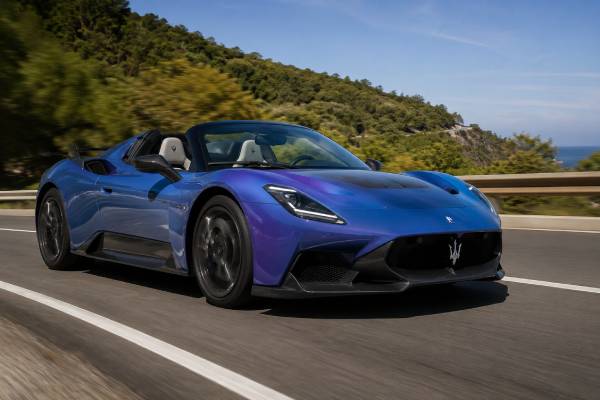
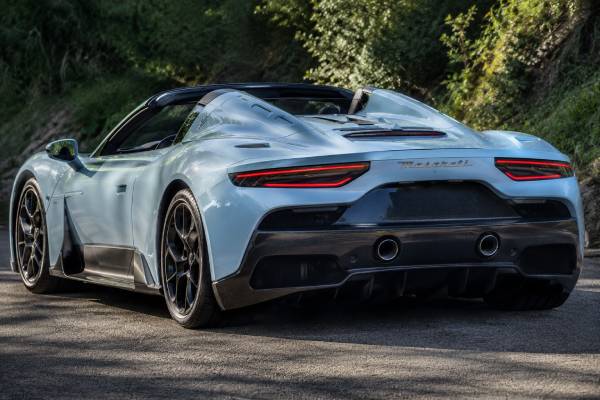
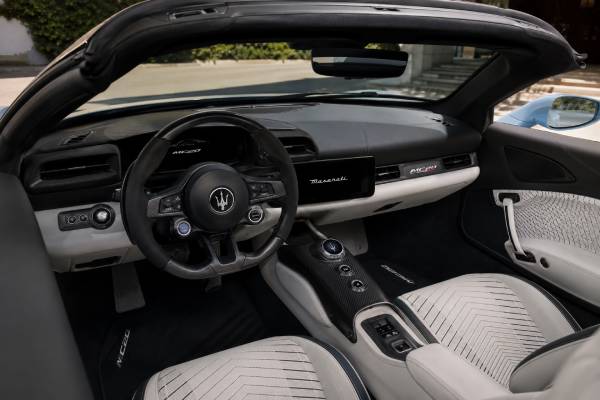
The Maserati MC20 Cielo brought open-air driving to the MC20 platform in 2022 without replacing its carbon-fiber structure, butterfly doors, or 630-CV Nettuno V6. Its defining component is a fully retractable polymer-dispersed liquid-crystal glass roof. The panel can switch from clear to opaque in about one second, opens or closes in roughly 12 seconds, and can be operated at speeds up to 50 km/h. Maserati limited the weight increase over the coupe to approximately 65 kg, preserving a claimed 0–100 km/h time near 2.9 seconds and a maximum speed above 320 km/h.
The Cielo is both a roadster and a complex roof-equipped supercar. Buyers must assess all normal MC20 systems plus roof motors, latches, calibration, seals, drains, glass switching, window indexing, and body alignment. Model years from 2022 through 2025 include launch cars, PrimaSerie examples, regional limited editions, and regular Fuoriserie specifications. Mechanical condition, campaign completion, and carbon-structure integrity remain more important than a dramatic color or low odometer. This guide explains the Cielo’s development, specifications, production choices, roof engineering, driving behavior, maintenance, and pre-purchase checks.
Table of Contents
- Why Maserati Created the Cielo
- Nettuno V6 and Open-Roof Chassis Specs
- Model Years, Options, and Limited Editions
- PDLC Roof, Carbon Tub, and Aerodynamics
- Driving with the Roof Closed, Clear, or Open
- Roof Care, Servicing, and Recall Status
- How to Inspect and Buy an MC20 Cielo
Why Maserati Created the Cielo
The MC20 Cielo was created to add three open-roof experiences to the MC20 without abandoning the coupe’s performance architecture. Drivers can use the car with the roof closed and opaque, closed and transparent, or fully retracted.
“Cielo” means sky in Italian. Maserati used the name to emphasize the glass roof rather than describe the car only as a convertible or spyder. The panel is larger and more technically ambitious than a removable roof section, yet it disappears beneath the rear deck without occupying the car’s luggage compartments.
The model premiered in May 2022, about two years after the MC20 coupe reveal. The carbon monocoque had been planned from the beginning for different applications. The Cielo uses the same basic architecture but adjusts the carbon-fiber type, quantity, and layup to provide torsional rigidity without a permanent roof panel. This allowed Maserati to avoid the heavy steel reinforcements often added late in a convertible program.
The claimed 65-kg increase is modest considering the glass panel, electric movement, rear cover, seals, latches, drainage, and control hardware. The Cielo remains lighter than many roofed grand-touring rivals and retains the same 630-CV engine. The maximum-speed claim falls slightly from the coupe’s more-than-325 km/h figure to more than 320 km/h, while 0–100 km/h remains around 2.9 seconds.
Designers preserved the butterfly doors and the clean upper body. The engine cover changes because the roof needs storage space behind the cabin, but the car still reads immediately as an MC20. An optional matte-titanium Trident graphic on the rear cover replaces the coupe’s visible engine-cover motif.
The Cielo also broadened available assistance systems. In addition to parking sensors, rear camera, and blind-spot monitoring, the launch material identified autonomous emergency braking, traffic-sign information, and a 360-degree surround-view system. Equipment varies by market and build, so an individual car should be checked against its option list.
Through 2025, the Cielo supported several special configurations. PrimaSerie launched the model with 65 Acquamarina cars. Japan received exceptionally rare Blu Infinito and Rosso Vincente heritage versions. Fuoriserie allowed further personalization. These editions affect collectibility but share the same roof and drivetrain fundamentals.
In 2025, Maserati introduced MCPURA Cielo as the evolved successor. That gives the 2022–2025 MC20 Cielo a defined position: it is the original open version of the first Nettuno-powered Maserati supercar.
Nettuno V6 and Open-Roof Chassis Specs
The Cielo uses the coupe’s 2,992 cc, 90-degree twin-turbo V6 with 630 CV and 730 Nm. Rear-wheel drive, an eight-speed dual-clutch transaxle, double-wishbone suspension, and adaptive dampers complete the mechanical package.
| Specification | MC20 Cielo |
|---|---|
| Engine | 2,992 cc twin-turbocharged V6 |
| Power | 630 CV at 7,500 rpm |
| Torque | 730 Nm at approximately 3,000–5,500 rpm |
| Transmission | Eight-speed dual-clutch |
| Drive | Rear-wheel drive |
| Roof | Electrically retractable PDLC glass hardtop |
| Roof cycle | Approximately 12 seconds |
| Roof operating speed | Up to approximately 50 km/h |
| Claimed 0–100 km/h | Approximately 2.9 seconds |
| Claimed top speed | More than 320 km/h |
| Approximate dry weight | 1,540 kg, specification dependent |
Nettuno uses Maserati’s pre-chamber combustion system. A small chamber with a spark plug sits above each main chamber, and flame jets pass through calibrated holes under suitable load. A second spark plug supports normal combustion across the operating map. The engine also combines high-pressure direct injection, lower-pressure port injection, twin turbochargers, an 11:1 compression ratio, and dry-sump lubrication.
The dry sump keeps oil controlled during high cornering and braking loads and allows the engine to sit compactly. Its level must be checked at the specified temperature and running condition. Incorrect checking can lead to overfill or underfill, so service records should identify the oil specification and procedure.
The eight-speed dual-clutch transmission drives an electronic limited-slip differential. Automatic and paddle-shift operation change with Wet, GT, Sport, Corsa, and ESC Off modes. GT supports daily use, Sport sharpens response, and Corsa brings the fastest shifts and reduced stability intervention. Launch control is available but should not be repeatedly used for demonstration.
The carbon passenger cell is supported by aluminum front and rear subframes. The Cielo’s carbon layup is designed to maintain rigidity around the open roof and large butterfly-door apertures. After an accident, composite structure must be assessed by trained specialists. A visually clean repair does not prove that load paths and bonding remain correct.
Suspension uses double wishbones with a virtual steering axis and adaptive dampers. A front lift was optional or included in some packages. It protects the splitter on ramps but must be checked for even movement, warning messages, and leakage.
Standard iron brakes use 380-mm front and 350-mm rear discs with six- and four-piston calipers. Optional carbon-ceramic discs are larger and lighter but expensive to replace. Tires are typically 245/35 ZR20 front and 305/30 ZR20 rear. Matching model, age, pressure, and condition are essential in a rear-driven car with 730 Nm.
Model Years, Options, and Limited Editions
The 2022–2025 Cielo retained the same basic engine, roof, and chassis, while colors, software, packages, safety features, and limited editions created meaningful differences. A buyer should verify the exact build rather than rely on model-year assumptions.
The 2022 launch introduced the production specification and the PrimaSerie Launch Edition. PrimaSerie was limited to 65 cars and used three-layer Acquamarina paint, Matte White Gold details, special wheels, Ice Alcantara and leather, Acquamarina stitching, and edition markings. Its value depends on those details and supporting documentation.
Regular Cielos offered a broad palette and Fuoriserie personalization. Carbon exterior pieces, carbon-ceramic brakes, suspension lift, wheel finishes, seats, interior packs, Sonus faber audio, and assistance systems could change the price substantially. A heavily optioned car is not automatically better if its features are worn or difficult to service.
The Japanese Blu Infinito and Rosso Vincente limited cars appeared for 2024. Blu Infinito used a blue heritage graphic related to Maserati’s 250F and Birdcage visual tradition. Rosso Vincente used red with blue-and-white striping linked officially to the 350S. Each color treatment was associated with a two-car Japanese allocation, making provenance central.
Other one-offs and Fuoriserie commissions can be valuable when factory records support them. An unusual wrap, repaint, or dealer-installed trim does not become a factory one-off merely because it is unique. Request the original specification sheet and invoice.
Market equipment varies. Right- or left-hand drive, lighting, infotainment region, radio frequencies, connected services, safety systems, labels, and emissions hardware may differ. Imported cars should have a complete conversion and registration history, especially when software modules have been changed.
The roof mechanism itself may receive calibration or software updates during service. A later car is not guaranteed to be trouble-free, and an early car is not automatically problematic. Campaign completion, careful operation, dry storage, and battery support are more useful indicators.
The model’s 2025 endpoint overlaps with the introduction of MCPURA Cielo. Registration timing may blur the distinction, so confirm whether a car is an MC20 Cielo or the updated MCPURA rather than identifying it by date alone. The MCPURA has revised front and rear styling, lower fascias, cabin materials, steering wheel, badges, and a slightly different quoted torque figure.
PDLC Roof, Carbon Tub, and Aerodynamics
The Cielo’s roof is a structural and electronic system, not a simple removable panel. Its glass changes transparency through PDLC technology and the complete panel slides into the rear housing through a synchronized 12-second sequence.
The clear roof measures about 909 mm long and 615 mm wide, with a surface area above half a square meter. Suspended liquid-crystal particles change their orientation when voltage is applied, altering the way light passes through. The transformation from clear to opaque occurs in about one second and is designed to operate over a wide temperature range.
The roof was developed with Webasto and aims to provide thermal sealing and lower noise than a fabric top. The opaque state reduces visible sunlight but should not be treated as a substitute for proper cabin cooling or sun protection in extreme heat. Glass, seals, and interior surfaces still absorb energy.
Opening begins with window indexing and unlatching at the windshield header. The rear cover moves, the glass panel folds or slides into its storage area, and the cover returns. Sensors confirm each stage. Low voltage, obstruction, misalignment, or failed position information can interrupt the cycle and produce a warning.
A roof inspection should test multiple cycles while stationary and, where safe and permitted, confirm low-speed operation. Check clear/opaque switching, side-window movement, header latches, rear-cover gaps, seals, drains, and the absence of scraping. Repeat after the car is warm because heat can change tolerances.
Water management is as important as movement. Inspect carpets, seat-belt areas, storage spaces, header trim, and rear compartments for dampness or staining. Pouring large amounts of water into a car during inspection is unwise; a specialist can test drains and seals safely.
The monocoque’s Cielo-specific carbon layup compensates for the missing fixed roof. Nevertheless, body alignment matters to roof operation. A tub or subframe repair can leave the roof apparently functional while creating seal compression, noise, or long-term wear. Door gaps, windshield frame, roof cover, and latch positions should be measured together.
Aerodynamic development preserved the MC20 theme of clean upper surfaces and a technical lower body. Roof-open airflow and thermal management required additional work, while the underside still uses channels, vortex generators, and a large diffuser. Damaged undertrays or an aftermarket wing can change the intended balance.
The optional Trident decal on the rear cover is a finish feature, not a cooling opening like the coupe’s engine-cover motif. Its condition and originality may matter to collectors, particularly on special colors.
Driving with the Roof Closed, Clear, or Open
The Cielo retains the MC20’s speed and steering precision while adding three cabin environments. Roof position changes sound, light, airflow, and refinement more than it changes the fundamental chassis.
With the roof closed and opaque, the car feels closest to the coupe. Wind noise should remain controlled, and the structure should not creak over ordinary road inputs. Excessive header noise, water hiss, or movement over bumps can indicate seal or alignment issues.
The clear mode fills the cabin with light while maintaining weather protection. It is useful in cooler conditions and gives the Cielo its distinctive “sky feeling.” Confirm that the panel changes evenly without cloudy zones, flicker, warning messages, or delayed response.
With the roof retracted, turbo, induction, exhaust, and transmission sounds become more present. Wind management is effective at normal speeds but cannot remove all buffeting. Loose cabin objects should be secured, and occupants should protect hearing and skin during extended open driving.
GT mode provides manageable throttle, smoother shifts, and compliant damping. The car remains low and wide, so cameras, sensors, and the front lift are important. Heat from the rear powertrain and limited luggage space require realistic touring plans.
Sport and Corsa modes release more of the car’s urgency. The Nettuno builds torque quickly, and the rear tires must transmit all of it. Cold, wet, old, or mismatched tires can make the car unpredictable. Wet mode is the sensible default when grip is uncertain.
Steering should remain direct and stable with the roof in any position. A pull, vibration, crooked wheel, or inconsistent response can indicate tires, alignment, wheel damage, or structural repair. Compare behavior on more than one road surface because wide front tires naturally follow grooves.
Braking performance is similar to the coupe. Iron discs may be preferable for routine road mileage and lower replacement cost. Carbon-ceramic discs suit repeated high-temperature use but require specialist evaluation. Roof-open noise can mask tire or brake sounds, so repeat suspicious tests with the roof closed.
On track, close inspection before and after use is essential. Verify oil level, brake fluid, tires, wheel torque, cooling openings, and roof closure. The retractable system should not be cycled unnecessarily in a dusty paddock. Debris damage to the windshield frame, glass panel, rear cover, or drains can be expensive.
Roof Care, Servicing, and Recall Status
Cielo maintenance combines standard MC20 servicing with roof cleaning, seal inspection, drain care, calibration, and strict battery management. Time-based work remains necessary even when annual mileage is low.
Official programs may include engine oil and filter, air and cabin filters, spark plugs, belt checks, gearbox filters, inspections, diagnostics, and selected electrical components. Intervals and included parts vary by market. The VIN-specific schedule and current service information must be followed.
The Nettuno engine needs approved oil and the proper dry-sump check. Inspect turbo and coolant connections, reservoirs, underbody lines, and engine-bay residue. Repeated fluid top-ups, odors, smoke, or temperature variation require diagnosis before hard use.
The roof should be kept free of grit and leaves. Clean seals with approved products, inspect drainage entrances, and avoid forcing the panel when frozen or obstructed. Do not interrupt the cycle casually. If movement stops, follow the owner-manual recovery procedure and seek qualified help rather than pulling panels by hand.
Stable voltage is critical. The roof, doors, windows, cameras, transmission, differential, dampers, and infotainment share the vehicle network. A weak battery can cause a cascade of faults and prevent roof completion. Use an appropriate maintainer during storage and perform a battery load test at service.
Diagnostic scans should preserve fault history. Roof position and calibration codes can show intermittent issues even when the panel works during a brief demonstration. Check for software updates and ask what prompted previous reprogramming.
Recall status must be searched by VIN in the original and current market. Some 2023 U.S.-market Cielos were included in a windshield-frame adhesion recall. Other MC20-family actions have involved tire labels and rear-camera software. A public model page may not reveal every applicable internal campaign, so obtain a dealer printout.
Tires, brakes, and lift components need regular inspection. Look at inner tire shoulders and date codes. Check carbon-ceramic discs by approved methods. Inspect the floor, splitter, roof drain exits, and rear underbody after transport or road debris impact.
Storage should be dry and ventilated, with the roof fully latched unless official guidance states otherwise. Keep records of battery support, tire pressure, service, roof work, and leak tests. Regular proper drives are generally better than repeated short starts that never warm the fluids.
How to Inspect and Buy an MC20 Cielo
A used Cielo should be purchased only after its carbon structure, roof system, drivetrain, electronics, and factory specification are independently verified. A perfect color and low mileage cannot compensate for hidden roof or collision problems.
Request the VIN, build sheet, original invoice, service history, campaign status, repair disclosure, tire dates, and roof invoices before viewing. For a special edition, add allocation records, certificates, delivery photographs, and edition-specific materials. Confirm that the seller’s model description matches factory data.
Inspect the body and roof in daylight. Look for inconsistent gaps around the windshield header, doors, rear cover, and glass. Check paint mismatch, overspray, disturbed fasteners, damaged carbon, lifting film, and underbody scrapes. Any accident near the tub or roof opening requires structural measurement and repair documentation.
Begin with a cold start and a full module scan. Test both keys and note battery voltage. Operate the glass clear/opaque function, then run several complete roof cycles. Watch both windows, latches, covers, and warning messages. Listen for scraping, clicking, or strain and check the cabin for dampness.
Test front lift, cameras, surround view if fitted, parking sensors, emergency-braking warnings, traffic-sign display, blind-spot system, seats, climate control, infotainment, audio, drive modes, dampers, and lighting. Confirm that replaced market electronics do not leave errors.
On the road, evaluate clutch take-up, automatic and paddle shifts, boost response, steering center, brake pedal, suspension changes, temperature, and wind noise. Drive with the roof closed, clear, and open when conditions allow. Repeat roof and diagnostic checks after warm-up.
Inspect consumables with costs in mind. Old tires, carbon-ceramic brake wear, a weak battery, scratched glass, damaged seals, or a slow lift can change the transaction materially. Obtain written estimates before agreeing to a price.
For imported cars, verify customs, registration, lighting, emissions, navigation, telematics, and warranty implications. Japanese-market limited editions may have unique right-hand-drive and documentation issues. A compliant conversion should remain traceable and reversible where practical.
Modifications need caution. Tunes, exhausts, wheel spacers, lowered suspension, aftermarket aero, and altered roof electronics can affect reliability, homologation, and insurance. Ask for original parts and software. Never accept a claim that a modification is “factory” without the build record.
The best Cielo is not necessarily the newest or least driven. Favor a car that has been used enough to expose faults, serviced on time, stored correctly, and documented completely. Complete the purchase with a written specialist report and a contract listing the exact vehicle, mileage, included accessories, known repairs, and unresolved findings.
References
- New Maserati MC20 Cielo | Maserati | Stellantis Media (2022, official press kit and specifications)
- Maserati MC20 Cielo – Model Overview: Info, Performance, Design | Maserati (accessed 2026, official model information)
- Vehicle Detail Search – 2023 MASERATI MC20 CIELO | NHTSA (accessed 2026, recall information)
- MC20 Prepaid Maintenance programs | Maserati US (accessed 2026, official maintenance scope)
- Maserati Owner Documentation (accessed 2026, official manuals)
Disclaimer
This article is for general informational and educational use and is not a substitute for professional diagnosis, repair, structural inspection, or legal advice. Specifications, torque values, intervals, procedures, software, recalls, roof adjustments, and equipment can vary by VIN, market, model year, and installed options. Verify all work and purchase decisions using current official Maserati service documentation and qualified specialists. Share this guide with other MC20 Cielo owners and buyers who may find it useful.