
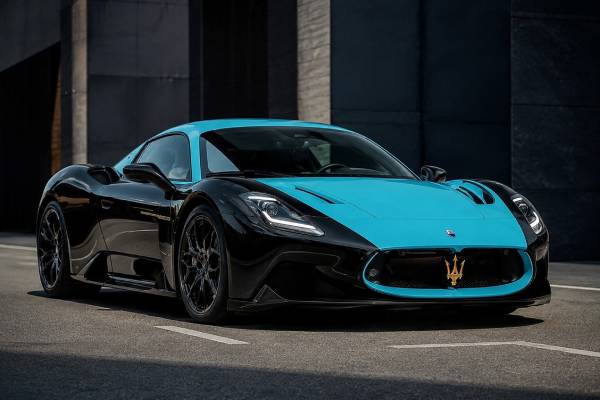
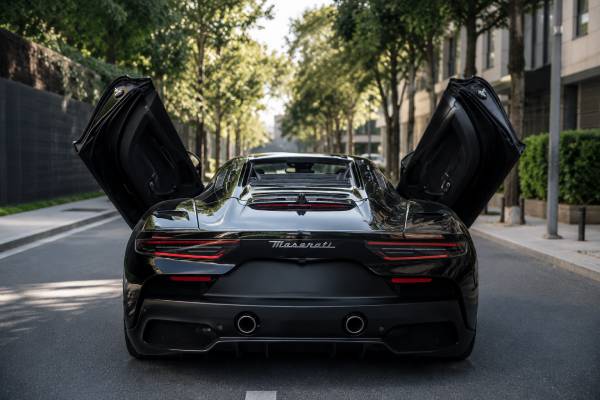
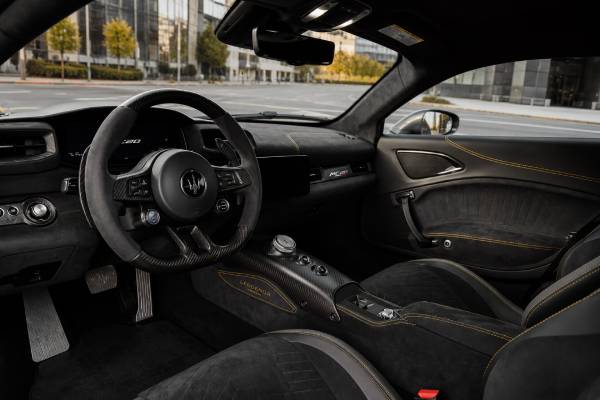
The 2024 Maserati MC20 Leggenda is a 20-unit special series inspired by the black-and-green Vitaphone MC12 GT1 race cars that dominated international GT competition. Its Nero Essenza body, Digital Mint Matte graphics, yellow Trident details, gloss-black wheels, black brake calipers, and numbered “LEGGENDA. UNA DI 20” engine badge turn the road-going MC20 into a direct visual reminder of Maserati’s championship era. The mechanical package remains the standard 630-CV MC20 coupe: a carbon-fiber monocoque, mid-mounted Nettuno twin-turbo V6, eight-speed dual-clutch transmission, adaptive double-wishbone suspension, and rear-wheel drive.
Leggenda means “legend,” and the name reflects a race-car story rather than the road-focused MC12 Stradale celebrated by the companion MC20 Icona. That difference determines how the car should look and how it must be authenticated. A recreated livery or modified standard MC20 is not one of the 20 factory cars. Buyers need proof of chassis identity, original Fuoriserie specification, correct numbered components, and an unbroken ownership and service record. This guide covers the history, specifications, production details, design, driving behavior, maintenance, and inspection priorities unique to the Leggenda.
Table of Contents
- The Vitaphone GT1 Legacy
- 630-CV Mechanics and Chassis Data
- One-of-Twenty Production Details
- Nero Essenza, Digital Mint, and Racing Cabin
- Performance with a GT1 Attitude
- Service, Storage, and Finish Preservation
- A Leggenda’s Pre-Purchase Checklist
The Vitaphone GT1 Legacy
The MC20 Leggenda commemorates the MC12 GT1 in its successful Vitaphone Racing colors, not the white-and-blue MC12 road car. Maserati produced 20 Leggendas for 2024 as part of the 20th-anniversary celebration of its 2004 return to international competition.
Maserati had spent 37 years away from factory-backed racing before the MC12 program arrived. The MC12 Stradale supported homologation, while the competition version entered the FIA GT Championship and quickly became a benchmark. From 2004 through 2010, MC12 GT1s recorded 27 FIA GT victories, three wins at the 24 Hours of Spa, six teams’ championships, five drivers’ championships, and two constructors’ titles.
Vitaphone Racing’s cars were especially recognizable. Their dark bodywork and vivid green graphics stood apart from traditional Italian red or the road car’s blue-and-white finish. The Leggenda translates that identity into Nero Essenza and Digital Mint Matte, with yellow Tridents adding another racing-style accent.
The relationship is visual and historical rather than mechanical. The MC12 GT1 used a naturally aspirated V12, a sequential racing transmission, extensive competition aerodynamics, and a chassis prepared solely for the circuit. The MC20 Leggenda is a road-legal, twin-turbocharged V6 supercar with climate control, infotainment, driver aids, and road suspension. It does not claim GT1 specifications or additional power.
That restraint gives the edition a clear place in the MC20 range. It is more exclusive and visually specific than a regular Fuoriserie order, but it is not a track derivative like the later GT2 Stradale. An original car should retain the ordinary MC20’s homologated exhaust, ride height, engine calibration, and body aero unless the individual build sheet states otherwise.
The sister MC20 Icona can be confused with Leggenda because both were launched together and each was limited to 20 units. Icona has Bianco Audace Matte and Blu Stradale, chrome wheels, blue calipers, and black-and-blue seats. Leggenda has the Vitaphone-inspired black-and-mint design, gloss-black wheels, black calipers, and a mostly black seat center. Mixing these components may indicate replacement, modification, or an incorrectly described car.
The anniversary narrative contributes to value because it connects a modern Maserati made in Modena with one of the brand’s strongest racing periods. Yet a buyer should not allow the story to replace normal scrutiny. The best Leggenda is both historically correct and mechanically healthy.
630-CV Mechanics and Chassis Data
The Leggenda’s drivetrain is the MC20’s 2,992 cc twin-turbo Nettuno V6 with 630 CV and 730 Nm. It drives the rear wheels through an eight-speed dual-clutch transaxle and is installed behind a carbon-fiber passenger cell.
| Specification | 2024 MC20 Leggenda |
|---|---|
| Engine configuration | 90-degree, twin-turbocharged V6 |
| Displacement | 2,992 cc |
| Maximum power | 630 CV (approximately 621 hp) at 7,500 rpm |
| Maximum torque | 730 Nm from approximately 3,000 rpm |
| Gearbox | Eight-speed dual-clutch |
| Drive | Rear-wheel drive with electronic limited-slip differential |
| Structure | Carbon-fiber monocoque with aluminum subframes |
| Suspension | Double wishbones and adaptive dampers |
| Claimed 0–100 km/h | Less than 2.9 seconds |
| Claimed maximum speed | More than 325 km/h |
Nettuno uses a pre-chamber combustion concept in a production-road-car engine. A small chamber above each cylinder contains a spark plug and communicates with the main chamber through small passages. When the system is active, jets of burning mixture promote rapid combustion. A conventional spark plug in the main chamber supports other operating conditions. The engine also uses direct and port injection, dry-sump lubrication, twin turbochargers, and variable valve timing.
The dry sump helps maintain oil supply during sustained cornering and allows compact engine placement. It makes service procedure important: oil type, temperature, run time, and the level-check sequence must follow current Maserati instructions. Guessing from the dipstick routine of an ordinary engine can produce a false result.
The dual-clutch gearbox provides automatic operation and manual control through large column-mounted paddles. Its logic changes with Wet, GT, Sport, Corsa, and ESC Off modes. GT prioritizes smooth road use; Sport adds sharper shifts and response; Corsa keeps the powertrain alert and relaxes stability intervention. Launch control is available for maximum acceleration but should not be repeatedly demonstrated during a sales inspection.
The carbon monocoque weighs roughly 100 kg and creates a stiff passenger cell. Aluminum subframes support the engine, transmission, suspension, and crash structures. This architecture contributes to a dry weight around 1,475 kg depending on equipment. It also means underbody or accident damage requires composite expertise rather than ordinary panel-straightening assumptions.
Double-wishbone suspension and adaptive dampers provide accurate wheel control. The electronically controlled differential manages rear-axle torque distribution. Large ventilated brakes are standard, with carbon-ceramic hardware possible depending on the build. The announced Leggenda specification includes black calipers, so refinishing should preserve correct color and logos.
Staggered 20-inch tires are normally 245/35 ZR20 in front and 305/30 ZR20 at the rear. Their age, matching specification, inflation, and inner-edge wear directly affect handling. The optional suspension lifter, included in the special-series equipment announcement, should protect the nose but still requires slow approaches to ramps.
One-of-Twenty Production Details
Only 20 MC20 Leggendas were produced, and each should carry a defined set of exterior, cabin, and equipment details. Authentication begins with Maserati’s factory build record and continues with a physical comparison of every limited-series element.
The official livery is Nero Essenza with Digital Mint Matte. Trident-design wheels are finished in Nero Lucido, or gloss black, with matte-black details and Digital Mint Trident hubcaps. Yellow Trident emblems appear on the grille, doors, and C-pillars. Brake calipers are black rather than mint or yellow.
The carbon-fiber engine cover carries a badge reading “LEGGENDA. UNA DI 20.” The phrase identifies the car as one of the 20 but should not automatically be interpreted as a numbered production sequence unless a separate number is shown. Inspect its typography, fasteners, finish, and position, then confirm the component through the chassis record.
The announced interior uses four-way lightweight monocoque racing seats with a black center over a silver backing. “Leggenda” and the Trident are embroidered on the headrests. The carbon-fiber interior package, carbon paddles, and sporting steering-wheel treatment reinforce the race theme. Sonus faber audio, electronic limited-slip differential, suspension lift, blind-spot monitoring, rear cross-path assistance, and fitted mats were included in Maserati’s description of the shared Icona/Leggenda equipment.
Individual-market details may vary, so publicity is not a substitute for the build sheet. A car can be genuine even if one convenience feature differs, but the seller should provide a documented explanation. Conversely, the presence of all visible parts cannot prove authenticity when those parts can be purchased or copied.
Record dates carefully. A car built as a 2024 special series may have a later first registration, especially if retained by a dealer or collector. Factory production date, warranty start, invoice date, and road-registration date should form a plausible sequence rather than being forced into one number.
Original documentation may include sales correspondence, allocation confirmation, Fuoriserie specification sheets, invoices, delivery photographs, books, keys, charger, covers, and presentation material. Since only 20 were made, those items carry more significance than they would with an ordinary production car. Their loss does not alter the VIN, but it weakens completeness.
Pay attention to changes made for another country. Lighting, infotainment, emissions equipment, labels, and connected services may be altered during import. A proper conversion should be documented and should not overwrite the car’s original calibration or identity. Keep original components when legal to do so.
The Leggenda’s public appearance at events can also aid provenance. Photographs may document a known car’s wheel, interior, and badge details from early ownership. Use such evidence carefully because plates can change and photographs can be reused. The VIN remains the decisive identifier.
Nero Essenza, Digital Mint, and Racing Cabin
The Leggenda’s black-and-mint livery is its most valuable visual feature and one of the best tools for detecting repair. Correct color, matte-versus-gloss contrast, graphic placement, and emblem detail should remain consistent across the entire car.
Nero Essenza creates a dark, reflective base that reveals swirl marks, scratches, sanding haze, and panel mismatch readily. Digital Mint Matte requires different care because polishing can change its texture. The intersection of the two finishes is especially vulnerable during detailing or paint-protection-film removal.
View the car under diffuse daylight and directional light. Look along the hood, doors, rear haunches, roof, engine cover, bumpers, and quarter panels. Compare graphic alignment at every shut line. A repaired black panel may match indoors but show a brown or gray cast outside. Matte mint may appear glossier or rougher where it has been resprayed.
The yellow Tridents are specific accents, not generic decals. Confirm their size, location, surface finish, and orientation on the grille, doors, and C-pillars. The wheel center details should be Digital Mint, while the wheels combine gloss and matte black. Incorrectly colored calipers or centers may suggest refinishing rather than an original configuration.
The MC20’s body separates elegant upper surfaces from functional aerodynamic work below. The low nose, side intakes, flat floor, channels, and rear diffuser manage cooling and stability without a prominent fixed wing. The Leggenda’s graphics follow the body rather than adding GT1 aerodynamic hardware. A large aftermarket wing may look thematic but is not part of the special series.
Butterfly doors create wide openings over exposed carbon sills. Check that they rise evenly, remain supported, and close without unusual force. Window indexing, latches, seals, hinges, wiring, and gas struts must work together. Door misalignment can indicate adjustment, wear, or structural repair.
The lightweight seats should be inspected for shell cracks, worn bolsters, loose mounts, failed adjusters, and changed upholstery. Their silver backing and Leggenda embroidery are difficult to reproduce perfectly. Verify that the seat style matches both sides and the original build record.
Inside, test all carbon pieces for cracking, clouding, or loose fit. Operate the screens, climate system, drive modes, steering controls, paddles, cameras, parking sensors, audio, seat adjustment, and front lift. Limited mileage does not protect electronic modules from low voltage or software faults.
The graphics and interior can be protected without turning the car into a museum object. High-quality film may reduce stone damage, but installers need experience with matte transitions and complex edges. Photographs should document the original surface before coverage, and film condition should be checked for lifting, yellowing, or adhesive marks.
Performance with a GT1 Attitude
The Leggenda has a GT1-inspired appearance but standard MC20 road-car performance: sub-three-second acceleration, a claimed top speed above 325 km/h, and a chassis that can move from compliant GT driving to demanding Corsa behavior. Its livery does not make it faster than another 630-CV MC20.
At urban speeds, the engine pulls without needing high revs and the gearbox can behave smoothly. GT mode is the best starting point for assessing a used car because it exposes clutch engagement, low-speed shifts, steering, ride quality, and brake modulation without aggressive calibration masking a fault.
Visibility ahead is acceptable for a low mid-engine car, but the width and rear blind areas require care. Cameras and sensors should be fully functional. The front lift is valuable on steep entries, yet its raised position does not make the floor immune to contact.
On an open road, boost builds quickly and the V6 delivers a broad surge rather than the rising character of the old MC12’s V12. The sound is more compact and turbocharged, but the acceleration is stronger at ordinary road speeds. Manual shifts should be immediate and consistent, with no flare or warning.
Sport mode sharpens the powertrain and permits a more active chassis. Corsa firms the dampers, changes shift strategy, and reduces electronic restraint. The rear tires alone manage 730 Nm, so cold surfaces, rain, debris, and abrupt throttle can overwhelm grip. Wet mode is a useful performance setting, not an admission that the car is unsuitable for use.
The steering should remain precise over smooth and uneven surfaces. Vibration may come from flat-spotted tires, damaged wheels, poor balancing, or alignment. A persistent pull or unstable braking deserves inspection of suspension arms, subframes, tires, and prior repair.
Brake evaluation depends on hardware. Iron discs can rust after storage and may clean after controlled stops. Judder, deep grooves, cracking, or a soft pedal require diagnosis. Carbon-ceramic discs should be inspected by a specialist for surface condition and wear; replacement can materially change the purchase economics.
Track driving is within the platform’s capability, but the Leggenda’s rarity makes preparation and damage avoidance essential. Use fresh approved tires, correct wheel torque, suitable brake fluid, accurate oil level, and clear cooling openings. Afterward, inspect the front body, undertrays, wheel barrels, brakes, and mint graphics for debris impact.
A sales road test should focus on repeatability rather than maximum output. Begin cold, allow full warm-up, use several transmission modes, check manual and automatic shifts, brake progressively, and monitor temperatures. Repeat a diagnostic scan afterward. A healthy car should finish without new faults or fluid odors.
Service, Storage, and Finish Preservation
Leggenda maintenance follows the MC20 schedule, but preservation of the two-tone livery, numbered parts, and low-use systems deserves equal attention. Service by time and mileage, maintain battery health, and confirm recalls or campaigns through the VIN.
Official maintenance packages can include engine oil and filter, air and pollen filters, spark plugs, belt inspections or replacement, transmission filters, diagnostic checks, and other age- or distance-based items. The exact schedule depends on market and chassis, so consult current owner and workshop documentation.
Nettuno requires approved lubricants and dry-sump procedure. Keep invoices that identify part numbers and specifications. Inspect for leaks around the engine, turbo oil and coolant connections, reservoir, underbody lines, and rear subframe. Any history of repeated coolant top-up should be resolved before high-load use.
The dual-clutch gearbox and electronic differential depend on correct fluid, calibration, and stable voltage. Harsh engagement may be mechanical, software-related, or caused by adaptation. A qualified technician should diagnose rather than repeatedly reset learning values.
Low-use cars commonly suffer battery problems. Connect an approved maintainer during storage, but still test battery capacity and charging performance. A voltage drop can create faults in cameras, doors, windows, infotainment, dampers, gearbox, and differential. Save scan reports instead of clearing them without explanation.
Recall and campaign checks should cover both the original and current market. MC20-family actions have included selected label, rear-camera software, door, hose, cooling, and control-module matters depending on VIN and model year. Obtain written confirmation of completion from Maserati.
Tire age is crucial. Check date codes, correct homologation, matching model, repairs, inner wear, and flat spots. Store at recommended pressure in a dry area and avoid leaving the car stationary for very long periods. Brake discs and hubs should be protected from persistent dampness.
Nero Essenza should be washed with methods that minimize swirl marks. Digital Mint Matte should not be polished like gloss paint. Remove contamination promptly with compatible products and little friction. Fuel drips, insects, tar, rubber, and bird residue can permanently mark delicate surfaces.
Document paint correction, film, wheel refinishing, and caliper work. A collector may prefer a professionally repaired panel to damaged original paint, but undisclosed work creates doubt. Keep before-and-after photographs, material details, and invoices so future owners can judge it accurately.
A Leggenda’s Pre-Purchase Checklist
A Leggenda purchase should proceed only after the car is authenticated as one of 20 and passes a complete structural, mechanical, electronic, and cosmetic inspection. The edition’s rarity increases the financial effect of missing or incorrect details.
Ask for the VIN before travel. Obtain the build sheet, original invoice, warranty record, allocation correspondence, ownership chain, service invoices, campaign history, tire dates, and repair disclosure. Check whether the seller can explain every market transfer and registration change.
Compare the car with the factory specification: Nero Essenza, Digital Mint Matte, yellow Tridents, gloss-and-matte black wheels with mint centers, black calipers, carbon engine cover, correct badge, black-and-silver lightweight seats, Leggenda embroidery, carbon package, and announced equipment. Record discrepancies and verify them with Maserati.
Inspect the carbon monocoque, aluminum subframes, suspension mounts, floor, undertrays, splitter, diffuser, and jacking points. Carbon damage may hide beneath trim. Any accident should be supported by structural measurements, photographs, parts invoices, and evidence of approved repair methods.
Assess the livery carefully. Look for color mismatch, polish marks, overspray, graphics that fail to align, replacement emblems, and paint film hiding damaged edges. Inspect wheels for cracks or bends and calipers for non-original refinishing. Use official images as a guide, not as the only authentication source.
Start the car cold and scan every module before clearing codes. Test both keys, doors, windows, front lift, air conditioning, cameras, parking aids, infotainment, audio, drive modes, dampers, differential, lights, and charging equipment. Repeat the scan after driving.
The road test should include low-speed clutch take-up, steady cruising, manual shifts, moderate boost, progressive braking, and rougher surfaces. Confirm straight steering, stable temperatures, consistent pedal feel, and absence of vibration. Full launch control is unnecessary and can add risk.
Budget for immediate needs. Tires can age out with little tread wear; batteries fail in storage; brake discs and pads can be costly; annual service and transport to a capable center add expense. Matte-livery correction and genuine edition parts may require more time and money than standard components.
Check completeness: keys, books, charger, cover, tools, compressor, mats, original wheels, removed factory parts, certificates, and sales material. If modifications are installed, obtain the original parts and software where possible. Avoid accepting undocumented engine tunes or emissions changes.
Finally, insure the car as an MC20 Leggenda with an agreed description and value. The contract of sale should state the VIN, mileage, limited-series status, included items, known repairs, and unresolved findings. A transparent, fully documented car is preferable to a lower-mileage example whose identity or condition depends on the seller’s assurance.
References
- MC20 Icona & MC20 Leggenda: two special series to celebrate the 20th anniversary of the timeless MC12 | Maserati Corse | Stellantis Media (2024, official press release)
- MC20 Special Series: Icona & Leggenda | Maserati (2024, official design presentation)
- Maserati MC20 – Model Overview: Info, Performance, Design | Maserati (accessed 2026, official specifications)
- Vehicle Detail Search – 2024 MASERATI MC20 | NHTSA (accessed 2026, recall information)
- MC20 Prepaid Maintenance programs | Maserati US (accessed 2026, official maintenance scope)
Disclaimer
This article is for general informational and educational use and is not a substitute for professional diagnosis, repair, structural inspection, or valuation. Specifications, torque values, intervals, procedures, software, recalls, and equipment can vary by VIN, market, production date, and installed options. Verify all work and purchase decisions with current official Maserati service documentation and qualified specialists. Share this guide with other MC20 enthusiasts and collectors who may find it useful.