
The Maserati Quattroporte 4200 was the car that proved a full-size luxury saloon could carry genuine Italian grand-touring speed. Introduced at the 1963 Turin Motor Show and built in regular production from 1964, the AM107 combined Pietro Frua’s formal four-door body with a race-bred, four-cam 4.1-liter V8. It was not simply a comfortable Maserati with extra doors. It created a new kind of automobile: a fast, handmade executive car able to cruise at speeds that were extraordinary for a saloon in the mid-1960s.
The 4200 also changed during its life. Early cars used a sophisticated De Dion rear axle with inboard brakes, while the revised Series II adopted twin headlamps, a redesigned cabin, and a simpler leaf-sprung live rear axle. Those differences matter to driving character, restoration cost, and collectibility. Today, every surviving AM107 deserves careful inspection because rust, neglected cooling systems, worn carburetors, and incomplete trim can turn an attractive purchase into a major restoration. A sound example, however, remains one of the most charismatic four-door classics ever built.
Table of Contents
- The Saloon That Created a New Class
- Four-Cam V8 and AM107 Specifications
- Series Changes, Production, and Original Equipment
- Frua Style Meets Maserati Engineering
- How the Quattroporte 4200 Drives
- Ownership Risks, Service, and Restoration
- Buying an AM107 With Confidence
The Saloon That Created a New Class
The Quattroporte 4200 matters because it joined limousine space, grand-touring pace, and low-volume Italian craftsmanship in one production car. Maserati had built fast road cars before, but the AM107 was its first series-produced four-door saloon and one of the earliest European luxury cars designed around sustained high-speed motorway travel.
The idea emerged when Europe’s expanding autostrada network made long-distance speed newly practical. Wealthy customers could already buy large formal saloons, but few offered the response, sound, and top-end ability of a serious GT. Maserati technical director Giulio Alfieri answered with a front-engined, rear-wheel-drive car powered by a developed version of the company’s aluminum V8. Pietro Frua shaped the body, drawing clear inspiration from the Frua-bodied 5000 GT built for the Aga Khan. Vignale constructed the bodywork.
The prototype appeared beside the Mistral at the 1963 Turin Motor Show. Its name was direct—“Quattroporte” means “four doors”—but its market position was unusual. The car offered four or five seats, a large luggage compartment, leather and wood, yet Maserati claimed performance comparable with many sports cars. A quoted 260 hp and a top speed around 210 to 230 km/h, depending on source, specification, and test conditions, placed it far beyond ordinary executive saloons of the period.
Regular production began in 1964. The first cars are now often called Series I, although Maserati’s period naming was less rigid than modern collector terminology. In 1966, the factory introduced a substantially revised version generally known as Series II. Production continued through 1969, with the 4.7-liter Quattroporte 4700 joining the range late in the run.
Collectors also value the AM107 because production was limited. Official Maserati heritage figures list 252 first-series 4.2-liter cars and 437 second-series 4.2-liter cars, although totals published elsewhere vary because prototypes, special cars, export specifications, and record-keeping are counted differently. The sensible approach is to treat chassis and factory documentation as more important than any single headline total.
Four-Cam V8 and AM107 Specifications
The defining component is the 4,136 cc, 90-degree V8 with two overhead camshafts per cylinder bank. Its four-cam layout, hemispherical combustion chambers, wet cylinder liners, and four twin-choke Weber carburetors gave the Quattroporte the hardware and character of an exotic grand tourer rather than a softly tuned luxury saloon.
| Item | Specification |
|---|---|
| Model code | Tipo AM107 |
| Engine | 90-degree aluminum V8, four overhead camshafts |
| Displacement | 4,136 cc |
| Fuel system | Four twin-choke Weber carburetors |
| Maximum output | 260 hp at approximately 5,000–5,500 rpm, depending on rating source |
| Maximum torque | Approximately 363–370 Nm at about 3,500 rpm |
| Transmission | Five-speed ZF manual; three-speed Borg-Warner automatic optional |
| Drivetrain | Front engine, rear-wheel drive |
| Body structure | Steel monocoque with front subframe |
| Wheelbase | 2,750 mm |
| Length | Approximately 4,978–5,000 mm |
| Width | Approximately 1,720–1,727 mm |
| Height | Approximately 1,346–1,360 mm |
| Weight | About 1,728–1,810 kg, depending on measure and specification |
| Claimed top speed | Approximately 210–230 km/h |
The V8 uses chain-driven camshafts and replaceable wet liners. This architecture supports rebuilding, but it also demands precision. Correct liner protrusion, head sealing, valve clearances, cam timing, and oil pressure are critical. The four carburetors must open together and deliver balanced mixtures. A car that idles unevenly, spits back through the intake, or smells heavily of fuel may need more than a simple adjustment.
Front suspension is independent with coil springs, dampers, and an anti-roll bar. Rear suspension depends on series. Early cars use a coil-sprung De Dion arrangement with the differential mounted to the body and the brakes positioned inboard. This reduces unsprung mass and gives the Series I a sophisticated technical identity. Later Series II cars use a Salisbury-type live rear axle located by a trailing link and suspended on semi-elliptic leaf springs. The later layout is simpler to understand and service, but it transmits road inputs differently.
Four-wheel Girling disc brakes were advanced equipment for a high-speed saloon of the period. Early cars’ inboard rear discs reduce unsprung weight but complicate access and can contaminate nearby components if leaks develop. Later cars place the rear brakes conventionally at the wheels. Brake servo condition, flexible hoses, caliper pistons, and master-cylinder health all deserve attention because a long-stored car may stop poorly even when the friction material looks usable.
Series Changes, Production, and Original Equipment
The most important buying distinction is not simply model year but Series I versus Series II. The 1966 revision changed the front appearance, dashboard, rear suspension, and several detail components, creating two cars with noticeably different technical and visual identities.
| Area | Series I | Series II |
|---|---|---|
| Approximate period | 1963/1964–1966 | 1966–1969 |
| Front lamps | Rectangular European lamps; some export cars used round lamps | Twin round headlamps became the familiar standard treatment |
| Rear suspension | Coil-sprung De Dion axle | Leaf-sprung live axle |
| Rear brakes | Inboard discs | Outboard discs |
| Dashboard | Earlier instrument and trim design | Redesigned full-width wood fascia |
| Official 4.2 production figure | 252 | 437 |
Export-market equipment can blur these categories. North American lighting rules encouraged round headlamps before the complete Series II change, and individual cars may have been altered during restoration. Owners also modernized cooling fans, alternators, ignition systems, air conditioning, mirrors, radios, and wheels. None of those changes automatically makes a car undesirable, but they should be documented and assessed for quality.
Originality is easiest to judge in layers:
- Confirm that the chassis stamping and identification plates match the registration and historical records.
- Compare the engine number and type with factory documentation where available.
- Check whether the body corresponds to its claimed series, market, and build date.
- Inspect instruments, switches, ventilation controls, seat patterns, door furniture, exterior trim, and wheels.
- Look for evidence of later color changes beneath seals, carpets, trim panels, and engine-bay components.
- Verify whether major mechanical conversions are reversible and whether removed original parts remain with the car.
Frua Style Meets Maserati Engineering
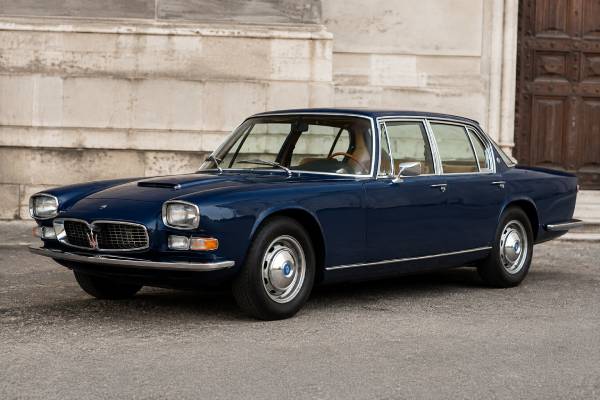
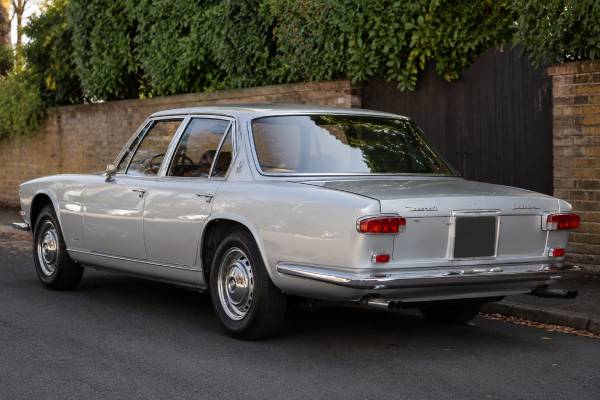
The Quattroporte’s greatest design achievement is that it looks formal without becoming heavy or anonymous. Frua used a long hood, low roof, restrained glasshouse, and clean body sides to give a five-meter saloon the visual balance of an Italian GT.
The front carries a broad grille with the Maserati trident as its focal point. Early rectangular lamps create a particularly crisp, understated expression, while the later twin round lamps give the Series II a more conventional but purposeful face. The roofline remains slim for a four-door car, and the gently tapering rear prevents the body from looking boxy. Thin pillars improve visibility and make the cabin feel lighter than the exterior dimensions suggest.
Vignale’s construction work joined the body to a steel monocoque with a separate front subframe supporting the engine and front suspension. This was a modern departure from the traditional tubular frames used by many low-volume GT cars. It gave Maserati the packaging efficiency needed for a spacious saloon while retaining the ability to mount a large V8 and substantial front suspension hardware.
The engine bay is densely packed but visually dramatic. Polished alloy cam covers, four carburetor throats, long intake paths, and the wide V8 define the car’s identity. Cooling and airflow are central engineering concerns because the engine produces substantial heat and the bay leaves limited room around hoses, manifolds, starter, wiring, and accessories.
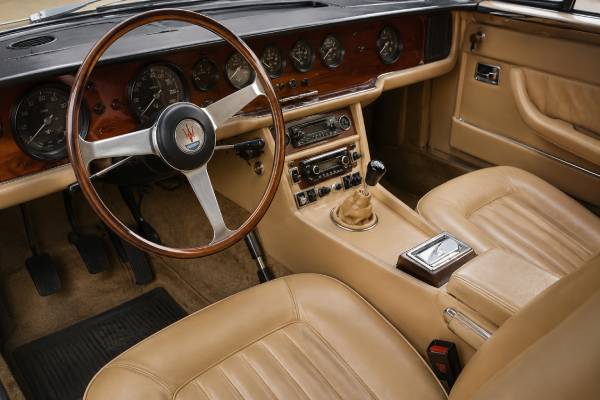
Inside, the AM107 combines leather, wood, chrome, and a broad instrument display. It feels handcrafted rather than standardized. The steering wheel is large, the controls are period-specific, and the driving position reflects 1960s ergonomics rather than modern expectations. Tall drivers should test seat travel, wheel clearance, and pedal alignment before purchase. Rear accommodation is generous for the era, but the low roof and thick seat cushions can affect headroom.
Several design details reveal the car’s dual purpose:
- A large trunk and four real doors support long-distance travel.
- The low beltline and thin pillars give the driver useful outward visibility.
- The V8 sits well forward, favoring cabin room over ideal sports-car weight distribution.
- The long wheelbase improves stability and ride quality.
- Disc brakes and a five-speed gearbox support sustained high-speed use.
- Luxury equipment adds comfort but also heat load, electrical complexity, and weight.
The exhaust note is more cultured than theatrical at idle, especially with a standard system. Under load, the engine develops the layered mechanical sound of induction, chains, valve gear, and eight cylinders working through a long exhaust. Worn or nonstandard systems can make the car boomy, so louder is not necessarily better.
How the Quattroporte 4200 Drives
A properly sorted Quattroporte 4200 feels fast, stable, and surprisingly communicative, but it expects the driver to manage weight, warm-up, gearbox technique, and braking distances. Its appeal comes from the way a large saloon performs its work through mechanical feedback rather than electronic assistance.
The V8 should start promptly when the choke or cold-start technique is correct, settle without persistent misfire, and build oil pressure quickly. Cold carbureted engines can hesitate, so aggressive throttle immediately after startup is unwise. Once warm, the engine responds cleanly and pulls with increasing urgency through the middle of the rev range. The final portion toward peak power brings more sound and speed, but an owner should not chase high rpm until oil temperature and mechanical condition are known.
A manual car’s clutch is heavier than a modern unit but should engage progressively. The ZF gearbox rewards deliberate movements. First gear gets the car’s mass moving, while the intermediate ratios allow the V8 to stay active. Synchromesh wear often appears as resistance or crunching during quick changes, especially when cold. A patient shift can hide moderate wear, so a road test should include slow and brisk changes after the transmission warms.
Steering varies with equipment and condition. Unassisted cars demand effort at parking speed, then become more natural once moving. Power-assisted systems should not feel vague or inconsistent. Play can come from the steering box, joints, idler components, wheel bearings, or flexible mountings, so a wandering car needs diagnosis rather than immediate blame placed on one part.
Series I and Series II cars differ most clearly at the rear. The De Dion setup gives the early car technical sophistication and can maintain good wheel control on smooth roads. Its inboard brakes and multiple locating components also make condition especially important. The later live axle is simpler and robust, but sharp bumps can be felt more directly. Neither version should clatter, steer from the rear, or oscillate after a dip.
Ride quality is firm by limousine standards but composed when springs, dampers, bushings, and tires are correct. Modern radial tires can improve grip and confidence, yet the wrong size, load rating, or steering feel can upset the car. Old tires may look unworn while offering dangerously poor adhesion. Tire date codes matter as much as tread depth.
The disc brakes should provide straight, progressive stopping. They lack the immediate bite and anti-lock control of modern brakes, and repeated hard use can expose fluid, pad, hose, or cooling limitations. A low pedal, pulling, vibration, or changing pedal height demands attention.
Ownership Risks, Service, and Restoration
The AM107 is maintainable when complete and regularly exercised, but deferred work is expensive because faults often interact. Cooling problems can damage the engine, poor electrical connections can mimic component failures, and long storage can affect fuel, brakes, hydraulics, seals, and carburetors at the same time.
Engine and cooling system
The V8’s most important health indicators are oil pressure, cooling stability, compression balance, valve-train condition, and absence of coolant contamination. Watch for smoke on startup or overrun, crankcase pressure, persistent tapping, timing-chain noise, and overheating in traffic. A cooling system that functions at road speed but overheats while stationary may have weak fans, a blocked radiator, incorrect ignition timing, or poor coolant circulation.
Wet-liner engines require experienced assembly. Head-gasket failure, corrosion, or incorrect liner height can lead to repeated sealing problems if a rebuild treats the engine like a simple cast-iron V8. Ask who performed major work, what was measured, which parts were used, and whether invoices include machine-shop details.
Carburetors need clean fuel, sound floats and needle valves, correct linkage, and synchronized airflow. Modern ethanol-blended fuel can attack old hoses, seals, and tank coatings. A fuel smell in the garage should never be dismissed. Inspect every flexible line, pump connection, filter, and carburetor union.
Transmission, axle, and brakes
Manual gearboxes can suffer worn synchromesh, bearings, and seals. Clutch replacement may reveal flywheel, release-bearing, hydraulic, or linkage issues. Automatic units need correct fluid condition and adjustment; rebuilding is possible but should be planned before purchase if symptoms are present.
Series I inboard rear brakes and De Dion components deserve specialist inspection. Oil leaks near the differential can contaminate brake surfaces, and access raises labor time. Series II rear axles should be checked for bearing noise, differential whine, worn spring bushes, broken leaves, and poor location under acceleration.
Brake calipers can seize after storage. Rubber hoses may collapse internally, causing dragging or uneven release. Replace aged fluid and inspect hard lines before assuming the system is safe because the pedal feels firm.
Body, trim, and electrical systems
Rust is often the largest financial risk. Inspect sills, jacking points, floor edges, wheel arches, door bottoms, windshield and rear-window surrounds, trunk floor, suspension pick-up areas, front subframe mounting points, and seams hidden by trim. Magnet tests alone are insufficient; use visual access, thickness readings, and a lift.
Body restoration is expensive because panel fit, window openings, brightwork, and door alignment are highly visible. Replacement trim is scarce. Missing grille pieces, lamp surrounds, badges, handles, switches, instruments, and interior fittings may take longer to source than mechanical parts.
Electrical problems commonly involve grounds, fuse connections, old relays, charging components, window motors, fan circuits, and previous accessory wiring. A neatly installed modern relay or alternator upgrade can improve usability, but undocumented wiring changes are a warning sign.
Buying an AM107 With Confidence
Buy the most complete, structurally sound, well-documented AM107 you can afford, even if a cheaper car appears mechanically lively. Correcting rust, missing trim, and an inaccurately restored interior can exceed the cost of engine service and may leave the car off the road for years.
Documents and identity
Begin with chassis number, engine number, registration history, invoices, and any Maserati Classiche or archive documentation. Confirm the claimed series and market specification. Study old photographs for changes in color, lamps, wheels, bumpers, and interior. A continuous history is valuable because mileage alone is difficult to verify on a 1960s exotic.
Inspection priorities
A pre-purchase inspection should include:
- Cold start with the engine genuinely cold.
- Oil-pressure observation from startup through hot idle.
- Cooling test in traffic and at sustained road speed.
- Compression or leak-down testing if engine condition is uncertain.
- Lift inspection of floors, sills, subframe mounts, suspension points, and previous repairs.
- Brake operation, hose age, caliper condition, and fluid leaks.
- Gearbox and clutch behavior when cold and warm.
- Carburetor synchronization, fuel leaks, and exhaust smoke.
- Operation of windows, gauges, fans, lights, wipers, heater, and air conditioning.
- Inventory of model-specific trim and any removed original parts.
Choosing between Series I and Series II
Choose a Series I if the early rectangular-lamp appearance and De Dion engineering are central to the appeal, and accept that rear-brake and suspension work can be more involved. Choose a Series II for its revised cabin, familiar twin-lamp face, and simpler live rear axle. Condition should outrank the theoretical hierarchy. A carefully maintained Series II is a better purchase than an incomplete or poorly repaired Series I.
Manual cars usually attract stronger enthusiast demand, but an automatic is not automatically inferior. The right choice depends on intended use, originality, and condition. A correct automatic car can be an excellent long-distance cruiser and may be less tiring in urban traffic.
Ownership budget and final decision
Set aside a substantial first-year reserve even after a favorable inspection. Old tires, fluids, hoses, battery, ignition components, carburetor service, brake work, and cooling improvements can all be needed before dependable touring. Major engine, body, or interior work belongs in a separate restoration budget rather than ordinary maintenance.
The strongest purchase has matching and credible identity, solid structure, stable temperatures, healthy oil pressure, complete trim, predictable controls, and records showing regular specialist care. The weakest purchase combines fresh cosmetics with uncertain numbers, missing pieces, hot-running behavior, fuel odor, weak brakes, and vague promises that faults are “just adjustment.”
For the right owner, the Quattroporte 4200 is not merely a collectible saloon. It is a usable historical statement: the moment Maserati placed a genuine four-cam V8, a luxurious cabin, and four doors into one elegant high-speed car.
References
- Quattroporte First series – Quattroporte models | Maserati 2026 (Manufacturer Heritage Specifications)
- Quattroporte I – Second series | Maserati 2026 (Manufacturer Heritage Specifications)
- Maserati Quattroporte Anniversary: The Luxury Italian Sedan Turns 60 | Maserati 2023 (Manufacturer History)
Disclaimer
This article is for informational purposes only and is not a substitute for professional diagnosis, repair, or restoration advice. Specifications, torque values, service intervals, and procedures can vary by VIN, market, production date, and equipment. Verify all work against official service documentation and consult a qualified Maserati specialist.
Please share this article on Facebook, X/Twitter, or your preferred enthusiast community if it helped you. Your support helps us produce more detailed classic-car guides.