
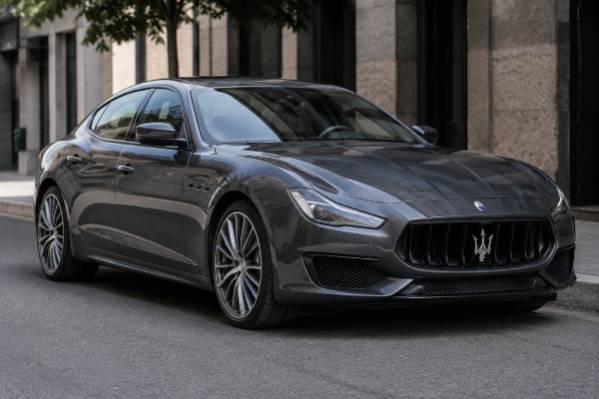
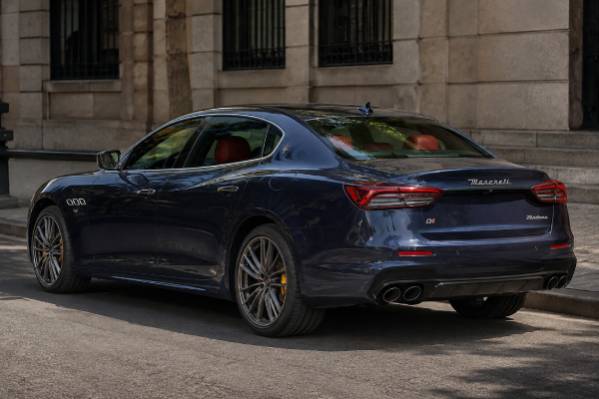
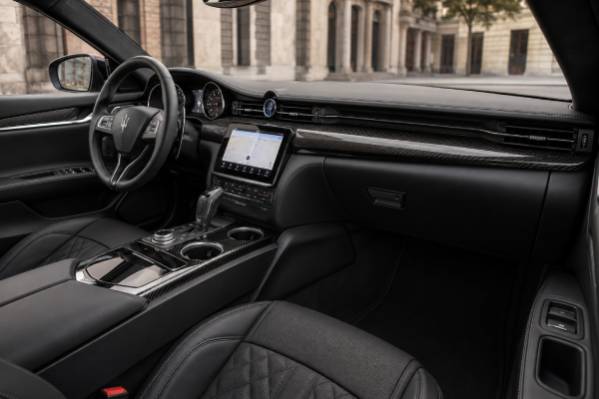
The 2022–2024 Maserati Quattroporte Modena is the final rear-wheel-drive 430 hp V6 version of the M156. It combines the F160 3.0-liter twin-turbo engine and 580 Nm with an eight-speed automatic, mechanical limited-slip differential, Skyhook adaptive dampers, electric steering, and the late 10.1-inch MIA infotainment system. Factory figures of about 5.0 seconds to 100 km/h and 288 km/h make it substantially quicker than the 350 hp GT while avoiding the Trofeo’s V8 costs and extreme 21-inch performance focus. The Modena trim adds sport bumpers, Black Piano exterior details, 20-inch wheels, wraparound leather seats, specific badging, and the updated Maserati logos introduced with the MY22 range strategy. It is the enthusiast-oriented middle choice: more responsive than the GT, lighter and mechanically simpler than the Modena Q4, and less costly to consume than the Trofeo. Buyers still need to verify cooling, turbo and ignition health, smooth shifts, rear-differential condition, tire age, wheel straightness, adaptive dampers, battery capacity, MIA operation, and calibration of active driver-assistance sensors. A carefully maintained Modena is one of the most balanced final Quattroportes.
Table of Contents
- The Sporting Middle of the Final Range
- 430 hp Modena Specifications
- Modena Trim, Options, and Authenticity
- Late M156 Performance Engineering
- Rear-Drive Modena on the Road
- Service Needs for the Final F160
- Buying a Final-Year Modena
The Sporting Middle of the Final Range
The Modena is the late M156’s best compromise for a driver: 430 hp, rear-wheel drive, sport-oriented trim, and mature technology without the weight of Q4 or the running costs of the V8 Trofeo.
Maserati reorganized its range for MY22 around GT, Modena, and Trofeo. GT represented elegant daily use, Modena expressed sport and driving pleasure, and Trofeo marked maximum performance. The Quattroporte Modena replaced the earlier S naming while retaining the proven high-output F160 V6.
The engine produces 430 hp and 580 Nm, enough for a claimed 5.0-second sprint to 100 km/h. That is only half a second behind the Trofeo’s published figure, though the V8 remains much stronger at high speed. In ordinary road use, the Modena’s torque makes it feel more powerful than a conventional middle trim.
Rear-wheel drive separates this car from the Modena Q4. It omits the transfer case, front differential, front propeller shaft, and front half-shafts. The steering is therefore free of front-axle drive torque, and the vehicle carries less mass. Owners in snowy regions may prefer Q4; drivers in mild climates often value the rear-drive version’s purity.
The Modena retains the Quattroporte’s full luxury dimensions. Its 3,171 mm wheelbase creates a spacious rear cabin, while the 530-liter trunk and 80-liter tank support long trips. The car can serve as an executive sedan without losing its performance intent.
By 2022, the M156 architecture was nearly a decade old, but the late technology package kept it usable. The 10.1-inch MIA screen, connected services, surround-view capability, adaptive cruise, lane support, and updated graphics were far removed from the launch car’s interface.
The final production years also give the Modena historical interest. It is among the last Quattroportes powered by the Maranello-built F160 V6 and part of the closing phase of the M156. Condition and original configuration will matter more as surviving cars age.
Used buyers should resist comparing purchase price only. A Modena with recent tires, brakes, annual service, clean diagnostics, and documented cooling work may be worth much more than a low-mileage car that sat on an old battery and original rubber.
430 hp Modena Specifications
The Modena uses the high-output 2,979 cc F160 twin-turbo V6, rated at 430 hp and 580 Nm, with a ZF eight-speed automatic and rear-wheel drive. Skyhook damping and a limited-slip differential support the performance.
| Item | Specification |
|---|---|
| Generation | M156, final trim phase |
| Engine family | F160 |
| Engine layout | 60-degree twin-turbo V6, direct injection |
| Displacement | 2,979 cc |
| Maximum power | 430 hp at approximately 5,750 rpm |
| Peak torque | 580 Nm at approximately 2,250–4,000 rpm |
| Maximum engine speed | Approximately 6,500 rpm |
| Transmission | Eight-speed ZF automatic |
| Drivetrain | Rear-wheel drive |
| Differential | Mechanical limited-slip |
| Front suspension | Double wishbone with Skyhook adaptive dampers |
| Rear suspension | Five-link with Skyhook adaptive dampers |
| Steering | Electric power assistance |
| Typical wheels | 20-inch alloy |
| Length | 5,262 mm |
| Width without mirrors | 1,948 mm |
| Width with mirrors | 2,128 mm |
| Height | 1,481 mm |
| Wheelbase | 3,171 mm |
| Trunk capacity | 530 liters |
| Fuel capacity | 80 liters |
| Homologated weight | Approximately 1,900 kg, market dependent |
| Claimed 0–100 km/h | 5.0 seconds |
| Claimed top speed | 288 km/h |
The F160 uses direct gasoline injection, twin turbochargers, high-turbulence cylinder heads, and four continuously variable cam phasers. The V6 shares several concepts with the related V8 family, including bore and timing technology, while its 60-degree architecture gives it a distinct firing character.
Compared with the GT’s 350 hp mapping, the Modena adds 80 hp and 80 Nm. The greatest difference appears in rolling acceleration, where the stronger torque band shortens passing time and requires fewer downshifts. The engine continues pulling toward the upper range instead of settling early.
The eight-speed automatic uses two overdrive ratios and a torque converter. It should operate smoothly in normal driving and respond decisively to the fixed column paddles. The later shifter includes a Park button and shorter travel than early M156 hardware.
The limited-slip differential helps allocate rear-axle torque. Its asymmetrical locking behavior supports traction under power and stability on release. Integrated Vehicle Control also uses predictive brake and engine intervention, but the mechanical differential remains an important part of the car’s feel.
Skyhook monitors body and wheel movement and varies each damper. The driver can select firmer damping independently from the powertrain’s Sport setting. This separation is useful when a road needs tighter body control but a progressive throttle.
Brake hardware can differ with market and package. Confirm disc dimensions and caliper type using the VIN and physical measurement. A Modena may carry larger performance components than a GT, and assuming parts interchange can lead to incorrect orders.
Modena Trim, Options, and Authenticity
A factory Modena combines the 430 hp drivetrain with specific late-model badges, sport styling, 20-inch wheels, and a more driver-focused cabin. Cosmetic conversion alone does not create the same car.
The Modena badge appears above the three fender vents. Updated Maserati logos sit on the hood and C-pillar, and revised lettering identifies the rear. Black Piano inserts and sport bumpers make the body more assertive than the chrome-accented GT.
Standard 20-inch wheels balance appearance and ride better than the Trofeo’s 21-inch setup. Different wheel designs and finishes were available, and Fuoriserie orders can vary. Verify part numbers, offsets, and whether a wheel has been refinished after damage.
Inside, sportier wraparound leather seats and Black Piano trim define the typical Modena theme. Pieno Fiore full-grain leather, carbon fiber, contrasting stitching, Alcantara-like headlining, and special colors may be optional. Natural leather needs careful inspection for scratches, bolster wear, and dye transfer.
The 10.1-inch MIA display provides navigation, smartphone integration, vehicle settings, cameras, voice control, and connected services. The system should be linked correctly to the current owner. Some functions depend on market coverage or subscription status.
Driver-assistance packages may include Active Driving Assist, adaptive cruise, Lane Keeping Assist, Active Blind Spot Assist, forward-collision functions, traffic-sign recognition, and surround-view cameras. The presence of a steering-wheel button does not prove that every feature was optioned or calibrated.
Premium audio, four-zone climate control, power and ventilated seats, rear-seat adjustment, rear shades, soft-close doors, wireless charging, and full-LED lighting can add value. They also add motors, amplifiers, sensors, and control units that must be tested.
Nerissimo or Fuoriserie details can make one car appear more aggressive than another. Factory documentation should support rare paint, stitching, carbon, wheel, and trim claims. A vinyl wrap can hide paint damage or a color change, so inspect edges and measure the underlying finish where possible.
A car registered in 2024 may have been built much earlier. Check production date, warranty start, tire date codes, battery age, and software version. Long dealer storage can create flat spots, discharged batteries, brake corrosion, and dried seals.
Late M156 Performance Engineering
The Modena’s engineering is a refined version of the original M156 formula: rear-drive proportions, mixed-material construction, active aerodynamics, adaptive suspension, predictive stability control, and electric steering.
The exterior retains the long hood, set-back cabin, frameless side glass, three vents, and broad grille that define the sixth-generation Quattroporte. Sport bumper shapes alter airflow and visual width without changing the basic body dimensions.
An active Air Shutter sits between the grille and radiator stack. It closes to reduce drag during low cooling demand and opens when the engine, transmission, or air conditioning requires more airflow. A fault can reduce thermal margin or set diagnostic codes.
The two turbochargers and their charge-air coolers generate significant heat. Inspect the low-mounted intercoolers, main radiator stack, hoses, ducts, fans, and undertrays. Bent fins, road debris, or collision repair can reduce cooling even when coolant level is correct.
Aluminum doors, hood, trunk lid, front subframe, and suspension pieces limit weight. The main structure uses high-strength material for stiffness and crash protection. Correct repair methods are essential because poor bonding or isolation can cause corrosion and alignment problems.
Electric power steering enables active corrections from Lane Keeping Assist and blind-spot systems. Its rack-mounted actuator should provide smooth effort and accurate return. Calibration depends on centered steering geometry and correct tire sizes.
Integrated Vehicle Control predicts dynamic problems and makes small adjustments before a conventional stability system would react. It considers wheel slip, steering, yaw, acceleration, speed, and braking. The result is a more natural intervention when the chassis is near its limit.
The exhaust system uses valves to balance refinement and sound. In normal operation, the V6 remains subdued. Sport mode opens a shorter flow path and creates a harder note. A valve or vacuum fault may produce uneven outlet sound or rattling.
Rear-Drive Modena on the Road
The Modena’s greatest strength is rolling performance with clear rear-drive balance. It feels more urgent than the GT without the Trofeo’s constant sense of excess.
In Normal mode, the throttle is progressive and the gearbox uses high ratios. The 580 Nm torque band means the car can accelerate briskly without high revs. A deep pedal input produces quick downshifts and a stronger surge than the 350 hp GT.
Sport mode changes the character noticeably. The transmission holds lower gears, exhaust valves open more readily, and pedal response becomes sharper. The suspension button can add damper firmness separately. The fixed paddles allow a driver to hold the engine in its strongest range.
The 5.0-second 0–100 km/h figure depends on rear-tire grip. On a warm dry surface, the car launches cleanly with stability support. On cold or wet pavement, the S Q4 or Modena Q4 can deploy power more easily. The rear-drive car rewards a progressive throttle.
Electric steering is accurate and free of front driveline torque. It filters some fine road texture but provides stable weighting and quick response. The long wheelbase adds calm at speed, while the rear differential helps the car rotate gently under power.
Twenty-inch wheels generally suit the chassis. They give sharper steering than the GT’s 19-inch setup without the Trofeo’s full impact harshness. Correct pressure is important; overinflation can make the car skittish and accelerate center wear.
Skyhook keeps the body composed through fast sweepers and motorway undulations. The soft setting is comfortable, while the firm setting reduces pitch and roll. A leaking damper or worn bushing can make one end react later than the other.
Brakes should provide a firm, predictable pedal. Vibration after warming may indicate disc runout or pad deposits. A car used hard can show heat marks, cracked drilled surfaces, tired fluid, and outer-shoulder tire wear.
The Modena is a large car in narrow streets. Surround-view cameras reduce risk to wheels and bumpers. Frameless windows should index correctly and remain quiet at motorway speed. Wind whistle or water entry requires seal and glass adjustment.
Service Needs for the Final F160
The late Modena still needs proactive maintenance. Higher boost and torque make cooling, oil quality, ignition, rear driveline condition, tires, and voltage especially important.
Engine, boost, and cooling
Start from cold and listen for extended rattle, uneven idle, belt noise, or exhaust leaks. Inspect cam covers, timing-cover joints, turbo oil and coolant lines, and the lower engine. Check for smoke after idling and under acceleration.
Pressure-test the cooling system. Examine the expansion tank, cap, thermostat, pump, hoses, fans, radiator stack, intercoolers, and active shutter. Temperature should remain stable in traffic and after repeated acceleration.
Spark plugs and coils may misfire only under boost. Injectors, high-pressure pumps, intake leaks, oxygen sensors, and boost-control hardware can create similar faults. Diagnose with cylinder counters, fuel pressure, boost request, and smoke testing.
Use the exact approved oil and replace it on time, with annual service sensible for low-mileage cars. Turbo bearings and cam phasers depend on clean lubricant. Keep invoices that identify the product rather than generic “engine oil.”
Transmission and rear driveline
The eight-speed automatic should select Drive and Reverse promptly and shift cleanly at all temperatures. Fluid and filter service requires correct procedure and level temperature. A harsh shift or shudder should be diagnosed before assuming service will cure it.
Inspect the limited-slip differential, propeller shaft, couplings, mounts, and half-shafts for leaks, clunks, or vibration. Rear tires should match closely. Repeated wheelspin or launch-style use adds heat to the differential and rubber.
Chassis, brakes, and electronics
Check Skyhook dampers, control arms, rear links, wheel bearings, wheels, and tire wear. Measure brake discs and pads, inspect calipers and hoses, and renew fluid by time. A 2022 car can already have aged original tires even at low mileage.
Load-test the battery and verify charging output. Low voltage can cause faults in EPS, ADAS, transmission, suspension, parking brake, MIA, and body systems. Scan every module before clearing codes.
Test MIA, phone pairing, connected services, cameras, radar functions, lane support, blind-spot intervention, lighting, audio, seats, climate zones, windows, locks, and soft-close doors. Confirm calibration after body, glass, suspension, or alignment work.
Recall and campaign status depends on VIN and country. Verify it officially and preserve software records. A reset warning light without a repair invoice is not proof of resolution.
Because the rear-drive Modena places its full torque through one axle, rear tires and differential behavior deserve a dedicated check. Inspect both inner and outer shoulders, compare tread depth side to side, and confirm that the tire model and load specification suit the car. During progressive acceleration, the chassis should remain composed and the stability system should not intervene constantly on a dry road. Clunks during throttle transitions, vibration under load, or noise that changes between acceleration and overrun can point toward mounts, shafts, wheel bearings, or differential wear. These observations are more useful when the test begins with correct pressures and includes both a cold and fully warmed phase. A fresh set of unsuitable tires can conceal poor maintenance just as easily as visibly worn ones.
Buying a Final-Year Modena
The ideal Modena is an original 430 hp rear-drive car with a clean cold start, stable cooling, recent matched tires, straight wheels, smooth shifts, dry dampers, and complete electronic health. Buy the history, then choose color and options.
Request the VIN, build sheet, production date, warranty start, service invoices, tire and brake records, diagnostic reports, and accident history. Confirm that the car is a factory Modena rather than a GT with sport trim or a former S registered late.
| Area | Strong evidence | Concern |
|---|---|---|
| Identity | VIN-linked 430 hp Modena build and original trim | Conflicting badge, output, or model-year claims |
| Engine | Clean cold start and full boost without misfire | Smoke, oil odor, reduced power, catalyst faults |
| Cooling | Stable temperature and pressure-holding system | Residue, repeated top-ups, fan or shutter faults |
| Driveline | Smooth transmission and quiet differential | Flare, clunk, whine, or load vibration |
| Chassis | Dry dampers, straight wheels, matched recent tires | Bent rims, inner wear, knocks, old original rubber |
| Technology | Fast MIA, clean scan, calibrated ADAS | Frozen screen, network faults, disabled assistance |
| History | Annual service and documented campaigns | Long storage or undocumented tune |
The pre-purchase inspection should begin cold and include underbody access, cooling pressure, wheel runout, tire dates, brake measurements, suspension play, and a full scan. Drive long enough to test Normal, Sport, manual shifting, cruise, cameras, and active assistance.
Ask about ECU software, exhaust changes, lowered suspension, and wheel replacements. A reversible modification with original parts is less concerning than a tune with no calibration details or a suspension change that disrupts driver-aid geometry.
A remaining warranty or service plan can add value, but confirm transfer rules and exclusions. Late registration does not guarantee remaining coverage if the warranty began when the dealer first placed the car in service.
Avoid repeated overheating, persistent misfire, heavy smoke, structural damage, harsh gearbox behavior, differential noise, or multiple module faults. Correcting several systems may exceed the price gap to a better car.
Budget for baseline work despite the car’s age. Battery, fluids, filters, plugs by schedule, tires, brake fluid, alignment, wheel repair, and software updates may already be due. Dealer storage can age a car without adding mileage.
The rear-drive Modena is the final M156 for buyers who want strong performance and a clean chassis feel without selecting the V8. It is quick, spacious, well equipped, and historically tied to the closing years of Maserati’s traditional sedan range. A strong example is worth protecting.
References
- Maserati introduces three new trims, GT, Modena and Trofeo – available for Ghibli, Quattroporte and Levante 2021
- Maserati Quattroporte MY22: GT, Modena and Trofeo 2021
- Maserati Guides & Documentation for your vehicle 2026 (Owner’s Manual Portal)
Disclaimer
This article is for informational purposes only and is not a substitute for professional diagnosis, inspection, maintenance, or repair. Specifications, torque values, service intervals, procedures, software requirements, and equipment can vary by VIN, production date, market, and configuration. Before buying, servicing, or modifying any vehicle, verify the relevant details against its official service documentation and consult a qualified Maserati specialist when necessary.
Please share this article on Facebook, X/Twitter, or another platform to support our work and help other owners and enthusiasts find it.