
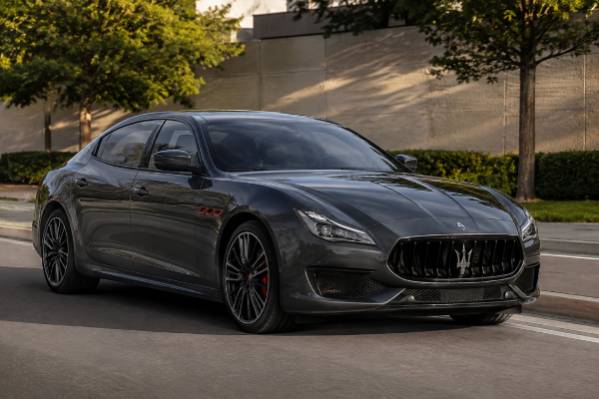
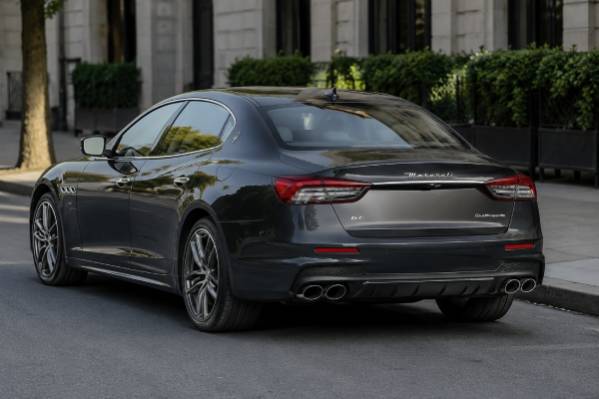
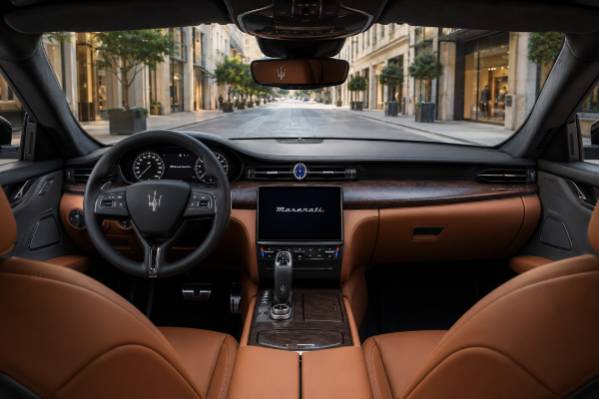
The 2022–2024 Maserati Quattroporte GT is the final entry-level gasoline version of the M156. It uses the 3.0-liter F160 twin-turbo V6 in 350 hp European specification, with 500 Nm, rear-wheel drive, an eight-speed automatic, Skyhook adaptive suspension, and electric power steering. Factory figures include about 5.5 seconds to 100 km/h and a 270 km/h top speed. The GT name arrived with Maserati’s MY22 three-trim strategy, positioning this car as the elegant, urban alternative to the 430 hp Modena and 580 hp Trofeo. Chrome accents, 19-inch wheels, leather comfort seats, traditional wood trim, updated brand badges, and the 10.1-inch MIA infotainment system define the standard theme. Although it is the least powerful final Quattroporte, it retains the same 5,262 mm body, 3,171 mm wheelbase, 530-liter trunk, and flagship-level complexity. Buyers should check cooling, oil seepage, ignition and boost health, transmission smoothness, battery condition, adaptive dampers, wheels, tires, camera and radar calibration, and connected-system operation. A documented GT can be the most usable late M156; a neglected one remains expensive to restore.
Table of Contents
- The Final Entry Quattroporte
- 350 hp GT Technical Specification
- MY22 Trim Strategy and Options
- Mature M156 Design and Technology
- GT Comfort and Road Performance
- Late-Model Maintenance Priorities
- Buying the Final 350 hp Version
The Final Entry Quattroporte
The GT is the calmest and most comfort-oriented final M156, but it is not a stripped base model. It combines the established 350 hp rear-drive powertrain with the latest branding, infotainment, and trim structure.
Maserati introduced GT, Modena, and Trofeo names for MY22 across the Quattroporte, Ghibli, and Levante. The goal was to make each model’s personality easier to understand. GT represented elegance and contemporary luxury, Modena emphasized sport, and Trofeo remained the performance flagship.
For the Quattroporte, GT retained the 2,979 cc twin-turbo V6 with 350 hp and 500 Nm. The mechanical package had already served in 2018–2021 cars, so the MY22 change was mainly in positioning, exterior identification, cabin presentation, and standard equipment.
The GT sits below the 430 hp Modena, but its real-world performance is still substantial. A 5.5-second run to 100 km/h is faster than many conventional luxury sedans, and 500 Nm arrives early enough that the car rarely feels strained. Rear-wheel drive keeps the front axle free of Q4 hardware.
The long M156 body was mature by this stage. Its proportions, aluminum closures, adaptive chassis, electric steering, and eight-speed automatic had received years of refinement. The final cars also use the 10.1-inch MIA system, making phone, navigation, camera, and vehicle functions easier than in early models.
The GT name can cause confusion with older Sport GT variants from the M139 generation. This car is not a track-focused derivative and does not share the old model’s fixed-damper philosophy. Here, “GT” means the elegant starting point of the late trim hierarchy.
Production through 2024 places the GT near the end of the internal-combustion Quattroporte’s long history. Final registration dates may not equal build dates, especially in smaller markets. Confirm the actual model year and equipment through the VIN.
As a used purchase, the GT can be more rational than the Modena or Trofeo. Smaller standard wheels, lower output, and simpler rear drive may reduce some costs. The car still has premium brakes, adaptive suspension, active safety sensors, expensive body pieces, and a complex turbo engine, so “base” should never be mistaken for inexpensive.
350 hp GT Technical Specification
The GT uses a 2,979 cc direct-injected twin-turbo V6 producing 350 hp and 500 Nm, an eight-speed ZF automatic, rear-wheel drive, and a mechanical limited-slip differential. The chassis remains fully adaptive.
| Item | Specification |
|---|---|
| Generation | M156, final trim phase |
| Engine family | F160 |
| Engine configuration | 60-degree twin-turbo V6, direct injection |
| Displacement | 2,979 cc |
| Maximum power | 350 hp at approximately 5,500 rpm |
| Peak torque | 500 Nm at approximately 1,750–4,500 rpm |
| Transmission | Eight-speed ZF automatic |
| Drive | Rear-wheel drive |
| Differential | Mechanical limited-slip |
| Front suspension | Double wishbone with Skyhook adaptive dampers |
| Rear suspension | Five-link with Skyhook adaptive dampers |
| Steering | Electric power assistance |
| Typical wheels | 19-inch alloy |
| Length | 5,262 mm |
| Width without mirrors | 1,948 mm |
| Width with mirrors | 2,128 mm |
| Height | 1,481 mm |
| Wheelbase | 3,171 mm |
| Trunk capacity | 530 liters |
| Fuel capacity | 80 liters |
| Homologated weight | Approximately 1,900 kg, market dependent |
| Claimed 0–100 km/h | 5.5 seconds |
| Claimed top speed | 270 km/h |
The F160 uses two turbochargers, direct injection, high-turbulence cylinder heads, and variable timing on all four camshafts. Ninety percent of peak torque is available near 1,600 rpm, so the engine responds well before the maximum output point.
This calibration is designed for a broad, smooth torque curve rather than the Modena’s stronger middle and upper range. The hardware family is related, but software, boost request, and protection strategies make the outputs distinct. An aftermarket tune changes the ownership and legal assumptions.
The ZF automatic uses two overdrive ratios for low-noise cruising. The redesigned later gear selector has a dedicated Park button and shorter movement than early M156 controls. Shifts should be almost unnoticed at light throttle and cleanly decisive in Sport.
Rear-wheel drive reduces mass and removes the transfer case and front axle components of Q4. The limited-slip differential assists traction, and Integrated Vehicle Control can make predictive engine or brake adjustments. Rear tires still need correct compound and pressure.
Skyhook independently varies damper force. The driver can request firmer damping without choosing the most aggressive throttle response. This supports the GT’s dual role as a comfortable sedan and a fast road car.
Electric steering is lighter at parking speed and enables active assistance. It should remain consistent around center and under load. A crooked wheel, lane-warning behavior, or assistance fault may require alignment and calibration rather than a simple reset.
MY22 Trim Strategy and Options
The GT’s factory appearance emphasizes restraint: chrome details, 19-inch wheels, leather comfort seats, and traditional interior trim. Correct options and late-year details should be verified through the build sheet.
The GT badge sits above the three side vents, while updated Maserati logos appear on the hood and C-pillar. Rear lettering also changed. These items were part of the new brand identity introduced after the MC20, not aftermarket decoration.
Chrome accents distinguish the exterior from the Modena’s sportier Black Piano treatment. Nineteen-inch wheels provide more tire sidewall and better urban durability than the 20- or 21-inch alternatives. Many buyers still ordered larger wheels, so standard appearance is not universal.
Leather comfort seats and wood trim suit the car’s luxury focus. Market literature may describe radica wood or other traditional finishes. Full-grain leather, contrasting stitching, headliner materials, and special-order colors can vary.
The 10.1-inch MIA screen is standard to the late interior experience. It uses an Android Automotive-based platform and supports Apple CarPlay, Android Auto, navigation, voice features, personalization, and Maserati Connect where available. Account transfer and subscription status should be checked on a used car.
Available driver assistance includes adaptive cruise, Active Driving Assist, Lane Keeping Assist, Active Blind Spot Assist, traffic-sign recognition, forward-collision functions, and surround-view cameras. Actual availability depends on market and option package.
Premium audio, four-zone climate control, heated and ventilated seats, power rear seats, rear shades, soft-close doors, wireless charging, full-LED lighting, and rear entertainment may be fitted. Test every item because a late-model car can still have failed motors, sensors, screens, or modules.
Fuoriserie customization can create uncommon paint, leather, stitching, and trim combinations. Genuine special-order content should appear in factory records. A later wrap or retrim may be attractive but is not equivalent for provenance.
A 2024 registration may represent an earlier build held in stock. Software version, warranty start, tire dates, and battery age can be older than the plate suggests. Ask for the production date and pre-delivery history.
The GT label should be verified as a factory trim rather than inferred from a seller’s description of the car as a grand tourer. Later badges, 19-inch wheels, chrome detailing, comfort seats, and the expected cabin finish should agree with the build record. National catalogues could package driver assistance, audio, rear-seat comfort, and cosmetic options differently, so a missing feature does not automatically indicate an incorrect car. It does mean the buyer should inventory the individual example instead of relying on a generic online specification. Production date, destination market, original invoice, and VIN-based equipment data are the strongest way to reconcile model-year language with the hardware in front of you.
Mature M156 Design and Technology
The GT uses the most developed form of the M156’s core design: long-wheelbase proportions, mixed-material construction, active aerodynamics, adaptive chassis, and modern connected infotainment.
The exterior still follows the original sixth-generation formula of a long hood, rearward cabin, frameless glass, three fender vents, and a concave grille. Later bumper and grille forms create a cleaner face than the 2013 car while preserving the same basic body.
The active Air Shutter behind the grille balances cooling and drag. It can close during low thermal demand and open for greater airflow. The actuator, linkage, sensor logic, and heat-exchanger cleanliness all matter. A fixed shutter or stored code deserves diagnosis.
Aluminum is used for the hood, doors, trunk lid, front subframe, and suspension components. High-strength materials form the central safety structure. Mixed-material collision repair requires proper joining, isolation, and corrosion protection. Inspect panel fit and underbody geometry.
The longitudinal engine and rear-wheel drive support balanced proportions. The transmission sits behind the engine, and a propeller shaft carries torque to the limited-slip differential. This layout provides clear steering and predictable rear-axle behavior.
Integrated Vehicle Control works within the stability system to predict a loss of control and make subtle adjustments before a conventional emergency intervention. It is supported by wheel-speed, steering, yaw, brake, and acceleration data.
Active Driving Assist uses camera, radar, and electric steering to help position the car on suitable roads. It remains a hands-on support system. Sensor cleanliness, windshield condition, alignment, tire consistency, and software determine how well it performs.
The cabin combines analog instruments and clock with the large central display. This balance prevents the late car from feeling completely screen-dominated. Physical mode buttons, rotary controls, fixed paddles, and a conventional steering wheel keep important functions easy to locate.
GT Comfort and Road Performance
The GT is tuned for effortless pace rather than maximum drama. Its 350 hp engine, 19-inch wheels, and comfort-oriented trim make it the most relaxed final Quattroporte, without making it slow.
Normal mode gives progressive throttle response and early upshifts. The V6 leans on 500 Nm, moving the car smoothly with little engine noise. A quick overtake may trigger multiple downshifts, but the powertrain should respond without hesitation or harshness.
Sport mode opens the exhaust valves more readily, holds lower ratios, and sharpens pedal response. The suspension can be firmed separately. This lets the driver improve body control while leaving the engine in a calmer map when carrying passengers.
A 5.5-second 0–100 km/h time is easily sufficient for public roads. The GT gives away performance to the Modena mainly during strong rolling acceleration and near the top of the speed range. In city traffic, the difference is rarely useful.
Rear-wheel drive gives the steering a clean response. Electric assistance is lighter and more filtered than the early hydraulic system but stable and accurate. The car should not wander, pull, or require constant correction on a level road.
Nineteen-inch wheels suit the chassis. They improve impact absorption, reduce wheel damage risk, and lower tire cost. A GT ordered with 20- or 21-inch wheels may look more aggressive but can ride closer to a Modena without gaining its power.
Skyhook controls the long body well. The soft setting absorbs broad undulations, while the firmer setting reduces pitch and roll. A floaty corner, repeated bounce, or impact inconsistency indicates damper, bushing, tire, or wheel trouble.
Braking should be linear and stable. The GT’s smaller standard system is less costly than Trofeo hardware but still needs correct high-quality pads and discs. Test for vibration after warming the brakes, and inspect inner surfaces.
At motorway speed, the GT is quiet, stable, and economical relative to the higher-output versions. The 80-liter tank and broad cabin make it a convincing grand tourer. Wind noise from frameless windows should remain modest; leaks or whistles point to glass indexing or seal issues.
Its moderate position in the range also shapes the driving experience. The 350 hp V6 does not deliver the Modena’s full 430 hp surge or the Trofeo’s V8 drama, but it remains strong enough for rapid motorway merging and sustained touring. The rear-drive chassis feels lighter in response than a Q4-equipped equivalent, while the eight-speed transmission can keep the engine quiet during relaxed travel. Evaluate the car in both normal and sport settings: throttle, shift strategy, damping, steering assistance, and exhaust character should change predictably without harshness or warning messages. A GT that feels unusually slow, rough, or reluctant to downshift needs diagnosis rather than an assumption that the entry power rating explains the behavior.
Late-Model Maintenance Priorities
Late production does not eliminate maintenance. The GT still depends on correct oil, stable cooling, clean boost control, healthy adaptive dampers, strong voltage, and calibrated active systems.
Engine and cooling
Start the car cold. Listen for prolonged rattle, uneven idle, belt noise, or exhaust leakage. Inspect for oil around cam covers, timing-cover joints, turbo lines, and lower engine areas. Check for smoke after idling and during acceleration.
Pressure-test the cooling circuit. Examine the expansion tank, cap, hoses, thermostat, pump, radiators, intercooler connections, fans, and Air Shutter. Temperature should remain stable in traffic and after boost.
Spark plugs and coils can fail under load. Injectors, fuel pumps, intake leaks, sensors, and turbo controls can create similar symptoms. Use diagnostic data and smoke testing rather than replacing parts by assumption.
Annual oil service with the exact approved specification supports turbo bearings and cam phasers. Low annual mileage does not justify extended time intervals. Keep receipts showing product and quantity.
Transmission, chassis, and brakes
The eight-speed transmission should engage promptly and shift cleanly in every mode. Fluid and filter service requires correct parts and a temperature-controlled fill. A late car may still need service based on age and use.
Inspect the rear differential, propeller shaft, couplings, and mounts for leaks or clunks. Check Skyhook dampers, control arms, rear links, wheel bearings, wheels, and tire wear. Correct mechanical play before alignment.
Measure brake discs and pads. Test the electronic parking brake and renew brake fluid on time. Tire date codes matter because original low-mileage tires may be old by 2026 even when tread remains.
Battery, MIA, and driver aids
The large number of modules makes battery condition critical. Load-test it, verify charging voltage, and investigate parasitic drain if the car discharges. Use a maintainer during storage.
Scan every module and test MIA, connected services, cameras, parking sensors, adaptive cruise, lane functions, blind-spot intervention, lighting, seats, climate zones, windows, and soft-close doors. Confirm calibration after windshield, bumper, suspension, or alignment work.
Verify recall and campaign status by VIN and market. Software updates can affect infotainment, transmission, assistance systems, and diagnostic behavior. Preserve update invoices.
Buying the Final 350 hp Version
Buy the GT for its balance of comfort, late technology, and simpler rear-drive hardware. The best value comes from condition and warranty history, not from choosing the newest registration alone.
Request the VIN, production date, build sheet, original invoice, warranty start, service invoices, diagnostic history, tire dates, and repair records. Confirm 350 hp European specification; some markets list 345 hp because of measurement conventions.
| Area | Good evidence | Concern |
|---|---|---|
| Identity | VIN-linked GT build with original late-model badges and trim | Late registration with unclear model year |
| Powertrain | Clean cold start, stable boost, smooth transmission | Misfire, smoke, reduced power, harsh shifts |
| Cooling | Stable temperature and pressure-holding system | Residue, repeated top-ups, shutter or fan faults |
| Chassis | Dry dampers, straight wheels, matched recent tires | Original aged tires, bent rims, uneven wear |
| MIA | Fast operation, working accounts and connections | Frozen screen, failed camera, unavailable settings |
| ADAS | All features active with calibration records | Disabled functions or repair without calibration |
| History | Annual service and documented campaigns | Long storage with old fluids and weak battery |
Have a specialist inspect the car cold and warm. The process should include underbody access, cooling pressure, wheel and brake measurements, suspension checks, a full module scan, and a road test covering Normal, Sport, manual, cruise, cameras, and assistance systems.
A transferable warranty or service plan can be valuable, but read exclusions and claim requirements. Confirm that services were completed on time and that modifications have not compromised coverage.
Avoid persistent coolant loss, heavy smoke, repeat misfire, structural repair, harsh gearbox behavior, multiple network faults, or an undocumented tune. A low-mileage late car with original old tires and fluids may need more immediate work than expected.
Budget for a baseline even with a young example. Battery, tires, brake fluid, oil, filters, plugs by schedule, wheel repair, alignment, and software updates can become due by age. Final-year cars may also have spent months in storage before sale.
The GT is the best late M156 for buyers who want elegance and everyday usability rather than the fastest badge. It retains the Quattroporte’s space, styling, and rear-drive identity while avoiding Q4 complexity and Trofeo consumables. With complete records, it can be the rational end-of-line choice.
References
- Maserati introduces three new trims, GT, Modena and Trofeo – available for Ghibli, Quattroporte and Levante 2021
- Maserati Quattroporte MY22: GT, Modena and Trofeo 2021
- Maserati Guides & Documentation for your vehicle 2026 (Owner’s Manual Portal)
Disclaimer
This article is for informational purposes only and is not a substitute for professional diagnosis, inspection, maintenance, or repair. Specifications, torque values, service intervals, procedures, software requirements, and equipment can vary by VIN, production date, market, and configuration. Before buying, servicing, or modifying any vehicle, verify the relevant details against its official service documentation and consult a qualified Maserati specialist when necessary.
Please share this article on Facebook, X/Twitter, or another platform to support our work and help other owners and enthusiasts find it.