
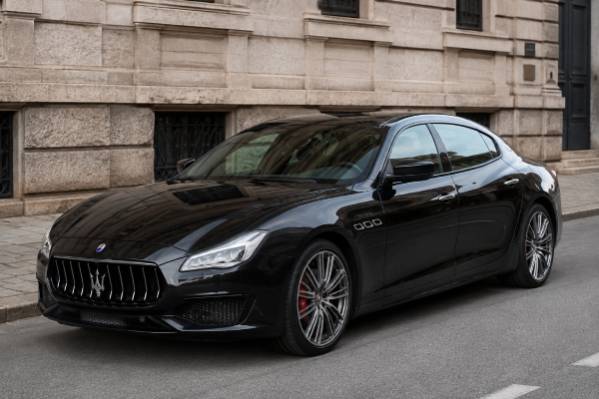
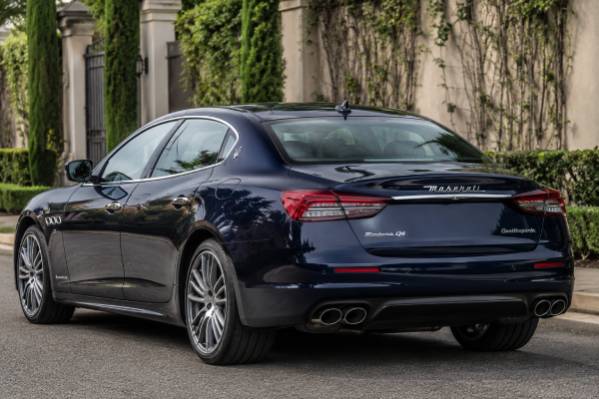
The Maserati Quattroporte Modena Q4 represented the all-weather, performance-oriented version of the final M156 range. Sold for the 2022, 2023, and 2024 model years in selected markets, it combined the 430 hp F160 twin-turbo V6 with Maserati’s Q4 on-demand all-wheel-drive system, an eight-speed automatic transmission, adaptive Skyhook suspension, and the sport-focused Modena trim. The result was a large Italian luxury sedan that retained a rear-driven character in normal conditions yet could direct torque toward the front axle when grip deteriorated.
This guide explains what distinguishes the Modena Q4 from the rear-wheel-drive Modena, the 350 hp GT, and the V8 Trofeo. It also covers identification, specifications, equipment, driving behavior, ownership risks, service priorities, and the checks that matter when inspecting a used example. Because equipment and homologation details varied by country, every prospective purchase should ultimately be verified through the VIN, market-specific build data, service records, and the physical car rather than a badge or advertisement alone.
Table of Contents
- Final M156 Modena Q4 overview
- F160 V6, Q4 chassis, and specifications
- Model years, markets, and equipment
- Design, cabin, and digital technology
- Road manners, performance, and weather ability
- Reliability, service, and Q4 maintenance
- Used buying inspection and value
Final M156 Modena Q4 overview
For model year 2022, Maserati reorganized the Quattroporte range around three identities: GT, Modena, and Trofeo. GT emphasized elegance and everyday grand touring, Modena balanced luxury with a more athletic presentation, and Trofeo occupied the V8 performance summit. The Quattroporte Modena used the higher-output 3.0-liter twin-turbo V6, and the Modena Q4 added the company’s electronically controlled all-wheel-drive hardware. In practical terms, it was the quickest six-cylinder Quattroporte of the closing M156 years while remaining less extreme, less expensive to fuel, and usually less costly to maintain than the Trofeo.
The M156 itself had debuted for the 2013 model year and was substantially larger and more modern than the preceding M139. By the time the Modena naming arrived, Maserati had already introduced electric power steering, updated driver-assistance systems, a revised infotainment architecture, and several rounds of trim and styling changes. The final cars therefore combined an established mechanical platform with the most mature cabin electronics and branding of the generation. They also carried the revised Maserati emblem on the hood, an updated Trident on the C-pillars, contemporary rear lettering, and a specific Modena badge above the familiar trio of front-fender vents.
Q4 is the defining technical difference. In ordinary, stable driving the system favors the rear axle, preserving the steering response and cornering attitude expected of a Maserati sedan. When wheel slip, steering angle, throttle position, yaw, or road conditions demand assistance, an electronically managed transfer system can send a substantial share of available torque forward. Maserati described the arrangement as capable of varying from fully rear-biased operation to an approximately even front-rear split. That does not make the Quattroporte a permanent four-wheel-drive cruiser; it makes it a rear-led sports sedan with an additional traction resource.
This variant suits an owner who wants the visual and dynamic character of the 430 hp Modena but regularly encounters rain, cold roads, mountain routes, or winter travel. It is less compelling for a buyer seeking the lightest or simplest configuration, because Q4 adds weight, rotating components, service points, and sensitivity to mismatched tires. Its strengths and obligations are therefore inseparable: the same hardware that improves launch traction and poor-weather confidence also demands more disciplined inspection and maintenance.
F160 V6, Q4 chassis, and specifications
The Modena Q4 uses Maserati’s F160 2,979 cc twin-turbocharged V6 gasoline engine. In European specification it was rated at 430 hp, with peak torque of about 580 Nm available across a broad midrange. The engine has direct fuel injection, dual turbochargers, variable valve timing, and an aluminum-intensive construction. It is mounted longitudinally and paired with a ZF eight-speed automatic transmission. The gearbox can operate unobtrusively in normal use, respond more aggressively in Sport mode, or be controlled through the steering-column paddles.
Key dimensions are approximately 5,262 mm long, 1,948 mm wide excluding mirrors, 2,128 mm wide including mirrors, and 1,481 mm high, with a 3,171 mm wheelbase. Luggage capacity is about 530 liters and the fuel tank holds roughly 80 liters. These figures explain both the Quattroporte’s generous rear compartment and its urban demands. It needs a long parking space, broad garage clearance, and care around low front bodywork and large wheels.
The suspension uses double wishbones at the front and a multi-link layout at the rear. Skyhook electronically controlled dampers vary their response according to drive mode and road input, attempting to reconcile body control with long-distance comfort. Large ventilated disc brakes provide the stopping capacity expected of a fast two-tonne sedan. Wheel and tire sizes vary with specification, options, and market, so the placard and build sheet should govern replacement decisions rather than assumptions based on another Quattroporte.
The Q4 system adds a transfer unit, front propeller shaft, front differential, front half-shafts, and associated control logic. Under normal cruising, the car remains strongly rear biased. If the control system predicts or detects reduced traction, a wet multi-plate clutch in the transfer arrangement progressively connects the front axle. The transition is intended to be rapid and unobtrusive. Because the system compares wheel speeds continuously, it relies on four tires with closely matched rolling circumferences. A large difference caused by mixed models, uneven wear, incorrect pressure, or an unsuitable replacement can keep the driveline working when it should be relaxed.
A specification summary is useful, but it is not a substitute for market-specific documentation:
| Item | Typical European specification |
|---|---|
| Engine | F160 2,979 cc twin-turbo V6 gasoline |
| Maximum output | 430 hp |
| Maximum torque | Approximately 580 Nm |
| Transmission | ZF eight-speed automatic |
| Drive | Q4 on-demand all-wheel drive, rear biased |
| 0–100 km/h | Approximately 4.8 seconds |
| Maximum speed | Approximately 288 km/h |
| Wheelbase | 3,171 mm |
| Luggage capacity | Approximately 530 liters |
| Fuel capacity | Approximately 80 liters |
Model years, markets, and equipment
The Modena designation began with the MY22 range renewal. On the Quattroporte it identified the 430 hp V6 performance trim, visually separated from GT through sportier exterior details and a more driver-focused interior treatment. Maserati specified sport bumpers with Black Piano inserts, 20-inch alloy wheels, wraparound leather seats, and Black Piano cabin trim as central Modena features. Exact wheel designs, leather grades, stitching, headliners, exterior packs, brake-caliper colors, and convenience equipment could vary by country or be changed through options.
In some markets, especially North America, naming and standard equipment do not map perfectly onto European catalogues. A listing may emphasize “Modena Q4,” “Modena AWD,” a package name, or a model-year-specific equipment group. Power may be stated as 424 hp rather than 430 hp because of the unit and certification convention. None of those differences automatically indicates a problem. The concern arises when the advertisement, VIN decoding, physical driveline, badges, and original window sticker contradict one another.
A genuine Q4 should have the complete front-drive hardware, not merely Q4 badging. The build record should identify the correct all-wheel-drive derivative, and an inspection from below should confirm the transfer case, front shaft, differential, and axle components. Badge replacement after paintwork, styling changes, or accident repair is easy. Conversely, a genuine car may have lost a badge during body repair. Authentication therefore depends on documentation and hardware together.
The Modena Q4’s desirable factory configuration depends on intended use. For frequent winter driving, a complete second wheel set with approved winter tires may be more valuable than decorative carbon-fiber pieces. For urban use, surround-view cameras and parking sensors reduce the risk associated with the car’s width. Long-distance passengers benefit from four-zone climate control, rear-seat heating or ventilation where fitted, powered shades, and the more elaborate rear comfort options. Enthusiasts may prioritize sport seats, paddle shifters, premium brakes, or darker exterior packages.
The final years also sit at the intersection of old and new Maserati branding. The hood emblem, C-pillar Trident, rear script, and trim badges should correspond to the later visual identity. Small inconsistencies may result from legitimate repairs, but they can also expose accident work or a cosmetic attempt to make an earlier car appear newer. Compare both sides carefully, examine fasteners and paint edges, and use dated production labels when assessing authenticity.
Design, cabin, and digital technology
The M156 Quattroporte’s proportions remain central to its appeal. A long hood, low glasshouse, short front overhang relative to overall length, frameless doors, and a flowing roofline give it a more expressive silhouette than many conventional executive sedans. The Modena treatment adds aggression without changing the fundamental shape: sport bumpers, dark inserts, larger wheels, side vents, and discreet badging sharpen the car while preserving its formal presence.
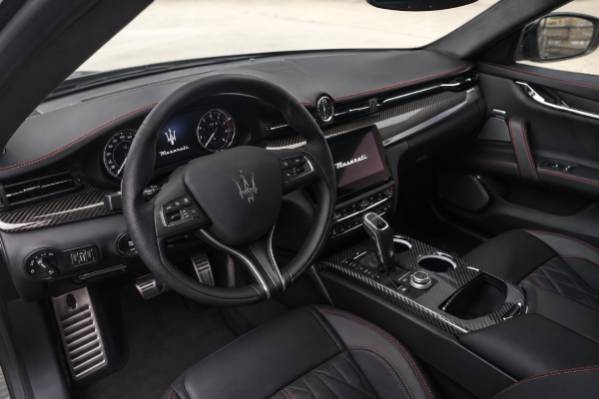
Inside, the Modena aims for a balance between a chauffeur-capable flagship and an owner-driven sports sedan. The dashboard wraps toward the front occupants, the transmission selector and drive controls sit high on the center console, and the analog clock provides a traditional focal point. The wraparound front seats are more supportive than a comfort-only design but still intended for long journeys. Rear occupants receive abundant legroom from the 3,171 mm wheelbase, although the sloping roof and center tunnel shape the experience differently from a square-roof limousine.
The later Maserati Intelligent Assistant infotainment system uses a 10.1-inch central display and a more modern software architecture than early M156 units. Depending on market and configuration, it supports smartphone integration, navigation, connected functions, voice control, vehicle settings, and media management. The screen’s speed and clarity are improvements, but a used-car test should still cover every input, camera view, audio source, USB port, Bluetooth connection, and steering-wheel control. Connected services may depend on region, subscription status, network retirement, and account transfer rather than hardware alone.
Driver-assistance equipment can include adaptive cruise control, forward-collision warning, automated emergency braking, lane-departure or lane-keeping support, blind-spot monitoring, rear cross-path detection, traffic-sign recognition, and a surround-view camera system. The exact combination varies. These systems depend on clean radar areas, correctly aimed cameras, sound wheel-speed information, and calibration after windshield, suspension, alignment, or body work. A dashboard without warning lamps is encouraging but does not prove that every feature operates correctly; each function should be activated in a safe test environment.
Cabin quality is a mix of evocative materials and many powered systems. Leather, wood or Black Piano trim, metal-look controls, ambient details, and the sculpted seats create a distinctive atmosphere. At the same time, the car contains multiple seat motors, door modules, climate actuators, window regulators, shades, cameras, amplifiers, and networked electronic controllers. Low battery voltage can produce misleading faults across several systems. Before diagnosing multiple unrelated warnings, technicians generally need to confirm battery condition, charging voltage, grounds, and stored fault history.
Road manners, performance, and weather ability
The Modena Q4 feels defined by effortless midrange acceleration rather than a single dramatic peak. With roughly 580 Nm available across the central rev range, the V6 can move the large sedan decisively without constant downshifts. The eight-speed automatic usually keeps the engine relaxed in normal driving, then tightens its strategy as throttle demand rises or Sport mode is selected. Manual paddle control adds involvement on a winding road, although the transmission remains protective of engine and driveline limits.
Traction is the Q4’s advantage. On a dry, clean surface, the car still behaves primarily like a rear-wheel-drive Quattroporte. The front axle is not meant to dominate the experience, and steering remains relatively natural for a sedan of this size. On wet exits, cold pavement, gravel-contaminated roads, or a steep launch, the front driveline can help translate torque into forward motion rather than wheelspin. The assistance is most valuable before a loss of control becomes obvious, because predictive inputs allow the system to prepare for changing grip.
All-wheel drive does not cancel physics. The Quattroporte remains heavy, powerful, and capable of very high speed. Q4 improves acceleration traction but cannot shorten every braking distance, create winter-tire grip, or eliminate aquaplaning. In snow or persistent low temperatures, four suitable, closely matched winter tires are more important than the badge. Electronic stability control should be treated as support, not permission to carry summer-road speed into winter conditions.
Skyhook gives the car a broad operating range. In its more compliant setting, the long wheelbase and substantial mass settle the body on open roads, producing the calm gait expected of a flagship. Sportier settings reduce roll and pitch, sharpen throttle and transmission behavior, and make the chassis feel smaller than its dimensions suggest. Rough, broken surfaces still expose the limits of large wheels and low-profile tires. A car that crashes harshly over every imperfection may have unsuitable tire pressures, damaged wheels, worn dampers, tired bushings, or nonstandard suspension parts.
A meaningful test drive should start cold, include urban maneuvering, steady cruising, several progressive accelerations, gentle full-lock turns, braking from different speeds, and a stretch of uneven road. Listen for driveline shudder, front-axle clicking, wheel-bearing hum, suspension knocks, and differential whine. Check whether the steering wheel remains centered, whether the car tracks straight, and whether the transmission shifts cleanly both cold and warm. A brief drive around a dealership block cannot evaluate a system as complex as the Modena Q4.
Reliability, service, and Q4 maintenance
The final M156 benefits from years of platform development, but maturity does not make it a low-maintenance economy car. Reliability depends heavily on correct fluids, timely servicing, battery health, cooling-system condition, software updates, and attention to small faults before they affect related systems. Parts pricing and labor time reflect the car’s original flagship position. A discounted purchase price should therefore be paired with a realistic reserve for maintenance and unexpected repairs.
Engine service begins with documented oil and filter changes using the specification required for the VIN and climate. Long calendar intervals, repeated short trips, or extended idling can be harder on oil than highway mileage suggests. Inspect for seepage around covers, turbo oil and coolant lines, the oil-filter housing area, and lower engine panels. Look for evidence of careless overfilling, incorrect sealants, or repeated cleaning intended to conceal leaks. A proper cold start should be prompt, stable, and free from persistent warning messages or abnormal mechanical noise.
The cooling system deserves equal priority because twin turbochargers and a tightly packaged engine bay generate substantial heat. Check coolant level only under safe, cold conditions; inspect reservoirs, hoses, radiator faces, intercooler areas, electric fans, and undertrays. Dried residue can reveal a slow leak even when the level has recently been corrected. During the drive, temperature should remain stable and the fans should not behave erratically. Overheating history can have consequences far beyond the original failed component.
Q4 maintenance adds several nonnegotiable checks:
- Fit four tires of compatible type, size, load rating, speed rating, and closely matched rolling circumference.
- Measure tread depth across all four tires rather than assuming a visual match is sufficient.
- Maintain pressures according to the vehicle placard and actual load.
- Investigate binding, shudder, or hopping during slow, tight turns.
- Inspect transfer-unit, front-differential, shaft, boot, seal, and axle areas for leakage or damage.
- Use the correct specified lubricants and service procedures for every driveline component.
A single new tire beside three substantially worn tires can create a meaningful circumference difference even when the sidewall size is identical. So can mixing tire models with different construction or using an incorrectly repaired wheel. The result may be unnecessary clutch activity, heat, vibration, or fault codes. Owners should rotate tires only where the approved stagger and directionality permit, and they should consult the handbook or a Maserati specialist before changing sizes.
Electrical health is another core maintenance item. The battery should be the correct type and capacity, securely mounted, and properly registered or initialized where required by the service procedure. A suitable maintainer can help cars that sit for long periods, but it cannot rescue an aged battery indefinitely. Scan every control module, not only the engine computer. Stored low-voltage, communication, camera, radar, suspension, transmission, and all-wheel-drive faults can reveal a pattern that the instrument cluster no longer displays.
Used buying inspection and value
A strong Modena Q4 purchase begins with identity. Obtain the VIN before traveling, confirm the model year and destination market, and compare the build record with the engine, driveline, trim, exterior color, interior color, and option content. Check registration documents and import history for consistent dates and mileage. Be cautious when a seller relies on badges, generic decoder results, or a copied equipment list instead of original documentation.
Next, review ownership and repair history chronologically. Mileage should rise logically across inspections, services, tire invoices, warranty visits, and registrations. Long gaps are not automatic disqualifiers, but they require explanation. Look for repeated battery replacements, cooling faults, driveline warnings, alignment attempts, tire changes, or electronic complaints. A pattern of unfinished diagnosis matters more than one properly resolved repair.
The physical inspection should occur with the engine cold and the car dry, clean enough to examine but not freshly detailed underneath. Useful checks include:
- Measure paint where permitted and inspect panel gaps, fasteners, labels, glass dates, lamp dates, and structural seams.
- Confirm all four wheels are correct, straight, and free from poor weld repairs.
- Record tire brand, model, size, production date, tread depth, and circumference-related differences.
- Inspect underbody panels, jacking points, transfer case, front shaft, front differential, axle boots, engine, transmission, and rear differential.
- Test every seat, window, lock, mirror, shade, climate zone, camera, sensor, light, and infotainment function.
- Perform a full multi-module diagnostic scan before and after the road test.
- Verify cold-start behavior, operating temperature, charging voltage, and warm restart.
During the test drive, pay attention to the Q4 system in low-speed turns and under progressive acceleration. Binding, vibration, clicking, thumping, or warning messages deserve diagnosis before purchase. Test the car on a smooth road to identify wheel or driveline vibration, then on broken pavement to expose suspension noise. Apply the brakes gently and firmly from safe speeds, checking for pull, pulsation, or a changing pedal. Repeat key observations after the car is fully warm.
Budget beyond the purchase price for immediate baseline work. Even an apparently excellent car may need fluids, filters, battery testing, alignment, tire correction, brake service, software review, or aging cosmetic items. Insurance, premium fuel, road tax, wheel refurbishment, and specialist labor vary sharply by country. Obtain real local quotations before committing, especially if the car is an import with uncommon specification.
The best Modena Q4 is not necessarily the cheapest example or the one with the longest option list. It is the car whose identity is clear, systems operate correctly, tires and driveline have been treated as a matched whole, and history demonstrates informed ownership. Properly selected, it offers an unusual combination: formal Italian flagship design, a spacious cabin, strong V6 performance, rear-biased handling, and genuine poor-weather traction. Neglected, the same complexity can turn an attractive purchase price into a sequence of expensive diagnostics.
References
- Maserati introduces three new trims, GT, Modena and Trofeo – available for Ghibli, Quattroporte and Levante 2021
- Maserati Quattroporte MY22: GT, Modena and Trofeo 2021
- International Press Launch Quattroporte S & Quattroporte S Q4 2014
- Maserati Guides & Documentation for your vehicle 2026 (Owner’s Manual Portal)
Disclaimer
This article is for informational purposes only and is not a substitute for professional diagnosis, inspection, maintenance, or repair. Specifications, torque values, service intervals, procedures, software requirements, and equipment can vary by VIN, production date, market, and configuration. Before buying, servicing, or modifying any vehicle, verify the relevant details against its official service documentation and consult a qualified Maserati specialist when necessary.
Please share this article on Facebook, X/Twitter, or another platform to support our work and help other owners and enthusiasts find it.