
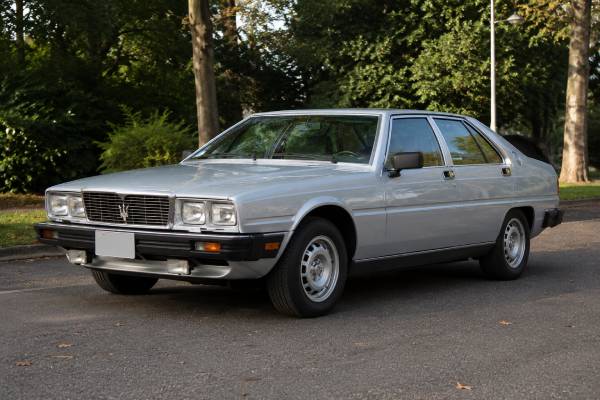
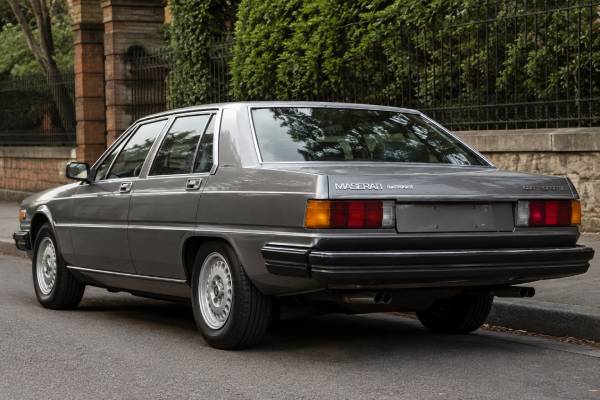
The Maserati Quattroporte 4900 is the definitive regular-production version of the third-generation AM330. Its 4,930 cc four-cam V8 produced 280 hp and supplied the torque the large Giugiaro saloon needed, while buyers could choose a five-speed ZF manual or a three-speed Chrysler TorqueFlite automatic. Built from 1978 to 1988, it accounted for 2,025 cars—by far the largest share of Quattroporte III production.
The 4900 joined old-school exotic-car hardware to limousine comfort. Four Weber carburetors, an aluminum wet-liner V8, rear-wheel drive, and ventilated disc brakes sat beneath a hand-finished steel body with broad leather seats, extensive wood trim, electric equipment, and air conditioning. The result was imposing, fast for its size, and very different from both German luxury saloons and contemporary Italian sports cars.
Age now matters more than mileage. Heat damage, low oil pressure, clogged cooling systems, fuel leaks, rust, tired rear-axle location, weak brakes, and failing cabin electrics can make a cheap example expensive. The strongest cars have documented engine work, stable temperatures, complete trim, and bodies that have not been disguised beneath filler and underseal.
Table of Contents
- The Mainstream Success of the AM330 Era
- 4.9-Liter V8 and Chassis Specifications
- Production Evolution, Transmissions, and Options
- Giugiaro Presence and Hand-Finished Luxury
- How the Quattroporte 4900 Drives
- Service Needs, Common Faults, and Cost Drivers
- Choosing the Best Quattroporte 4900
The Mainstream Success of the AM330 Era
The Quattroporte 4900 became the commercial heart of the AM330 range because its larger engine matched the car’s weight and purpose. It restored Maserati’s reputation for building a V8, rear-wheel-drive luxury saloon after the technically ambitious but unsuccessful front-drive Quattroporte II.
Alejandro de Tomaso rejected the previous Citroën-led direction and returned to familiar Maserati mechanicals. Giorgetto Giugiaro developed the body from ideas explored in the Italdesign Medici concepts. A pre-production car appeared in 1976, and the 4.9-liter version entered production in 1978 before broader sales began around 1979.
The car used a stretched and adapted platform related to the Kyalami, itself connected to De Tomaso engineering. Maserati installed the Tipo 107.23 V8, a developed version of the aluminum four-cam engine family that had powered its grand tourers since the 1960s. Rear-wheel drive, conventional power steering, and steel-sprung suspension replaced the front-wheel drive and central hydraulics of the AM123.
The Quattroporte III was initially badged “4porte” in some markets, then carried the full Quattroporte script from 1981. Its angular shape and heavily trimmed cabin made it one of the most distinctive executive cars of the 1980s. It found customers among industrialists, celebrities, officials, and buyers who wanted something more individual than a Mercedes-Benz or Jaguar.
Maserati’s heritage data records 2,025 examples of the 4.9-liter Quattroporte from 1978 to 1988. That figure includes manual and automatic cars across multiple markets and equipment specifications. The 4.9 outsold the 69-car 4.2 by a huge margin and later formed the basis for the 300 hp Royale.
The 4900’s success came from balance rather than novelty. It was spacious without feeling generic, fast without looking like a sports saloon, and luxurious without suppressing the mechanical personality of its engine. The carbureted V8 and live rear axle were conservative by 1980s standards, yet they also gave the car a durable conceptual simplicity when maintained correctly.
Today, the model remains undervalued relative to its craftsmanship and rarity, partly because restoration costs can exceed market value. A good car offers tremendous presence and a unique driving experience. A poor car can require simultaneous work to its body, engine, fuel system, brakes, air conditioning, and interior.
4.9-Liter V8 and Chassis Specifications
The 4,930 cc Tipo 107.23 V8 is the right engine for the Quattroporte III’s mass. It delivers 280 hp at 5,600 rpm and roughly 392 Nm near 3,000 rpm, giving the saloon stronger low- and mid-range response than the 4.2 while retaining the free-revving character of Maserati’s four-cam design.
| Item | Specification |
|---|---|
| Model code | Tipo AM330/49 |
| Engine code | Tipo 107.23 |
| Engine | 90-degree aluminum V8, four overhead camshafts |
| Displacement | 4,930 cc |
| Induction | Four twin-choke Weber carburetors |
| Maximum output | 280 hp at 5,600 rpm |
| Maximum torque | Approximately 392 Nm at 3,000 rpm |
| Manual transmission | Five-speed ZF S5 |
| Automatic transmission | Three-speed Chrysler A727 TorqueFlite |
| Drivetrain | Front engine, rear-wheel drive |
| Front suspension | Independent double wishbones, coil springs, dampers |
| Rear suspension | Live axle, coil springs, locating links |
| Brakes | Servo-assisted ventilated discs on all four wheels |
| Steering | Power-assisted recirculating ball |
| Wheelbase | Approximately 2,800 mm |
| Length | Approximately 4,880–4,980 mm |
| Kerb weight | Approximately 1,780–1,975 kg |
| Top speed | About 220–230 km/h depending on transmission and source |
The engine uses wet cylinder liners and chain-driven camshafts. Its robust basic architecture can cover substantial mileage, but only with clean oil, adequate pressure, correct valve clearances, stable coolant temperature, and properly tuned carburetors. Overheating or incorrect liner assembly can turn a serviceable engine into a costly rebuild.
The four Weber carburetors are both a feature and a responsibility. They must share airflow evenly, receive the correct fuel pressure, and operate through a linkage with minimal play. When tuned, the engine starts cleanly, idles smoothly for a large carbureted V8, and responds progressively. When neglected, it can run rich, hesitate, backfire, dilute the oil with fuel, or create a fire risk.
Transmission choice changes the car’s character. The ZF manual is uncommon and desirable because it gives direct control and makes the engine feel more sporting. The Chrysler A727 automatic is durable, widely understood, and well suited to relaxed use, but only if its fluid, cooling, kickdown linkage, mounts, and internal clutches are healthy.
The live rear axle sounds crude beside independent competitors, yet Maserati located it carefully and paired it with coil springs. Its behavior depends heavily on bushings, trailing links, dampers, ride height, and tires. A worn rear end can move laterally or steer the car under power.
Original Pirelli 205VR15 tires had a tall sidewall and appropriate load capability. Modern replacements should preserve overall diameter and load rating. Very wide, low-profile tires increase steering effort, transmit impacts, and may overload suspension parts without improving the car’s real-world balance.
Production Evolution, Transmissions, and Options
The Quattroporte 4900 evolved gradually rather than through one dramatic facelift. Badges, climate controls, switchgear, market equipment, trim, emissions hardware, and detail finishes changed across the 1978–1988 run, so authenticity must be judged against build date and destination.
Early examples may carry “4porte” identification. From 1981, Quattroporte badging became standard. In 1984, climate-control components were revised to share parts with Maserati’s higher-volume Biturbo family, improving serviceability in some areas but creating another dividing line for restorers.
Most cars used the three-speed automatic, especially in export markets where the Quattroporte was sold as a formal luxury saloon. Manual cars are significantly rarer and generally attract enthusiasts. A transmission swap is possible but requires the correct gearbox, pedal assembly, flywheel, clutch hydraulics, driveshaft, console, linkage, and documentation.
Equipment often included:
- Full leather upholstery and leather-covered door panels.
- Burr wood or similar veneer across the dashboard and console.
- Air conditioning and heating controls.
- Electric windows, central locking, and power seats on some cars.
- Power steering and four-wheel disc brakes.
- Audio systems and market-specific antenna installations.
- Rear-seat accessories, footrests, reading lamps, or special trim by request.
- Optional armored or extended coachbuilt conversions on a very small number of cars.
The AM330’s hand finishing creates legitimate variation, but not every unusual feature is factory original. Buyers should compare equipment with build sheets, early photographs, manuals, and parts catalogs. Modern radios, altered consoles, generic window switches, and replacement veneers are common.
Chassis and engine identity matter. Record the AM330/49 chassis number, engine number, gearbox type, body markings, and paint evidence. Factory archives can confirm original color, interior, delivery market, and sometimes mechanical specification. A replacement Tipo 107.23 engine may be acceptable for use but affects matching-numbers value.
Special histories can add interest. Some Quattroporte IIIs were used by government officials, and coachbuilders produced armored and long-wheelbase cars. Such claims should be supported by period records. Armor adds major weight and can accelerate wear in brakes, suspension, steering, cooling, and body mounts.
Giugiaro Presence and Hand-Finished Luxury
The Quattroporte III looks commanding because Giugiaro used disciplined geometry rather than decoration. A low rectangular nose, straight beltline, broad roof, thick C-pillars, and high tail give the car the stance of a formal state saloon while preserving enough glass to keep the cabin airy.
The body shells were produced at the Innocenti plant and finished in Modena. Maserati filled panel joints to create seamless surfaces, then hand-fitted doors, brightwork, glass, and interior trim. This process created individuality but also means panel gaps and seam shapes need expert interpretation during restoration.
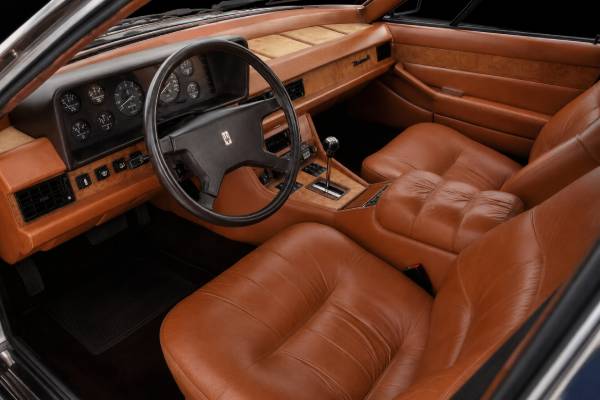
The cabin is the model’s emotional center. Deep leather seats, wood veneer, thick carpets, chrome details, and generous rear space create an atmosphere unlike a mass-produced luxury car. The design favors comfort over modern ergonomics. Controls can be scattered, the steering wheel is large, and the view over the long hood reinforces the car’s size.
A correct interior is expensive to reproduce. Leather grain, stitching, seat shape, wood color, instrument fonts, switchgear, headliner, and carpeting all affect authenticity. Replacing tired original material with generic modern trim may produce a clean cabin but reduce historical character.
The engine compartment is dense and hot. The broad V8, carburetor air box, cooling fans, air-conditioning compressor, ignition hardware, and emissions equipment leave limited space. Missing shrouds or improvised wiring may appear minor but can cause overheating or electrical failure.
The exterior’s apparent simplicity makes poor bodywork easy to spot. Long flat panels reveal ripples. Heavy filler can crack around seams, door frames, and wheel arches. Incorrect ride height makes the car look awkward and can indicate tired springs or overloaded suspension.
Sound completes the design. At idle, the V8 is subdued. Under load, induction from eight carburetor throats combines with a deep exhaust note. A standard or carefully designed exhaust preserves refinement at cruising speed; loud systems create resonance inside the large cabin.
How the Quattroporte 4900 Drives
The Quattroporte 4900 drives as a fast grand saloon rather than a sports sedan. Its best qualities are strong mid-range torque, relaxed high-speed stability, and a sense of mechanical occasion; its limits are weight, slow responses in tight spaces, and the absence of electronic safety systems.
A healthy engine should start without excessive cranking, build oil pressure promptly, and warm without fuel fouling. Carbureted cars may need a specific cold-start technique, but persistent misfire or black smoke is not normal. Hot restarting tests fuel temperature, starter condition, battery cables, and ignition health.
The automatic suits the car’s formal mission. It should select drive promptly, shift without flare, and respond to kickdown. A harsh engagement can indicate mount or pressure problems; delayed engagement and slipping point to internal wear. Because the gearbox is common by exotic-car standards, specialist support is generally better than for the engine.
The manual transforms the experience. The clutch is substantial, and the ZF lever prefers deliberate shifts. In return, the driver can keep the V8 in its strongest range and use engine braking. A manual 4900 feels more like a four-door GT and is often the collector’s choice.
Power steering makes the car manageable but does not hide its size. It should be smooth and consistent, with no excessive play or groaning. Wandering can come from steering-box adjustment, idler arms, tie rods, wheel bearings, alignment, or rear-axle bushes.
Ride quality is composed when springs, dampers, bushes, and tires are correct. The live rear axle can react to sharp one-wheel bumps, but it should not hop or shift sideways. The long wheelbase gives excellent motorway stability.
Braking performance is strong for the period. The ventilated discs need a firm, progressive pedal and balanced calipers. Repeated hard stops will expose old fluid, restricted hoses, weak cooling, or incorrect pads. Tire age is critical because the car’s mass can overwhelm hardened rubber even on a dry road.
The Quattroporte is not happiest in narrow city streets. Heat, width, turning effort, and visibility around the rear corners require patience. On an open road it settles into its intended rhythm, using torque rather than frantic revs and covering distance with a blend of comfort and drama.
Transmission choice changes the ownership experience more than it changes the car’s identity. The five-speed manual gives closer control of the V8 and should shift cleanly once warm, with no jumping out of gear or heavy clutch slip. The three-speed TorqueFlite is less sporting but suits the engine’s torque and the car’s formal character. It should engage promptly, change without flare, and remain free of burnt-smelling fluid or kickdown faults.
Neither version should be evaluated on a short urban loop. The cooling system, oil pressure, carburetor balance, automatic-fluid behavior, brakes, and rear-axle location all need a fully warm road test. A 4900 that feels impressive for ten minutes can reveal temperature creep, fuel vaporization, transmission delay, or rear-end steering only after sustained use.
Service Needs, Common Faults, and Cost Drivers
Preventive care determines whether a 4900 is usable or constantly under repair. Cooling, lubrication, fuel safety, corrosion, brake condition, and electrical load are the core ownership priorities.
Engine, carburetion, and cooling
Measure oil pressure fully hot and investigate chain noise, valve clatter, smoke, coolant loss, and crankcase pressure. Compression and leak-down results help distinguish carburetor faults from internal wear. A proper rebuild requires correct liner protrusion, bearing clearances, head work, oil-pump inspection, and cam timing.
Cooling must remain stable in traffic with the air conditioning running. Inspect the radiator internally and externally, fan motors, relays, shrouds, water pump, thermostat, hoses, expansion tank, and ignition timing. Repeated overheating is a major warning.
Fuel tanks can rust or shed old coating. Pumps, filters, rubber hoses, carburetor needle valves, and unions must be leak-free. Use ethanol-compatible hose and proper clamps. Carrying a fire extinguisher is sensible, but it is not a substitute for repair.
Transmission, suspension, and brakes
ZF gearboxes can suffer synchro and bearing wear. Clutches are labor-intensive to replace. The A727 needs clean fluid, correct adjustment, and adequate cooling. Differential whine, axle-bearing noise, worn rear links, and tired front ball joints affect safety and refinement.
Brake calipers seize after storage, hoses collapse internally, and boosters or master cylinders leak. Replace old fluid and inspect every line. Wheel bearings and tires should be checked at the same time.
Rust, electrics, and trim
Inspect sills, floors, jacking points, door bottoms, wheel arches, windshield and rear-window surrounds, trunk floor, front structure, suspension mounts, and filled exterior seams. New paint without restoration photographs deserves caution.
Electrical faults often involve grounds, fuse contacts, relays, charging circuits, cooling fans, windows, seats, locks, and air conditioning. Cabin parts are scarce. Wood can delaminate, leather can shrink, and dashboard materials can warp from heat. Preserve original pieces even when refurbishment is needed.
Choosing the Best Quattroporte 4900
Buy on body condition, mechanical health, completeness, and records—not low mileage or cosmetic shine. The best value is usually a regularly driven car with documented specialist care, even if its paint and leather show honest age.
Verify chassis, engine, transmission, color, trim, and market specification. Review invoices for engine rebuilding, cooling work, carburetors, brakes, suspension, air conditioning, and rust repair. Ask for photographs of body work before filler and paint.
A specialist inspection should include:
- Cold start, hot restart, oil pressure, smoke, and engine noise.
- Cooling performance at speed and while stationary.
- Compression or leak-down testing when history is uncertain.
- Carburetor synchronization and fuel-leak inspection.
- Manual synchros and clutch, or automatic pressure and shift quality.
- Steering play, front joints, rear links, axle bearings, and differential.
- Brake hydraulics, calipers, discs, hoses, and booster.
- Lift inspection of the shell and suspension mounts.
- Operation of all electrical and climate-control equipment.
- Inventory of trim, tools, manuals, keys, and spare parts.
Choose manual or automatic based on intended use. Manuals are rarer, more engaging, and generally more collectible. Automatics are better for relaxed touring and easier to service in many regions. Condition should outrank transmission preference.
Set aside a first-year reserve for tires, fluids, hoses, ignition service, carburetor balancing, brake work, and electrical repairs. Large jobs—engine overhaul, structural rust repair, full interior restoration, or complete air-conditioning reconstruction—need separate budgets.
Avoid cars with low hot oil pressure, repeated overheating, severe rust at mounting points, fuel leakage, unclear identity, or extensive missing trim unless priced as projects. A non-running car may require every system at once.
A sound Quattroporte 4900 delivers the experience Maserati intended: formal Giugiaro design, a richly finished cabin, and a large four-cam V8 capable of moving the saloon with authority. It is less precise than a modern performance sedan but far more individual.
References
- Quattroporte III – Classic Cars | Maserati 2026 (Manufacturer Heritage Specifications)
- Maserati TechInfo 2026 (Manufacturer Technical Information)
- Maserati Quattroporte III (Tipo AM 330) – Cathedral Classics 2025 (Survivor and Model Details)
Disclaimer
This article is for informational purposes only and is not a substitute for professional diagnosis, repair, or restoration advice. Specifications, torque values, service intervals, and procedures vary by VIN, market, production date, and equipment. Verify all work against official service documentation and consult a qualified Maserati specialist.
Please share this article on Facebook, X/Twitter, or your preferred enthusiast community if it was useful. Sharing supports the creation of more detailed collector-car guides.