
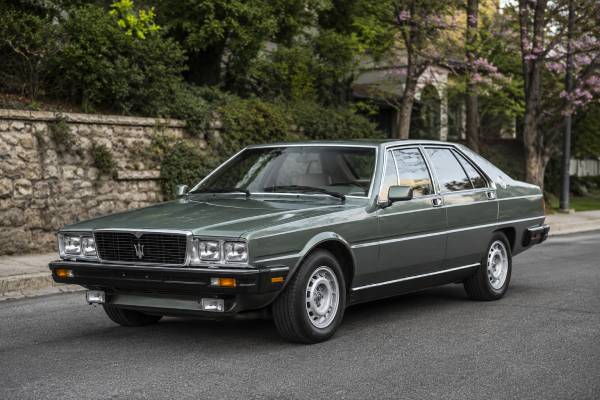
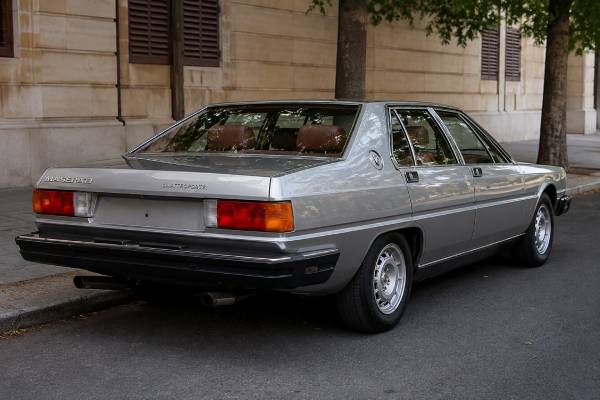
The 4.1-liter Maserati Quattroporte III is the rare entry version of the Giugiaro-designed AM330. Built from 1979 to 1983 and officially recorded at only 69 examples, it returned the Quattroporte name to a traditional Maserati formula after the front-wheel-drive, hydraulically suspended Quattroporte II: a large four-door body, a hand-built four-cam V8, rear-wheel drive, and an opulent leather-and-wood interior.
Its 4,136 cc Tipo 107.21 engine produced 255 hp and was normally paired with a five-speed ZF manual gearbox. The smaller V8 did not have the effortless torque of the much more common 4.9-liter model, but it gave the heavy saloon a revvier, more interactive character. Its scarcity also makes correct identification important. A 4.2-liter car converted to 4.9 specification may be easier to use, yet it loses the very configuration that makes this version special.
Ownership depends on condition rather than headline rarity. Rust, overheating, worn Weber carburetors, aged suspension bushes, weak air conditioning, and missing cabin trim can be expensive to correct. A complete, documented AM330 4.2 with healthy oil pressure and sound structure is a distinctive collector car; a neglected one can become a long-term restoration.
Table of Contents
- The Rare 4.2-Liter Quattroporte III
- Tipo 107.21 V8 and AM330 Specifications
- Production Details, Options, and Authenticity
- Giugiaro’s Formal, Hand-Built Luxury Saloon
- Driving the Small-Engine Quattroporte III
- Maintenance, Rust, and Recommissioning Risks
- Buying a 4.2-Liter AM330
The Rare 4.2-Liter Quattroporte III
The 4.2-liter AM330 is historically important because it marked Maserati’s return to a conventional V8 luxury saloon under Alejandro de Tomaso. It replaced Citroën-era experimentation with a rear-wheel-drive platform, familiar Maserati mechanicals, and the imposing square-edged design language of Giorgetto Giugiaro.
The roots of the shape appeared in Italdesign’s Medici concept cars of the mid-1970s. Maserati showed a pre-production saloon in 1976, but customer production did not begin until 1979. The finished car was first marketed in some places as the “4porte” before the full Quattroporte name returned.
Mechanical components drew from the Kyalami and Maserati’s long-lived V8 family. The 4.2-liter Tipo 107.21 retained aluminum construction, four overhead camshafts, and four Weber carburetors. It drove the rear wheels through a five-speed ZF manual gearbox. The larger 4.9-liter version soon became the dominant choice, while the 4.2 remained rare.
Maserati’s heritage data lists 69 examples produced from 1979 to 1983. That number makes it one of the least common regular-production Quattroporte variants. Its rarity was not caused by an exotic body or special trim package; buyers simply preferred the additional torque of the 4.9 in a car weighing roughly 1,780 to 1,975 kg depending on equipment and measurement.
The 4.2 therefore has a particular character. It asks the driver to use revs and gearbox more actively, especially when overtaking or climbing. The car feels less effortless than a 4.9 automatic, but the manual transmission and slightly keener engine response can make it more rewarding for an enthusiast.
The Quattroporte III also occupies a distinctive place in manufacturing history. Steel body shells were produced at Innocenti near Milan and finished and assembled in Modena. The cars retained extensive hand work, including filled exterior seams, fitted trim, leather upholstery, and wood veneers. They were among the last large Italian luxury saloons built in this labor-intensive manner.
Its image differed from the delicate first Quattroporte. The AM330 looked authoritative and formal, and it became associated with business leaders, public officials, and state transport. Yet beneath the square body sat an engine closely related to Maserati grand tourers. That contrast—limousine appearance with carbureted exotic-car hardware—defines the model today.
Tipo 107.21 V8 and AM330 Specifications
The 4.2-liter Quattroporte III uses a 4,136 cc naturally aspirated V8 producing 255 hp at 6,000 rpm. Its four-cam, four-carburetor layout delivers smooth high-rpm power, but the heavy body and modest low-speed torque require careful use of the five-speed manual gearbox.
| Item | Specification |
|---|---|
| Model code | Tipo AM330 |
| Engine type | Tipo 107.21, 90-degree aluminum V8 |
| Displacement | 4,136 cc |
| Valve gear | Double overhead camshafts per bank, two valves per cylinder |
| Fuel system | Four twin-choke Weber carburetors |
| Maximum output | 255 hp at 6,000 rpm |
| Maximum torque | Approximately 353 Nm at about 3,200 rpm |
| Transmission | Five-speed ZF manual |
| Drivetrain | Front engine, rear-wheel drive |
| Chassis | Steel platform structure |
| Front suspension | Independent double wishbones, coil springs, dampers |
| Rear suspension | Live axle located by links, coil springs, dampers |
| Brakes | Four-wheel ventilated discs with servo assistance |
| Steering | Power-assisted recirculating-ball system |
| Wheelbase | Approximately 2,800 mm |
| Length | Approximately 4,910–4,980 mm |
| Width | Approximately 1,890 mm |
| Kerb weight | Approximately 1,780–1,975 kg |
| Top speed | Approximately 215 km/h |
The engine uses wet cylinder liners, chain-driven camshafts, hemispherical combustion chambers, and an aluminum block and heads. Its design descends from Maserati’s 1960s V8 family, but installation and ancillaries evolved for the later saloon. Correct valve clearances, cam timing, oil pressure, and cooling remain essential.
Four Weber carburetors sit beneath a large air-cleaner assembly. When balanced, they provide smooth progression and a clean transition onto the main circuits. When worn or poorly synchronized, the engine may stumble, surge, foul plugs, smell of fuel, or idle unevenly. Linkage condition matters because a small mismatch is multiplied across eight barrels.
The ZF five-speed is central to the 4.2’s personality. First gear moves the car’s mass, while second through fourth keep the engine in its stronger range. Fifth supports quiet cruising. The gearbox should shift cleanly once warm; persistent baulking or crunching suggests synchro, linkage, clutch, or lubricant issues.
The platform uses independent front suspension and a well-located live rear axle. This is conventional compared with the Quattroporte II’s hydropneumatic layout, but it suits the car’s weight and long-distance mission. Worn bushes, rear links, springs, and dampers can make the body float, steer from the rear, or clunk over bumps.
Ventilated disc brakes provide strong stopping for the era, provided the calipers, booster, hoses, and master cylinder are healthy. The original 205VR15 tire specification gave the car a relatively tall sidewall. Modern replacements should preserve suitable load rating, diameter, and steering behavior rather than merely fitting the wheel.
Production Details, Options, and Authenticity
The 4.2-liter AM330 should be authenticated through chassis, engine, and factory records because its low production gives it more historical value than a visually identical 4.9 conversion. Exterior badges alone are weak evidence.
A serious inspection should record the chassis plate, stamped number, engine number, gearbox type, and body-number markings. Compare these with registration papers and Maserati archive information. The Tipo 107.21 engine designation should align with the claimed 4.2 specification.
The early AM330 evolved in detail during its run. Badging changed from “4porte” to Quattroporte, switchgear and climate-control parts were revised, and market equipment varied. Cars may differ in bumpers, lamps, emissions hardware, mirrors, instruments, and interior details. These differences should be judged against build date and destination.
Typical equipment included leather upholstery, extensive wood veneer, air conditioning, power steering, electric windows, central locking, and high-quality audio options. Customers could choose colors and trim combinations, and low-volume assembly allowed special requests. Later modifications are common because owners upgraded air conditioning, radios, ignition, alternators, cooling fans, and tires.
Authenticity priorities include:
- Correct 4.2-liter engine identity and plausible internal specification.
- Original five-speed manual gearbox and associated pedal box and console.
- Factory body configuration without undocumented structural alteration.
- Correct instruments, steering wheel, seats, door panels, wood, and switchgear.
- Proper wheels and hub details.
- Evidence of original paint and trim colors beneath later finishes.
- Documentation for any replacement engine, interior retrim, or body restoration.
Because only 69 were built, restoring a converted car to exact specification can be difficult. A missing carburetor air box, intake component, manual-console piece, instrument, grille part, or interior fitting may require fabrication or a long search. Complete spare parts supplied with the car can be highly valuable.
A 4.9 engine swap was understandable when these cars were simply old luxury saloons. Today it should be disclosed. The conversion may improve low-speed performance, but collectors will distinguish it from an original 4.2. Reversibility and retention of the original engine affect value.
Giugiaro’s Formal, Hand-Built Luxury Saloon
The AM330’s design succeeds by turning straight lines and broad surfaces into presence rather than bulk. Giugiaro gave the car a low, wide stance, a long hood, a crisp roof, and a high trunk, creating a formal shape that looks deliberate from every angle.
The front is defined by rectangular headlamps and a deep grille carrying the trident. The beltline runs almost uninterrupted to the tail. Thick C-pillars and a broad rear deck give the car privacy and authority, while generous side glass prevents the cabin from feeling enclosed.
Steel bodies were built at Innocenti and completed in Modena. Seams were filled to create smooth exterior surfaces, and hand finishing was extensive. That craftsmanship is attractive but can also hide corrosion or old repairs. Restorers must understand how the original body was assembled before cutting or replacing structural sections.
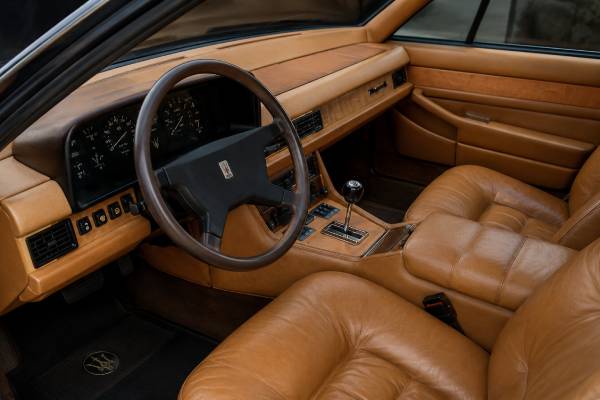
Inside, the Quattroporte III feels closer to a private club than a sports car. Leather covers broad seats and door panels. Wood frames instruments and climate controls. Carpeting is deep, rear legroom is generous, and the trunk suits long-distance travel. The dashboard is large but logically arranged for its era.
The driving position reveals the engineering beneath the luxury. The steering wheel is substantial, the hood stretches forward, and the pedals and shifter require deliberate movement. Visibility ahead is good, but the car’s corners and width demand care in tight spaces.
The engine bay provides the visual contrast. Four carburetors, cam covers, ignition components, hoses, and exhaust manifolds occupy a broad compartment. Heat management is crucial. Factory shields, correct fan shrouds, sealed ducting, and clean radiator fins should not be removed for appearance.
The sensory character is restrained at idle and richer under load. The V8 produces induction noise as the throttles open, then a deep exhaust note. The standard system suits the car better than a loud free-flow setup because the Quattroporte was designed for sustained travel, not constant theater.
Driving the Small-Engine Quattroporte III
The 4.2-liter Quattroporte III feels stately at low speed and increasingly energetic as revs rise. It is not a quick-launching saloon, but the manual gearbox lets the driver extract performance and makes this rare version more involving than its specifications suggest.
Cold starting depends on carburetor tune and technique. A healthy engine should build pressure quickly, settle without heavy smoke, and accept throttle cleanly as it warms. Prolonged cranking, fuel odor, backfiring, or repeated plug fouling indicates faults rather than normal exotic-car behavior.
The clutch is heavier than a modern unit but should engage progressively. A high bite point, judder, slipping, or hydraulic leakage can lead to gearbox removal. The ZF shift has a mechanical feel; it improves when warm and rewards a measured hand.
At city speeds, the car’s width, long hood, steering ratio, and heat are obvious. Power steering should remain consistent without groaning or dead zones. The engine may need lower gears to respond promptly. Air conditioning performance matters because the large glass area and dark interiors can make the cabin hot.
On open roads, the chassis settles. The long wheelbase supports straight-line stability, and the tall-sidewall tires absorb small impacts. The live rear axle is controlled when links and dampers are healthy, but worn components can cause rear steer or wheel hop.
The 4.2’s best quality is its progressive power delivery. It encourages the driver to hold a gear and use the upper half of the tachometer. The sound becomes more urgent without losing refinement. Overtaking requires planning, but the manual transmission gives precise control.
Brakes should feel firm and predictable. Pulling, vibration, low pedal, or a booster that changes assistance during a stop requires attention. There is no anti-lock system, and the car’s weight means tire quality and brake balance are critical in wet conditions.
A meaningful test drive should include cold start, urban traffic, sustained highway speed, rough surfaces, repeated braking, and a hot restart. Monitor coolant temperature and oil pressure throughout. A car that appears fine for ten minutes may reveal heat soak, fuel vaporization, or weak charging later.
The 4.2 also rewards realistic use planning. Its lower torque means a driver must use the ZF manual’s ratios rather than expecting the relaxed third-gear surge of a 4.9. On a test drive, accelerate from low rpm in several gears and watch for carburetor hesitation, clutch slip, driveline shunt, or a gear lever that moves under load. The engine should become freer as revs rise without losing oil pressure or temperature stability.
Because only 69 were built, mechanical substitutions deserve careful documentation. A later 4.9 engine, different carburetors, altered differential ratio, or non-original gearbox may make the car faster or easier to maintain, but it changes the historical object. A reversible upgrade with the original components retained is very different from an undocumented conversion. Ask for engine-number photographs, old invoices, removed parts, and any correspondence with Maserati specialists before judging authenticity or value.
Maintenance, Rust, and Recommissioning Risks
The largest AM330 expenses usually come from corrosion, engine damage caused by heat or low oil pressure, and the accumulated effects of long storage. A complete maintenance plan must address body, cooling, fuel, brakes, suspension, electrics, and cabin systems together.
Engine and cooling
Check compression, leak-down, hot oil pressure, coolant condition, timing-chain noise, valve clearances, and exhaust smoke. Wet-liner assembly requires correct protrusion and sealing. A rebuilt engine should have detailed machine-shop records, not only a general invoice.
The cooling system must keep temperature stable in traffic with the air conditioning operating. Inspect radiator flow, fans, shrouds, relays, thermostat, water pump, hoses, expansion tank, and ignition timing. Repeated overheating can warp heads and damage liner seals.
Carburetors need clean fuel and synchronized linkage. Replace old hoses with ethanol-compatible material, inspect pump pressure, and clean tanks that contain rust or degraded coating. Fuel leaks above a hot V8 are an immediate fire risk.
Chassis and body
Inspect sills, floors, jacking points, wheel arches, door bottoms, windshield and rear-window surrounds, trunk floor, front structure, suspension mounts, and seams beneath filler. Thick underseal can conceal poor repairs. Door alignment can reveal weakened sills or hinge areas.
The front suspension needs sound ball joints, bushes, wheel bearings, and dampers. At the rear, check axle links, bushes, springs, differential mounts, and bearings. Original self-leveling or load-control components, where fitted, require specialist assessment.
Electrical and interior systems
Old fuse contacts, grounds, relays, fan circuits, window motors, central locking, and charging systems can fail intermittently. Air conditioning may need hoses, compressor seals, condenser work, and careful refrigerant conversion. Avoid workshops that remove controls or bypass systems without documenting the change.
Leather, wood, headlining, carpets, switches, and exterior brightwork are expensive to restore correctly. Preserve complete original materials even when worn. An inaccurate retrim can cost heavily while reducing authenticity.
Buying a 4.2-Liter AM330
Buy the best documented and least rusty 4.2 you can find, not the cheapest example with a running engine. Structural work and rare trim can consume more money than a planned mechanical overhaul.
Start with identity. Verify the chassis and Tipo 107.21 engine, obtain factory information, and establish whether the car remains a true 4.2 manual. Review invoices for engine work, cooling upgrades, body repairs, and interior restoration. Mileage claims matter less than condition and continuity of care.
A pre-purchase inspection should cover:
- Genuine cold start and hot restart.
- Oil pressure at startup, cruise, and fully hot idle.
- Cooling stability in traffic and at speed.
- Compression or leak-down testing if history is incomplete.
- Carburetor balance, fuel pressure, and leak inspection.
- Clutch, gearbox, differential, and rear-axle condition.
- Brake hydraulics, calipers, hoses, discs, and booster.
- Lift inspection of sills, floors, mounts, and prior welding.
- Operation of every electrical and climate-control function.
- Inventory of original trim, tools, manuals, and spare parts.
Choose originality level according to intended use. A preserved car with sympathetic mechanical updates may be ideal for touring. A concours project should retain its correct engine, gearbox, carburetion, colors, and interior details. A 4.9 conversion can be enjoyable but should be priced as a modified car.
Budget for baseline service immediately after purchase. Tires may be unsafe despite good tread. Brake fluid, coolant, engine oil, gearbox oil, differential oil, hoses, belts, filters, plugs, and ignition components may all need replacement. Set aside additional funds for air conditioning and electric windows, which often fail after storage.
Walk away from a car with persistent overheating, low hot oil pressure, severe rust at suspension points, unclear chassis identity, or extensive missing trim unless the purchase is explicitly a restoration project. Cosmetic shine does not offset those risks.
A correct 4.2-liter Quattroporte III offers something the 4.9 cannot exactly duplicate: extreme rarity, a rev-focused four-cam V8, and a manual-driving experience inside one of Giugiaro’s most imposing saloon bodies. Its value is strongest when that original combination remains intact.
References
- Quattroporte III – Classic Cars | Maserati 2026 (Manufacturer Heritage Specifications)
- Classic Sedans: Quattroporte III (1979 – 1990) | Maserati US 2026 (Manufacturer History)
- Maserati TechInfo 2026 (Manufacturer Technical Information)
- The Car Nut | Atlanta, Georgia | Maserati Manuals and Sales Brochures 2026 (Manual Index)
Disclaimer
This article is for informational purposes only and is not a substitute for professional diagnosis, repair, or restoration advice. Specifications, torque values, service intervals, and procedures vary by VIN, market, production date, and equipment. Verify all work against official service documentation and consult a qualified Maserati specialist.
Please share this article on Facebook, X/Twitter, or your preferred enthusiast community if it was helpful. Sharing supports the creation of more detailed classic-car guides.