
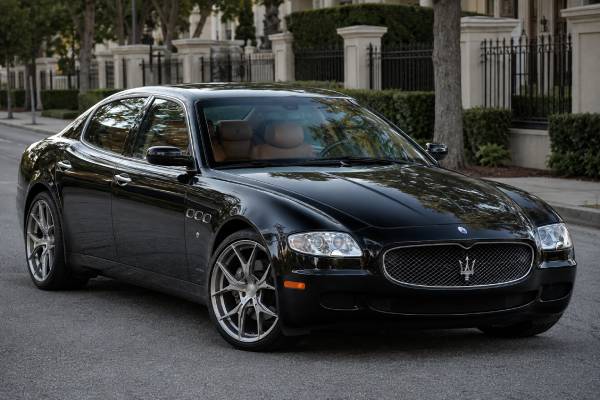
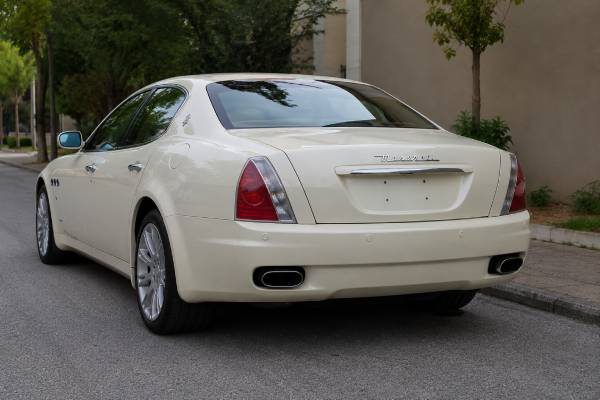
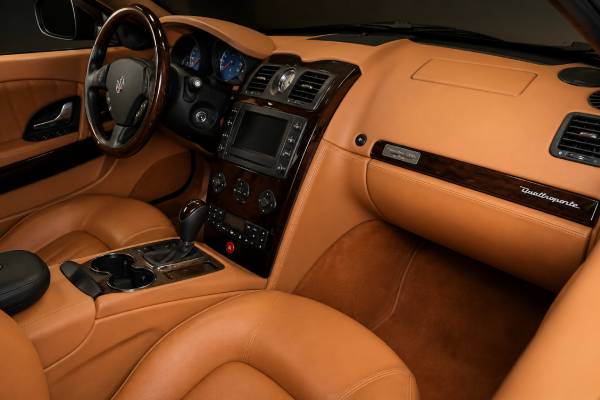
The 2008 Maserati Quattroporte Collezione Cento is a 100-car luxury edition of the pre-facelift M139 Quattroporte Automatica. It combines the 400 hp wet-sump 4.2-liter V8 and six-speed ZF automatic with a tightly defined ivory, Cuoio leather, Wengé wood, and mother-of-pearl specification. Its signature feature is the rear Multimedia Business Center, which placed two 10.4-inch touchscreens, media controls, an iPod connection, USB and auxiliary inputs, a SIM-card interface, and a wireless keyboard around the rear passengers.
That equipment makes the Collezione Cento more than a paint-and-trim package, but it also creates its main buying challenge. The mechanical foundation is familiar to an M139 specialist; the model-specific electronics, tufted upholstery, inlaid wood, coachline, keyboards, headsets, and control hardware are much harder to replace correctly. Period internet functions may no longer operate on modern networks, so originality and condition matter more than promises that every 2008-era service remains usable. A strong example should prove its factory identity, retain the special interior, start quietly from cold, shift smoothly when hot, cool itself in traffic, and pass a complete module scan. The best Collezione Cento is not merely a low-mileage Quattroporte. It is a complete, documented technology flagship whose unique pieces have survived.
Table of Contents
- A One-Hundred-Car Technology Flagship
- F136UC V8, ZF, and Core Specifications
- Collezione Cento Colors, Materials, and Numbering
- Rear Multimedia Business Center Engineering
- Driving the Luxury-Focused Cento
- Preserving the Automatic and Period Electronics
- Buying an Authentic Collezione Cento
A One-Hundred-Car Technology Flagship
The Collezione Cento is the most equipment-led special edition of the pre-facelift Quattroporte V. Maserati announced it for the 2008 model year and limited production to 100 cars, using the automatic 4.2-liter platform as the basis for a rear-cabin technology showcase.
The M139 Quattroporte had already changed Maserati’s position in the luxury-sedan market. Pininfarina gave the large four-door a low nose, flowing roofline, short rear deck, and proportions that looked more like a stretched grand tourer than a conventional limousine. The original DuoSelect version placed an automated manual transaxle at the rear, creating sports-car balance but also low-speed behavior that some luxury buyers found abrupt.
The Quattroporte Automatica answered that criticism. Maserati installed a conventional ZF six-speed automatic behind a wet-sump version of the 4.2-liter V8, revised thousands of components, and shifted the weight distribution only modestly from the earlier car’s rear bias. The result was easier to drive in traffic, smoother from rest, and better suited to owners who expected a flagship sedan to work without clutch-management technique.
The Collezione Cento built on that more usable platform. Its name translates naturally as “Collection One Hundred,” and the production limit was the core of the concept. Rather than chase more power, Maserati combined a single visual theme with unusually ambitious rear entertainment and communications equipment. It aimed at customers who wanted the style and sound of a Quattroporte but expected the rear seats to function as a private lounge or mobile office.
Collectors care because only 100 were intended, but low production alone does not guarantee quality or value. The edition’s attraction depends on completeness. An ivory Quattroporte with tan leather and added screens is not automatically a Cento. Conversely, a genuine car that has lost its keyboard, Bluetooth headsets, inlaid trim, original screen hardware, or rear-armrest controls has surrendered much of what made the edition special.
F136UC V8, ZF, and Core Specifications
Mechanically, the Collezione Cento follows the 4.2-liter Quattroporte Automatica: a 4,244 cc naturally aspirated wet-sump V8, 400 hp, a front-mounted ZF six-speed automatic, rear-wheel drive, and double-wishbone suspension. Its performance is therefore essentially the same as the regular automatic model.
| Item | Specification |
|---|---|
| Model code | M139 |
| Engine identifier | F136UC wet-sump V8 specification |
| Engine | 90-degree aluminum V8, DOHC, 32 valves |
| Displacement | 4,244 cc |
| Induction and fueling | Naturally aspirated, electronic multipoint injection |
| Maximum power | 400 hp at 7,000 rpm |
| Maximum torque | Approximately 460 Nm at 4,250 rpm |
| Transmission | ZF 6HP26 six-speed hydraulic automatic with manual paddle control |
| Drivetrain | Rear-wheel drive with limited-slip differential |
| Weight distribution | Approximately 49 percent front, 51 percent rear |
| Construction | Steel monocoque with front and rear subframes |
| Front suspension | Double wishbones with coil springs and Skyhook adaptive damping |
| Rear suspension | Double wishbones with coil springs and Skyhook adaptive damping |
| Steering | Hydraulic power-assisted rack and pinion |
| Brakes | Ventilated discs with ABS, traction control, and stability control |
| Wheelbase | 3,064 mm |
| Length | 5,052 mm |
| Width | 1,895 mm |
| Kerb weight | Approximately 1,970 kg before model-specific equipment variation |
| 0–100 km/h | Approximately 5.6 seconds |
| Top speed | Approximately 275 km/h |
| Production | 100 examples |
The F136UC is the wet-sump member of the 4.2-liter M139 family associated with the ZF automatic. It uses an aluminum block and heads, four overhead camshafts, four valves per cylinder, electronic throttle control, and variable timing on the intake camshafts. A cross-plane crankshaft gives it a deep, unevenly spaced exhaust character that sounds more muscular than a flat-plane racing V8 while remaining smooth enough for a luxury sedan.
“Wet sump” means the engine stores its oil in a pan beneath the crankcase rather than in the separate tank used by the dry-sump DuoSelect installation. The change was part of a wider repackaging effort required to mount the automatic transmission directly behind the engine. Buyers should not order parts from displacement alone because the dry-sump and wet-sump 4.2 engines differ in lubrication, ancillaries, transmission interface, and service details.
The ZF 6HP26 uses a torque converter for smooth takeoff, six forward ratios, electronic control, and a lock-up function that reduces slip once the car is moving. The driver can leave it in Drive, choose a more responsive program, or request shifts with steering-column paddles. It is more intuitive at parking speeds than the single-clutch DuoSelect and usually places less attention on clutch wear, though it introduces its own fluid, seal, valve-body, converter, and heat-management needs.
The steel body uses front and rear subframes and double-wishbone suspension at all four corners. Most luxury-focused automatic cars use Skyhook adaptive dampers, which vary damping force in response to sensor data and driver selection. Hydraulic steering gives more natural feedback than many later electrically assisted systems, but worn inner joints, tie rods, rack mounts, hoses, or front suspension arms can quickly make the large sedan feel vague.
Collezione Cento Colors, Materials, and Numbering
A correct Collezione Cento should present as a coordinated factory design, not a collection of vaguely similar luxury options. The defining combination is new ivory exterior paint, a fine waist-level coachline, Cuoio leather with distinctive tufting, and Wengé wood inlaid with mother of pearl.
The pale exterior color emphasizes the M139’s surfaces. Light catches the front fenders, shoulder line, and rear haunches differently than on the dark metallic finishes commonly seen on Quattroportes. The slender side stripe adds definition without turning the car into a loud special edition. Because paintwork is central to identity, accident repair and full resprays require more scrutiny than they would on an ordinary color.
Use a paint-depth gauge across every steel panel, but interpret results intelligently. A repainted bumper or stone-chipped nose is not automatically a reason to reject a 2008 car. The concern is poor color match, lost or incorrectly positioned coachlines, excessive filler, overspray, masking edges, corrosion repair, or a full color change unsupported by records. Photograph the stripe dimensions and termination points before restoration because recreating a delicate factory line by eye can produce an obvious mismatch.
Inside, Cuoio leather creates the warm tan foundation. The quilted or tufted treatment gives the rear compartment a furniture-like appearance and is more specific than ordinary smooth upholstery. Inspect the high points of the pattern for abrasion, the perforations and seams for splitting, and the bolsters for recoloring that has filled grain or stitching.
Wengé is a dark, strongly grained wood that gives the cabin contrast. The mother-of-pearl inlay adds a reflective detail that can be damaged by careless refinishing. Clouded lacquer, edge lifting, cracks around apertures, fading, or missing inlay are not simple cosmetic faults when replacement panels are edition-specific. A specialist may be able to conserve original veneer more successfully than a trim shop accustomed to replacing modern decorative panels.
Evidence that should accompany the car
A serious seller should be able to support identity with several forms of evidence:
- A VIN that decodes to the correct production period and specification.
- A factory build sheet, dealer invoice, or heritage confirmation naming the edition.
- Original exterior and interior color codes.
- Documentation for the rear multimedia equipment.
- Edition-specific manuals, accessories, keys, remotes, keyboard, and headsets.
- Service invoices that trace mileage and ownership rather than a disconnected stamp book.
- Photographs showing the car before any restoration or technology update.
Rear Multimedia Business Center Engineering
The rear Multimedia Business Center is the Collezione Cento’s defining engineering feature. It integrates two 10.4-inch touchscreens into the front seatbacks and concentrates connection, storage, and control functions around the rear center armrest.
Period descriptions list CD, DVD, MP3, photo, and video capability, plus internet and email functions. The armrest area provided auxiliary input, an iPod dock, USB connectivity, and a SIM-card interface. A keyboard could be used for text entry, while Bluetooth headsets allowed private listening instead of routing all sound through the main cabin audio system.
What the system can and cannot promise today
The display and local media functions may remain usable if the screens, drives, control units, and wiring are healthy. Network-dependent services are different. Cellular frequencies, SIM standards, security protocols, websites, email authentication, and supported media formats have changed since 2008. A system can be factory-correct and electrically functional yet unable to connect to a modern mobile network or online service.
A complete test should include:
- Starting with a fully charged battery and stable system voltage.
- Powering both screens from a cold start.
- Checking brightness, color, dead pixels, pressure marks, and image stability.
- Testing every touch area and menu rather than only the home screen.
- Playing known-good compatible media through each supported drive or port.
- Confirming left and right audio routing through the main system and original headsets.
- Moving both front seats through their full range while watching for interruption.
- Testing keyboard pairing, charging, battery compartment, and key response.
- Inspecting the armrest for damaged sockets, broken hinges, spills, or heat.
- Scanning related control modules and documenting faults before clearing anything.
Originality versus modernization
Modern tablets can deliver better resolution, streaming, navigation, and connectivity, but cutting the original seatbacks to install them usually lowers historical integrity. The strongest approach is reversible modernization. Preserve every original screen, bracket, harness, trim panel, drive, keyboard, headset, and controller even if a removable modern device is used for everyday convenience.
Avoid splicing into unknown power feeds or vehicle-network wiring. The M139 is sensitive to low voltage and communication faults, and an entertainment installer can create problems far beyond the rear screens by choosing the wrong circuit or ground. Any update should have its own properly protected supply, professional documentation, and a clear return path to factory condition.
Driving the Luxury-Focused Cento
The Collezione Cento drives like a well-equipped Quattroporte Automatica: fast, fluid, rear-biased, and more relaxed at low speed than a DuoSelect. Its special character is strongest from the rear seat, but the driver still gets the steering feel, V8 response, and chassis balance that made the M139 unusual among luxury sedans.
The 4.2-liter engine does not deliver the effortless low-rpm surge of a modern turbocharged V8. It builds power progressively and becomes more urgent as the tachometer rises. That linear response makes the large car easy to place in a corner because small throttle changes produce predictable changes in speed and balance.
The ZF transmission suits the edition. In Drive, the torque converter smooths parking maneuvers and urban traffic. Under a firmer accelerator it downshifts and lets the engine reach its more expressive upper range. Paddle commands add involvement, though the control software protects the drivetrain and may decline a shift that would over-rev or lug the engine.
Steering is one of the M139’s strengths. The hydraulic rack has real weight and communicates front-tire load better than many luxury rivals. A healthy car turns in cleanly and tracks securely, but it should not feel nervous, pull under braking, or shake through the wheel. Those symptoms can come from bent wheels, old tires, incorrect pressures, worn arms, poor alignment, brake variation, or steering-rack wear.
Skyhook damping gives the Cento two personalities. In its softer setting, it can cover long distances with controlled compliance, though large wheels and low-profile tires still transmit sharp edges. A firmer mode reduces movement and supports faster direction changes. The system should change behavior without producing warning lights, knocking, repeated bouncing, or a harsh impact from one corner.
The brakes are strong enough for the car’s speed when the discs, pads, fluid, hoses, and tires are healthy. Pedal travel should be consistent through repeated stops. Vibration may indicate disc thickness variation, deposits, hub corrosion, wheel issues, or suspension play rather than a simple need to “bed in” the brakes.
Rear passengers receive the clearest reason to choose the Cento. The long wheelbase provides useful legroom, and the special trim creates a richer atmosphere than an ordinary automatic model. Test rear-seat adjustment, heating, ventilation, massage, climate controls, blinds, and multimedia equipment where fitted. A chauffeur-driven buyer should also ride in the back over broken pavement; a car can feel acceptable from the front while a noisy rear damper or tire makes the passenger experience poor.
Preserving the Automatic and Period Electronics
Reliable ownership requires simultaneous care of the V8, ZF automatic, cooling system, adaptive chassis, battery, and edition-specific electronics. A low odometer does not reduce the need; long storage can harden seals, age tires, discharge batteries, corrode connectors, and leave moving parts unused.
Cold-start and engine checks
Listen from a true cold start. A brief mechanical sound can occur as oil pressure builds, but pronounced or repeated cam-variator or timing rattle needs specialist assessment. Inspect the cam covers, timing case, oil-filter area, sump, cooler connections, and undertray for leaks. Oil can travel along castings and make the source appear lower than it is.
Check belts, pulleys, mounts, coils, plugs, injectors, oxygen sensors, catalysts, and exhaust joints. Misfires under load can damage catalysts quickly. Verify that the engine reaches normal temperature, holds stable oil pressure, and restarts cleanly when hot.
Cooling deserves special attention because debris can collect between heat exchangers where it is difficult to see. Confirm both fan operation and inspect the expansion tank, cap, hoses, thermostat behavior, radiator, condenser, and coolant condition. Let the car idle with the air conditioning operating after a road test; a car that behaves on the highway may overheat once airflow falls.
ZF transmission and driveline
The automatic should engage Drive and Reverse promptly, shift cleanly at light and full throttle, and lock its converter without shudder. Test it cold and fully hot. Delayed engagement, flare between gears, harsh downshifts, slipping, vibration, or fluid leaks can involve the pan and filter, connector sleeve, valve body, solenoids, converter, cooler, adaptations, or internal wear.
“Lifetime fluid” should not be treated as a ban on service. Age, heat, and use still degrade fluid. A specialist should use the correct specification, temperature-based level procedure, and suitable diagnostic equipment. An aggressive flush on a neglected gearbox is not the same as a careful service with inspection and records.
Inspect the differential for leaks and noise, the propeller shaft and couplings for vibration, and mounts for collapse. A thump when selecting a gear can come from driveline movement rather than the transmission itself.
Chassis, brakes, and electrical systems
Check Skyhook dampers for leaks, wiring damage, and unequal control. Inspect wishbones, bushes, ball joints, anti-roll-bar links, tie rods, bearings, subframes, steering hoses, and rack. Scan the suspension module before assuming a mechanical fault is only a worn bush.
Measure brake discs and pad thickness, inspect hoses and calipers, and replace old fluid. Check every wheel for inner-barrel cracks or repairs and every tire for date, matching model, correct load and speed rating, sidewall damage, and flat spotting.
The battery should be high quality, correctly rated, and supported by a healthy alternator. Low voltage can create unrelated warnings across transmission, suspension, parking, seat, climate, audio, and body modules. Record codes before clearing them because the pattern can reveal voltage collapse, water ingress, a failing module, or modified wiring.
Edition-specific electronics need a preservation inventory. Record screen serial numbers, software behavior, accessories, remote controls, keyboard condition, headsets, cables, discs, manuals, and spare parts. Remove leaking batteries from accessories during long storage. Do not discard a non-working original component before a specialist has assessed whether it can be repaired.
Buying an Authentic Collezione Cento
Buy the most complete, best-documented, and best-functioning Collezione Cento you can verify. Mechanical repairs can be expensive, but missing limited-edition trim and multimedia parts may be harder to solve at any price.
Start remotely by requesting the VIN, build sheet, original invoice, color and trim codes, service history, ownership chronology, cold-start video, diagnostic report, underside photographs, wheel images, and a complete inventory of rear-system accessories. Ask the seller to show both screens, every armrest port, keyboard, headsets, seat movement, and audio routing rather than sending one photograph of an illuminated display.
A specialist pre-purchase inspection should cover:
- Factory confirmation that the VIN belongs to the Collezione Cento run.
- Ivory paint, coachline, Cuoio tufted leather, Wengé wood, and mother-of-pearl details.
- Paint depth, accident history, corrosion, underbody impact, and water entry.
- F136UC cold-start noise, oil pressure, leaks, misfire data, and hot restart.
- Cooling performance in traffic with the climate system operating.
- ZF fluid leaks, engagement, adaptations, converter lock-up, and hot shift quality.
- Skyhook operation, suspension joints, steering rack, alignment, wheels, and tires.
- Brake disc measurements, caliper condition, fluid age, ABS, and stability control.
- Battery and charging health plus a scan of every accessible control module.
- Full operation and completeness of the Multimedia Business Center and rear-seat equipment.
High-risk warning signs
Walk away or price a major investigation when the car has severe startup rattle, low oil pressure, overheating, transmission slip, coolant and oil contamination, persistent misfires, structural repairs, multiple dead modules, wet carpets, cut vehicle wiring, missing screen assemblies, or a story that relies on badges instead of factory documentation.
Be cautious with extremely low mileage. A car that has covered little distance may still need tires, fluids, belts, seals, battery, brake work, suspension components, and electronics repair. Ask how it was stored, how often it reached full operating temperature, and whether the air conditioning and rear systems were exercised.
A higher-mileage car with continuous specialist invoices can be a better ownership prospect than a static display car. Regular use reveals faults, keeps seals active, and gives the service history a meaningful timeline. Condition, completeness, and evidence should outweigh a round odometer number.
The Collezione Cento is compelling because it combines one of the most charismatic modern sports sedans with an unusually specific vision of 2008 luxury technology. Its 400 hp V8 and ZF automatic make it usable, but the ivory finish, handcrafted cabin, and twin-screen rear business center make it collectible. Prove all of those elements, and the car is a meaningful limited edition. Ignore them, and it becomes an ordinary Quattroporte wearing a rare name.
References
- Maserati looks to the future with an even richer offering | Maserati | Stellantis Media 2008 (Manufacturer Press Release)
- Quattroporte V Automatica – Quattroporte models | Maserati 2026 (Manufacturer Heritage Specifications)
- Maserati TechInfo 2026 (Manufacturer Technical Information)
- Maserati Quattroporte ‘Collezione Cento’ | Classic Driver Magazine 2008 (Period Model Information)
- Maserati Quattroporte V buyer’s guide: what to pay and what to look for | Classic & Sports Car 2019 (Model Buying Guide)
Disclaimer
This article is for informational purposes only and is not a substitute for professional diagnosis, repair, authentication, valuation, or a pre-purchase inspection. Specifications, torque values, service intervals, procedures, equipment, software, and communication functions vary by VIN, market, and production configuration. Verify all work and model-specific details against official service documentation and qualified Maserati specialist advice.
Please share this article on Facebook, X/Twitter, or your preferred enthusiast community if it was useful. Sharing supports the creation of more detailed specialist-car guides.