
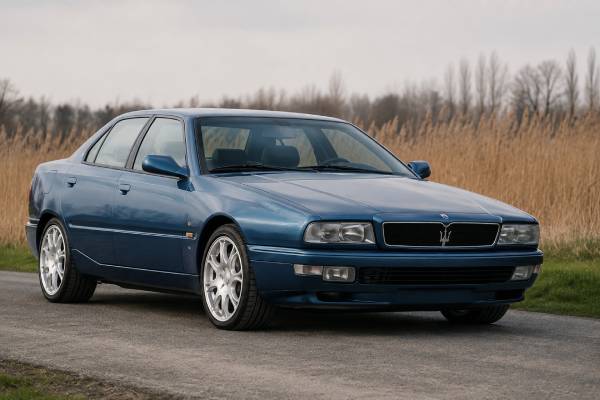
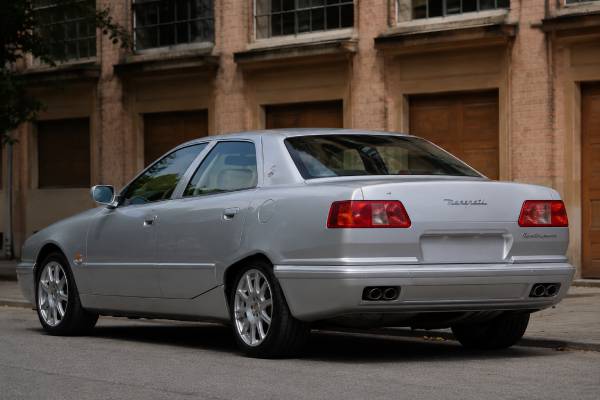
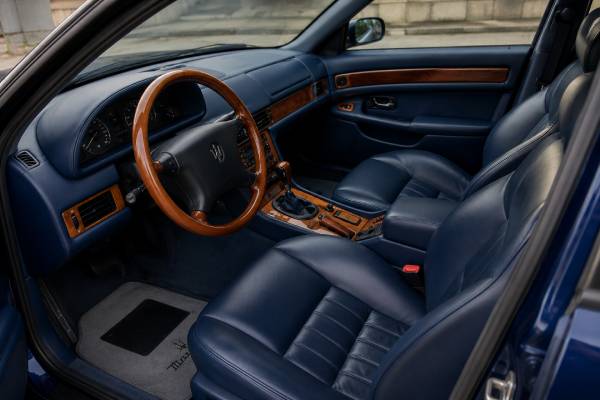
The Maserati Quattroporte Cornes Serie Speciale V6 Evoluzione is one of the final cars built in the AM337 program and one of the rarest factory-recognized Quattroporte IV configurations. Japanese importer Cornes & Co. commissioned a numbered run of 50 Serie Speciale cars at the end of production in 2001. The batch included both V6 and V8 Evoluzione models, and every example used an automatic transmission. The V6 version combines the 2,790 cc AM574 twin-turbo engine, approximately 280 hp, rear-wheel drive, a limited-slip differential, and the electronically controlled four-speed BTR automatic.
Its importance rests less on additional performance than on provenance. A genuine car should have consistent Japanese-market history, special-edition numbering, correct late-production details, and the equipment associated with the Cornes order. Some documented cars also show distinctive C-pillar Trident emblems and a traditional oval dashboard clock retained despite its deletion from standard Evoluzione models. Because the 50-car total covers both engines, the exact V6 share should not be assumed without chassis-level evidence. Buyers must authenticate the individual car and then assess it like any other high-output AM337: timing belt, twin turbos, cooling, fuel delivery, automatic transmission, adjustable dampers, rear subframe, electrics, rust, and scarce trim all matter.
Table of Contents
- The Final Japanese-Market V6 Quattroporte IV
- AM574 Automatic Powertrain and Core Specifications
- Cornes Numbering, Equipment, and Authentication
- Late Evoluzione Engineering with Special-Edition Details
- Driving the V6 Cornes Serie Speciale
- Preserving the Engine, Transmission, and Rare Trim
- Buying and Importing an Authentic Cornes V6
The Final Japanese-Market V6 Quattroporte IV
The Cornes V6 is a closing-chapter car rather than a faster Evoluzione. Its appeal comes from being part of the final numbered 50-car commission, built for Maserati’s long-established Japanese distributor as AM337 production ended.
Cornes & Co. played an important role in representing European luxury and performance brands in Japan. Near the end of Quattroporte IV manufacture, the importer ordered a special run for its customers. These cars were called Cornes Serie Speciale and were individually numbered.
The order included both 2.8-liter V6 and 3.2-liter V8 Evoluzione versions. All used automatic transmissions, a logical choice for the Japanese luxury market and dense urban use. The surviving published record does not establish a universally accepted split between V6 and V8 cars, so an individual seller should not invent a production number for either engine.
Mechanically, the V6 Cornes belongs to the 1998–2001 Evoluzione family. Ferrari had already modernized the Modena factory and revised a large proportion of the AM337’s components. The late cars benefited from improved production control, wiring, trim fit, calibration, and component consistency while retaining the original Gandini body and Biturbo-derived chassis layout.
The AM574 gave the special edition a useful balance. Its 2.8-liter twin-turbo V6 produces less peak torque and drama than the V8 but reduces front-end weight and retains strong mid-range performance. The BTR automatic makes it suited to touring and city driving, provided its fluid, cooling, electrical control, and internal condition are healthy.
The Cornes edition’s collector value depends on proof. A 2001 V6 Evoluzione automatic is not automatically a Serie Speciale. Numbered identification, Japanese documents, Cornes delivery records, original books, labels, and consistent equipment should support the claim.
Some cars have left Japan and now appear in Europe or other markets. Export history can add paperwork, replacement audio equipment, speedometer changes, lighting changes, and underbody exposure. These modifications need to be understood without assuming they erase authenticity.
Because the edition is rare, preservation should be thoughtful. Mechanical updates that protect the engine are sensible; irreversible changes to badges, numbered pieces, interior, wheels, or wiring can reduce historical value. The best examples remain recognizable as the final factory-supported development of the smallest Quattroporte generation.
AM574 Automatic Powertrain and Core Specifications
The Cornes V6 uses the late 2,790 cc AM574: a 90-degree, 24-valve, twin-turbocharged V6 producing approximately 280 hp and 397 Nm. Power passes through the Evoluzione-specification BTR four-speed automatic to a limited-slip rear differential.
| Item | Specification |
|---|---|
| Model code | Tipo AM337 |
| Version | V6 Evoluzione Cornes Serie Speciale |
| Model year | 2001 |
| Engine code | AM574 |
| Engine layout | 90-degree V6, 24 valves, double overhead camshafts |
| Displacement | 2,790 cc |
| Induction | Twin turbochargers with intercooling |
| Fuel system | Electronic multipoint injection |
| Maximum output | Approximately 280 hp at 6,000 rpm |
| Maximum torque | Approximately 397 Nm at 3,500 rpm |
| Transmission | Four-speed electronically controlled BTR automatic |
| Drivetrain | Rear-wheel drive with limited-slip differential |
| Front suspension | MacPherson struts with coil springs |
| Rear suspension | Independent tubular trailing arms on subframe |
| Brakes | Four-wheel ventilated discs with ABS |
| Wheelbase | 2,650 mm |
| Length | Approximately 4,550 mm |
| Width | Approximately 1,810 mm |
| Top speed | Approximately 255 km/h |
| Special-edition production | Part of 50 combined V6 and V8 numbered cars |
The V6 uses separate turbochargers for the cylinder banks and intercoolers to reduce charge temperature. It relies on clean oil, unrestricted oil feeds and returns, intact intake hoses, accurate boost control, strong ignition, and adequate fuel pressure.
The BTR automatic replaced the ZF 4HP22 used in earlier 2.8 automatics. Its torque converter smooths departure and helps the engine move through the off-boost range. Four ratios are fewer than the six available to manual cars, but the V6’s torque peak suits relaxed acceleration.
Transmission health cannot be judged from one gentle drive. The unit should engage Drive and Reverse without a long pause, shift cleanly at light and heavy throttle, respond to kickdown, and remain consistent after full warming. Old fluid, worn seals, valve-body faults, sensors, wiring, and low charging voltage can all affect behavior.
The rear limited-slip differential improves traction. It sits with the independent suspension on a tubular rear subframe. Worn subframe or differential mounts can create clunks and steering effects under power, which may be mistaken for automatic-transmission harshness.
Many late AM337s have four-position adjustable dampers. The system should change firmness without warning lamps. A rare special edition is not exempt from expensive damper wear, leaking seals, damaged wiring, or unavailable original components.
Published performance figures for the automatic are less consistent than the manual, but the car should still feel genuinely rapid. If it is merely adequate, investigate boost leaks, fuel pressure, ignition, restricted exhaust, turbo condition, and transmission slip before accepting age as the explanation.
Cornes Numbering, Equipment, and Authentication
Authentication is the central ownership task. The numbered special-edition identity, Japanese-market records, Cornes provenance, engine and chassis numbers, and distinctive trim should form a continuous and plausible history.
Start with the special-edition number. Inspect the plate or numbered feature for correct material, typography, placement, fasteners, and aging. Compare it with documented cars, but recognize that internet photographs may show restored or altered examples.
Japanese documentation can include registration records, service books, inspection records, auction sheets, dealer stickers, warranty material, and Cornes-branded items. A translated document pack is worth obtaining because it can establish mileage, ownership, accident grading, and service events.
Reported Cornes details include a Trident emblem inserted in the C-pillar and retention of the traditional oval dashboard clock, even though normal Evoluzione cars generally replaced that clock. Blue Sebring Metallic and Quarzo Dolomite Metallic appear frequently among surviving examples, but color alone proves nothing.
Other equipment typically follows late Evoluzione specification:
- Full leather upholstery and extensive wood veneer.
- Automatic climate control.
- Electric seats, windows, and mirrors.
- Anti-lock brakes and a limited-slip differential.
- Electronic adjustable damping on many examples.
- BTR four-speed automatic transmission.
- Japanese-market audio, navigation, alarm, and immobilizer equipment.
Japanese audio or navigation units may no longer function outside their original market. Replacing them can improve usability, but preserve the original hardware when possible. Cutting the dashboard or harness for a modern display is undesirable on a numbered car.
Speedometer markings, radio frequencies, lamps, mirrors, and emissions components may have been changed during export. The quality and reversibility of those changes matter. Poor conversion work can create electrical problems and obscure the original specification.
The exact V6 production count within the 50-car run is not reliably established by broad public data. Any claimed fraction should be backed by a recognized register or factory documentation tied to the chassis. Avoid statements such as “one of only ten” unless the evidence is available.
A replaced engine or transmission needs special scrutiny. It may keep the car usable, but the original-numbered powertrain can matter more on a limited edition. Ask why the replacement occurred, where the original unit is, and whether the work retained correct calibration and equipment.
Late Evoluzione Engineering with Special-Edition Details
The Cornes V6 combines the most mature AM337 production with small market-specific touches. Its engineering remains fundamentally Maserati’s compact twin-turbo saloon layout, not a mechanically unique special edition.
Gandini’s body is only about 4.55 meters long, giving the car a smaller footprint than almost any luxury saloon with comparable speed. The low nose, high rear deck, and slanted rear wheel openings make it visually distinctive without relying on spoilers or aggressive vents.
The steel monocoque provides four doors and a useful trunk. Rear space is adequate rather than generous. For Japanese urban conditions, the narrow body and compact wheelbase were practical advantages compared with larger European flagships.
The Evoluzione program improved the way the body, trim, and wiring were assembled. Door fit, seals, switchgear, electrical routing, and cabin finish can feel more consistent than on early AM337s. Age can still cause leather shrinkage, cracked veneer, sagging headlining, failed seat motors, and brittle plastics.
The engine bay packages two turbos, intercoolers, radiator, condenser, fans, oil lines, fuel lines, and wiring closely. Correct shrouds, undertrays, and heat shields protect both airflow and components. A polished engine bay with missing ducts is less desirable than a complete, lightly aged one.
The automatic selector suits the luxury presentation. The absence of a clutch pedal makes the cabin easier in traffic, while the compact driving position still feels sporting. Visibility is reasonable forward; the high tail and rear pillars require care.
The V6 sound is technical rather than traditionally operatic. At idle, valve gear and exhaust remain subdued. Under boost, turbo whistle and intake rush build around a sharper exhaust note. A loud system may reduce refinement and hide useful diagnostic noises.
Special-edition details should be preserved, but reliability updates can be discreet. Improved relays, correctly rated hoses, modern tires, rebuilt dampers, and specialist-restored electronics may make the car safer without changing its appearance. The goal is to retain the Cornes identity while making every original system function as intended.
Driving the V6 Cornes Serie Speciale
The Cornes V6 is a fast automatic grand tourer with a distinctly 1990s turbo character. It feels more relaxed than a six-speed manual Evoluzione but retains strong mid-range acceleration and compact-chassis responses.
The engine should start promptly from cold and settle into an even idle. Do not use full boost until oil temperature rises. Long storage, common with collector cars, can leave fuel stale, seals dry, batteries weak, and turbo oil supply uncertain.
Initial acceleration is smoothed by the torque converter. The V6 may feel calm before boost, then build a broad surge around the middle of the rev range. Delivery should remain progressive. Hesitation, a sudden cut, pinging, warning lights, or smoke indicates a fault.
Kickdown should be prompt enough to place the engine in a useful range. A four-speed automatic cannot keep the engine on boost as continuously as the manual, but it should not feel sluggish. Transmission flare can mimic turbo lag: engine speed rises, yet road speed does not follow.
The steering is quicker and more communicative than expected from a leather-lined saloon. The V6’s lower mass compared with the V8 helps turn-in. Worn strut mounts, poor alignment, old tires, or rear-subframe movement can make the car wander or react unpredictably to boost.
Adjustable dampers should provide a real difference between comfort and firm settings. A healthy car rides with discipline rather than softness. Oversized wheels and low-profile tires can damage that balance and make the cabin rattle.
Braking should be straight and repeatable. Cars that spent long periods stored can develop corroded discs, seized caliper sliders, aged hoses, contaminated fluid, and ABS-sensor faults. Tire grip is as important as brake hardware.
In city traffic, monitor coolant temperature, fan cycling, charging voltage, climate-control output, and transmission behavior. On the highway, the car should settle into quiet cruising with strong passing performance. A collector car that cannot tolerate traffic is not fully sorted.
The Cornes V6 should not be driven harshly simply because it is rare, nor kept static to preserve mileage. Regular, careful use warms seals, exercises switches, circulates fluids, and exposes developing faults before they become severe. Condition improves through informed operation, not neglect disguised as preservation.
Preserving the Engine, Transmission, and Rare Trim
Maintenance must protect both mechanical function and edition-specific originality. Timing-belt service, turbo and cooling care, automatic-transmission health, electrical stability, rust prevention, and preservation of numbered parts should form one plan.
AM574 timing and turbo systems
An undocumented timing belt is due regardless of low mileage. Replace the specified belt, tensioners, idlers, seals, and related components according to official procedures. A failed belt can damage valves and pistons.
Check hot oil pressure, compression, leak-down, coolant integrity, and crankcase condition. Inspect both turbochargers for shaft play, oil, damaged blades, and equal boost. Pressure-test hoses and intercoolers, and verify wastegate control.
Fuel pressure, injector balance, coils, plugs, sensors, relays, and grounds must remain correct under load. A car can idle perfectly yet run lean or misfire under boost. Avoid nonstandard chips or boost increases without complete documentation.
Cooling and BTR automatic service
Inspect the radiator for leakage or blocked fins and verify every fan speed and relay. Renew aged hoses, thermostat, cap, and coolant with the correct materials. Confirm stable temperature in traffic with the climate system operating.
Assess the BTR fluid for level, color, odor, and debris using the correct procedure. A specialist should diagnose delayed engagement, harsh shifts, flare, or limp behavior before parts are replaced. Electrical supply and sensor faults can produce symptoms similar to internal wear.
Chassis, electrics, body, and trim
Check rear-subframe mounts, differential bushes, trailing arms, front struts, steering joints, wheel bearings, brakes, and damper control. Use matched, appropriately sized tires with recent date codes.
Test the alternator, battery, grounds, fuse boxes, cooling fans, windows, seats, mirrors, locks, lights, climate control, instruments, ABS, immobilizer, and damping system. Japanese-market accessories and later conversions deserve special attention.
Inspect sills, floors, jacking points, arches, door bottoms, glass surrounds, trunk floor, and suspension pickups for rust. Imported cars may have experienced coastal storage, snow, or long outdoor auction periods despite Japan’s reputation for clean vehicles.
Protect numbered plates, C-pillar emblems, original clock, wheels, books, keys, labels, audio equipment, and removed market-specific parts. Photograph and catalog everything before restoration. Refinish leather and wood conservatively so original patterns and colors remain visible.
Preserve all Japanese-market labels, import documents, and numbered-edition accessories.
Buying and Importing an Authentic Cornes V6
The best Cornes V6 is authentic first and mechanically excellent second; both standards are necessary. A special-edition claim without documentation or a documented car with major engine faults should be valued accordingly.
Build an authentication file before negotiating. It should include clear photographs of the numbered identity, chassis and engine numbers, Japanese documents, Cornes materials, special trim, original labels, and any export paperwork. Translate important records.
A specialist inspection should cover:
- Cold start, hot oil pressure, compression, and leak-down.
- Timing-belt date and complete service scope.
- Turbo condition, boost control, and intake pressure testing.
- Fuel pressure and ignition performance under load.
- Radiator, fans, hoses, thermostat, and traffic-temperature stability.
- BTR engagement, shift quality, fluid, and electronic control.
- Rear subframe, differential, dampers, steering, brakes, and tires.
- Charging system, immobilizer, climate control, and all accessories.
- Rust, collision repair, underbody condition, and export conversions.
- Special-edition numbering, trim, books, keys, and provenance.
Road-test the car from cold to fully hot. Confirm that boost builds evenly, the transmission does not flare, steering remains stable, and temperatures do not move in traffic. Test every switch and damper setting more than once.
For an imported car, verify registration eligibility, emissions rules, lighting compliance, speedometer requirements, and parts availability in the destination country. These administrative costs can be significant and should be settled before shipping.
Avoid falsified numbering, unexplained identity differences, missing Japanese history, structural rust, coolant pressurization, low oil pressure, heavy turbo smoke, or a failing automatic. The edition’s rarity cannot compensate for a compromised shell or powertrain.
After purchase, establish a maintenance baseline while preserving removed parts. Renew questionable fluids, verify the timing system, inspect fuel and coolant hoses, test boost and fuel pressure, service brakes, fit correct tires, and record every action.
The V6 Cornes Serie Speciale offers a different kind of rarity from a competition car or high-power derivative. It is a carefully specified farewell to the AM337 for an important market. Its appeal lies in the numbered provenance, late Evoluzione maturity, automatic usability, and the 2.8 twin-turbo engine’s balance. Treated as both a machine and an artifact, it can remain one of the most interesting final-series Maserati saloons.
References
- Quattroporte IV Evoluzione – Quattroporte models | Maserati 2026 (Manufacturer Heritage Specifications)
- Maserati TechInfo 2026 (Manufacturer Technical Information)
- Barr-Tech used cars in Cambridgeshire 2026 (Special-Edition Example)
- Limited editions from Japan part 7 – Yaroslav Bozhdynsky’s Personal Website 2018 (Special-Edition Details)
Disclaimer
This article is for informational purposes only and is not a substitute for professional diagnosis, repair, authentication, import advice, or restoration work. Specifications, torque values, intervals, procedures, and special-edition details vary by VIN, market, equipment, and surviving documentation. Verify all work against official service documentation and authenticate each car with a qualified Maserati specialist.
Please share this article on Facebook, X/Twitter, or your preferred enthusiast community if it was useful. Sharing supports the creation of more detailed specialist-car guides.