
The 2020–2024 Maserati Quattroporte Trofeo is the fastest factory production Quattroporte. Its 3.8-liter F154 twin-turbo V8 produces 580 hp and 730 Nm in European specification, driving the rear wheels through a specially calibrated ZF eight-speed automatic. Maserati claimed 4.5 seconds to 100 km/h and a 326 km/h top speed. The Trofeo also introduced Corsa mode, Launch Control, model-specific Skyhook calibration, 21-inch Orione wheels, large Brembo brakes, carbon-fiber exterior details, Pieno Fiore leather, a 10.1-inch Android Automotive-based MIA screen, and expanded active driver assistance. It replaced the 530 hp GTS as the M156 flagship and remained the most extreme sedan in the range through the final model years. That performance brings ownership responsibilities: cooling, turbo and ignition health, premium tires, brake measurements, battery condition, software, camera and radar calibration, and proof of careful launch-control use all matter. A well-preserved Trofeo is a rare end-of-era V8 super-sedan. A poorly maintained example can require expensive work across engine, transmission, chassis, electronics, and edition-specific trim at the same time.
Table of Contents
- The Fastest Quattroporte
- 580 hp V8 and Trofeo Hardware
- Launch Specification and Late Production
- Corsa Mode, Carbon, and MIA
- Driving a 326 km/h Sedan
- Trofeo Maintenance and Cost Drivers
- Buying the Final V8 Flagship
The Fastest Quattroporte
The Trofeo is the M156’s final performance statement: 580 hp, rear-wheel drive, launch control, and a 326 km/h maximum in a full-size four-door body. It is more than a renamed GTS.
Maserati announced the Quattroporte Trofeo in August 2020 as part of a complete Trofeo collection. The Levante had introduced the name first, and the Ghibli received a V8 for the first time. The Quattroporte already had V8 history, but its 530 hp GTS was discontinued as the stronger Trofeo arrived.
The F154 engine was developed from the GTS and Levante Trofeo family. For the sedan, Maserati calibrated the 3,799 cc V8 to 580 hp at 6,750 rpm and 730 Nm from roughly 2,250 to 5,250 rpm. Rear-wheel drive was retained, unlike the all-wheel-drive Levante Trofeo.
The performance target was explicit. Both Ghibli and Quattroporte Trofeo were presented as the fastest production Maserati sedans, each capable of 326 km/h. The Quattroporte’s longer, heavier body gave it a 4.5-second 0–100 km/h claim, still quicker than the outgoing GTS.
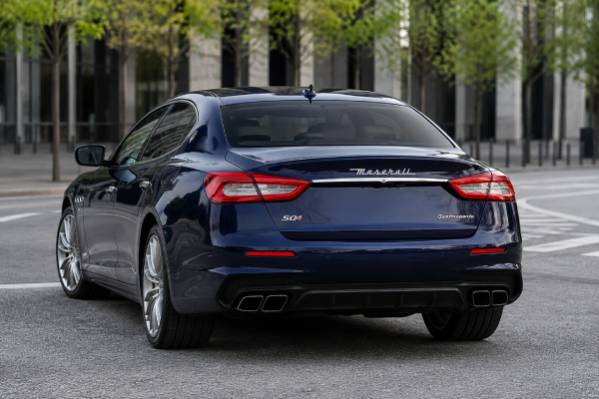
The model also arrived with the MY21 technology refresh. A 10.1-inch MIA interface replaced the smaller screen, connected services expanded, and active assistance could operate on a broader range of suitable roads. New boomerang-style rear lamps and updated brand graphics refreshed the body.
From MY22, Maserati organized the range around GT, Modena, and Trofeo trims. Trofeo remained the top specification, with carbon fiber, 21-inch wheels, red detailing, and full-grain leather reinforcing its position. Power figures may appear as 572 hp or similar in markets using SAE conversions, but the assignment’s 580 hp rating is the European metric specification.
The Trofeo’s significance increased as the M156 approached the end of production. It became one of the last Maserati sedans powered by a Ferrari-associated V8 and the ultimate expression of the sixth-generation Quattroporte. That makes originality, complete records, and condition increasingly important.
580 hp V8 and Trofeo Hardware
The Trofeo pairs a 3.8-liter twin-turbo V8 and 730 Nm with an eight-speed automatic, rear-wheel drive, a limited-slip differential, specific adaptive damping, and brakes sized for repeated high-speed deceleration.
| Item | Specification |
|---|---|
| Generation | M156 Trofeo |
| Engine family | F154 |
| Engine type | 90-degree twin-turbocharged V8, direct injection |
| Displacement | 3,799 cc |
| Maximum power | 580 hp at approximately 6,750 rpm |
| Peak torque | 730 Nm at approximately 2,250–5,250 rpm |
| Transmission | Eight-speed ZF automatic with Trofeo calibration |
| Drivetrain | Rear-wheel drive |
| Differential | Mechanical limited-slip |
| Drive modes | I.C.E., Normal, Sport, and Corsa |
| Launch Control | Available in Corsa under defined conditions |
| Front suspension | Double wishbone with Trofeo-calibrated Skyhook dampers |
| Rear suspension | Five-link with Trofeo-calibrated Skyhook dampers |
| Steering | Electric power assistance |
| Wheels | 21-inch Orione forged aluminum |
| Length | 5,262 mm |
| Wheelbase | 3,171 mm |
| Width without mirrors | 1,948 mm |
| Height | 1,481 mm |
| Trunk capacity | 530 liters |
| Fuel capacity | 80 liters |
| Claimed 0–100 km/h | 4.5 seconds |
| Claimed top speed | 326 km/h |
The V8 uses two small parallel twin-scroll turbochargers, one for each cylinder bank, and separate air-to-air intercoolers. High-tumble cylinder heads, four cam phasers, direct injection, and electronic control give the engine strong torque from low speed and continued power near the top of the range.
Compared with the 530 hp GTS, the Trofeo gains 50 hp and 20 Nm, but calibration and controls matter as much as peak output. The transmission receives specific software and hardware adaptation to handle the higher torque and faster shifts in Corsa mode.
Corsa is more aggressive than Sport. It sharpens throttle response, opens the exhaust valves, commands the quickest shifts, firms the adaptive dampers, and reduces stability and traction intervention. It is intended for skilled use in appropriate conditions, not as a default road setting.
Launch Control requires the engine and systems to be within defined limits. The coolant and oil must be warm, no relevant faults can be present, the car must have completed its initial mileage requirement, the steering must be straight, the driver’s door must be closed, and the seat belt must be fastened. The system’s safeguards do not eliminate mechanical stress.
The limited-slip differential manages rear-axle torque, while Integrated Vehicle Control uses predictive engine and brake intervention. The combination allows the car to deploy substantial power without all-wheel drive, but tire temperature and condition remain decisive.
The brake system uses large ventilated components and multi-piston calipers. Exact dimensions can vary by market documentation, but the hardware is expensive enough that disc thickness, runout, pad life, and caliper condition should always be measured.
Launch Specification and Late Production
Trofeo identity is visible in specific exterior, cabin, and electronic details. Because ordinary Quattroportes can be modified to look similar, the VIN and factory build record remain the final proof.
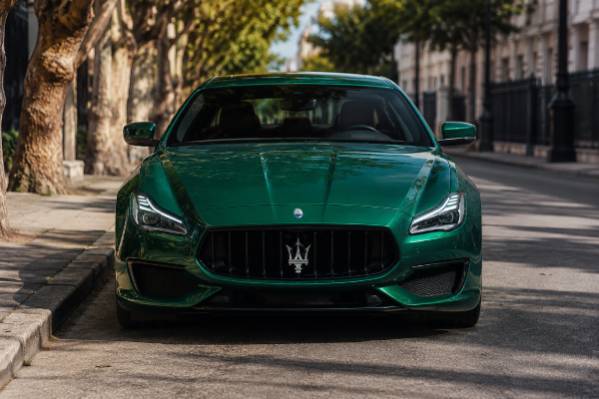
At launch, the Quattroporte Trofeo used a grille with twin vertical bars in Black Piano finish. Carbon fiber appears on the lower splitter, front air-intake blades, and rear extractor. Red accents highlight the side vents and Trofeo badging, while a small Italian flag marks the B-pillar.
The side skirt is black, the rear Maserati badge is burnished chrome, and the 21-inch Orione forged wheels give the long sedan a distinct stance. Brake calipers were offered in several colors. A replacement wheel must match correct dimensions, offset, load rating, and brake clearance.
The MY21 boomerang rear lamps use a three-color lens treatment inspired by earlier Maserati designs. The front grille and updated logos were part of a broader range refresh. These details can help date a car, but replacement parts and retrofits make documentation more reliable.
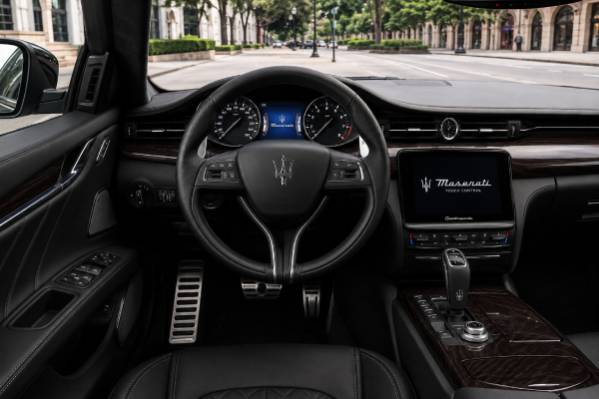
Inside, Trofeo headrests carry three-dimensional branding, and Pieno Fiore full-grain leather is central to the specification. Carbon-fiber trim, sport seats, a model-specific start-up graphic, and a revised center console reinforce the performance theme.
The 10.1-inch MIA display uses an Android Automotive foundation and supports connected services, navigation, personalization, Apple CarPlay, and Android Auto. Screen resolution and response improve substantially over the older 8.4-inch system. Wireless charging and regional connected features vary.
From MY22, the Trofeo badge above the side vents became part of Maserati’s new three-trim strategy. New hood and C-pillar logos and updated rear lettering appeared across the line. Later cars may have market-specific equipment changes, but the 580 hp mechanical identity remained.
Production totals are not always published consistently by market, and 2024 registrations may include cars built earlier. A final-year claim should be checked through the VIN, build date, original invoice, and homologation information. Rarity should not be asserted from registration alone.
Factory color, trim, wheel, brake, and assistance options affect desirability. An unusual Fuoriserie specification can add appeal when documented. A repainted or retrimmed car should be valued for quality and transparency rather than assumed to be a special order.
Corsa Mode, Carbon, and MIA
The Trofeo’s engineering distinction comes from the interaction of high-output hardware, Corsa calibration, aerodynamic detail, adaptive control, and a newer digital cabin. None of these elements works well in isolation.
The long M156 body has a drag coefficient near 0.28 in Trofeo form, according to launch material. Carbon appendages manage local airflow and visually lower the car without resorting to a large rear wing. The 326 km/h capability demands stable lift balance and precise underbody condition.
Damage to front splitters, undertrays, brake ducts, or rear diffuser pieces should not be treated as cosmetic only. Missing panels can alter airflow and expose components. Carbon repair quality varies, and original replacement pieces can be expensive.
The active Air Shutter behind the grille works with the cooling package. It closes when drag reduction is beneficial and opens under thermal demand. The V8’s two intercoolers sit low and receive dedicated airflow. Debris, bent fins, collision damage, or a failed shutter can reduce heat rejection.
Skyhook uses body and wheel acceleration sensors to adjust each damper. In its default setting, the car remains comfortable enough for luxury use. The suspension button and Corsa mode progressively increase control. A leaking or weak damper can upset this carefully calibrated range.
Integrated Vehicle Control predicts instability and adjusts torque or brakes earlier than a conventional reactive system. In Corsa, intervention is reduced, not absent. A driver should understand that the car can still exceed tire grip quickly with 730 Nm at the rear axle.
The MIA system centralizes many settings. Its connected features depend on account status, cellular support, region, subscription, and software. A used car may need ownership transfer or reactivation. Test navigation, phone pairing, cameras, audio, charging, voice functions, and vehicle menus.
Active Driving Assist, Lane Keeping Assist, adaptive cruise, blind-spot intervention, traffic-sign recognition, and surround-view cameras depend on radar, camera, ultrasonic sensors, steering, and precise alignment. Windshield or bumper work should be followed by documented calibration.
Driving a 326 km/h Sedan
The Trofeo feels less like a tuned limousine and more like a long-wheelbase super-sedan. Its speed arrives through a dense, continuous surge, yet Normal and I.C.E. modes keep it manageable in everyday traffic.
In I.C.E. mode, throttle response is gentle, overboost is restricted, and exhaust behavior stays quieter. The setting is useful on low-grip surfaces and when passengers value smoothness. Normal mode provides stronger response without the intensity of Sport.
Sport opens the exhaust more readily, holds gears, and sharpens the drivetrain. Corsa goes further, producing the quickest shifts and firmest damping. The change is obvious even at moderate speed. Corsa also leaves less electronic margin, so warm tires and a dry, open road are essential.
Launch Control can produce a repeatable start when conditions are met. It should be used sparingly. Each launch loads the torque converter, transmission, differential, mounts, rear tires, and half-shafts. Diagnostic counters or thermal history may not provide a complete record of prior use, so physical condition and seller transparency matter.
At rolling speeds, the Trofeo’s advantage over the GTS becomes more apparent. The engine continues pulling hard beyond ordinary motorway pace. The 326 km/h figure is a statement of engineering capability, not a target for public roads.
Electric steering is accurate and stable. It filters some road texture but supports active safety and remains consistent under load. The car’s length creates calm high-speed behavior, while the rear-drive layout gives the front axle a clean response.
Twenty-one-inch tires provide immediate turn-in and high load capacity but need temperature. Cold, old, or mismatched rubber can make the car nervous. Tire date, construction, speed rating, and manufacturer approval matter as much as tread depth.
The Trofeo’s ride is firm but not punishing on smooth roads. Broken surfaces can produce sharp impacts, and forged wheels are not immune to bending. A repeated bounce or corner-to-corner inconsistency suggests damper or bushing trouble.
Brakes should remain firm after several controlled stops. Vibration when hot can reveal disc runout or deposits. A car used for track days may show heat discoloration, cracked drilled surfaces, cooked fluid, worn outer tire shoulders, and damaged underbody panels.
Trofeo Maintenance and Cost Drivers
Trofeo ownership is governed by heat and load. The V8, transmission, rear axle, brakes, tires, cooling package, and electronics all operate closer to high-performance limits than in a 350 hp Quattroporte.
Engine, turbochargers, and cooling
Begin every inspection from cold. Listen for sustained rattle, misfire, belt noise, exhaust leakage, and turbo-related whine. Watch for smoke after start-up and after idling. Full-load acceleration should remain clean without a flashing warning or boost interruption.
Inspect oil seepage around cam covers, timing-cover joints, turbo feed and return lines, and the lower engine. The correct oil specification and annual replacement are essential. Track use or repeated high-temperature operation may justify more conservative intervals based on specialist advice.
Pressure-test the cooling system. Examine the expansion tank, cap, hoses, pump, thermostat, radiator stack, intercoolers, fans, and Air Shutter. Clean heat exchangers carefully; high-pressure washing can bend fins and force debris deeper.
Spark plugs and coils work under severe cylinder pressure. Misfire can also come from injectors, fuel pumps, sensors, intake leaks, or compression. Diagnose with cylinder counters, rail pressure, lambda data, boost request, and leak testing.
Turbo health should be evaluated through boost data, noise, oil consumption, and charge plumbing. After hard driving, a gentle cool-down period reduces concentrated heat. It does not replace clean oil or sound coolant circulation.
Transmission, differential, brakes, and tires
The ZF automatic should engage promptly and shift smoothly in Normal, firmly but cleanly in Sport, and rapidly without a bang in Corsa. Fluid and filter service must follow correct temperature and filling procedures. Repeated launch use increases the value of documented inspection.
Check engine and transmission mounts, propeller shaft, couplings, differential seals, and rear half-shafts. Clunks during throttle changes can travel through several components. Metal debris, whine, or persistent shudder requires specialist diagnosis.
Measure all brake components. Large discs and high-performance pads can be costly, and a dashboard estimate is not enough. Inspect caliper seals, hoses, parking-brake operation, and fluid condition.
Examine each forged wheel inside and out. Use four matched premium tires with correct load and speed ratings. Replace by condition and age, not tread alone. A 326 km/h homologation leaves no room for unknown low-cost tires.
Battery, MIA, and active systems
Load-test the battery and verify charging output. Low voltage can create faults in EPS, ADAS, transmission, suspension, parking brake, MIA, and body modules. Use a quality maintainer during storage.
Scan all modules before and after the road test. Confirm camera and radar calibration, MIA updates, connected-service status, headlight operation, seat functions, climate zones, windows, soft-close doors, and all assistance features.
Recall and campaign status varies by VIN and country. Verify it through official channels. Keep software and calibration invoices because they help distinguish a repaired car from one that merely had warnings cleared.
Buying the Final V8 Flagship
Buy a Trofeo only after confirming factory identity, originality, complete service history, and the condition of every high-cost system. A bargain price is rarely enough to absorb engine, brake, tire, carbon, and electronic work together.
Request the VIN, build sheet, original invoice, service invoices, diagnostic records, tire and brake history, collision details, and documentation for any tune or exhaust modification. Confirm 580 hp market specification and model-year equipment.
| Area | Strong evidence | Major concern |
|---|---|---|
| Identity | VIN-linked factory Trofeo build and original trim | GTS conversion, uncertain output, or cosmetic replica |
| V8 | Clean cold start, even boost, no smoke or misfire | Oil odor, reduced power, catalyst faults, coolant loss |
| Transmission | Clean shifts in every mode and documented service | Flare, harsh engagement, repeated launch abuse |
| Brakes and tires | Measured brakes and recent matched premium tires | Cracked discs, old rubber, bent forged wheels |
| Carbon and body | Original undamaged pieces and measured repair history | Missing undertrays, poor carbon repair, structural damage |
| Electronics | Healthy battery, clean scan, calibrated ADAS | Network faults, disabled aids, MIA or camera failures |
| History | Annual specialist invoices and transparent use | Long gaps, undocumented tune, recently cleared codes |
The pre-purchase inspection should take place at a Maserati specialist with factory-level tools. Start cold, remove undertrays as needed, inspect the radiator and intercooler stack, check turbo and fluid lines, measure brakes and tires, and drive long enough to test every mode after warm-up.
Ask directly about track days, launch control, tuning, and top-speed events. Honest use with excellent maintenance may be preferable to a low-mileage car whose history is concealed. Look for heat effects on brakes, tires, fluids, underbody panels, and exhaust components.
Avoid repeated overheating, heavy smoke, persistent misfire, structural repair, metal in fluids, severe transmission shudder, or multiple inaccessible modules. Edition-specific carbon and interior repairs should also influence price because parts can be scarce.
Set aside a large reserve even after a clean inspection. Tires, brakes, battery, fluids, plugs, wheel repair, adaptive dampers, cooling components, and software can coincide. A service plan or extended warranty may have value when transferable and applicable.
The ideal Trofeo buyer wants a final-generation V8 Maserati sedan, has secure storage, and accepts specialist-level costs. In return, the car offers exceptional speed, real luxury space, rear-drive character, and historical importance as the fastest Quattroporte built.
References
- Trofeo collection 2020
- Trofeo: The most powerful Maserati collection ever 2020
- Maserati Quattroporte MY22: GT, Modena and Trofeo 2021
- Maserati Guides & Documentation for your vehicle 2026 (Owner’s Manual Portal)
Disclaimer
This article is for informational purposes only and is not a substitute for professional diagnosis, inspection, maintenance, or repair. Specifications, torque values, service intervals, procedures, software requirements, and equipment can vary by VIN, production date, market, and configuration. Before buying, servicing, or modifying any vehicle, verify the relevant details against its official service documentation and consult a qualified Maserati specialist when necessary.
Please share this article on Facebook, X/Twitter, or another platform to support our work and help other owners and enthusiasts find it.