
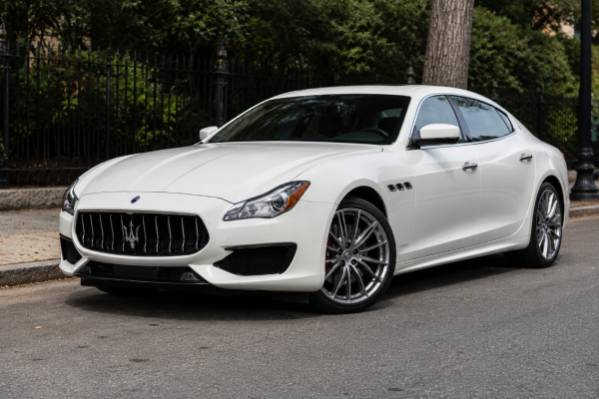
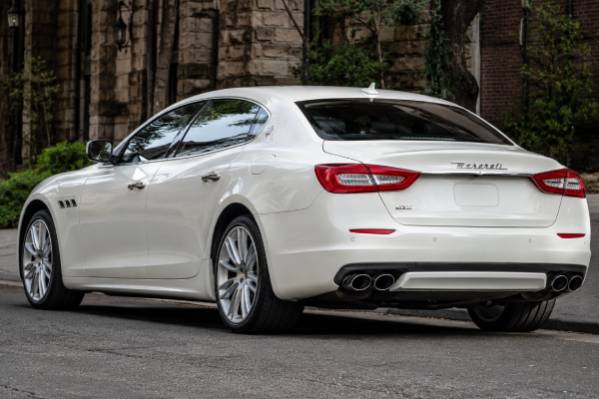
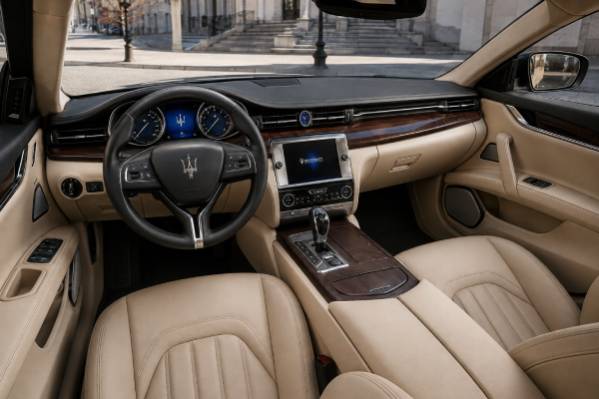
The 2013–2020 Maserati Quattroporte GTS is the original V8 flagship of the M156 generation. Its 3.8-liter F154 twin-turbo engine produces 530 hp and up to 710 Nm, driving the rear wheels through a ZF eight-speed automatic. Factory figures of 4.7 seconds to 100 km/h and 307–310 km/h placed it among the fastest luxury sedans of its era, yet its appeal also comes from Italian styling, a long 3,171 mm wheelbase, adaptive Skyhook suspension, and a richly trimmed cabin. The production span covers meaningful changes: the 2017 facelift revised the body, aerodynamics, infotainment, and trim strategy, while 2018-on cars moved from hydraulic to electric power steering and gained more active driver-assistance capability. Used values can make the GTS look deceptively accessible. Running costs still reflect a 530 hp, 300 km/h flagship with large Brembo brakes, wide tires, twin turbochargers, complex cooling, adaptive dampers, and many control modules. The right example has stable temperatures, clean boost, smooth shifts, straight wheels, recent matched tires, full diagnostic health, and detailed annual service records.
Table of Contents
- The First Turbo V8 Quattroporte
- F154 Power and Flagship Chassis
- Evolution from Launch to 2020
- V8 Packaging, Aero, and Cabin
- Performance Beyond the Numbers
- Maintaining the 530 hp GTS
- Buying the Right V8 Flagship
The First Turbo V8 Quattroporte
The GTS transformed the Quattroporte from a naturally aspirated sports sedan into a twin-turbo, 300 km/h flagship. It kept rear-wheel drive and a strong driver focus while adding far more torque, cabin space, and modern technology.
The M156 arrived for 2013 as Maserati expanded beyond low-volume niche production. Its body was longer and roomier than the M139, with a full-size rear compartment and 530-liter trunk. Aluminum panels and suspension components limited weight growth, while a new engine family and eight-speed transmission improved performance and efficiency.
At the top sat the GTS. Its F154 V8 was developed for Maserati and assembled in Maranello. Two turbochargers, direct injection, variable valve timing, and an overboost strategy produced 530 hp and as much as 710 Nm. The previous 4.7-liter V8 needed revs to make its best performance; the 3.8 delivered an immediate wall of mid-range torque.
Maserati chose rear-wheel drive only for the GTS. Q4 all-wheel drive was paired with the V6, not the early Quattroporte V8. This decision preserved a simpler, lighter front axle and a traditional flagship layout, though it placed heavy demands on the rear tires and stability system.
The GTS was not a stripped performance derivative. It remained the most luxurious version, available with fine leather, wood, carbon fiber, rear comfort features, premium audio, and extensive personalization. The Zegna Limited Edition used the same mechanical base, showing how the GTS could support both performance and design-led special editions.
Its role changed near the end of the decade. The 580 hp Trofeo was announced in 2020 as the faster, more overtly sporting top model. That makes the GTS the bridge between the launch-era M156 and the later Trofeo: less extreme, more discreet, and available across most of the generation.
Today, the GTS attracts buyers who want a Ferrari-associated Maserati V8 without supercar packaging. Depreciation makes purchase possible, but restoration by deferred maintenance is rarely economical. A strong history and specialist inspection matter more than the difference between two advertised prices.
F154 Power and Flagship Chassis
The GTS combines a 3,799 cc twin-turbo V8, 530 hp, 710 Nm overboost torque, an eight-speed automatic, rear-wheel drive, adaptive dampers, and the largest brake package in the early M156 range.
| Item | Specification |
|---|---|
| Generation | M156 |
| Engine family | F154 |
| Configuration | 90-degree twin-turbocharged V8, direct injection |
| Displacement | 3,799 cc |
| Bore × stroke | 86.5 × 80.8 mm |
| Maximum power | 530 hp at approximately 6,500–6,800 rpm |
| Peak torque | 650 Nm normally; up to 710 Nm in overboost |
| Transmission | Eight-speed ZF automatic |
| Drivetrain | Rear-wheel drive with limited-slip differential |
| Front suspension | Double wishbone with Skyhook adaptive dampers |
| Rear suspension | Five-link with Skyhook adaptive dampers |
| Front brakes | 380 mm dual-cast ventilated discs, six-piston Brembo calipers on later specification |
| Rear brakes | 345 mm ventilated discs with fixed calipers on flagship specification |
| Length | 5,262 mm |
| Wheelbase | 3,171 mm |
| Width without mirrors | 1,948 mm |
| Height | 1,481 mm |
| Luggage capacity | 530 liters |
| Fuel capacity | 80 liters |
| Claimed 0–100 km/h | 4.7 seconds |
| Claimed top speed | 307–310 km/h, depending on model year |
The F154 uses a compact bore and short stroke, four overhead camshafts, continuously variable timing, direct injection, and two turbochargers. Overboost allows the higher 710 Nm figure in defined operating conditions. Normal peak torque is lower, which protects the driveline and manages traction.
The engine’s character changes across its range. It is quiet and strong below 3,000 rpm, with enough torque to move the car without drama. In the middle range, acceleration becomes intense. Near the top, the V8 continues to build power rather than fading like a purely low-rev turbo engine.
The ZF automatic has ratios wide enough for both a hard launch and relaxed cruising. It uses a torque converter, which suits smooth luxury operation. Sport mode modifies throttle, shift timing, exhaust valves, and chassis response. Manual commands come through fixed column paddles.
Rear-wheel drive and the limited-slip differential give the GTS a clear mechanical balance. The stability system manages torque when grip is limited, but tire quality remains fundamental. On old or mismatched rear tires, the car can trigger intervention even in moderate conditions.
The suspension layout is shared broadly with other M156 versions, but calibration and wheel packages support the V8’s greater speed. Skyhook adjusts each damper electronically. Large brakes provide the thermal capacity required by the car’s mass and performance, though discs and pads are expensive consumables.
Early cars use hydraulic steering. From the 2018 model year, electric power steering enabled active lane assistance and new control functions. The two systems feel different and should be considered part of model selection, not simply as an upgrade from old to new.
Evolution from Launch to 2020
The GTS changed most in 2017 and 2018. Output remained 530 hp, but the car gained revised styling, a better infotainment interface, new trim themes, electric steering, and more advanced driver aids.
The 2013–2016 cars have the original M156 nose, rear bumper, console, and touchscreen generation. Their hydraulic steering is valued for natural weighting and direct road information. Early build cars may also show more software updates and trim corrections in their history, so evidence of dealer campaigns is useful.
For 2017, Maserati reshaped the grille and bumpers and introduced an active Air Shutter. The aerodynamic changes reduced drag by roughly ten percent across the restyled range. The center console gained a rotary controller, and the 8.4-inch screen became capacitive with Apple CarPlay and Android Auto.
GranLusso and GranSport became the two principal design directions. GranLusso emphasized formal luxury with premium leather or available Zegna silk, wood, chrome, and comfort-oriented details. GranSport added a more aggressive bumper treatment, sport seats, darker accents, and carbon-fiber availability. Both could be fitted to a GTS depending on market.
For 2018, electric power steering replaced the hydraulic system. The change supported Lane Keeping Assist, Active Blind Spot Assist, Highway Assist, and other active functions that can apply steering torque. Integrated Vehicle Control also used predictive intervention through engine and brakes to improve stability.
Later cars could receive adaptive full-LED lighting, surround-view cameras, traffic-sign recognition, and expanded assistance packages. These features improve usability when calibrated and functioning, but collision repairs, windshield replacement, battery problems, or software faults can disable them.
Nerissimo packages and other appearance combinations introduced black exterior trim, dark wheels, and specific cabin choices. Verify that a claimed package matches the factory build rather than a collection of later black-painted parts.
Wheel sizes and brake details evolved with market and trim. Twenty-inch wheels are common on GTS cars, with 21-inch options adding visual impact. Inspect exact wheel part numbers, offsets, tire sizes, and brake clearance before accepting an aftermarket set.
By 2020, the GTS was near the end of its role. Production and registration dates can overlap with the introduction of Trofeo branding in different markets. A late GTS remains a 530 hp car unless factory records state otherwise; badges and ECU claims do not make it a Trofeo.
V8 Packaging, Aero, and Cabin
The GTS hides serious thermal and mechanical demands beneath an elegant body. Its design works because cooling, aerodynamics, cabin packaging, and performance hardware are integrated rather than displayed as separate add-ons.
The long hood, three fender vents, frameless glass, and rearward cabin create classic rear-drive proportions. The grille feeds a dense stack of cooling equipment. Twin turbochargers, engine coolant, charge air, transmission fluid, air conditioning, and engine oil all depend on clean airflow.
The 2017 active Air Shutter can close at lower cooling demand to reduce drag, then open when temperature or load requires more airflow. A shutter fault can affect warning messages, warm-up, cooling, or efficiency. Inspect operation and stored codes rather than assuming fixed-open blades are harmless.
Aluminum is used for the hood, doors, trunk lid, front subframe, and suspension pieces. This controls weight and helps balance, but it changes repair methods. Improperly repaired aluminum can suffer distortion, galvanic corrosion, weak joints, or paint problems. A high-quality body inspection should include structure and fasteners, not only surface gloss.
The V8 sits longitudinally behind the front axle line as far as the architecture allows. The conventional front-mounted gearbox differs from the older M139 transaxle. This packaging creates more rear cabin room and simplifies the eight-speed installation, while chassis tuning and the rear differential preserve a driver-focused balance.
Inside, broad leather surfaces, an analog clock, conventional gauges, and metal paddles create a richer atmosphere than many digital-first rivals. Rear space is generous. Options such as power rear seats, four-zone climate control, entertainment screens, premium audio, soft-close doors, and sunshades can make the car a true chauffeur sedan.
Every luxury feature is also a test item. Check all seat motors, memory, heating, ventilation, climate outlets, screens, shades, windows, glass indexing, locks, soft-close mechanisms, cameras, and audio channels. Water leaks around doors, sunroof drains, or trunk seals can damage trim and modules.
The exhaust uses valves to keep normal driving restrained and to release a deeper note in Sport mode. Turbochargers soften the sharp metallic sound of the old 4.7, but the GTS produces a dense bass and harder upper-range roar. Failed valve actuators or vacuum lines can leave one side operating differently.
Performance Beyond the Numbers
The GTS feels defined by effortless torque rather than by a dramatic launch alone. Its strongest performance is the speed it can add from ordinary road velocities while remaining composed and quiet.
Normal mode makes the throttle progressive and lets the gearbox seek high ratios. The car can move through a city without feeling nervous, though its length and width require attention. A light pedal is enough because useful torque arrives early.
Sport mode reveals the other side. Downshifts occur sooner, ratios stay engaged longer, the exhaust opens, and the damping strategy becomes firmer. The fixed paddles are easy to find in a corner, and the transmission responds quickly for a torque-converter unit.
A factory 4.7-second run to 100 km/h depends on warm performance tires and a clean launch. Rear drive means the first meters are traction-limited compared with an S Q4 on a poor surface. Once moving, the V8’s power becomes dominant. Acceleration above highway speed remains the GTS’s signature.
Early hydraulic-steering cars provide heavier, more organic feedback. Later electric-steering cars are lighter at parking speed and support active assistance. Neither is automatically superior. Buyers who prioritize road feel may prefer early cars; those who want lane-centering functions and newer electronics may prefer 2018–2020.
The chassis is stable and progressive. It resists roll well for its size, but physics remains obvious during rapid transitions. Smooth braking and measured steering inputs produce the best result. Sudden direction changes load the outside tires heavily and can expose weak dampers or old bushings.
Ride quality is good on smooth roads and can be brittle over sharp urban damage, especially with 21-inch wheels. Correct pressures and tire construction matter. A tire chosen only for price can add noise, reduce steering precision, and weaken wet braking.
The large Brembo system should deliver a firm, consistent pedal. Brake vibration after several stops may reveal runout or deposits that are absent when cold. Track use is possible, but the car’s mass quickly consumes tires, pads, and fluid. It is better suited to rapid grand touring than repeated circuit sessions.
At motorway speed, the GTS feels settled and quiet. Passing requires little planning. Its 80-liter tank is useful, but sustained boost can reduce range quickly. Wind noise from frameless glass should remain controlled; a whistle often indicates window or seal adjustment.
Maintaining the 530 hp GTS
The GTS needs preventive care around heat, lubrication, ignition, cooling, brakes, tires, and voltage. Waiting for a warning light can turn a manageable service item into collateral damage.
V8, turbochargers, and cooling
Start from cold and listen for prolonged mechanical rattle, uneven firing, belt noise, or exhaust leaks. Watch for smoke after start-up and after a long idle. Full-load acceleration should be smooth, with stable boost and no flashing engine warning.
Oil leaks can develop around cam covers, timing-cover joints, turbo feed and return lines, and lower engine seals. Oil on hot exhaust or turbo components creates odor and risk. The approved oil specification and annual change interval are important even at low mileage.
Inspect the expansion tank, cap, hoses, thermostat, water pump, radiators, charge-air coolers, and connections. Debris often collects between stacked heat exchangers. Pressure-test any coolant loss and confirm fan operation. A car that runs warm only in traffic may have airflow, fan, or radiator-efficiency issues.
Spark plugs and coils endure high cylinder pressure. Misfires under boost require prompt diagnosis because unburned fuel can damage catalysts. Injectors, high-pressure pumps, sensors, intake leaks, and compression should be considered before replacing parts at random.
Turbochargers should build boost without siren noise, smoke, or excess oil consumption. Inspect related hoses and control lines. After high-load driving, a short gentle period helps reduce concentrated heat, although modern oil and coolant circulation remain the primary protection.
Transmission, differential, suspension, and brakes
The eight-speed automatic is durable when serviced and not abused. Check for delayed selection, harsh engagement, flare, converter shudder, and leaks. Fluid and filter replacement must use correct parts, temperature, and level procedure. It cannot reverse internal wear.
Inspect the limited-slip differential, propeller shaft, couplings, and mounts for leaks, noise, or load-sensitive vibration. Rear tires should be closely matched in model, tread, and pressure. Excessive wheelspin places extra heat into the tires and differential.
Skyhook dampers can leak or lose control with age. Check front arms, rear links, ball joints, wheel bearings, and anti-roll-bar components. Straight wheels and correct alignment are essential before judging steering behavior.
Measure disc thickness and runout. Inspect pads, caliper boots, hoses, and the parking-brake system. Flagship dual-cast discs are costly, so a seller’s claim of “plenty of brake left” should be supported by numbers.
Electrical systems and late-model technology
A correct, fully charged battery prevents many network faults. Test reserve capacity and alternator output. Low voltage can trigger messages from transmission, suspension, steering, parking brake, infotainment, and driver aids.
Scan every module before and after the road test. On later cars, test EPS, adaptive cruise, lane keeping, blind-spot intervention, surround-view cameras, traffic-sign recognition, and headlight functions. Sensor alignment after body or glass work must be documented.
Software updates, recall work, and service campaigns vary by VIN and country. Verify status through official channels. Keep diagnostic reports because they establish a baseline and can show whether faults return after clearing.
Buying the Right V8 Flagship
Buy a GTS for condition and history, then choose model year and trim. A neglected late car with active safety features is usually a worse purchase than a thoroughly maintained early hydraulic-steering example.
Request the VIN, build sheet, original invoice, service invoices, recall status, diagnostic records, tire history, and details of any collision or tuning. Confirm that the car is a factory 530 hp GTS and not a V6 with cosmetic parts or a GTS advertised as a Trofeo.
| Area | What supports purchase | Major warning |
|---|---|---|
| Cooling | Stable temperature, clean pressure test, clear heat exchangers | Coolant loss, staining, fan faults, repeated overheating |
| V8 and turbos | Clean cold start, even boost, no smoke or misfire | Oil odor, blue smoke, reduced power, catalyst faults |
| Transmission | Prompt engagement and smooth hot shifts | Flare, shudder, harsh selection, fluid leak |
| Brakes and tires | Measured discs and recent matched premium tires | Old mixed tires, cracked wheels, worn flagship brakes |
| Suspension | Dry dampers, quiet joints, correct ride height | Leaks, knocking, uneven stance, inner-tire wear |
| Electronics | Strong battery and clean full-system scan | Multiple communication faults or disabled ADAS |
| Provenance | Annual specialist invoices and documented campaigns | Long gaps, unexplained tune, or vague repair history |
The pre-purchase inspection should begin with a cold engine and continue until the car is fully warm. Remove undertrays as needed, inspect turbo and cooling plumbing, measure brakes, examine inner wheel barrels, and read module history. A short drive around a dealer block is not enough.
Choose early versus late based on priorities. The 2013–2016 cars offer the original design and hydraulic steering. The 2017 facelift brings better infotainment and styling revisions. The 2018–2020 cars add EPS, active assistance, and later software. More equipment means more capability and more items to test.
Avoid unexplained overheating, persistent misfire, structural damage, heavy smoke, metal in fluids, severe brake neglect, or repeated electronic communication failures. Also be cautious with aggressive engine tunes. Extra boost raises thermal and driveline loads and may complicate emissions readiness or warranty history.
Budget a substantial reserve. Four premium tires, front and rear brakes, adaptive dampers, cooling work, plugs, fluids, battery, and wheel repair can overlap. Paying more for documented recent work is often cheaper than buying the least expensive car.
A properly sorted GTS offers a rare combination: rear-drive V8 performance, real rear-seat space, understated styling, and enough comfort for long travel. Its value is not that it has become cheap; it is that careful buyers can access a genuinely special flagship while understanding the costs that made it special when new.
References
- All-new Maserati Quattroporte Unveiled at NAIAS 2013 2013
- The new Quattroporte: restyling and range strategy for a new product experience 2016
- Maserati debuts Nerissimo Package for Levante, Ghibli and Quattroporte at Los Angeles Auto Show 2017
- Maserati Quattroporte MY19 Press Kit 2018
- Maserati Guides & Documentation for your vehicle 2026 (Owner’s Manual Portal)
Disclaimer
This article is for informational purposes only and is not a substitute for professional diagnosis, inspection, maintenance, or repair. Specifications, torque values, service intervals, procedures, software requirements, and equipment can vary by VIN, production date, market, and configuration. Before buying, servicing, or modifying any vehicle, verify the relevant details against its official service documentation and consult a qualified Maserati specialist when necessary.
Please share this article on Facebook, X/Twitter, or another platform to support our work and help other owners and enthusiasts find it.