
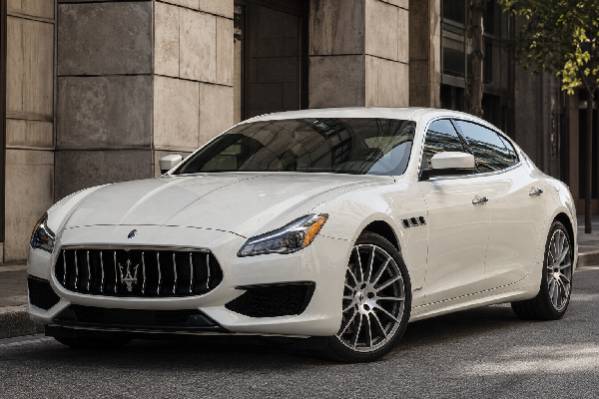
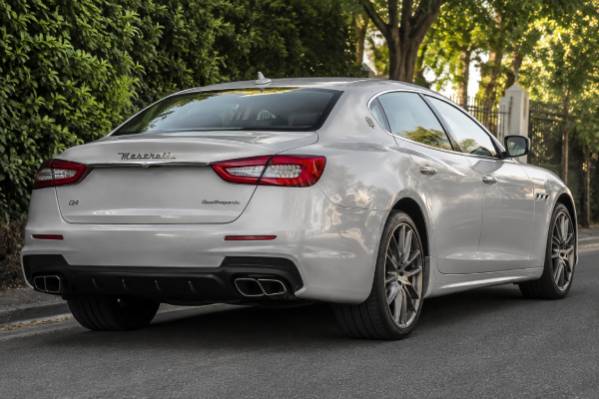
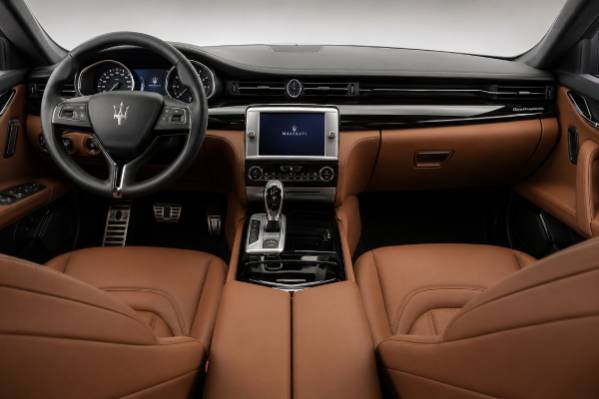
The 2015–2017 Maserati Quattroporte with 330 hp is a market-specific entry version of the early M156 gasoline range. It uses the same 3.0-liter F160 twin-turbo V6 family, eight-speed ZF automatic, rear-wheel-drive layout, hydraulic steering, and full-size 3,171 mm wheelbase as more powerful Quattroportes, but with software and output calibrated to 330 hp and about 500 Nm. The model was especially important in China and selected tax- or regulation-sensitive markets, where it gave buyers the flagship body and cabin without stepping up to the 410 hp S or 530 hp GTS. Performance remains substantial for a luxury sedan, with period figures around 5.6 seconds to 100 km/h and a top speed near 263 km/h, depending on market documentation. Used examples require precise identification because sellers sometimes describe them as an S, quote later 350 hp figures, or confuse registration year with model year. The best cars combine verified factory specification, consistent annual service, stable cooling, smooth transmission behavior, healthy adaptive suspension, matched tires, and a clean full-system diagnostic scan.
Table of Contents
- The 330 hp Flagship Strategy
- F160 Specification with Rear Drive
- Markets, Model Years, and Options
- Full-Size Design with Lower Output
- Everyday Performance and Road Feel
- Maintenance for the 330 hp V6
- How to Buy the Correct Version
The 330 hp Flagship Strategy
The 330 hp Quattroporte was not a smaller or simplified car; it was a full M156 sedan with a lower-output calibration created for selected markets. Its appeal lies in combining flagship space and chassis hardware with less aggressive power delivery.
Maserati launched the sixth-generation Quattroporte in 2013. The new model was significantly larger than the M139, offering more rear-seat room and a 530-liter trunk. It adopted turbocharged direct-injection engines, an eight-speed automatic, extensive aluminum components, and new electronics. The change positioned the Quattroporte against modern full-size luxury sedans rather than only as an Italian alternative for enthusiasts.
The 330 hp version appeared as Maserati expanded in China and other markets where engine-output positioning, taxation, insurance, or customer preference favored a lower rung. It retained the 2,979 cc twin-turbo V6 but used different engine management from the 410 hp S. Peak torque was also lower, though still broad and available at low engine speed.
This model should not be judged as a detuned bargain alone. Its output remains higher than many executive sedans of the period, and the rear-drive chassis gives it a distinctive balance. The softer power delivery can make it easier to use in dense traffic and reduce the frequency of full-boost operation, though it does not turn maintenance into that of an ordinary family car.
The 330 hp car also illustrates Maserati’s global product strategy. The same basic architecture could support a 250 or 275 hp diesel, several V6 gasoline calibrations, all-wheel drive, and the 530 hp V8. Market brochures did not always list every version, which is why online databases often omit or mix the 330 hp Quattroporte.
By 2017, the range received its first major facelift. Some 330 hp cars were sold alongside revised styling and equipment, while others were earlier builds registered later. The exact VIN, build date, option codes, and market documentation are therefore more reliable than a registration certificate alone.
Today, the model is often priced below the S. That can be good value for a buyer who prioritizes comfort, steering feel, and appearance over maximum acceleration. The risk is buying a neglected example simply because the initial price looks modest. Cooling, suspension, brakes, electronics, tires, and trim remain those of a high-end Italian sedan.
F160 Specification with Rear Drive
The 330 hp version uses a 2,979 cc twin-turbo direct-injection V6, a ZF eight-speed automatic, and rear-wheel drive. It shares the M156’s sophisticated suspension and hydraulic steering, so the lower engine rating does not remove the car’s core engineering character.
| Item | Specification |
|---|---|
| Platform code | M156 |
| Engine family | F160 |
| Engine layout | 60-degree twin-turbocharged V6, direct injection |
| Displacement | 2,979 cc |
| Maximum power | 330 hp |
| Peak torque | Approximately 500 Nm |
| Transmission | Eight-speed ZF automatic |
| Drivetrain | Rear-wheel drive with limited-slip differential |
| Front suspension | Double wishbone with Skyhook adaptive damping |
| Rear suspension | Five-link with Skyhook adaptive damping |
| Steering | Hydraulic power assistance |
| Length | 5,262 mm |
| Wheelbase | 3,171 mm |
| Width without mirrors | 1,948 mm |
| Height | 1,481 mm |
| Luggage capacity | 530 liters |
| Fuel capacity | 80 liters |
| Typical 0–100 km/h claim | Approximately 5.6 seconds |
| Typical top-speed claim | Approximately 263 km/h |
The F160 engine has aluminum block and cylinder heads, four camshafts, variable timing, two turbochargers, and high-pressure direct injection. The basic architecture is shared with stronger versions, but calibration affects boost pressure, torque request, ignition, fueling, and protection strategies. Treat an aftermarket tune as a modification, not proof that a 330 hp car is “the same” as an S.
Peak torque arrives early enough that the gearbox can keep engine speed low in normal driving. The car moves away cleanly and overtakes without needing the high revs of the previous naturally aspirated Quattroporte. Full-throttle acceleration lacks the final urgency of the 410 hp version, but the difference is smaller in ordinary traffic than the power figures imply.
The ZF automatic uses eight forward ratios and a torque converter. It should select Drive and Reverse without a long pause, upshift almost invisibly under light load, and respond promptly in Sport or manual mode. Shift shock, flare, shudder, or repeated hunting indicate a fault, poor adaptation, incorrect fluid condition, or another driveline problem.
Rear-wheel drive avoids the Q4 system’s transfer case, front differential, and front half-shafts. That reduces mass and service complexity. A mechanical limited-slip differential helps distribute torque across the rear axle. Differential oil condition, seals, mounts, and driveshaft couplings still deserve inspection.
Double wishbones control the front wheels, while a five-link arrangement manages the rear. Skyhook varies damper force based on body and wheel movement. The system provides a useful comfort-to-control range, but its expensive dampers eventually leak or weaken. Tires and bushings have just as much influence on ride quality.
Brakes vary by market and wheel package. The lower-output car often uses smaller front hardware than S Q4 or GTS versions, but replacement remains costly compared with mass-market sedans. Confirm the exact disc diameter, caliper type, and minimum thickness from VIN-specific documentation before ordering parts.
Markets, Model Years, and Options
Correct identification is the most important production issue. The 330 hp Quattroporte was not sold uniformly worldwide, and its naming can appear simply as “Quattroporte” without an S suffix.
China was a major market for the specification, and official communications highlighted the 330 hp rear-drive Quattroporte during Maserati’s rapid regional growth. Other markets may have received similar output depending on homologation and local range planning. Import history can therefore be normal, but it should be documented.
A genuine car’s build information should show the F160 gasoline engine, rear-wheel drive, and 330 hp market calibration. Some advertisements use 350 hp because that later rating is better known. Others call every gasoline V6 an S. Neither assumption is reliable. VIN-linked factory data and the original market brochure should settle the question.
The 2015 and 2016 cars normally carry the launch-era exterior and interior. They have the original grille and bumpers, early center console, and first infotainment generation. A 2017 model may have the updated body with an active Air Shutter, revised console, capacitive 8.4-inch screen, and smartphone integration, depending on build timing and market.
Equipment could be generous even without an S badge. Typical options included full leather, wood or carbon-look trim, heated and ventilated seats, four-zone climate control, power rear seats, rear sunshades, premium audio, navigation, reversing camera, parking sensors, soft-close doors, adaptive lighting, and rear entertainment.
Wheel and tire choices commonly ranged from 19 to 21 inches. Smaller wheels improve compliance, reduce replacement cost, and resist impact damage better. Larger wheels create a stronger visual stance but make inner-rim bends and sidewall damage more likely. Verify that the installed wheel style and size were available for the car.
Color and trim can influence desirability more than the output level. A tasteful original combination with preserved leather, wood, headlining, and switchgear may be worth more than a more powerful car with a worn cabin. Special-order paint or upholstery should be supported by the build record.
Aftermarket upgrades need careful interpretation. ECU software, exhaust changes, lowered suspension, nonstandard wheels, and infotainment replacements may reduce originality and complicate diagnosis. A tune can also increase heat and torque beyond what the previous owner’s maintenance supported. Ask for original parts, invoices, software information, and the name of the calibrator.
Full-Size Design with Lower Output
The 330 hp model looks and feels like a full Quattroporte because its body, cabin architecture, and chassis are not visually downgraded. Its restraint is mostly in the engine calibration and standard equipment mix.
The M156 body uses a long hood, rearward cabin, frameless windows, three fender vents, and a large concave grille. At more than 5.2 meters, it has real road presence. The broad rear compartment and 530-liter luggage area make it much more practical than the M139 it replaced.
Aluminum doors, hood, trunk lid, front subframe, and suspension components help control mass. The passenger structure combines materials selected for stiffness, safety, and manufacturability. Collision repairs require correct measuring, joining, and corrosion protection. A panel that appears straight can still hide a misaligned subframe or suspension pickup point.
The engine sits longitudinally and drives the rear axle through the transmission and propeller shaft. This layout supports balanced proportions and isolates the steering from power delivery. The absence of Q4 hardware gives the front suspension more straightforward packaging and preserves a lighter response.
Cooling airflow is important even at 330 hp. The two turbochargers, air-conditioning condenser, coolant radiators, and charge-air system share the nose. Debris can collect between heat exchangers. A superficial wash through the grille may bend fins or push dirt deeper, so proper cleaning often requires careful access.
The cabin combines an analog clock, leather-covered dashboard, conventional instruments, and fixed steering-column paddles. Early infotainment software feels old beside a modern phone, but the controls remain usable when functioning. The facelift screen and phone integration make 2017 cars easier to live with.
Exhaust valves provide a quieter normal setting and a more open Sport character. The 330 hp calibration does not erase the V6’s distinctive uneven growl, although volume and valve behavior can vary by market. Exhaust modifications may create drone or fault codes and should not be valued automatically as improvements.
Everyday Performance and Road Feel
The 330 hp Quattroporte is quick enough for real-world use and often calmer than higher-output versions. Its strengths are smooth torque, steering feel, motorway composure, and the ability to cover distance without constantly provoking the rear tires.
At low speed, the throttle is progressive and the gearbox moves through ratios early. The engine’s 500 Nm means the car does not feel weak, even with passengers. There can be a brief delay when demanding maximum acceleration from a high gear, but the transmission usually responds with one or more downshifts.
Sport mode changes the experience. It holds gears longer, sharpens accelerator response, increases exhaust presence, and firms the adaptive damping strategy. The car then feels more alert without becoming as aggressive as a 410 hp S. Paddles allow the driver to select a ratio before an overtake or downhill section.
Hydraulic steering gives meaningful resistance and self-centering. It lets the driver sense front-tire loading better than many early electric systems. The wheel should turn smoothly without pump groan, dead spots, or fluid smell. Heavy steering at parking speed can point to low fluid, belt, pump, rack, or tire-pressure issues.
The long wheelbase creates excellent straight-line stability. On broad, fast roads the body settles and the car feels smaller than its dimensions suggest. In tight urban areas, width and turning circle become more obvious. Cameras and parking sensors are useful rather than optional luxuries.
Rear-drive balance is predictable on good tires. The lower output makes abrupt wheelspin less likely than in an S, but 500 Nm can still overcome worn rear rubber in rain. Stability control should operate unobtrusively. A constant flashing intervention during modest acceleration suggests poor tires, alignment, sensor issues, or a mechanical problem.
Ride quality depends on wheel diameter and damper health. Nineteen-inch wheels usually provide the best comfort. Twenty- and 21-inch setups increase impact harshness and are more vulnerable to potholes. A car that crashes over small bumps may have bent wheels, hardened tires, incorrect pressures, lowered springs, or worn dampers.
Braking should feel linear and stable. Vibration can come from disc runout, deposits, wheel damage, or suspension play. A road test should include both gentle and firm stops once the system is warm. The electronic parking brake must apply and release without messages.
Fuel consumption remains substantial in city use, though the 330 hp calibration can be more restrained when driven gently. The 80-liter tank supports touring range. Buying this version solely to save fuel over an S is unlikely to justify a poor example; condition will dominate total cost.
Maintenance for the 330 hp V6
The lower power rating does not eliminate M156 maintenance. The car still needs annual fluids, careful cooling inspection, ignition-system attention, healthy electronics, and suspension upkeep from technicians with correct diagnostic access.
Engine and heat management
Inspect for oil seepage at cam covers, front or timing-cover joints, turbocharger lines, and lower engine surfaces. Check the expansion tank, cap, hose connections, thermostat area, water pump, and radiator stack for dried coolant. Pressure-test unexplained loss and confirm the temperature remains stable in traffic.
The engine should start evenly when cold and pull through full boost without hesitation. Spark plugs and coils can cause load-related misfires, but injectors, high-pressure pumps, intake leaks, sensors, and compression can produce similar symptoms. Read freeze-frame data and cylinder counters before replacing parts.
Use the exact approved oil specification and respect time as well as mileage. Clean oil supports turbo bearings, cam phasers, and timing components. A low-mileage car that receives oil only every several years is not well maintained.
Turbocharger health should be evaluated through boost data, smoke, noise, oil consumption, and intake inspection. A small film in charge plumbing can be normal; heavy pooling, blue smoke, or weak boost is not. After sustained hard driving, a gentle final period reduces heat concentration.
Transmission, rear axle, and chassis
The eight-speed transmission benefits from condition-based fluid and filter attention using the proper fill procedure. Delayed engagement, shudder, ratio flare, or a hard shift needs diagnosis. Software adaptation or fluid service cannot repair mechanical wear.
Inspect the differential and propeller shaft for leaks, noise, vibration, and coupling deterioration. Rear mounts can contribute to clunks during on-off throttle transitions. A road test at different speeds and loads helps distinguish driveline issues from tires or wheel bearings.
Skyhook dampers, control arms, rear links, ball joints, anti-roll-bar components, and wheel bearings all age. Uneven tire wear is a clue, not a diagnosis. Correct worn parts and bent wheels before paying for alignment.
Measure brake discs and pads, test caliper operation, and renew brake fluid at the specified time interval. Check the inner faces because corrosion can be hidden. Confirm tire age as well as tread depth; an old premium tire may have less wet grip than a newer quality replacement.
Electrical and interior systems
Battery health is central to the M156. Low voltage can trigger warnings from the transmission, suspension, parking brake, steering, and body modules. Load-test the battery, verify charging output, and use a maintainer during storage.
Operate every electrical feature, including all climate zones, seat motors, heating and ventilation, windows, frameless-glass indexing, locks, sunroof, shades, cameras, sensors, audio, infotainment, and driver aids. Scan all modules and confirm campaign or recall completion by VIN and market.
Routine service parts are generally obtainable, but adaptive dampers, modules, trim, lamps, and interior components can be costly. A specialist who diagnoses before replacing assemblies can save more money than the lowest hourly rate.
How to Buy the Correct Version
The buying process should prove two things separately: that the car is genuinely the 330 hp specification, and that it has been maintained to full Quattroporte standards. Do not accept an uncertain identity in exchange for a low price.
Request the VIN, build sheet, original sales invoice, market brochure, service invoices, and diagnostic report. Compare engine output, drivetrain, trim, wheels, brakes, and model-year equipment. A badge can be changed in minutes; factory records are far harder to misread.
| Priority | Good evidence | Concern |
|---|---|---|
| Specification | VIN-linked 330 hp rear-drive build data | Seller calls it an S or quotes 350 hp without records |
| Engine | Cold start, stable cooling, clean full-load acceleration | Smoke, misfire, coolant loss, oil odor |
| Gearbox | Prompt engagement and smooth shifts hot and cold | Delay, flare, shudder, or harsh downshift |
| Chassis | Straight wheels, matched tires, dry dampers, even wear | Bent rims, mixed tires, leaks, suspension noise |
| Electronics | Strong battery and clean module scan | Multiple low-voltage or communication faults |
| History | Annual invoices with part and fluid detail | Long gaps, stamps only, unexplained import history |
Have an independent Maserati specialist inspect the car from cold. The inspection should include paint depth, structure, underbody, leaks, radiator stack, brake measurements, tire dates, wheel runout, suspension play, module scans, and a long enough drive to reach full operating temperature.
An imported example can be perfectly legitimate, but confirm that navigation, radio frequencies, lighting, emissions equipment, instruments, and parts support suit the destination country. Verify tax and registration status before purchase. Market-specific software or hardware may complicate future updates.
A 2017 facelift car may be worth more for its touchscreen and driver aids, while an earlier car may offer stronger value. Choose condition over the calendar. A meticulously serviced 2015 is usually preferable to a neglected 2017 carrying several deferred jobs.
Set aside money for immediate baseline work. Even a sound car may need fluids, filters, plugs, battery, tires, alignment, brake service, or minor cooling parts. Completing a known baseline makes future symptoms easier to interpret.
The 330 hp Quattroporte suits a buyer who wants the M156’s proportions, cabin, steering, and rear-drive feel without paying for the highest output. It is not a low-cost substitute for a mainstream sedan. Verified and maintained correctly, it is a rare, understated version of Maserati’s modern flagship.
References
- Maserati at Shanghai Auto Show with local products’ premieres 2015
- Special Maserati event in Shanghai celebrates Neptune in the Wind sculpture 2015
- All-new Maserati Quattroporte Unveiled at NAIAS 2013 2013
- The new Quattroporte: restyling and range strategy for a new product experience 2016
- Maserati Guides & Documentation for your vehicle 2026 (Owner’s Manual Portal)
Disclaimer
This article is for informational purposes only and is not a substitute for professional diagnosis, inspection, maintenance, or repair. Specifications, torque values, service intervals, procedures, software requirements, and equipment can vary by VIN, production date, market, and configuration. Before buying, servicing, or modifying any vehicle, verify the relevant details against its official service documentation and consult a qualified Maserati specialist when necessary.
Please share this article on Facebook, X/Twitter, or another platform to support our work and help other owners and enthusiasts find it.