
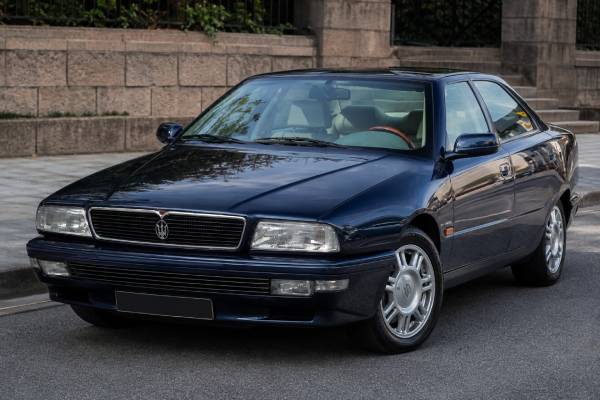
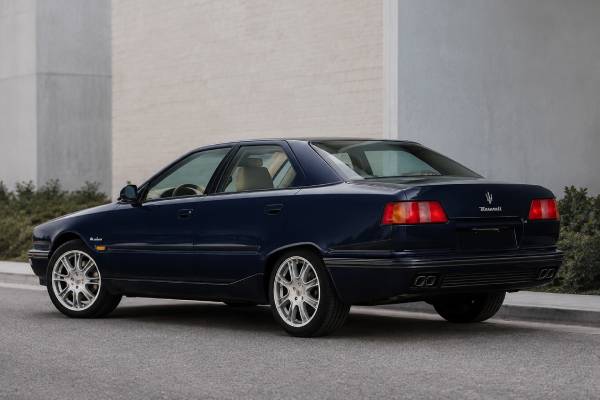
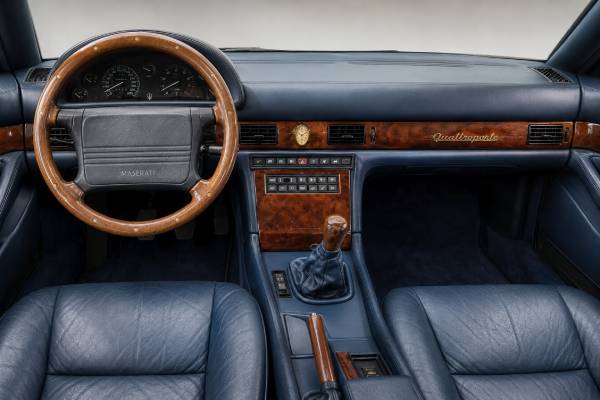
The Maserati Quattroporte ottocilindri 3.2 is the short-lived V8 flagship of the pre-Evoluzione AM337 range. Introduced for 1996 after a preview at the 1995 Bologna Motor Show, it placed the 3,217 cc AM578 twin-turbo V8 from the Shamal lineage into Marcello Gandini’s compact four-door body. Output was 335 hp at 6,400 rpm with approximately 450 Nm at 4,400 rpm, enough for a claimed 270 km/h with the six-speed manual or about 265 km/h with the optional BTR four-speed automatic.
Only 415 examples were produced before the Ferrari-directed Evoluzione replaced the original specification in 1998. That combination of low production, V8 power, original dashboard details, and compact proportions makes the ottocilindri one of the most desirable Quattroporte IV variants. It is also one of the least forgiving. The AM578 uses two turbochargers, four camshafts, 32 valves, belt-driven timing, complex cooling and fuel systems, and tightly packaged heat-sensitive components. Buyers should treat service records, engine condition, turbo health, correct boost control, rear-subframe integrity, and complete trim as central value factors. A properly sorted car is brutally quick yet discreet; a neglected one can become a restoration project before the first full-throttle drive.
Table of Contents
- The Original V8 Quattroporte IV Flagship
- AM578 V8, Chassis, and Performance Figures
- Limited Production, Transmissions, and Originality
- Shamal Power Inside a Gandini Saloon
- The Ottocilindri Driving Experience
- V8 Timing, Turbos, Cooling, and Chassis Care
- How to Buy a Pre-Evoluzione V8
The Original V8 Quattroporte IV Flagship
The ottocilindri turned the Quattroporte IV from a rapid twin-turbo V6 saloon into a compact 270 km/h flagship. It was not merely a larger-engine option: its Shamal-derived V8, extra torque, heavier front end, specific badging, and rarity gave it a distinct place above the seicilindri cars.
Maserati launched the fourth-generation Quattroporte in 1994 under Fiat ownership. The first cars used 2.0- and 2.8-liter V6 engines related to those in the second-generation Ghibli. The platform traced its roots to the Biturbo family but gained a longer wheelbase, revised independent suspension, a tubular rear subframe, better equipment, and a more rigid steel shell.
The V8 appeared in 1996 after being shown at Bologna late in 1995. Maserati adapted the AM578 from the Shamal’s twin-turbo eight-cylinder engine, retaining the compact 90-degree layout, four camshafts, four valves per cylinder, two intercoolers, and electronic injection. The result delivered 335 hp and 450 Nm without changing the car’s understated four-door mission.
“ottocilindri” means eight cylinders in Italian. Fender badges made the distinction visible, while new aerodynamic mirrors and eight-spoke alloy wheels formed part of the broader 1996 updates. The oval Maserati clock, rich wood veneer, and original pre-Evoluzione cabin remained.
The V8 arrived at an important moment. Ferrari acquired a controlling stake in Maserati in 1997 and began modernizing the Modena factory and its quality systems. The original ottocilindri therefore lasted only through early 1998. It was then superseded by the Quattroporte V8 Evoluzione, which kept broadly similar output but incorporated hundreds of new or modified parts.
Maserati’s heritage data records 415 pre-Evoluzione V8 cars. That figure makes the variant rarer than either early V6. Manual and automatic examples both exist, and their characters differ substantially. The manual maximizes performance and driver involvement; the BTR automatic turns the same engine into a high-speed luxury express.
Enthusiasts value the original V8 for its combination of Shamal-related engineering and Gandini’s clean first-series presentation. It has no modern driver aids beyond ABS, no soft torque delivery, and no large body to dilute the powertrain. Its appeal is direct, but its condition must be understood at specialist level.
AM578 V8, Chassis, and Performance Figures
The AM578 is a 3,217 cc, 90-degree V8 with 32 valves, double overhead camshafts for each bank, twin turbochargers, and intercooling. It produces 335 hp at 6,400 rpm and approximately 450 Nm at 4,400 rpm, driving the rear wheels through a six-speed Getrag manual or computer-controlled four-speed BTR automatic.
| Item | Specification |
|---|---|
| Model code | Tipo AM337 |
| Engine code | AM578 |
| Engine layout | 90-degree V8, 32 valves, four overhead camshafts |
| Displacement | 3,217 cc |
| Bore and stroke | Approximately 80 mm × 80 mm |
| Induction | Twin turbochargers with twin intercoolers |
| Fuel system | Electronic multipoint injection |
| Maximum output | 335 hp at 6,400 rpm |
| Maximum torque | Approximately 450 Nm at 4,400 rpm |
| Manual transmission | Six-speed Getrag |
| Automatic transmission | Four-speed electronically controlled BTR |
| Drivetrain | Rear-wheel drive with limited-slip differential |
| Front suspension | MacPherson struts, coil springs, anti-roll bar |
| Rear suspension | Independent tubular trailing arms on subframe |
| Brakes | Four-wheel ventilated discs with ABS |
| Wheelbase | 2,650 mm |
| Length | Approximately 4,550 mm |
| Width | Approximately 1,810 mm |
| Dry weight | Approximately 1,647 kg |
| 0–100 km/h | Approximately 5.8 seconds for the manual |
| Top speed | Approximately 270 km/h manual; 265 km/h automatic |
The square bore-and-stroke dimensions help the V8 combine rev capability with useful torque. Two turbochargers feed separate banks, while intercoolers reduce charge temperature. The engine’s 7.3:1 compression ratio reflects the boost and fuel quality available when the design was developed.
Compared with the 2.8 V6, the V8 adds only about 51 hp but carries a broader sense of effortlessness at speed. Its torque peak occurs higher than the 2.8’s, yet the extra cylinders and displacement make the build-up smoother. The engine still has recognizable turbo lag and should not be judged like a modern direct-injection unit.
The Getrag six-speed keeps the engine in its effective range and allows the driver to manage boost. The BTR automatic is electronically controlled and better matched to the V8 than the ZF unit used with the early 2.8, though it has only four ratios. Correct fluid, cooling, electrical voltage, and control inputs are essential.
The chassis remains a front-engine, rear-drive steel monocoque with MacPherson struts in front and independent tubular trailing arms behind. The limited-slip differential and rear suspension attach to a purpose-built tubular subframe. That subframe is central to the car’s behavior; worn bushes or mounts can produce clunks, rear steering, and unstable traction under boost.
Many cars have four-position adjustable dampers. Their electronic control changes damper firmness but does not compensate for worn joints or poor alignment. A system warning, leaking damper, or unequal axle response can be expensive because original-style components are not mass-market parts.
Maserati quoted 270 km/h for the manual, making the car one of the fastest production saloons of its time. Real performance depends on temperature, boost integrity, tire quality, and mechanical health. A car that feels merely quick may have substantial lost output from intake leaks, restricted catalysts, weak ignition, low fuel pressure, or tired turbochargers.
Limited Production, Transmissions, and Originality
The V8’s 415-car production means originality and documented identity deserve careful attention. A correct engine, transmission, badges, wheels, interior details, and pre-Evoluzione body specification can materially affect desirability, but mechanical quality remains more important than cosmetic perfection.
All original ottocilindri cars were built from 1996 to 1998. They belong to the updated pre-Evoluzione phase, so aerodynamic mirrors and eight-spoke wheels are expected. The fender scripts should identify the eight-cylinder version. Inside, the oval clock and original dashboard arrangement distinguish it from the Evoluzione.
Common factory features included Connolly leather, elm or similar burl wood trim, automatic climate control, electric seats and windows, central locking, ABS, adjustable dampers, and market-specific alarm or audio systems. Color and trim combinations could be individualized, so unusual upholstery is not automatically non-original.
The six-speed manual is generally the collector’s choice because it offers full claimed performance and a closer link to the Shamal powertrain. It is also vulnerable to clutch wear, hydraulic problems, tired synchros, and expensive internal repairs. A gearbox that crunches when warm should not be excused as normal.
The BTR automatic suits the car’s executive role and may be rarer in some markets. It should engage Drive and Reverse promptly, shift consistently at light and full throttle, and remain stable when hot. Electrical or sensor faults can alter shift behavior, so diagnosis should include both hydraulic and control systems.
Modifications deserve caution. Period tuners could extract more power from the AM578, and many owners fitted boost controllers, chips, larger exhausts, altered wastegates, intake systems, or modern engine-management components. Increased output can be reliable only when fuel delivery, ignition, charge cooling, exhaust temperature, and engine condition are measured rather than assumed.
Other common changes include larger wheels, lowered springs, aftermarket dampers, modern stereos, improvised alarm bypasses, and replacement steering wheels. Oversized wheels may damage ride quality and stress the suspension. Poor alarm removal can create intermittent starting and charging faults.
Confirm chassis and engine numbers, but also examine physical consistency. Engine castings, turbo installation, intercoolers, intake plumbing, transmission controls, instrument cluster, wiring, wheels, brakes, and exhaust should agree with the car’s year. A replacement engine is acceptable when its origin and rebuild quality are clear; undocumented swaps reduce confidence.
Because the ottocilindri was once undervalued, some cars received repairs that were economical rather than correct. A complete file of invoices, photographs, old registration records, and specialist notes can be more informative than a stamped book alone.
Shamal Power Inside a Gandini Saloon
The ottocilindri’s special character comes from placing an exotic twin-turbo V8 in the smallest Quattroporte body. It combines restrained visual signals with engineering that would be dramatic even in a two-seat sports car.
Gandini’s exterior does not advertise the performance with wings or deep spoilers. The wedge profile, low front, high tail, and diagonal rear wheel openings create tension without decoration. The formal grille and Trident establish the luxury identity, while the compact length keeps the car from looking like a limousine.
The V8 fills the engine bay more completely than the V6. Heat management is therefore critical. Radiator efficiency, both cooling fans, intercooler airflow, oil circulation, exhaust shielding, and intact ducting all contribute to durability. Missing undertrays or shrouds can alter airflow even if coolant temperature appears normal in gentle use.
The twin-turbo layout creates two parallel air and exhaust paths. Both sides must operate evenly. Differences in plug color, exhaust temperature, boost response, smoke, or turbo sound can reveal a bank-specific problem. Balanced compression and fuel delivery matter because one weak bank can be masked by the other during a casual test drive.
The steel body provides four proper doors and a usable trunk, but rear space is compact. The cabin feels hand-finished rather than industrial. Leather covers a large area, wood veneer adds warmth, and the analog instruments reinforce the car’s early-1990s character.
The driving position is lower and more intimate than in the AM330. The manual lever falls close to hand; the automatic selector preserves a traditional executive-car feel. Visibility is good forward, though the high tail and broad rear pillars require care when parking.
The AM578’s sound differs from a naturally aspirated Italian V8. At idle it is subdued, with mechanical texture from four camshafts and 32 valves. Under load, intake rush and turbo whistle join a dense exhaust note. It becomes urgent rather than theatrical. A standard or carefully designed exhaust preserves the contrast between quiet cruising and hard acceleration.
The car’s engineering bridges eras. Its rear subframe and adjustable dampers were sophisticated, but its boost delivery and electronics remain analog enough for the driver to feel every change in temperature, grip, and gear. The later Evoluzione improved assembly and systems integration; the pre-Evoluzione V8 retains more of the original hand-built atmosphere.
The Ottocilindri Driving Experience
A healthy ottocilindri feels compact, forceful, and surprisingly agile. The V8 gives it stronger acceleration than the body suggests, but the driver must respect turbo lag, rear-wheel drive, and the limited electronic assistance available on a 1990s car.
Cold-start behavior is the first test. The engine should fire promptly without prolonged smoke, heavy tapping, or unstable idle. Full boost should wait until oil and coolant are warm. Thick cold oil does not protect turbo bearings or cam surfaces during immediate hard use.
At low throttle, the V8 is smoother and more flexible than the smaller engines. It can move the car without constant gear changes. As boost builds, acceleration becomes intense and continues strongly through the upper rev range. The transition should be clean, not an uncontrolled hit accompanied by detonation, misfire, or warning lights.
The manual creates the most vivid experience. Its ratios let the driver prepare for boost before overtaking or corner exit. The clutch is substantial, the gearshift deliberate, and the engine responds best to confident but smooth inputs. A tired clutch may hold during normal driving and slip only at peak torque in fourth, fifth, or sixth.
The automatic makes the car calmer. Torque-converter slip helps it move smoothly from rest, while kickdown brings the engine into boost. Four gears mean larger drops in engine speed, so it does not feel as continuously urgent as the manual. Harsh engagement, flare, hunting, or a transmission warning is not normal.
Steering has useful weight and relatively quick response. The additional V8 mass is noticeable, but good front dampers, bushings, tires, and alignment keep the nose accurate. Under power, the limited-slip differential gives strong traction on dry roads. In rain, an abrupt boost rise can exceed the rear tires’ grip before the driver expects it.
Ride quality is firm yet acceptable on correct wheel sizes. The adjustable dampers should change body control without turning the car into a rigid, bouncing platform. Old tires, oversized wheels, or seized suspension joints can make the car feel nervous and harsh.
Braking performance is adequate for the speed when the system is fully maintained. Discs, pads, calipers, hoses, fluid, ABS sensors, and tires must all be sound. The pedal should remain consistent during repeated stops, and the car should track straight.
The ottocilindri excels at rapid cross-country travel. It can cruise quietly, then deliver immediate high-speed overtaking once the correct gear is selected. City use exposes its heavy controls, heat, visibility limits, and electrical loads. Track use is possible but places exceptional demand on cooling, brakes, tires, and oil; the car is better understood as a grand-touring saloon than a circuit machine.
V8 Timing, Turbos, Cooling, and Chassis Care
The AM578 requires disciplined preventive maintenance. Timing belts, tensioners, turbo oil supply, fuel pressure, cooling fans, ignition, and hot oil pressure must be verified before the engine’s performance is used regularly.
Timing system and engine assessment
Treat missing belt documentation as a requirement for immediate service. The V8’s belt-driven camshafts and interference design make failure potentially catastrophic. A correct job should address tensioners, idlers, seals, auxiliary drives, and accessible cooling components as specified for the car.
A pre-purchase inspection should include compression or leak-down testing, hot oil-pressure measurement, coolant pressure testing, and examination for combustion gases. Listen for bottom-end knock, persistent cam or tappet noise, exhaust manifold leaks, and unusual mechanical sounds from either bank.
Oil leaks around cam covers, front seals, turbo feeds, and return lines are common age-related concerns. A small seep can become dangerous if it reaches hot exhaust components or lowers the level between checks. Use the correct lubricant and shorten intervals for repeated short trips or hard use.
Twin-turbo and fuel-system health
Both turbochargers need inspection for shaft play, oil leakage, blade damage, and consistent boost. Check wastegate operation, vacuum hoses, intercoolers, pressure pipes, clamps, and bypass controls. Unequal turbo response can create uneven cylinder loading.
Fuel pumps, filters, injectors, regulator, wiring, and voltage supply must maintain pressure at full load. Weak ignition components can misfire only under boost. Misfire or lean running on a high-output turbo engine can damage pistons and exhaust valves quickly.
Avoid undocumented high-boost calibrations. Ask for dyno data, air-fuel measurements, parts lists, and the name of the tuner. A nonstandard exhaust alone is less concerning than altered boost with no evidence of supporting work.
Gearbox, rear subframe, and electronics
Manual cars need checks for clutch slip, hydraulic leakage, gear noise, synchro wear, and mount deterioration. BTR automatic cars need proper fluid condition, cooling, electrical supply, selector inputs, and hot shift testing. A transmission fault may involve sensors or control wiring as well as internal wear.
Inspect the rear subframe, differential mounts, trailing arms, front struts, wheel bearings, steering rack, ball joints, brakes, and adjustable dampers. Movement at the rear axle can make a powerful car unsafe even when the engine is perfect.
Low battery voltage creates misleading faults. Test the battery, alternator, grounds, relays, fuse boxes, cooling fans, climate control, windows, seats, locks, ABS, damping controls, and immobilizer. Aftermarket alarms are a frequent source of poor repairs.
Rust can affect sills, jacking points, wheel arches, floors, door bottoms, glass surrounds, trunk floor, and suspension pickup areas. Check beneath trim and underseal. Structural corrosion or poor collision repair should outweigh an attractive engine or rare color.
Parts can be obtained through specialists, but V8-specific timing, turbo, transmission, electronic, and trim components may require time. The cheapest way to own one is usually to buy a complete, correctly maintained car rather than restore a neglected example piece by piece.
How to Buy a Pre-Evoluzione V8
The right ottocilindri is a documented, mostly standard car that passes specialist engine, boost, cooling, transmission, chassis, and corrosion checks. Low mileage without maintenance evidence is not a substitute for condition.
First confirm that the car is a genuine pre-Evoluzione V8. Check the AM337 identity, AM578 engine, ottocilindri badges, correct 1996–1998 mirrors and wheels, original dashboard clock, and transmission specification. Compare these details with period documentation and service records.
Request invoices for:
- Timing belts, tensioners, idlers, seals, and related work.
- Oil changes and hot oil-pressure investigation.
- Turbocharger rebuilding or replacement.
- Radiator, fans, hoses, thermostat, and coolant service.
- Fuel pumps, filters, injectors, coils, plugs, and sensors.
- Clutch and gearbox work or BTR automatic service.
- Rear subframe, differential, dampers, steering, and brakes.
- Corrosion repairs, paintwork, and accident damage.
- Engine-management, exhaust, alarm, or immobilizer changes.
The inspection should begin with the engine completely cold. Watch exhaust smoke, oil-pressure behavior, idle stability, and warning lamps. When fully hot, repeat oil-pressure and cooling checks. Use compression and leak-down tests where access and seller permission allow.
A road test should progress from gentle operation to measured full load only after temperatures stabilize. The engine must pull evenly, build boost without surging, and show no detonation or smoke. Test several gears, then inspect for fresh oil or coolant leaks.
Manual buyers should test synchros at different temperatures and provoke clutch slip with high load in a tall gear. Automatic buyers should test engagement, kickdown, upshifts, downshifts, and hot restart behavior. Any inconsistency deserves specialist diagnosis before a price is agreed.
Check all four tires for matching type and age. Confirm the damping settings, ABS, climate control, fans, windows, seats, locks, instruments, and charging system. Lift the car to inspect rear-subframe mounts, suspension points, floor corrosion, exhaust, differential leaks, and signs of impact.
Avoid severe overheating history, low hot oil pressure, heavy blue smoke, uncontrolled boost, coolant pressurization, major gearbox faults, structural rust, or incomplete wiring. These problems can consume more than the value difference between a poor car and an excellent one.
After purchase, create a baseline before chasing maximum performance. Replace questionable fluids, inspect or renew belts, verify boost and fuel pressure, fit fresh matched tires, service the brakes, and correct voltage problems. Preserve original parts when making reversible improvements.
The pre-Evoluzione V8 suits an owner who wants the most intense version of the original Quattroporte IV. It is rare, fast, compact, and mechanically fascinating. Its risks are not hidden, but neither is its reward: few four-door cars combine a Gandini body, twin-turbo Shamal-derived V8, manual gearbox option, and such low production in one understated package.
References
- Quattroporte IV – Quattroporte models | Maserati 2026 (Manufacturer Heritage Specifications)
- Maserati TechInfo 2026 (Manufacturer Technical Information)
- Buying Guide: 1994–2001 Maserati Quattroporte IV | Hagerty UK 2025 (Buying Guide)
- 1997 Maserati Quattroporte – Ottocilindri 3.2 V8 | Classic Driver Market 2020 (Model History)
Disclaimer
This article is for informational purposes only and is not a substitute for professional diagnosis, repair, tuning, or restoration advice. Specifications, torque values, belt intervals, boost settings, and procedures vary by VIN, market, production date, and equipment. Verify all work against official service documentation and consult a qualified Maserati specialist.
Please share this article on Facebook, X/Twitter, or your preferred enthusiast community if it was useful. Sharing supports the creation of more detailed specialist-car guides.