
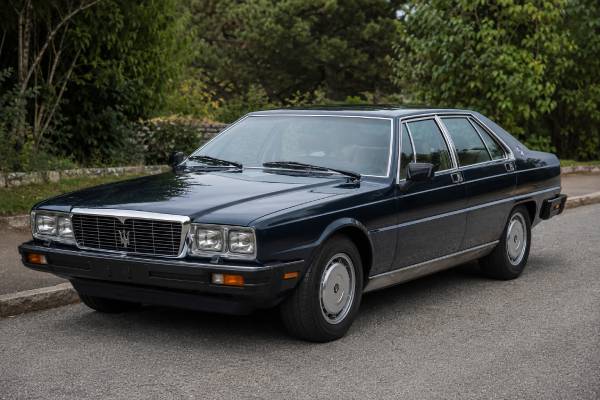
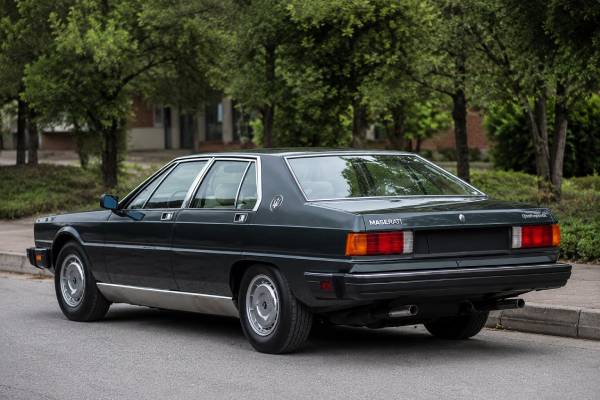
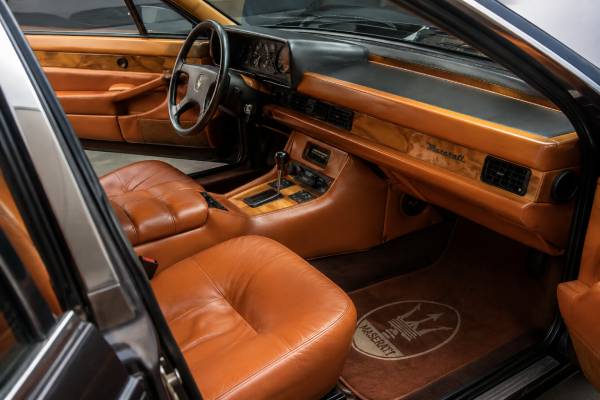
The Maserati Quattroporte Royale was the final and most luxurious development of the Giugiaro-designed third generation. Announced in late 1986 and built from 1987 to 1990, it combined a higher-output 300 hp version of the 4,930 cc four-cam V8 with an upgraded cabin, distinctive wheels, richer trim, and rear-passenger features intended to place it above the already lavish Quattroporte 4900.
Maserati planned a larger limited run, but only 51 examples were completed according to current factory heritage material. That makes the Royale exceptionally scarce and places unusual weight on identity, documentation, and completeness. A normal Quattroporte III fitted with similar trim is not the same car, and missing Royale-specific interior pieces can be extremely difficult to replace.
Mechanically, the Royale remains an AM330-era Maserati: four Weber carburetors, wet cylinder liners, rear-wheel drive, a live rear axle, four-wheel ventilated discs, and either a five-speed ZF manual or three-speed automatic depending on the individual car. Its ownership risks are equally traditional. Heat, low oil pressure, carburetor imbalance, fuel leaks, body corrosion, weak air conditioning, and aging electrical systems can turn a rare saloon into an expensive project. The right example, however, is one of the last truly hand-finished Italian formal cars.
Table of Contents
- The Final Expression of Quattroporte III
- 300-Horsepower V8 and Royale Specifications
- Limited Production, Equipment, and Authentication
- Royale Design, Luxury, and Rear-Seat Details
- Driving Maserati’s Formal Flagship
- Royale Maintenance and Restoration Challenges
- Buying One of the 51 Royales
The Final Expression of Quattroporte III
The Royale matters because it closed the AM330 era with more power and a deliberately exclusive specification. It was not a new generation; it was a carefully upgraded Quattroporte III created for buyers who wanted maximum comfort, rarity, and prestige from Maserati’s traditional V8 saloon.
The third-generation Quattroporte had returned Maserati to rear-wheel drive after the Citroën-influenced AM123. Giorgetto Giugiaro’s formal body, Maserati’s aluminum four-cam V8, and extensive hand finishing made the car successful enough to remain in production for more than a decade. By the mid-1980s, however, its basic architecture was aging beside newer luxury competitors.
Rather than replace it immediately, Maserati presented the Royale on 14 December 1986 during celebrations of the company’s 60 years as a car manufacturer. The idea was to refine the established car: increase output from 280 to 300 hp, improve the interior, distinguish the exterior, and build a small series to order.
Factory history describes exclusive blue and green exterior colors, softer leather, more extensive wood, special disc-style alloy wheels, silver-colored lower side treatment, four electrically adjustable seats, rear-door folding tables, and a radio telephone located between the front seats. Equipment could vary, but the Royale’s defining purpose was rear-seat luxury as much as driver performance.
Only 51 were produced from 1987 to 1990 according to Maserati’s official heritage pages. Historical publications sometimes quote 53, often because counting methods differ or unfinished and specially configured chassis are included. For a buyer, the important fact is that every car should be traceable as an individual chassis.
The Royale also represents the end of a manufacturing philosophy. Its steel shell, filled exterior seams, fitted wood, hand-trimmed leather, and low-volume assembly came from a world before Maserati’s later integration into larger industrial groups. The next Quattroporte, introduced in the 1990s, would be smaller, turbocharged, and built around Biturbo-era engineering.
The model’s appeal today lies in its contradictions. It looks like an austere formal saloon, but its engine uses four carburetors and four camshafts. It was intended for chauffeured travel, yet rare manual cars can involve the driver deeply. It is exclusive enough for a collection, but its systems work best when exercised regularly.
300-Horsepower V8 and Royale Specifications
The Royale’s 4.9-liter V8 produced 300 hp, 20 hp more than the standard Quattroporte 4900. Higher compression and revised tuning improved performance, while torque remained around 402 Nm, giving the heavy saloon stronger acceleration without changing its fundamental character.
| Item | Specification |
|---|---|
| Model family | Tipo AM330/49 Royale |
| Engine | 90-degree aluminum V8, double overhead camshafts per bank |
| Displacement | 4,930 cc |
| Fuel system | Four twin-choke Weber carburetors |
| Maximum output | 300 hp at approximately 5,600 rpm |
| Maximum torque | Approximately 402 Nm |
| Transmission | Five-speed ZF manual or three-speed automatic, depending on car |
| Drivetrain | Front engine, rear-wheel drive |
| Front suspension | Independent double wishbones, coil springs, dampers |
| Rear suspension | Live axle, coil springs, locating links |
| Brakes | Servo-assisted ventilated discs on all four wheels |
| Steering | Power-assisted recirculating ball |
| Wheelbase | Approximately 2,800 mm |
| Kerb weight | Approximately 1,780–1,975 kg depending on equipment |
| Top speed | Approximately 230 km/h |
| Production | 51 examples in current Maserati heritage data |
The V8 belongs to Maserati’s long-running wet-liner Tipo 107 family. It uses an aluminum block and heads, chain-driven camshafts, two valves per cylinder, and four carburetors. The extra output did not transform the Royale into a sports sedan, but it reduced the effort needed to move the heavy car and gave it stronger passing performance.
Engine condition matters more than the nominal 300 hp rating. Incorrect ignition timing, worn throttle shafts, uneven compression, restricted exhausts, weak fuel delivery, or retarded cam timing can erase much of the gain. A properly tuned engine should pull smoothly from moderate revs and become notably more energetic toward the upper half of the tachometer.
The automatic transmission fits the Royale’s chauffeur-oriented role and was the common choice. The Chrysler A727 TorqueFlite is strong and serviceable, but old fluid, incorrect kickdown adjustment, heat, and worn clutches can cause delayed engagement or slipping. The five-speed ZF manual is rarer and turns the car into a more active grand tourer.
Suspension architecture remained conventional. The front uses double wishbones, while the rear uses a live axle located by links and suspended on coils. Added luxury equipment and, on some cars, heavy accessories place more demand on springs, dampers, bushes, wheel bearings, and brakes.
The Royale’s top-speed claim sits around 230 km/h, though individual sources vary and automatic gearing may reduce the maximum. Modern owners should treat that figure as historical context, not a target. Tire age, brake condition, wheel balance, cooling capacity, and suspension wear are more important than confirming a brochure number.
Limited Production, Equipment, and Authentication
A Royale must be authenticated as a complete factory specification, not merely a late Quattroporte III with a 300 hp claim. The combination of chassis records, engine identity, trim, colors, wheels, and original equipment establishes whether the car is genuine.
Begin by recording the chassis number, engine number, gearbox type, body markings, and all identification plates. Obtain Maserati archive documentation that confirms the completion date, original paint, interior, destination, and model designation. Because production was so small, specialists may know the history of a particular chassis.
Royale features commonly include:
- Higher-output 4.9-liter V8.
- Special disc-shaped alloy wheels.
- Silver-finished lower side or sill treatment.
- Richer wood veneer across dashboard and doors.
- Softer leather and four electrically adjustable seats.
- Folding veneered tables concealed in the rear doors.
- A radio telephone in the center compartment on specified cars.
- Enhanced rear-seat amenities and individual equipment requests.
- Exclusive or strongly associated blue and green exterior finishes.
Not every car will retain every item. Telephones became obsolete, wheels were replaced, tables were damaged, and interiors were retrimmed. Missing pieces should be documented and priced realistically because reproducing them accurately may require bespoke work rather than catalog parts.
The engine should correspond to the Royale’s higher-output specification. Engine numbers and factory records matter because a standard 280 hp 4.9 can be installed easily and may look nearly identical. Internal compression and cam or carburetor settings are difficult to verify without detailed history, so rebuild invoices should specify what was done.
Beware of ordinary AM330 cars upgraded cosmetically. Special wheels, wood, and badges can be copied. A convincing conversion may still be a desirable custom Quattroporte, but it should not carry the value of one of the documented Royales.
Originality is not the only measure of quality. A car with a correctly rebuilt replacement engine, discreetly upgraded cooling fans, and restored tables may be more usable than an untouched but deteriorated example. The key is transparent records and reversible changes.
Royale Design, Luxury, and Rear-Seat Details
The Royale’s exterior changes are subtle because its exclusivity was expressed mainly through materials and detail. Giugiaro’s original rectilinear body remained intact, preserving the wide grille, rectangular lamps, long hood, formal roof, and high rear deck that defined the Quattroporte III.
The disc-style wheels give the Royale a smoother, more ceremonial appearance than the standard car. Silver lower trim visually separates the body from the road and distinguishes late examples without resorting to spoilers or aggressive cladding. Correct ride height is essential; tired springs make the car look heavy and can cause tire or driveline problems.
Inside, the rear compartment received special attention. Folding tables built into the rear doors allowed passengers to work or dine, while richer veneers and soft leather created a more private atmosphere. Four powered seats gave both front and rear occupants greater control. The radio telephone reflected the status and technology of the late 1980s.
Restoring these details is difficult because the Royale’s low production left little spare inventory. Table hinges, latches, veneer patterns, switch surrounds, telephone fittings, special seat controls, wheels, and lower-body trim may need careful refurbishment. Replacing them with generic modern items undermines the car’s identity.
The hand-finished body also needs specialist understanding. Maserati filled seams to create smooth surfaces. Old filler can crack, trap moisture, or hide corrosion. Long flat panels reveal waves and sanding marks. Correct restoration requires preserving the original geometry rather than simply applying more material.
The cabin can suffer from sun and heat. Leather shrinks, wood delaminates, dashboard tops warp, headliners sag, and electric seat mechanisms seize. A complete but worn original interior is often a better restoration starting point than a freshly retrimmed cabin with incorrect stitching and veneer.
The engine bay should remain orderly despite dense packaging. Factory air cleaners, heat shields, fan shrouds, wiring routes, hose supports, and emissions components help reliability as well as authenticity. Chrome and polished alloy should not replace correct finishes without evidence.
Driving Maserati’s Formal Flagship
The Royale feels like a powerful formal car rather than a modern performance saloon. Its 300 hp V8 provides dignified speed, the long wheelbase gives excellent stability, and the cabin isolates passengers reasonably well, but the steering, brakes, and live rear axle still communicate its 1970s origins.
Cold starting requires a healthy battery, correct carburetor technique, and good ignition. The engine should build oil pressure immediately and settle without heavy smoke or fuel leakage. Once warm, it should accept throttle without flat spots and pull strongly through the mid-range.
The automatic emphasizes smoothness. It should engage quickly and shift cleanly without flaring. Kickdown should be decisive, not violent. The manual requires more effort but gives direct control over the V8 and makes the Royale unexpectedly engaging on open roads.
Power steering keeps low-speed effort manageable. Excessive play, inconsistent assistance, or wandering is not normal and can involve the steering box, idler, tie rods, wheel bearings, front bushes, alignment, or rear-axle location. The car should track steadily at speed.
The suspension is soft enough for comfort but should not float through repeated undulations. Worn dampers allow the heavy body to continue moving after a bump. Rear-link wear can cause clunks and a vague feeling under acceleration. Correct load-rated tires and pressures are essential.
Braking should be strong and progressive. The ventilated discs can handle ordinary fast-road use, but old fluid, seized calipers, restricted hoses, and hardened tires reduce safety quickly. A long pedal, pull, vibration, or changing assistance demands immediate work.
The Royale is best on wide, flowing roads. Tight city spaces expose its width and turning circle. Mountain roads require early braking and smooth steering. On a motorway, torque, stability, comfortable seats, and low engine stress create the experience the car was built to provide.
A test drive should include a full heat cycle, air conditioning, all electric seats, several brake applications, rough surfaces, and a hot restart. Listen for driveline vibration, differential whine, suspension knocks, fan noise, and fuel vaporization after shutdown.
The Royale’s additional cabin equipment should be treated as part of the model, not as secondary decoration. Test rear controls, seat functions, tables, lighting, audio, air conditioning, locks, windows, and every switch with the engine running and again after a hot drive. Weak voltage can make several items fail together, but a new battery will not repair burned motors, brittle wiring, vacuum leaks, or missing actuators.
Restoration decisions should favor conservation. Correct leather grain, veneer tone, carpets, wheels, badges, and rear-passenger fittings are difficult to reproduce from photographs. Before dismantling, record fasteners, labels, stitching, panel gaps, wiring routes, and the order of trim layers. Bag and identify even damaged original pieces; a specialist can often use them as patterns or restore them when no replacement exists.
Royale Maintenance and Restoration Challenges
Maintaining a Royale requires the same mechanical discipline as a Quattroporte 4900 plus extra care for irreplaceable model-specific equipment. The engine, cooling, fuel, structure, electrics, and interior should be assessed as separate budgets.
Engine and cooling
Check hot oil pressure, compression, leak-down, timing-chain noise, valve clearances, coolant contamination, and exhaust smoke. Wet-liner rebuilds need accurate liner protrusion, head preparation, bearing measurements, oil-pump inspection, and cam timing. General V8 experience is not enough.
Cooling must remain stable in traffic with the air conditioning operating. Radiators may be internally blocked, fan motors weak, relays overheated, and shrouds missing. Inspect the water pump, thermostat, hoses, expansion tank, and ignition timing. Repeated overheating can cause major engine damage.
Four Weber carburetors need synchronized airflow, sound floats, correct fuel pressure, clean jets, and leak-free unions. Replace old hoses with ethanol-compatible material and inspect tanks for rust or degraded coatings.
Chassis, brakes, and body
Inspect front ball joints, bushes, steering joints, dampers, wheel bearings, rear links, springs, axle bearings, and differential mounts. Added luxury weight makes tired components obvious. Automatic-transmission mounts and driveshaft joints can create vibration.
Brake calipers can seize after storage. Inspect discs, hoses, hard lines, master cylinder, booster, and fluid. Tires should be replaced by age, not only tread.
Rust inspection must cover sills, floors, jacking points, doors, arches, window surrounds, trunk floor, front structure, suspension mounts, and filled seams. Royale-specific lower trim can hide corrosion.
Electrical and interior preservation
Electric seats, windows, locks, climate control, telephone wiring, lamps, and charging systems can place high load on aging connectors. Clean grounds and fuse contacts before replacing expensive components. Document any wiring changes.
Restore original wood, leather, tables, switches, and phone fittings where possible. A specialist cabinetmaker or trimmer may be needed. Keep removed parts, templates, and photographs so future owners understand the work.
A Royale should also be judged in the context of intended use. A concours-focused car may justify painstaking restoration of every unique detail, while a touring car still needs sympathetic upgrades to remain reversible. Modern relays, improved cooling service, and hidden battery protection can increase usability without changing visible identity when documented carefully.
Buying One of the 51 Royales
The best Royale is the car with verifiable factory identity, complete unique equipment, solid structure, and a mechanical history that proves it can complete a full heat cycle. Rarity alone does not make a neglected example a good purchase.
Commission an inspection from a Maserati specialist familiar with AM330 cars and ask a marque historian to review provenance. The checklist should include:
- Factory confirmation of Royale chassis and original specification.
- Engine-number and higher-output configuration review.
- Cold start, hot oil pressure, compression, and cooling tests.
- Carburetor balance and fuel-system safety inspection.
- Transmission, differential, driveshaft, and axle evaluation.
- Steering, suspension, brake, wheel, and tire inspection.
- Lift examination of the steel structure and prior repairs.
- Operation of all four powered seats, windows, locks, and climate systems.
- Inventory of wheels, tables, telephone fittings, wood, switches, tools, and manuals.
- Review of restoration photographs, invoices, and ownership history.
Do not pay a Royale premium for a car missing its defining equipment unless the price reflects replacement difficulty. Likewise, do not reject a documented replacement engine automatically; judge how the work affects intended use and collector value.
Budget for immediate baseline service even after a favorable inspection. Fluids, tires, hoses, belts, ignition parts, carburetor service, brake work, and electrical repairs are common first-year needs. Major engine, body, and interior restoration should be costed separately.
A rarely driven display car may need more recommissioning than a regularly exercised example. Carburetors gum up, seals dry, brakes seize, air conditioning loses charge, and hydraulic components corrode during inactivity. Regular gentle use after proper servicing is often the best preservation method.
Walk away from unclear identity, severe structural rust, low oil pressure, persistent overheating, fuel leaks, or a cabin stripped of Royale-specific parts unless the car is being bought as a documented long-term project.
A sound Royale is a compelling endpoint to the classic Quattroporte formula: Giugiaro formality, handmade luxury, a stronger four-cam V8, and only 51 official examples. It asks for patience and specialist care, but no other Maserati saloon combines its exact blend of ceremony and mechanical character.
References
- Quattroporte III – Classic Cars | Maserati 2026 (Manufacturer Heritage Specifications)
- Maserati Royale special series: homage to the heritage | Maserati 2020 (Manufacturer History)
- Forty years ago, the Maserati Quattroporte was presented to Italian President Sandro Pertini 2019 (Manufacturer History)
- 1990 Maserati Quattroporte Royale | Open Roads, December 2021 | RM Sotheby’s 2021 (Auction History)
Disclaimer
This article is for informational purposes only and is not a substitute for professional diagnosis, repair, or restoration advice. Specifications, torque values, service intervals, and procedures vary by VIN, market, production date, and equipment. Verify all work against official service documentation and consult a qualified Maserati specialist.
Please share this article on Facebook, X/Twitter, or your preferred collector community if it was helpful. Sharing supports the creation of more detailed automotive guides.