
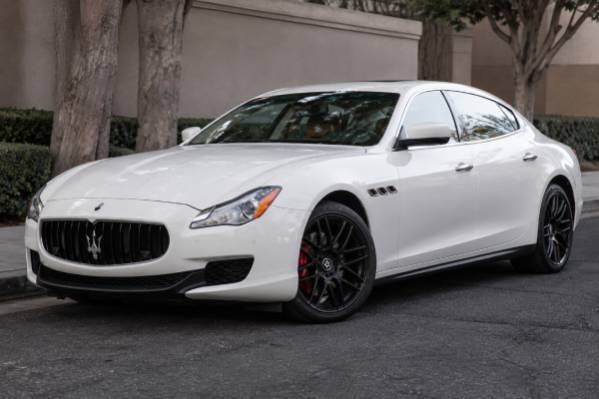
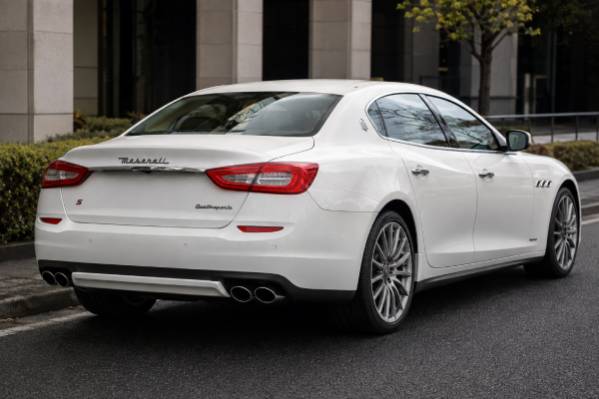
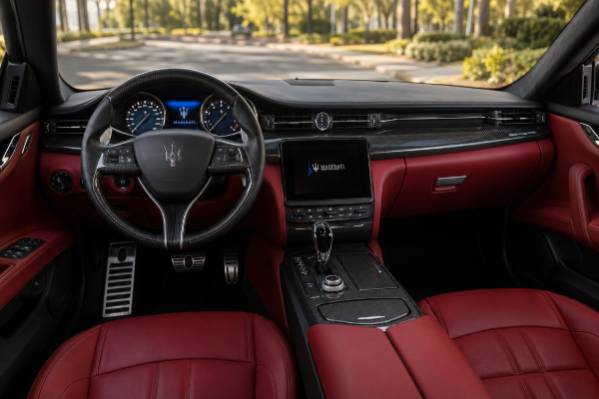
The 2013–2017 Maserati Quattroporte S is the rear-wheel-drive, 410 hp twin-turbo V6 version of the early M156 generation. It offers most of the speed and character of the larger V8 car with lower purchase and operating costs, while retaining hydraulic steering, an eight-speed automatic, Skyhook adaptive dampers, and classic rear-drive balance. The 3.0-liter F160 produces 550 Nm, giving the long sedan strong mid-range performance and a claimed 0–100 km/h time near 5.1 seconds. Early cars introduced the new architecture; the 2017 model-year update brought revised styling, better aerodynamics, a capacitive infotainment screen, smartphone integration, and broader driver-assistance availability. Age now matters more than mileage alone. Cooling-system leaks, oil seepage, ignition faults, worn suspension joints, tired adaptive dampers, old tires, weak batteries, and neglected transmission service can turn an affordable example into a costly project. A sound Quattroporte S remains unusually engaging for a full-size luxury sedan, but the right purchase depends on complete history, correct diagnosis, and an inspection by someone who understands the M156 platform.
Table of Contents
- The Rear-Drive V6 Quattroporte
- F160 Engine and M156 Foundations
- Model Years, Trims, and Options
- Italian Layout and Modern Systems
- Road Manners with 410 hp
- Service Needs and Failure Points
- Choosing a Quattroporte S
The Rear-Drive V6 Quattroporte
The Quattroporte S is the most traditional early M156 V6: it sends 410 hp to the rear wheels and combines executive-sedan space with the steering and throttle adjustability enthusiasts expect from a Maserati.
The sixth-generation Quattroporte arrived in 2013 as a major strategic change. It grew to 5,262 mm long and gained a 3,171 mm wheelbase, creating more rear-seat and luggage room than the M139. Aluminum doors, hood, trunk lid, front subframe, and suspension pieces helped offset the larger dimensions. The result was a genuine full-size sedan rather than a close-coupled four-door grand tourer.
Maserati also replaced the previous naturally aspirated engines with a family of direct-injected twin-turbo units. The F160 V6 was designed for Maserati and assembled in Maranello. In S form it produced 410 hp and 550 Nm. The engine gave the car greater low-speed torque and better everyday flexibility than the old 4.2-liter V8, though its sound and response were different.
The S sat between lower-output V6 versions offered in selected markets and the 530 hp GTS. It shared much of the GTS chassis and cabin but avoided the V8’s purchase price, fuel use, and rear-tire appetite. Unlike the S Q4, it did not carry a front differential, transfer hardware, or driveshafts. That made it lighter and gave it a cleaner rear-drive character.
This version matters today because it represents a narrow combination no longer common in large sedans: rear-wheel drive, hydraulic steering, a powerful gasoline V6, adaptive suspension, and no hybrid assistance. Later Quattroportes became more polished and powerful, but early 410 hp cars can feel more direct and mechanically simple in their responses.
Reputation is mixed mainly because condition varies. Well-maintained cars feel solid, fast, and special. Neglected examples can display several warning lights, suspension noise, poor tires, low voltage, and fluid leaks at once. Depreciation has made purchase prices approachable, but parts and labor still reflect the car’s original luxury positioning.
F160 Engine and M156 Foundations
The core specification is a 2,979 cc twin-turbo V6 with 410 hp and 550 Nm, driving the rear wheels through a ZF eight-speed automatic and a mechanical limited-slip differential. Its performance remains competitive, but health is more important than brochure figures.
| Item | Specification |
|---|---|
| Platform | M156 |
| Engine family | F160 |
| Configuration | 60-degree twin-turbocharged V6, direct injection |
| Displacement | 2,979 cc |
| Maximum power | 410 hp at approximately 5,500 rpm |
| Peak torque | 550 Nm from approximately 1,750 rpm |
| Transmission | Eight-speed ZF automatic |
| Drive | Rear-wheel drive |
| Rear differential | Mechanical limited-slip |
| Front suspension | Double wishbone with Skyhook adaptive dampers |
| Rear suspension | Five-link with Skyhook adaptive dampers |
| Steering | Hydraulic power assistance |
| Body length | 5,262 mm |
| Wheelbase | 3,171 mm |
| Width without mirrors | 1,948 mm |
| Height | 1,481 mm |
| Trunk volume | 530 liters |
| Fuel tank | 80 liters |
| Claimed 0–100 km/h | Approximately 5.1 seconds |
| Claimed top speed | Approximately 285–286 km/h |
The F160 uses aluminum construction, four valves per cylinder, variable valve timing, direct injection, and two small turbochargers. Its broad torque plateau is the main advantage. In ordinary traffic the transmission can use a high gear while the engine still responds decisively. Under full load, boost builds quickly and the car continues pulling through the upper middle range.
Direct injection places fuel directly in the combustion chamber at high pressure. That improves control of mixture and knock, but it adds high-pressure pumps, injectors, sensors, and more complex diagnostics. Intake valves no longer receive the washing effect of port-injected fuel, so deposits can develop depending on use, oil vapor, and service history. Cleaning should follow diagnosis rather than a fixed assumption.
The eight-speed automatic has a broad ratio spread. First gear helps launch the heavy sedan, while the upper ratios reduce engine speed on highways. Normal, Sport, and manual behavior are meaningfully different. A healthy unit engages Drive and Reverse promptly, changes ratio smoothly when cold, and responds cleanly to the paddles when warm.
The chassis provides near-even mass distribution and uses double wishbones at the front with a five-link rear. Skyhook continuously adjusts damper forces from sensor inputs. The system cannot compensate for worn bushings, bent wheels, weak tires, or leaking dampers, so a car with poor fundamentals may still ride badly despite having no suspension warning.
Brake specifications vary with market and wheel package, but all S models use substantial ventilated discs and multi-piston front calipers. Replacement quality matters. Cheap pads can create noise, dust, poor cold response, or unbalanced pedal feel. Measure disc thickness and runout rather than judging only visible lip.
Model Years, Trims, and Options
The largest distinction is between the 2013–2016 launch-style cars and the updated 2017 version. Mechanical output stayed at 410 hp, but the facelift improved controls, aerodynamics, appearance, and available assistance systems.
Early cars have the original front bumper, grille, rear treatment, console arrangement, and infotainment interface. Equipment depended heavily on country and order. Common features included leather trim, navigation, bi-xenon lighting, power front seats, dual-zone or four-zone climate control, parking sensors, a reversing camera, premium audio, and power rear sunshades.
For the 2017 model year, Maserati revised the grille and bumpers and added an electrically controlled Air Shutter behind the grille. Together with other detail changes, the revision reduced aerodynamic drag by roughly ten percent. Inside, an 8.4-inch capacitive touchscreen replaced the earlier interface behavior, and the console gained a rotary controller and cleaner layout. Apple CarPlay and Android Auto improved daily usability.
The facelift also introduced a two-theme range strategy in many markets. GranLusso emphasized silk or luxury materials, chrome details, comfort equipment, and a more formal look. GranSport used sport seats, more aggressive exterior treatment, darker trim, and performance-inspired cabin details. These were equipment and design directions, not separate engine outputs.
Driver-assistance availability expanded around the update. Depending on build and market, cars could have adaptive cruise control with stop-and-go, forward-collision warning, autonomous emergency braking support, lane-departure warning, blind-spot monitoring, surround-view cameras, and traffic-sign recognition. A seller’s option list should be verified through the build record because dashboard buttons can be misunderstood.
Wheel sizes generally ranged from 19 to 21 inches. Larger wheels improve stance and steering immediacy but increase tire cost, impact sensitivity, and risk of bending. A 19- or 20-inch setup often suits long-distance use better. Brake packages and caliper colors also varied.
Rear-seat options can materially affect ownership. Power-adjustable rear seats, separate climate controls, entertainment screens, tables, sunshades, and upgraded audio add appeal but introduce motors, modules, wiring, and trim that must work. Test every feature rather than assuming rarely used equipment is healthy.
Identification starts with the VIN and factory data. Confirm that the car is an S rather than a lower-output V6 with cosmetic changes. Check original engine output, drivetrain, market specification, paint, leather, wheels, brakes, trim line, and option codes. Model-year labels can differ from registration dates, particularly for cars first registered after sitting in stock.
Italian Layout and Modern Systems
The Quattroporte S stands out because its design supports both rear-seat luxury and driver engagement. The long hood, rearward cabin, frameless glass, and short front overhang visually express the rear-drive layout.
The body shape was developed under Maserati design leadership with a large concave grille, three side vents, flowing shoulder line, and tapered rear lamps. It is more imposing than the M139 and less delicate, reflecting the M156’s role as a global flagship. Early and facelift cars have distinct details, but both retain the same basic proportions.
Aluminum is used where reducing mass has the greatest effect, including closures and suspension pieces. The structure combines different materials to balance stiffness, crash performance, production cost, and repairability. After a collision, correct methods and measuring equipment are important. Cosmetic panel alignment alone does not prove that suspension pickup points are straight.
Cooling and airflow are functional parts of the exterior. Twin turbochargers, charge-air coolers, engine coolant, transmission fluid, and air conditioning all generate heat. The front heat-exchanger stack can collect dirt and leaves between layers. A clean grille does not guarantee clear radiator surfaces behind it.
The cabin places a large analog clock above the center screen and uses broad leather-covered surfaces to create a traditional luxury atmosphere. Column-mounted shift paddles stay in a consistent position while the wheel turns. The main instruments are conventional and easy to read. Early infotainment graphics reveal the car’s age, while the 2017 update feels more modern.
Maserati tuned the exhaust to provide two characters. In normal driving the V6 is quiet enough for executive use. Sport mode opens valves under selected conditions, revealing a deeper, uneven-edged note. The sound is less naturally resonant than the old V8, but it has its own urgent character under load.
Hydraulic steering is unusual for this period. It gives the wheel continuous resistance and clearer changes in front-tire load than many early electric systems. The tradeoff is extra plumbing, fluid, pump load, and potential leak points. Inspect hoses, reservoir condition, pump noise, and rack boots.
Road Manners with 410 hp
The rear-drive S feels fast without being difficult in normal use. Its strongest traits are mid-range acceleration, natural steering, stable high-speed behavior, and the ability to rotate progressively when the driver asks more from the rear axle.
In the standard mode, throttle response is measured and shifts occur early. This makes the car smooth in traffic despite substantial torque. Turbo lag is modest, though a sudden large throttle input from very low engine speed can produce a brief pause while the gearbox and boost system respond.
Sport mode wakes the car. It holds lower ratios, gives quicker downshifts, firms damper behavior, increases exhaust presence, and makes the throttle more immediate. The fixed column paddles are large and easy to find. Manual mode works well for a sequence of bends, although the gearbox protects the powertrain and may not obey an unsafe request.
Rear-wheel drive gives the S a different feel from the Q4. The steering is not burdened by front driveshaft torque, and the car can tighten its line under power when the rear tires are loaded correctly. Stability control intervenes smoothly in ordinary use. Turning it back should be treated with respect because 550 Nm can overwhelm old rear tires quickly.
Ride quality is supple on good surfaces but sensitive to wheel choice. Skyhook keeps long body motions under control, especially at speed. Sharp potholes expose the limited sidewall of 20- and 21-inch tires. A crashy car may have overinflated tires, damaged wheels, nonstandard springs, or worn dampers rather than an inherently bad chassis.
The brakes offer strong stopping power, but pedal feel varies with pad compound and maintenance. Vibration under light braking often indicates disc runout or deposits; a soft pedal can point to old fluid, air, hose expansion, or hydraulic faults. Repeated high-speed stops generate substantial heat in a car of this mass.
Visibility forward is acceptable once the driver learns the hood’s width. Rearward visibility is less generous, making sensors and cameras valuable. The turning circle and body length require patience in older parking structures. Frameless windows should drop and rise correctly when doors open and close; poor indexing can create wind noise or damaged seals.
On a motorway, the S is convincing. It tracks straight, stays quiet, and produces instant passing pace. In a city, its width, fuel use, and wheel vulnerability are more apparent. On a mountain road, it rewards smooth inputs and early braking rather than abrupt attempts to make a large sedan behave like a small coupe.
Service Needs and Failure Points
A Quattroporte S becomes reliable through active maintenance, not low odometer readings. The priority areas are fluids, cooling, ignition, oil sealing, transmission behavior, adaptive suspension, brakes, tires, and voltage stability.
Engine and cooling checks
Start the engine from cold. Listen for prolonged rattle, uneven idle, belt or pulley noise, and exhaust leaks. Watch for blue or white smoke after start-up and after an extended idle. During the road test, full-load acceleration should be clean, with no misfire, reduced-power message, or boost interruption.
Inspect for oil around cam covers, timing-cover joints, turbocharger feed and return lines, and the lower engine. Look for coolant residue at the expansion tank, hose connections, thermostat housing, radiators, and water-pump area. Pressure testing is worthwhile because small leaks may evaporate on hot components.
Spark plugs and coils are common service items on a boosted direct-injection engine. A misfire can also come from an injector, high-pressure fuel system, air leak, sensor, or compression problem. Read individual-cylinder counts and freeze-frame data before replacing parts.
Oil quality and interval history matter to turbochargers and variable valve timing. Annual service is sensible even at low mileage. Use the exact approved specification for the VIN and market. Overfilling, incorrect viscosity, or extending intervals because the car is rarely driven can create its own problems.
Gearbox, differential, and suspension
The ZF automatic should not bang into gear, shudder at light throttle, flare between ratios, or leak. Fluid and filter service can be beneficial when performed correctly with the proper temperature and fill procedure. It will not repair worn internal parts, so diagnose symptoms before treating service as a cure.
Check the differential for whining, seal leakage, and chatter. The driveshaft and flexible couplings should be inspected for vibration or deterioration. Rear-drive cars avoid Q4 transfer-case hardware, but they still have expensive rotating components.
Front control arms, rear links, anti-roll-bar bushes, wheel bearings, and adaptive dampers wear with age and road conditions. Uneven tire wear may indicate alignment problems, worn joints, or previous impact. A four-wheel alignment is useful only after play and wheel damage have been corrected.
Electronics and cabin equipment
Battery condition is foundational. A weak battery can generate unrelated fault messages and stress modules during starting. Test reserve capacity and charging voltage, confirm the correct battery type, and use a quality maintainer during long storage.
Scan all modules, not only the engine controller. Operate the infotainment system, Bluetooth, navigation, cameras, parking sensors, climate zones, seat functions, windows, locks, sunroof, sunshades, audio, adaptive cruise, and warning systems. Confirm that software updates and recall or service-campaign work applicable to the VIN have been completed.
Parts availability is generally reasonable for routine service, but dealer-only modules, trim, lamps, dampers, and control units can be costly. Independent Maserati specialists may reduce labor cost and improve diagnosis, provided they have factory-level tools and current technical information.
Choosing a Quattroporte S
The best purchase is a standard, documented car with a clean diagnostic report, stable cooling, matched recent tires, straight wheels, dry dampers, smooth transmission behavior, and proof of regular specialist attention. Low price should come after those factors.
Ask for service invoices rather than relying on a stamped book. Useful records show dates, mileage, fluid specifications, part numbers, reported symptoms, and follow-up work. Long gaps are concerning even when annual mileage is small. A car can age through heat cycles, moisture, battery discharge, and stationary deterioration.
Use a structured inspection:
- Verify VIN, engine output, rear-drive specification, model year, and options.
- Examine paint depth, panel alignment, glass dates, wheel condition, and underbody damage.
- Inspect fluids, leaks, hoses, belts, heat exchangers, tires, brakes, and suspension joints.
- Start from cold and scan every module before codes are cleared.
- Drive in normal, Sport, and manual modes until fully warm.
- Recheck for leaks, odors, cooling pressure, and newly stored faults.
- Price immediate work using a specialist familiar with local parts costs.
Facelift and pre-facelift cars serve different priorities. A 2017 car offers better infotainment, smartphone integration, revised styling, and more available driver aids. A 2013–2016 example may cost less and has the original design, but early build quality and software updates deserve close attention. Condition can outweigh model year.
Avoid cars with unexplained overheating, persistent misfire, coolant contamination, heavy smoke, structural repair, multiple inaccessible modules, or severe interior water damage. Also be cautious when every fault has been attributed to “just the battery” without a full scan and load test.
A pre-purchase inspection should be independent of the selling dealer. The technician needs enough time to remove covers, raise the car, measure brakes and tires, inspect the radiator stack, review live data, and road-test it. A generic inspection that checks lights and fluid levels is not enough.
Maintain a reserve after purchase. Catch-up work may include tires, brakes, fluids, plugs, filters, battery, suspension pieces, wheel repair, alignment, and cooling components. Completing those jobs at once can transform the car, but their combined cost explains why apparently similar examples have very different values.
For an owner who wants a large sedan with real steering feel and rear-drive behavior, the 410 hp S remains compelling. It is not the cheapest executive car to run and it should not be bought without specialist support. Chosen carefully, it delivers much of the M156’s performance and occasion in a balanced, usable form.
References
- International Press Launch Quattroporte S & Quattroporte S Q4 2014
- All-new Maserati Quattroporte Unveiled at NAIAS 2013 2013
- The new Quattroporte: restyling and range strategy for a new product experience 2016
- Maserati Guides & Documentation for your vehicle 2026 (Owner’s Manual Portal)
Disclaimer
This article is for informational purposes only and is not a substitute for professional diagnosis, inspection, maintenance, or repair. Specifications, torque values, service intervals, procedures, software requirements, and equipment can vary by VIN, production date, market, and configuration. Before buying, servicing, or modifying any vehicle, verify the relevant details against its official service documentation and consult a qualified Maserati specialist when necessary.
Please share this article on Facebook, X/Twitter, or another platform to support our work and help other owners and enthusiasts find it.