
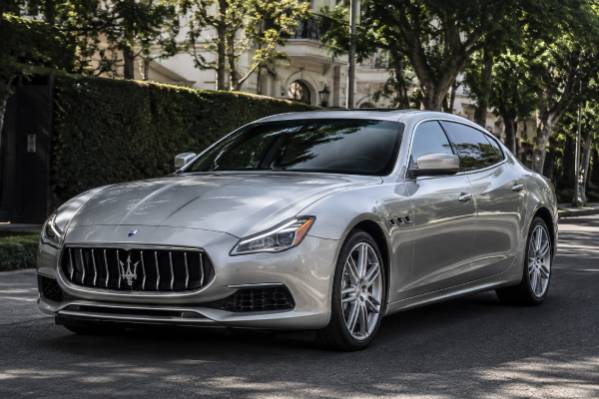
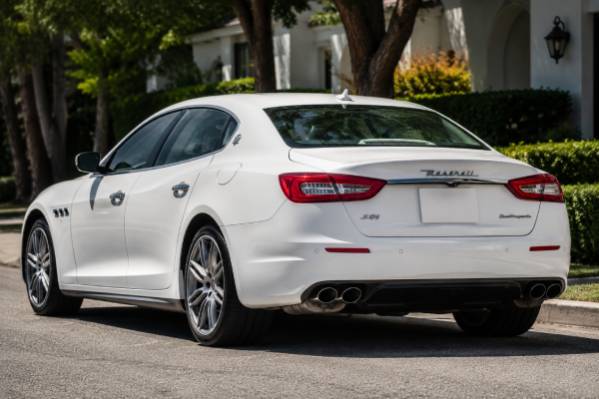
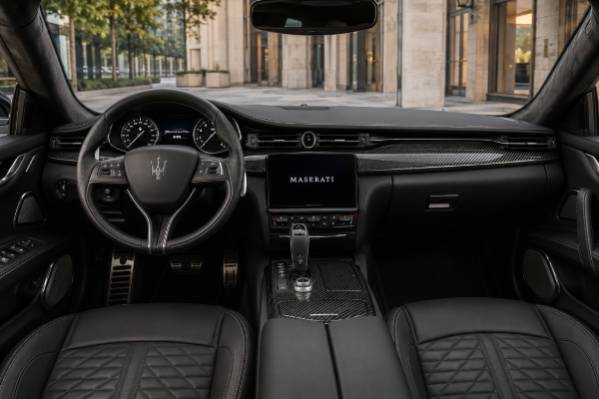
The 2018–2021 Maserati Quattroporte S is the 430 hp rear-wheel-drive V6 for the mature M156 generation. It pairs a 3.0-liter F160 twin-turbo engine and 580 Nm with an eight-speed automatic, limited-slip differential, Skyhook adaptive dampers, and electric power steering. Factory figures of about 5.0 seconds to 100 km/h and 288 km/h place it much closer to the original V8 GTS than the six-cylinder badge suggests. These cars also benefit from the facelifted body, active grille shutter, smartphone-compatible infotainment, Integrated Vehicle Control, and available Level 2-style driver assistance. Rear-wheel drive gives the S a lighter, cleaner front-axle feel than the S Q4, but it asks more from the rear tires and driver in poor weather. Reliability depends on heat management, correct oil, healthy ignition and boost systems, smooth gearbox behavior, good battery voltage, straight wheels, and working adaptive dampers. A sound example is a fast, spacious grand tourer with genuine chassis character. A neglected one can combine turbo V6 faults, expensive electronics, worn 20- or 21-inch tires, and deferred brake or suspension work.
Table of Contents
- The Strongest Rear-Drive V6
- 430 hp Powertrain and Chassis
- GranLusso, GranSport, and Model Years
- Engineering the Later M156
- Rear-Drive Performance on the Road
- Keeping the F160 S Healthy
- Buying a 430 hp Quattroporte S
The Strongest Rear-Drive V6
The 430 hp S is the highest-output rear-drive V6 Quattroporte of the M156 era. It offers nearly GTS-level road speed with less front-end mass and lower running costs than the V8.
The 430 hp calibration followed the earlier 410 hp S. Maserati increased both power and torque, raising the latter from 550 to 580 Nm. The engine’s maximum speed remained about 6,500 rpm, while a broad torque band made the improvement useful well below that point.
By 2018, the Quattroporte had already received the major 2017 facelift. The revised grille, bumpers, active Air Shutter, capacitive touchscreen, rotary controller, and phone integration gave the M156 a more polished character. Electric power steering then replaced the hydraulic system and enabled active lane and blind-spot functions.
Within the range, the S sat above the 350 hp rear-drive car and below the 530 hp GTS. It shared the V6 architecture with the S Q4 but omitted the transfer case, front differential, and front driveshafts. The resulting car is lighter and more transparent through the front axle, especially when accelerating out of a bend.
This version is sometimes overlooked because the Q4 posts a quicker standing-start figure. On dry roads after launch, the rear-drive S offers almost identical power and top speed. Its simpler driveline also reduces the number of fluids, seals, joints, and control components that can age.
The S is still a large luxury sedan. Its 5,262 mm body and 3,171 mm wheelbase provide genuine rear-seat room, while an 80-liter tank and 530-liter trunk support long travel. The car can be specified as an understated GranLusso or a more aggressive GranSport.
In the used market, a 430 hp S can be one of the most appealing M156 choices for an enthusiast in a mild climate. It retains enough power to feel exceptional without the GTS’s V8 heat and brake costs. That value only applies when the car has received maintenance appropriate to its original status, not its depreciated price.
430 hp Powertrain and Chassis
The S uses a 2,979 cc twin-turbo V6 producing 430 hp and 580 Nm, rear-wheel drive, an eight-speed ZF automatic, and a mechanical limited-slip differential. The chassis combines double wishbones, a five-link rear axle, adaptive dampers, and electric steering.
| Item | Specification |
|---|---|
| Platform | M156 facelift |
| Engine family | F160 |
| Engine configuration | 60-degree twin-turbo V6, direct injection |
| Displacement | 2,979 cc |
| Maximum power | 430 hp at approximately 5,750 rpm |
| Peak torque | 580 Nm at approximately 2,250–4,000 rpm |
| Maximum engine speed | Approximately 6,500 rpm |
| Transmission | Eight-speed ZF automatic |
| Drivetrain | Rear-wheel drive |
| Differential | Mechanical limited-slip |
| Front suspension | Double wishbone with Skyhook adaptive damping |
| Rear suspension | Five-link with Skyhook adaptive damping |
| Steering | Electric power assistance |
| Length | 5,262 mm |
| Wheelbase | 3,171 mm |
| Width without mirrors | 1,948 mm |
| Height | 1,481 mm |
| Trunk capacity | 530 liters |
| Fuel capacity | 80 liters |
| Claimed 0–100 km/h | Approximately 5.0 seconds |
| Claimed top speed | 288 km/h |
The F160 uses aluminum block and heads, direct injection, two turbochargers, and four continuously variable cam phasers. Its bore, timing technology, and several manufacturing concepts are related to the contemporary Maserati V8, but the 60-degree V6 has its own firing character and calibration.
Peak torque begins above the base 350 hp version’s lowest range, but the additional 80 Nm creates a much stronger middle. The car accelerates decisively from ordinary road speeds and continues pulling toward 6,000 rpm. Turbo response is quick enough that gearbox strategy is often more noticeable than boost delay.
The ZF automatic supports normal, Sport, and manual operation. It should make near-invisible shifts in relaxed driving and firm, clean changes under load. A fast shift is not the same as a violent one. Bangs, flare, converter shudder, or delayed engagement are faults.
The limited-slip differential provides a mechanical response when rear-wheel speeds differ. It works with Integrated Vehicle Control and the stability system, which can adjust engine torque and individual brakes. Differential seals, mounts, and fluid condition remain important under 580 Nm.
Brake hardware can vary. Many S cars use 345 mm front discs with four-piston fixed calipers, while performance packages may have larger drilled dual-cast components. Determine exact equipment by VIN and measurement rather than copying the S Q4 parts list.
Skyhook controls damping independently at each corner. The suspension button can request firmer damping separately from the engine’s Sport mode. This lets the driver keep a measured throttle while reducing body movement on a fast road.
GranLusso, GranSport, and Model Years
The S’s character depends strongly on trim and options. GranLusso favors traditional luxury, while GranSport adds visual and seating changes without altering the 430 hp powertrain.
GranLusso models can include premium leather or Zegna silk, wood trim, chrome exterior details, comfort-oriented seats, and richer rear-cabin equipment. They suit buyers who use the Quattroporte as an executive car but still want the stronger engine.
GranSport models normally have sport bumpers, black or carbon details, more supportive seats, larger wheels, and a darker cabin. The suspension’s basic adaptive architecture remains the same, although tire and wheel choices change ride and steering response.
Nerissimo packages create a blacked-out appearance through window surrounds, grille bars, exhaust tips, wheels, and selected trim. Verify the package on the build sheet. Later repainting can imitate it without the original finish or component list.
The 2018 cars introduce the steering and active assistance era. The 2019 model year brought detail updates, available Pieno Fiore natural leather, revised controls in some markets, and continuing refinement of Integrated Vehicle Control and assistance systems. Equipment changes vary by region.
For 2021, Maserati refreshed logos and rear lighting graphics in many markets. Boomerang-inspired lamp design and updated lettering help identify late cars. The MY22 GT, Modena, and Trofeo naming began after this period; a late-registered 2021 car should be decoded rather than labeled by appearance.
Useful options include adaptive cruise, Highway Assist, Lane Keeping Assist, Active Blind Spot Assist, surround-view cameras, full-LED lights, premium audio, four-zone climate control, ventilated seats, power rear seats, rear entertainment, and soft-close doors. Every added module deserves testing.
Wheel size requires a practical decision. Nineteen-inch wheels are rare on a sporty S but give the best compliance. Twenty-inch wheels balance appearance and durability. Twenty-one-inch wheels create a dramatic stance but increase tire cost and risk of inner-rim damage.
A car’s original color and interior can affect resale. Pieno Fiore leather is soft and attractive but marks more easily than heavily coated hides. Zegna fabric requires specialist cleaning. Carbon trim can crack or lift after heat exposure. Inspect materials in daylight rather than only under dealer lighting.
Engineering the Later M156
The later M156 blends traditional rear-drive proportions with predictive electronic control. The driver feels a conventional sedan, while steering, brakes, damping, engine, and sensors exchange information continuously.
Integrated Vehicle Control works before a major slide develops. It predicts loss of stability from steering, yaw, wheel-speed, throttle, and other data, then makes small torque or brake corrections. This approach can feel less intrusive than a late, obvious stability-control intervention.
Electric power steering is central to the active assistance package. Lane Keeping Assist can apply corrective torque, and Active Blind Spot Assist can resist an unsafe lane change. Highway Assist combines lane centering with adaptive cruise on suitable roads. The driver remains responsible at all times.
These functions depend on geometry. Incorrect toe, an off-center steering wheel, mismatched tires, ride-height changes, or collision misalignment can reduce performance. Windshield and bumper replacement may disturb camera or radar aim. Calibration records are important after repair.
The active Air Shutter behind the grille manages cooling and drag. It must open under higher heat demand. Inspect actuator function and the heat-exchanger stack behind it. Leaves and road debris can accumulate between radiators and reduce cooling efficiency.
Aluminum hood, doors, trunk lid, front subframe, and suspension parts help manage weight. The central structure uses high-strength steels and other strategic materials. Repairing mixed-material construction requires correct tools, separation, joining methods, and corrosion protection.
The cabin combines analog and digital elements. Conventional gauges and a center clock preserve identity, while the 8.4-inch touchscreen provides navigation, phone integration, vehicle settings, and camera displays. A rotary controller supports use without reaching forward.
The exhaust system uses valves to vary sound. In normal mode it remains refined. Sport mode creates a deeper, more urgent V6 note. Rattles, one-sided sound, or a valve fault can result from vacuum lines, actuators, hinges, or aftermarket changes.
Rear-Drive Performance on the Road
The 430 hp S feels strongest after the first few meters, where its rear-drive balance and broad torque create smooth, sustained acceleration. It is less secure than Q4 on a poor surface but more natural through the steering under power.
Normal mode makes the first portion of throttle travel calm enough for passengers. The gearbox uses high ratios and allows the V6 to lean on torque. Full acceleration triggers rapid downshifts and a pronounced surge through the middle range.
Sport mode changes shift points, throttle mapping, exhaust behavior, and the overall sense of urgency. The fixed paddles allow precise gear planning. On a flowing road, choosing one ratio early produces a more settled result than demanding repeated automatic kickdown.
The factory 5.0-second 0–100 km/h claim assumes good traction. A cold or worn rear tire can lengthen that time and provoke stability control. The S’s advantage over the 350 hp car is more obvious in rolling acceleration than in a single standing-start number.
Electric steering is accurate and consistent, though it communicates less fine texture than the early hydraulic rack. The front axle feels cleaner than the Q4 because it does not carry drive torque. Assistance should build smoothly without sudden lightness or steering warnings.
The rear differential allows progressive power application through a corner. On dry roads, the car can tighten its line under throttle. On wet roads, 580 Nm demands restraint. Stability control is effective, but a matched set of recent premium tires is the first safety system.
Skyhook gives the large sedan strong body control. In its softer setting, the car absorbs long waves and remains comfortable on motorways. The firmer setting reduces pitch and roll. Sharp potholes still reach the cabin, particularly with 21-inch wheels.
Braking should be stable and repeatable. A pulsation can come from disc runout, deposits, wheel damage, or suspension play. Cars used mainly in city traffic can show corrosion; aggressively driven examples may have heat-marked discs or tired fluid.
At high speed, the S is quiet and composed. Its top-speed capability is academic on public roads, but it explains the demands placed on tires, wheels, alignment, and brakes. Every replacement part must match the car’s load and speed requirements.
Rear-wheel drive makes tire condition especially important on the 430 hp S. The rear pair must transmit substantial midrange torque while the front pair carries steering and much of the braking load. Mixed compounds, old rubber, incorrect pressures, or uneven rear wear can make the car feel nervous long before an electronic warning appears. Check production dates as well as tread depth, inspect inner shoulders that are difficult to see, and compare wheel alignment records with the wear pattern. During the road test, progressive acceleration should produce clean forward motion rather than repeated intervention, axle tramp, or a sudden change in direction. Tire quality is part of the chassis setup, not merely a consumable to negotiate after purchase.
Keeping the F160 S Healthy
The 430 hp F160 needs attentive lubrication, cooling, ignition, boost control, and diagnostics. The extra output makes small faults more apparent under load than in the 350 hp version.
Engine, turbos, and cooling
A cold start should be prompt and even. Listen for sustained rattle, belt noise, exhaust leakage, or misfire. Watch for blue smoke after idling and white vapor that continues after warm-up. Full-throttle operation should be clean, without a flashing warning or reduced-power mode.
Inspect cam covers, timing-cover joints, turbo oil and coolant lines, and the lower engine for seepage. Oil reaching hot turbo or exhaust parts creates odor and risk. Use the exact approved lubricant and change it at least annually in low-mileage use.
Pressure-test the cooling system. Examine the expansion tank, cap, hoses, thermostat, pump, radiator stack, and intercooler plumbing. Confirm that cooling fans and Air Shutter respond correctly. Heat problems may appear only in traffic or after repeated boost.
Spark plugs and coils can break down under cylinder pressure. Injectors, high-pressure pumps, air leaks, oxygen sensors, and boost controls can produce similar symptoms. Review cylinder counters, fuel pressure, lambda behavior, and boost request before replacing assemblies.
Gearbox, rear axle, and chassis
The eight-speed transmission should select gears promptly and shift without flare or shudder. Fluid and filter service should follow official or specialist guidance for the VIN and use. Correct fluid temperature and level are essential.
Check the limited-slip differential, propeller shaft, couplings, and mounts for leaks, noise, and clunks. A load-sensitive vibration can come from a shaft, wheel, tire, bearing, or mount. Diagnosis needs a road test at several speeds.
Inspect Skyhook dampers, control arms, rear links, wheel bearings, anti-roll-bar components, wheels, and tires. Alignment should be performed only after worn parts and bent rims are corrected. Measure brakes rather than relying on dashboard wear estimates.
Battery and electronics
Battery reserve is critical. Low voltage can generate faults in EPS, ADAS, transmission, suspension, parking brake, and infotainment. Verify the correct battery type, charging output, and sleep current if the car repeatedly discharges.
Scan every module before and after the road test. Test all cameras, radar functions, blind-spot sensors, lights, climate zones, seats, windows, soft-close doors, audio, and infotainment. Confirm software updates and VIN-specific recall or campaign completion.
Buying a 430 hp Quattroporte S
The best S is standard, documented, and mechanically quiet, with recent matching tires and no unexplained warning history. Do not buy a tuned or cosmetically perfect car until diagnostics and underbody inspection support it.
Request the VIN, build sheet, full invoices, accident records, tire dates, brake measurements, and any ECU or exhaust documentation. Verify factory 430 hp rear-drive specification. A badge or seller’s dyno sheet is not enough.
| Area | Strong example | Risk signal |
|---|---|---|
| Engine | Clean cold start and full boost without misfire | Smoke, oil odor, catalyst codes, reduced power |
| Cooling | Stable temperature and pressure-holding system | Residue, top-ups, fan or shutter faults |
| Transmission | Smooth engagement and clean manual response | Flare, shudder, delay, harsh downshift |
| Rear axle | Quiet differential and vibration-free shaft | Whine, clunk, seal leak, load vibration |
| Chassis | Dry dampers, straight wheels, matched tires | Knocks, cracked rims, mixed tires, uneven wear |
| ADAS | All functions active with calibration evidence | Disabled system or repair without calibration |
| History | Annual specialist invoices | Long gaps or recent code clearing |
The inspection should start with a cold engine. Lift the car, remove covers as needed, inspect the radiator stack and turbo plumbing, measure brake wear, check wheel runout and suspension play, and scan all modules. Drive until oil and transmission temperatures stabilize.
Compare GranLusso and GranSport based on actual use. A GranLusso with 20-inch wheels may be the better long-distance car. A GranSport with larger wheels and performance brakes may suit an owner who accepts higher consumable costs.
Avoid repeated overheating, heavy smoke, persistent misfire, severe structural repair, unexplained ECU tuning, or multiple communication faults. Also be cautious when a seller blames every warning on an old battery without providing a clean scan after replacement.
Keep a first-year reserve for fluids, plugs, filters, battery, tires, brakes, wheel repair, alignment, suspension arms, and cooling parts. The S can be good value because of depreciation, but it is not inexpensive to restore from neglect.
For the right buyer, the 430 hp rear-drive S is one of the sweetest M156 configurations. It has enough power to challenge the V8 in ordinary use, fewer driveline parts than Q4, and a chassis that still feels alive. Its appeal is strongest when maintenance allows the performance to feel effortless rather than fragile.
References
- Maserati debuts Nerissimo Package for Levante, Ghibli and Quattroporte at Los Angeles Auto Show 2017
- Maserati Quattroporte MY19 Press Kit 2018
- The new Quattroporte: restyling and range strategy for a new product experience 2016
- Maserati Guides & Documentation for your vehicle 2026 (Owner’s Manual Portal)
Disclaimer
This article is for informational purposes only and is not a substitute for professional diagnosis, inspection, maintenance, or repair. Specifications, torque values, service intervals, procedures, software requirements, and equipment can vary by VIN, production date, market, and configuration. Before buying, servicing, or modifying any vehicle, verify the relevant details against its official service documentation and consult a qualified Maserati specialist when necessary.
Please share this article on Facebook, X/Twitter, or another platform to support our work and help other owners and enthusiasts find it.