
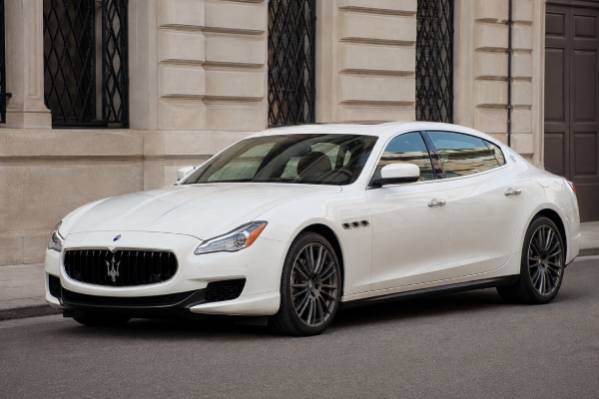
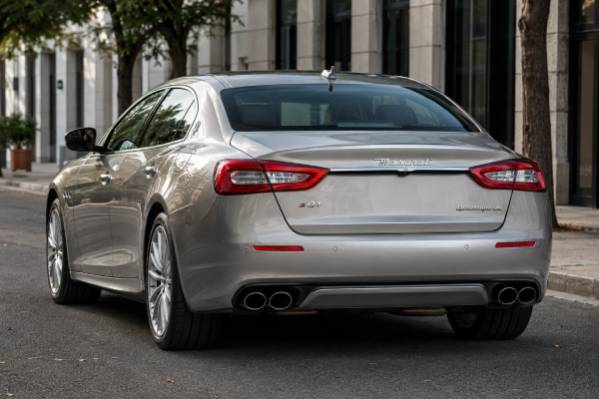
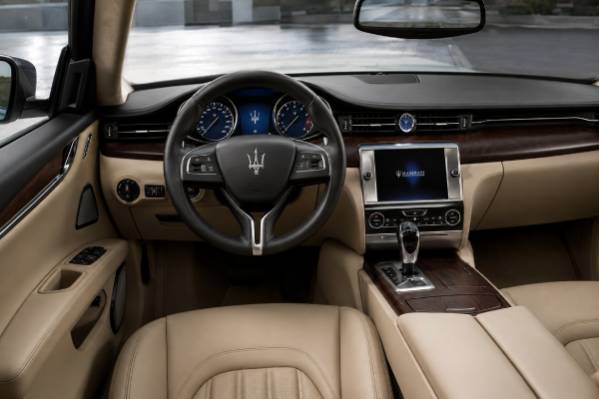
The 2013–2017 Maserati Quattroporte S Q4 is the all-wheel-drive version of the early 410 hp M156 V6 sedan. Its Q4 system normally preserves rear-drive behavior, then sends torque to the front axle when acceleration, steering angle, wheel slip, or surface conditions demand extra traction. With 550 Nm, an eight-speed automatic, Skyhook adaptive suspension, and a claimed 0–100 km/h time of about 4.9 seconds, it is the quicker-launching and more all-weather-focused alternative to the rear-drive Quattroporte S. The added transfer case, front differential, driveshafts, and half-shafts improve usable performance but create extra inspection and service points. Early 2013–2016 cars carry the original body and infotainment design; 2017 models add the facelifted grille and bumpers, active Air Shutter, smartphone integration, a revised console, and broader driver-assistance options. Buyers should prioritize matched tires, clean transfer-case operation, stable cooling, smooth shifts, strong battery voltage, healthy adaptive dampers, and complete specialist records. A well-kept S Q4 is a distinctive high-speed touring sedan, while a neglected one can combine ordinary M156 faults with expensive all-wheel-drive problems.
Table of Contents
- Why Q4 Changed the Quattroporte
- 410 hp V6 and Q4 Hardware
- Early Cars, Facelift, and Equipment
- Packaging, Traction, and Control Systems
- Driving the All-Weather Maserati
- Q4-Specific Maintenance and Aging
- Inspection Plan for an S Q4
Why Q4 Changed the Quattroporte
The S Q4 made the Quattroporte easier to use in rain, cold climates, and hard standing starts without turning it into a permanently front-driven luxury sedan. It was the first production Quattroporte built around an active all-wheel-drive option.
When the M156 generation arrived for 2013, Maserati needed a flagship that could compete globally with turbocharged, technology-rich German sedans. The new car was larger than the M139, with a 3,171 mm wheelbase and much more rear-seat room. It adopted lightweight aluminum closures and suspension components, direct-injected turbo engines, and a ZF eight-speed automatic.
The S Q4 paired the 410 hp F160 V6 with a compact front-drive system. Under steady cruising, the front axle is disengaged and the car behaves as rear-wheel drive. When the controller predicts or detects reduced traction, a multi-plate wet clutch transfers torque forward. The strategy protects steering character and efficiency while giving the car stronger launch traction than the rear-drive S.
That distinction mattered in markets where a large performance sedan must operate through snow and long winters. Before Q4, buyers who wanted a Quattroporte accepted rear-wheel drive and depended entirely on suitable tires and stability control. The M156 could now offer a credible four-season configuration without abandoning Maserati’s rear-biased handling philosophy.
The S Q4 sat below the rear-drive V8 GTS in power but could beat it away from a stop under imperfect conditions. Its broad 550 Nm torque curve and traction produced a factory 0–100 km/h claim near 4.9 seconds. At high speed, the lower-power V6 eventually gave the GTS an advantage, but everyday acceleration remained very strong.
Today, the Q4 is appealing to owners who need year-round usability. It is also more mechanically complex than the S. A low purchase price does not reduce the cost of a transfer case, front differential, driveshaft, or front axle repair. Tires become part of the driveline maintenance strategy because rolling-radius differences can keep the clutch system working unnecessarily.
A good example still feels distinctly Maserati. Hydraulic steering, a rear-biased power delivery, column-mounted paddles, adaptive dampers, and a vocal exhaust separate it from a conventional all-wheel-drive executive sedan. Its reputation depends less on the badge than on whether previous owners maintained all four corners as one system.
410 hp V6 and Q4 Hardware
The S Q4 uses a 2,979 cc twin-turbo V6 producing 410 hp and 550 Nm, an eight-speed automatic, and an electronically controlled clutch that can direct torque to the front axle. The additional hardware raises mass but improves launch performance and low-grip security.
| Item | Specification |
|---|---|
| Generation | M156 |
| Engine family | F160 |
| Engine type | 60-degree twin-turbo V6 with direct injection |
| Displacement | 2,979 cc |
| Maximum power | 410 hp at approximately 5,500 rpm |
| Peak torque | 550 Nm from approximately 1,750 rpm |
| Transmission | Eight-speed ZF automatic |
| Drive system | Q4 on-demand all-wheel drive |
| Normal torque strategy | Rear-wheel drive until front assistance is required |
| Maximum nominal front share | Up to approximately 50 percent |
| Front suspension | Double wishbone with Skyhook adaptive dampers |
| Rear suspension | Five-link with Skyhook adaptive dampers |
| Steering | Hydraulic power assistance |
| Length | 5,262 mm |
| Wheelbase | 3,171 mm |
| Width without mirrors | 1,948 mm |
| Height | 1,481 mm |
| Luggage capacity | 530 liters |
| Fuel capacity | 80 liters |
| Claimed 0–100 km/h | Approximately 4.9 seconds |
| Claimed top speed | Approximately 285–286 km/h |
The F160 has two turbochargers, direct fuel injection, variable valve timing, and aluminum construction. Maserati calibrated it for an early torque peak, giving the heavy sedan effortless response once the gearbox has selected the right ratio. The engine was assembled in Maranello and shares broad architecture with other contemporary Maserati applications, but software, intake, exhaust, and installation details are model-specific.
The Q4 transfer unit sits behind the transmission and uses an electronically controlled multi-plate clutch. A driveshaft runs forward to a differential, which sends torque through front half-shafts. Control software uses information from wheel-speed sensors, steering, throttle, yaw, braking, and stability systems. It can begin coupling the front axle before obvious wheelspin develops.
This predictive behavior is important. Q4 is not simply an emergency device that reacts after the rear tires lose grip. During a hard launch, rapid corner exit, or low-friction maneuver, it can preload the clutch and distribute torque according to the anticipated demand. When conditions stabilize, it reduces front engagement to restore the normal rear-drive state.
The eight-speed automatic links the engine and Q4 system. Its wide ratio range supports both acceleration and relaxed cruising. Shift quality should remain smooth at light throttle and decisive in Sport mode. A thump caused by driveline lash can be felt through several components, so diagnosis must distinguish transmission behavior from mounts, prop shafts, differential play, or transfer-case operation.
The suspension uses double wishbones at the front and a five-link rear arrangement. Q4 adds front driveline packaging but retains the basic geometry. Skyhook varies damping continuously, while springs and anti-roll bars carry the vehicle’s static and cornering loads. Adaptive control cannot hide a seized joint, damaged tire, or leaking damper.
Early Cars, Facelift, and Equipment
The 2017 facelift is the major dividing line within this assignment. It did not change the 410 hp rating, but it made the S Q4 easier to live with and easier to identify through revised exterior and interior details.
Launch-era 2013–2016 cars use the original grille, bumper forms, rear detailing, center console, and infotainment interface. Equipment varies significantly because Maserati allowed broad personalization and market packages differed. A basic option list may not describe all installed features, so decode the VIN and compare the car with its original order information.
The 2017 update introduced a sharper grille and revised bumpers. An active Air Shutter behind the grille helped manage cooling and airflow, contributing to an approximate ten-percent reduction in aerodynamic drag with the wider restyling changes. The update is subtle in photographs but gives the front a cleaner, more technical appearance.
The interior received an 8.4-inch capacitive touchscreen, Apple CarPlay, Android Auto, and a redesigned lower console with a rotary controller. These changes are more important in daily use than the cosmetic revisions. Early systems can still provide navigation, audio, and connectivity, but their response and phone integration feel dated.
GranLusso and GranSport themes became available in many markets. GranLusso emphasized luxury upholstery, comfort features, and polished exterior details. GranSport used more assertive bumpers, sport seats, dark trim, and athletic cues. Neither name changes the underlying 410 hp Q4 drivetrain.
Available driver aids expanded around the facelift. Depending on specification, an S Q4 may include adaptive cruise control, stop-and-go operation, forward-collision warning, emergency-braking assistance, lane-departure warning, blind-spot monitoring, surround-view cameras, or traffic-sign recognition. Test each system and scan its module; a missing warning light does not prove calibration is correct.
Wheel diameter has a direct effect on Q4 ownership. Factory 19-, 20-, and 21-inch arrangements were offered. Check that front and rear tire sizes match the approved staggered set and that brands, models, wear levels, and circumference remain compatible. Replacing only one worn tire can create a meaningful rolling-radius difference.
Cold-climate options such as heated seats, heated steering wheel, rear climate equipment, and suitable wheels can make one car more desirable than another. However, no option substitutes for proper winter tires. Q4 can distribute torque, but it cannot create braking or cornering grip on an unsuitable summer compound.
Packaging, Traction, and Control Systems
Q4 is distinctive because it adds front-axle traction while leaving the Quattroporte’s proportions and steering largely intact. The engineering goal was not permanent four-wheel drive; it was rear-drive feel with a fast reserve of front grip.
The M156’s long hood and rearward cabin remain visually dominant. Frameless side glass, a concave grille, three fender vents, and a strong rear haunch communicate Maserati identity. The front differential and shafts fit around the engine and suspension without changing the car into a nose-heavy shape.
The body combines steel structure with aluminum closures, subframes, and suspension elements. This construction reduces weight compared with an all-steel solution, but collision repair requires correct bonding, fastening, corrosion protection, and measurement. A Q4 car that has struck a curb can damage both suspension and driveline alignment even when the outer panel looks minor.
Front half-shafts add rotating mass and articulation. Their constant-velocity joints must accommodate steering and suspension movement while transmitting torque. Split boots allow grease to escape and contamination to enter. Catching a torn boot early may prevent joint replacement; ignoring it can lead to clicking, vibration, or complete wear.
The control system works with stability and brake electronics. If a wheel-speed sensor, steering-angle sensor, yaw sensor, or voltage supply is unreliable, the car may disable or limit Q4. A dashboard warning can therefore originate outside the transfer case. Accurate diagnosis requires reading all related modules and comparing live values.
Tire circumference is another engineering input. The controller expects front and rear wheel speeds to differ only within modeled limits. Unequal tread depth, wrong size, mixed construction, or pressure differences can appear as persistent slip. That may increase clutch activity and heat. Owners should rotate only where the staggered specification permits and replace tires as a coordinated set.
Inside, the driver does not select a separate permanent AWD mode. The system works automatically. Normal and Sport settings influence powertrain and chassis behavior, while the traction system decides how much front assistance is needed. This simplicity is useful, but it can hide developing problems until a warning or vibration appears.
The exhaust valves and transmission programming provide the car’s emotional layer. In normal use the V6 is restrained. Sport mode holds gears, sharpens response, firms damping, and increases exhaust volume. Q4 then helps deploy the stronger response rather than changing the sound itself.
Driving the All-Weather Maserati
The S Q4 feels rear-driven in ordinary conditions and noticeably more secure when the surface is wet or the throttle is opened early. Its launch traction is the clearest advantage, but stability at speed is equally valuable.
From rest, the combination of first gear, 550 Nm, and predictive front-axle engagement produces a clean, forceful start. On dry pavement the difference from the S may be small after the first few meters. On cold or damp roads, the Q4 can convert more torque into motion with less stability-control intervention.
Throttle response remains progressive in normal mode. The turbochargers provide a broad surge rather than a high-rev rush. Sport mode reduces the sense of delay by keeping the engine in a more responsive range. The gearbox’s column paddles let the driver prepare a ratio before an overtake or corner.
Steering feel remains one of the platform’s strengths. Hydraulic assistance gives the wheel weight and a natural return toward center. Under heavy power on a low-grip surface, the front axle can feel slightly busier as torque arrives, but the system does not normally pull the car like a front-driven layout.
Cornering balance is safe and rear-biased. Enter smoothly, allow the long body to settle, and the car takes a stable line. On exit, Q4 can reduce rear-tire load by sharing torque forward. Abrupt inputs still reveal the sedan’s mass. It is better driven with deliberate braking and progressive throttle than with constant electronic correction.
Ride quality depends on wheel and tire choice. Nineteen-inch wheels offer more impact compliance and protection; 21-inch wheels sharpen appearance and response but expose the rims and dampers to greater shock. Skyhook controls broad motions well, especially in high-speed bends. A repeated bounce, corner-to-corner inconsistency, or excessive impact suggests wear.
Winter performance requires realistic expectations. With four matched winter tires, Q4 can make the car highly capable on cold, wet, or lightly snowy roads. Ground clearance remains limited, and the wide body is not suited to deep snow. Braking distance still depends on tires, not on the number of driven wheels.
Highway cruising is quiet and stable. The 80-liter tank supports useful range, though cold weather and frequent boost use raise consumption. Wind noise from frameless glass should be controlled. Whistling, water entry, or glass movement can point to window indexing, seals, or door adjustment.
During a test drive, include tight full-lock turns in both directions, gentle acceleration from low speed, a hard straight-line pull, steady highway speed, and deceleration through several gears. Listen for clicking, binding, droning, clunks, or vibration that changes with throttle. These patterns help separate tires, bearings, shafts, differentials, and transfer hardware.
Q4-Specific Maintenance and Aging
Maintenance must treat the S Q4 as one integrated driveline. Correct tires, clean fluids, healthy mounts, accurate sensors, and stable voltage protect the transfer system as much as the transfer-case oil itself.
Transfer case, front axle, and tires
Inspect the transfer unit and front differential for leaks. Check front and rear propeller shafts, couplings, center support where fitted, and all CV boots. A vibration under load may come from a worn joint or shaft balance, while a shudder in tight turns can indicate tire mismatch, clutch control, fluid condition, or differential trouble.
Ask for evidence of driveline-fluid service based on the official schedule and specialist guidance for the specific VIN. Fluid must meet the exact requirement. Using a generic gear oil or incorrect fill method can alter clutch or bearing behavior. If symptoms already exist, obtain a diagnosis before assuming fresh fluid will solve them.
Measure every tire’s tread depth and circumference. Check date codes, pressure, load rating, repairs, and inner-shoulder wear. Four tires with the same brand name may still differ if they are different models or production generations. A matched approved set is the safest baseline.
Engine and cooling
The F160 shares the core concerns of the rear-drive S. Look for oil seepage around upper covers, timing joints, and turbo lines. Pressure-test the cooling system and inspect the expansion tank, hoses, thermostat area, water pump, radiator stack, and charge-air cooling components. Stable temperature in traffic with the air conditioning on is essential.
Misfires under boost may involve plugs, coils, injectors, fuel pressure, intake leaks, or compression. Do not continue hard driving with a flashing warning because unburned fuel can damage catalysts. Annual oil changes with the approved lubricant help protect turbo bearings and timing controls, even when mileage is low.
The ZF eight-speed should engage smoothly and shift without flare, shudder, or harshness. Inspect mounts because excessive engine or transmission movement can create driveline clunks that resemble internal faults. Review any adaptation reset or software work in the service history.
Suspension, brakes, and electronics
Check Skyhook dampers for leakage and compare ride height at all corners. Inspect control arms, ball joints, rear links, wheel bearings, and anti-roll-bar components. Q4 front packaging can make access more involved, so labor may differ from a rear-drive car.
Brake fluid ages by time. Measure discs, inspect pads and calipers, and test the electronic parking brake. Large wheels can hide inner-disc corrosion and inner-tire damage. Remove wheels during a serious pre-purchase inspection.
A strong battery is essential because Q4, stability, transmission, suspension, and body systems share network information. Load-test the battery, verify charging output, and scan every module. Investigate communication faults and low-voltage history rather than simply clearing them.
Recall and service-campaign status depends on VIN and market. Confirm completion through an authorized source. Software updates can affect shift behavior, driver aids, infotainment, and diagnostic logic, so records of programming are valuable.
Inspection Plan for an S Q4
Choose an S Q4 only after proving that its all-wheel-drive system is healthy. A cheaper rear-drive S may be a better purchase than a Q4 with mixed tires, driveline vibration, and undocumented fluid history.
Begin with the build record. Confirm the 410 hp specification, Q4 drivetrain, model year, trim theme, wheel package, brakes, driver aids, and rear-seat equipment. Registration year alone can misidentify a late-stock early car as a facelift model.
| Inspection area | Healthy signs | Reason to pause |
|---|---|---|
| Tires | Matched set, close tread depths, correct sizes and pressures | Mixed models, large wear difference, incorrect diameter |
| Q4 operation | No warnings, binding, shudder, clicking, or leaks | Full-lock vibration, axle noise, transfer-case fault history |
| Engine | Clean cold start, stable temperature, full boost without misfire | Smoke, coolant loss, oil odor, reduced power |
| Transmission | Prompt engagement and smooth shifts in all modes | Flare, bang, delay, or load-dependent clunk |
| Chassis | Dry dampers, straight wheels, even alignment | Uneven tire wear, leaking damper, bent rim |
| Electronics | Strong battery and clean full-module scan | Multiple communication faults or recently cleared readiness data |
| History | Dated invoices and documented campaign completion | Long gaps or unsupported verbal claims |
Have the inspection performed cold and warm. The technician should lift the car, remove undertrays as needed, inspect all driveline seals and boots, measure brakes and tires, check cooling pressure, and review live data. A road test should include low-speed turns and sustained highway operation.
Facelift cars command a premium for improved infotainment and available assistance features. That premium is justified only when those systems work. Cameras, radar, sensors, and windshield-mounted equipment may need calibration after glass or body repair. Confirm no warning has been hidden by coding or disconnected equipment.
A complete service file should show annual maintenance, correct oil, brake fluid, coolant attention, plugs, filters, battery replacement, tire sets, alignment, and any transmission or Q4 fluid work. Mileage should progress logically across invoices and inspection records.
Avoid structural damage near front suspension pickups or underbody driveline mounts. Also avoid a car that repeatedly overheats, displays persistent Q4 faults, has metal in driveline fluid, or shudders despite correct tires. Those problems can exceed the saving offered by an attractive sale price.
Set aside a post-purchase reserve for four tires, wheel straightening, fluids, filters, battery, brakes, suspension joints, and cooling components. Q4 ownership is most satisfying when maintenance is done as a system instead of one warning at a time.
For drivers who genuinely face poor weather, the S Q4 can be the most usable early M156. It retains the Quattroporte’s sense of occasion and steering character while making its torque easier to deploy. The reward depends on buying a car whose front and rear axles have always been maintained as partners.
References
- International Press Launch Quattroporte S & Quattroporte S Q4 2014
- All-new Maserati Quattroporte Unveiled at NAIAS 2013 2013
- The new Quattroporte: restyling and range strategy for a new product experience 2016
- Maserati Guides & Documentation for your vehicle 2026 (Owner’s Manual Portal)
Disclaimer
This article is for informational purposes only and is not a substitute for professional diagnosis, inspection, maintenance, or repair. Specifications, torque values, service intervals, procedures, software requirements, and equipment can vary by VIN, production date, market, and configuration. Before buying, servicing, or modifying any vehicle, verify the relevant details against its official service documentation and consult a qualified Maserati specialist when necessary.
Please share this article on Facebook, X/Twitter, or another platform to support our work and help other owners and enthusiasts find it.