
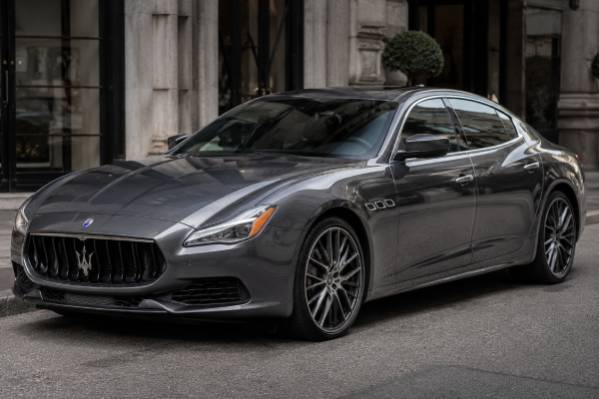
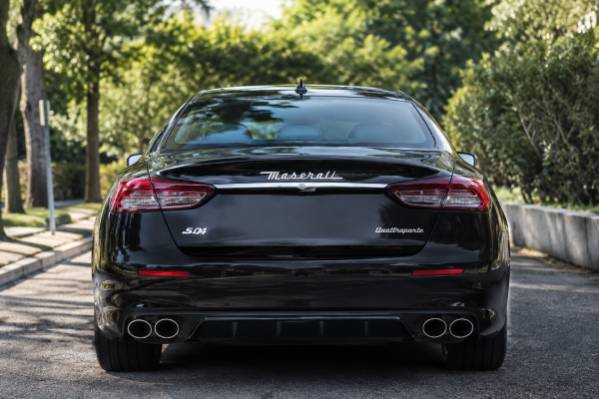
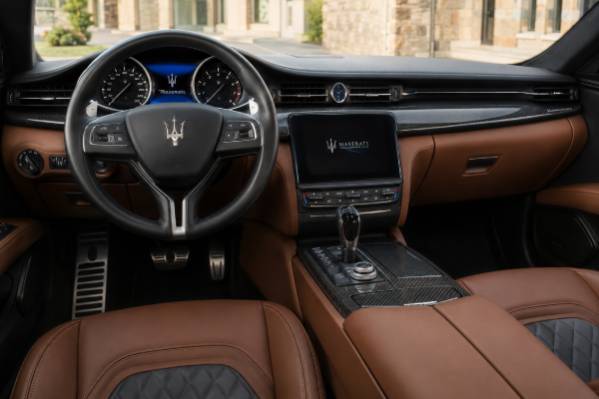
The 2018–2021 Maserati Quattroporte S Q4 is the mature 430 hp all-wheel-drive V6 version of the M156. Its 3.0-liter F160 twin-turbo engine produces 580 Nm, while the Q4 system normally runs in rear-wheel drive and couples the front axle when traction or vehicle dynamics require it. An eight-speed automatic, Skyhook adaptive dampers, electric power steering, and Integrated Vehicle Control support factory figures of about 4.8 seconds to 100 km/h and 288 km/h. These years combine the facelifted body and smartphone-compatible infotainment with active lane, blind-spot, and highway assistance when optioned. Q4 makes the power easier to deploy in rain, cold weather, and hard launches, but it adds a transfer case, front differential, driveshafts, CV joints, and strict tire-matching requirements. Buyers should examine rolling circumference across all four tires, driveline leaks, full-lock shudder, axle noise, battery condition, sensor calibration, cooling performance, boost health, and transmission behavior. Properly maintained, the S Q4 is one of the most capable all-season Quattroportes. Neglected, it combines the normal costs of a turbocharged luxury sedan with expensive four-wheel-drive faults.
Table of Contents
- The Mature Q4 Performance Sedan
- 430 hp and Active All-Wheel Drive
- Late M156 Trims and Equipment
- Q4 Control Logic and Packaging
- All-Season Speed and Road Behavior
- Servicing the Complete Q4 System
- Buying with Four Driven Wheels
The Mature Q4 Performance Sedan
The 430 hp S Q4 is the quickest-launching V6 Quattroporte of its period and the easiest to use across changing weather. It keeps a rear-driven feel until front torque is useful.
The earlier 410 hp S Q4 established the M156’s active all-wheel-drive formula. The later model raised output to 430 hp and torque to 580 Nm while retaining the same basic 3.0-liter engine family, eight-speed automatic, and rear-biased Q4 concept.
By 2018, Maserati had completed the important mid-cycle changes. The facelifted grille and bumpers, active Air Shutter, capacitive 8.4-inch touchscreen, phone integration, and revised console were already in place. Electric power steering then allowed active driver-assistance systems to influence direction.
The S Q4 sat above the 350 hp rear-drive version and alongside the rear-drive S. It did not use the V8 GTS engine, but its launch traction produced an impressive 4.8-second 0–100 km/h claim. At speed, the S and S Q4 shared the same 288 km/h maximum.
Q4 is not a permanent equal-split system. Under steady conditions, the wet multi-plate clutch is open and the rear axle carries propulsion. When control software predicts slip or greater traction demand, the clutch closes and sends torque through the front propeller shaft and differential.
That strategy gives the model broad appeal. Owners in wet or snowy regions gain usable security, while drivers in dry climates can enjoy hard launches and corner exits with less rear-tire intervention. The car still needs season-appropriate tires; all-wheel drive cannot improve braking on an unsuitable compound.
The mature S Q4 also carries more electronics than early cars. Integrated Vehicle Control, active lane functions, radar cruise, blind-spot intervention, adaptive lighting, and surround-view cameras create a safer and more convenient sedan when calibrated. They also raise the importance of battery health and complete diagnostics.
Used values can obscure original complexity. Four premium tires, Q4 fluid service, transfer-case repair, adaptive dampers, brakes, and electronic calibration may cost a large share of the purchase price. A documented example is worth a clear premium over a car with mixed tires and vague history.
430 hp and Active All-Wheel Drive
The S Q4 combines 430 hp, 580 Nm, an eight-speed ZF automatic, and an electronically controlled front-axle clutch. Its additional driveline mass is offset by superior traction and a faster standing start.
| Item | Specification |
|---|---|
| Platform | M156 facelift |
| Engine family | F160 |
| Engine type | 60-degree twin-turbo V6, direct injection |
| Displacement | 2,979 cc |
| Maximum power | 430 hp at approximately 5,750 rpm |
| Peak torque | 580 Nm at approximately 2,250–4,000 rpm |
| Transmission | Eight-speed ZF automatic |
| Drive system | Q4 on-demand all-wheel drive |
| Normal propulsion | Rear-wheel drive |
| Maximum nominal front share | Up to approximately 50 percent |
| Front suspension | Double wishbone with Skyhook adaptive damping |
| Rear suspension | Five-link with Skyhook adaptive damping |
| Steering | Electric power assistance |
| Typical front brakes | 360 × 32 mm drilled dual-cast discs, six-piston Brembo calipers |
| Typical rear brakes | 345 × 28 mm ventilated drilled discs, fixed calipers |
| Length | 5,262 mm |
| Wheelbase | 3,171 mm |
| Width without mirrors | 1,948 mm |
| Height | 1,481 mm |
| Trunk volume | 530 liters |
| Fuel capacity | 80 liters |
| Claimed 0–100 km/h | 4.8 seconds |
| Claimed top speed | 288 km/h |
The F160 uses direct injection, twin turbochargers, aluminum construction, and variable timing on all four camshafts. The 430 hp mapping provides substantially more middle-range force than the 350 hp calibration. Maximum torque arrives over a wide band, making passing quick even before the engine reaches its power peak.
The eight-speed automatic works as the system’s central torque path. Its output feeds the rear axle and the Q4 transfer unit. Shift quality and driveline behavior must be diagnosed together because a clunk can come from transmission mounts, transfer clutch, propeller shafts, differentials, or CV joints.
The front axle is coupled by a wet multi-plate clutch under electronic control. Inputs include throttle position, steering angle, wheel speeds, yaw, acceleration, brake status, and stability-system calculations. The controller can preemptively add front torque rather than waiting for visible rear slip.
A nominal maximum of about half the torque can go forward. The exact amount changes continuously. Once traction demand falls, the clutch reduces pressure and the car returns toward rear drive. There is no need for a manual snow setting to make the basic distribution work.
The Q4 brake package is often larger than the rear-drive S system, although market and option differences exist. Dual-cast discs pair an iron friction ring with an aluminum hat to reduce unsprung mass. They are effective but expensive, so thickness and condition must be measured.
Skyhook controls individual damper forces, while electric steering supports active assistance. The car’s higher driveline mass does not transform its basic balance, but worn front components or mismatched tires can make the Q4 feel heavier and less precise than intended.
Late M156 Trims and Equipment
GranLusso and GranSport define the main personalities, while annual changes refine lighting, leather, assistance systems, and 2021 visual details. All retain the 430 hp Q4 powertrain when correctly specified.
GranLusso places emphasis on luxury materials, comfort seats, wood, chrome, and available Zegna silk. It often carries rear-cabin options that suit chauffeur use. GranSport adds sportier bumpers, darker trim, more supportive seats, and larger wheel choices.
A GranSport badge does not mean a different boost calibration. Likewise, a blacked-out Nerissimo package does not increase output. Use the build sheet to separate factory trim from later cosmetic changes.
Pieno Fiore natural leather became an important premium option in this period. It has a rich feel and visible grain but can show scratches, dye transfer, and bolster wear. Zegna silk needs textile-specific cleaning. Poor recoloring or aggressive extraction can reduce value.
Available active features include adaptive cruise with stop-and-go, Highway Assist, Lane Keeping Assist, Active Blind Spot Assist, forward-collision warning, emergency braking support, traffic-sign recognition, and surround-view cameras. Test each feature on a suitable road and inspect module faults.
Adaptive full-LED headlights provide strong illumination but can be costly after lens damage, condensation, or module failure. A front-end repair may also affect radar, parking sensors, Air Shutter, and cooling ducts. Compare body gaps and paint depth with calibration records.
For 2021, many markets received updated logos, lettering, and boomerang-style rear lamp graphics. These details mark the final pre-MY22 phase. The later Modena Q4 name belongs to the 2022 trim strategy, even when a late 2021-built car was registered in 2022.
Wheel size matters more on Q4 than appearance alone suggests. The approved staggered tire sizes must maintain compatible rolling circumference. A replacement tire with a different model, tread depth, or real-world diameter can create speed differences that the transfer clutch must absorb.
Winter wheel packages should be verified for brake clearance, load rating, offset, and tire diameter. A smaller approved wheel with proper winter tires may provide better cold-weather performance than large all-season tires.
Q4 Control Logic and Packaging
The Q4 system preserves Maserati’s rear-drive layout by treating front torque as a variable resource. Its success depends on accurate sensors, matched tires, sound joints, clean fluid, and stable electrical supply.
The transfer case sits behind the gearbox and directs power forward through a shaft. The front differential divides it between the half-shafts. Each CV joint must accommodate suspension and steering motion. Torn boots can release grease and admit dirt before noise begins.
Tire circumference is a direct control input. If one axle rotates faster because of wear, wrong size, or low pressure, the system may interpret the difference as slip. Prolonged clutch correction creates heat and wear. Measure tread at several points and compare actual tire models, not only sidewall numbers.
Wheel-speed sensors are shared with ABS and stability functions. Steering-angle, yaw, brake-pressure, and accelerator data also influence Q4. A fault in any related system may disable all-wheel drive or produce a generic warning. A complete module scan is essential.
Integrated Vehicle Control adds predictive engine and brake management. It can reduce instability before a conventional system would make an obvious correction. Q4 then adds traction by distributing torque, so the two systems cooperate rather than operating as separate layers.
Electric steering enables lane-centering and blind-spot torque intervention. Correct front alignment is especially important because the car must know where straight ahead is. An off-center steering wheel after tire or suspension work can affect assistance behavior.
The active Air Shutter and heat-exchanger stack occupy the front of the car near Q4 components. Road debris, corrosion, leaks, or collision repair in this area can affect cooling and driveline packaging. Undertrays should be removed for a serious inspection.
The M156 body uses aluminum closures and front subframe pieces with high-strength structural materials. A curb impact can bend a wheel, arm, subframe, or front shaft without dramatic body damage. Look for fresh hardware, uneven tire wear, and inconsistent alignment readings.
All-Season Speed and Road Behavior
The S Q4’s defining road advantage is its ability to use 580 Nm early and cleanly. It feels rear-driven in normal cruising, then gains front assistance almost invisibly when conditions deteriorate.
A full-throttle launch produces strong acceleration with less wheelspin than the S. The claimed 4.8-second time depends on suitable tires and conditions, but the system’s benefit remains clear in rain or low temperatures. Q4 is especially useful when joining fast traffic from a damp side road.
Normal mode keeps the gearbox in high ratios and softens throttle response. Sport mode holds lower gears, opens exhaust valves, sharpens response, and supports more assertive driving. The column paddles allow the driver to prepare the engine before a pass.
Steering is precise but slightly less free of driveline influence than the rear-drive S. During strong acceleration on a low-grip surface, the front axle may feel more active as it carries torque. Under ordinary conditions, the difference is subtle.
Cornering behavior remains rear-biased. Enter with smooth braking and the long body takes a stable set. On exit, Q4 can share torque forward, reducing the tendency for the rear stability system to cut power. The car still has substantial mass and prefers measured transitions.
Skyhook provides a broad ride range. The soft setting works well for motorway travel; the firmer setting reduces roll and pitch. Twenty-one-inch wheels can create sharp impact noise, while 19- or 20-inch winter setups often improve compliance.
All-wheel drive does not shorten braking distance. Cold-weather security comes from four proper winter tires. Q4 improves acceleration and stability, but tire compound controls stopping and lateral grip. Old all-season tires remain a weak link.
During a test drive, make slow full-lock turns in both directions. Binding, hopping, groaning, or shudder may indicate tire mismatch, transfer-clutch behavior, CV joints, or differential trouble. Then test steady highway speed and acceleration through several gears for vibration.
The large Brembo brakes should deliver a consistent pedal. Drilled discs can develop visible surface checking; distinguish normal fine marks from cracks reaching edges or holes. Measure thickness and inspect both faces.
The most revealing Q4 test is often conducted at low speed rather than full throttle. With the car warm, make gentle circles in both directions on a dry, level surface and listen for hopping, binding, clicking, or a pulsing sensation through the floor. Then accelerate progressively in a straight line and note any vibration that changes with load. These symptoms can come from tires, wheels, half-shafts, mounts, the transfer unit, or differentials, so diagnosis should precede parts replacement. Record all four tire models, sizes, pressures, production dates, and tread depths. Even nominally identical sizes can have different rolling circumferences when brands or wear levels are mixed. A complete matched set and correct alignment reduce unnecessary work within the active coupling and provide a reliable baseline for evaluating the rest of the driveline.
Servicing the Complete Q4 System
Good Q4 maintenance treats tires, fluids, sensors, shafts, and voltage as one system. Replacing only the failed transfer component without correcting the cause can lead to repeat damage.
All-wheel-drive hardware
Inspect the transfer case, front differential, rear differential, and shaft seals for leakage. Check front CV boots, joints, propeller shafts, couplings, and mounts. Record fluid condition and service history using the exact specification for each unit.
A shudder can result from incorrect tires, degraded fluid, clutch wear, software, mounts, or joint problems. Diagnose it before performing a fluid change as a cure. Metal debris, burnt odor, or persistent binding needs specialist evaluation.
Keep all four tires matched by brand, model, size, load rating, speed rating, and similar tread depth. If one tire is damaged, compare replacement circumference with the remaining set. Depending on wear, replacing all four may be cheaper than stressing the driveline.
F160 engine and transmission
Check cold-start quality, oil leaks, spark plugs, coils, injectors, boost control, high-pressure fuel delivery, and turbo plumbing. Misfires often appear only under load. Continued driving can damage catalysts.
Pressure-test the cooling system and inspect the expansion tank, hoses, thermostat, pump, fans, radiators, intercoolers, and Air Shutter. The temperature must remain stable during traffic and hard acceleration.
The eight-speed automatic should engage promptly and shift cleanly. Fluid and filter service requires correct temperature and fill procedure. Inspect engine and transmission mounts because movement can create clunks throughout the Q4 driveline.
Chassis and electronics
Examine Skyhook dampers, control arms, rear links, wheel bearings, wheels, brakes, and tire wear. An alignment should include a centered steering sensor and should follow repair of mechanical play.
Load-test the battery and verify charging voltage. Low supply can trigger Q4, EPS, ADAS, transmission, and suspension faults. Scan all modules before clearing any code. Confirm recalls, campaigns, and software updates by VIN and market.
Buying with Four Driven Wheels
Buy an S Q4 only when the all-wheel-drive system can be proven healthy. The Q4 badge adds real capability, but it should also raise the standard of the pre-purchase inspection.
Request the VIN, build sheet, full service invoices, tire replacement history, drivetrain-fluid records, diagnostic reports, and details of collision or wheel damage. Confirm factory 430 hp Q4 specification and correct trim.
| Area | Healthy evidence | Warning |
|---|---|---|
| Tires | Matched set with close tread depth and correct pressures | Mixed models, wrong size, large front-to-rear wear difference |
| Q4 hardware | Dry cases, quiet joints, no full-lock binding | Shudder, clicking, leaks, or transfer warnings |
| Engine | Even cold start and full boost without misfire | Smoke, oil odor, coolant loss, reduced power |
| Transmission | Prompt engagement and smooth hot shifts | Delay, flare, bang, or load vibration |
| Chassis | Straight wheels, dry dampers, measured brakes | Cracked rims, knocks, uneven ride height |
| Electronics | Strong battery and clean full-module scan | Network faults or disabled active systems |
| History | Annual specialist invoices | No tire or Q4 records despite high mileage |
A specialist should inspect the car cold, raise it, remove undertrays as needed, check every driveline seal and boot, measure wheel and tire condition, pressure-test cooling, and scan modules. The road test must include full-lock maneuvers, sustained cruising, and hard acceleration after warm-up.
GranLusso and GranSport should be chosen for comfort and appearance, not assumed mechanical differences. Wheel size should suit local roads and climate. A smaller approved winter set can add more useful performance than an expensive cosmetic option.
Avoid a car with persistent Q4 faults, mismatched tires, metal in driveline fluid, structural front-end repair, repeated overheating, or aggressive tuning without records. Restoring several systems at once can exceed the price advantage.
Budget for four tires as a set, drivetrain fluids, battery, brakes, adaptive dampers, suspension arms, plugs, filters, and cooling parts. Q4 ownership is rewarding when maintenance is coordinated rather than delayed until warnings appear.
For an owner who travels through rain, cold, or snow, the 430 hp S Q4 may be the most complete late M156 V6. It combines the range’s mature electronics with genuine rear-biased dynamics and strong performance. The best examples feel seamless because every part of the system agrees on speed, grip, and torque.
References
- Maserati debuts Nerissimo Package for Levante, Ghibli and Quattroporte at Los Angeles Auto Show 2017
- Maserati Quattroporte MY19 Press Kit 2018
- International Press Launch Quattroporte S & Quattroporte S Q4 2014
- Maserati Guides & Documentation for your vehicle 2026 (Owner’s Manual Portal)
Disclaimer
This article is for informational purposes only and is not a substitute for professional diagnosis, inspection, maintenance, or repair. Specifications, torque values, service intervals, procedures, software requirements, and equipment can vary by VIN, production date, market, and configuration. Before buying, servicing, or modifying any vehicle, verify the relevant details against its official service documentation and consult a qualified Maserati specialist when necessary.
Please share this article on Facebook, X/Twitter, or another platform to support our work and help other owners and enthusiasts find it.