
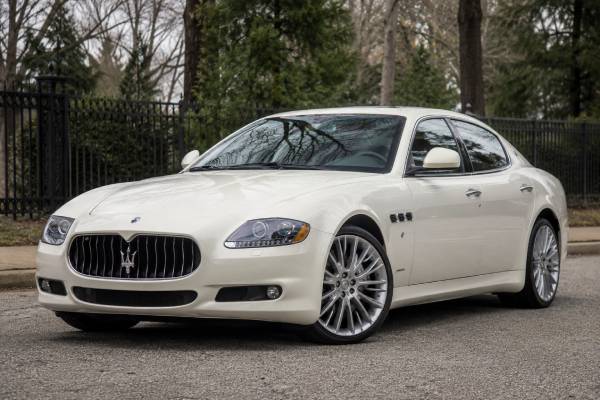
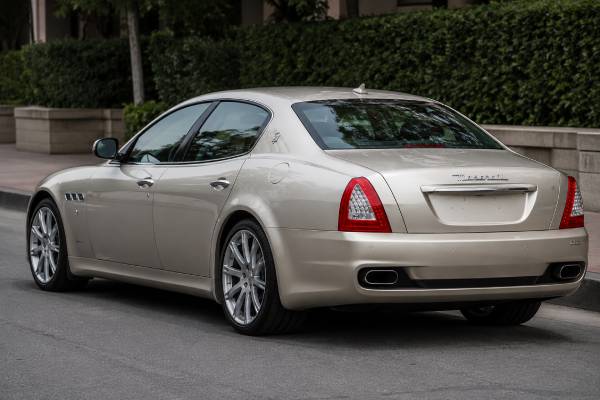
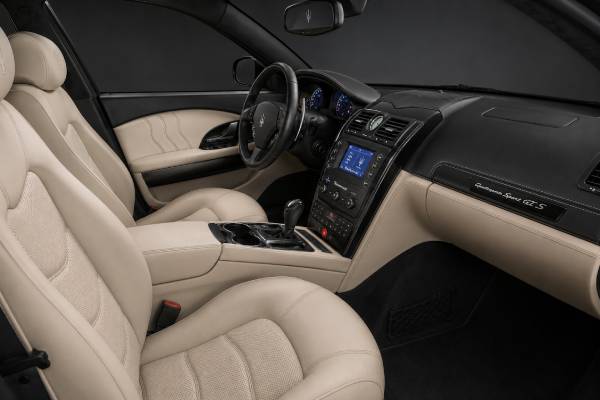
The Maserati Quattroporte Sport GT S Awards Edition is a limited, detail-focused celebration of the M139’s critical success. Revealed at the 2010 Geneva Motor Show, it marked the 56 awards the fifth-generation Quattroporte had received during its first six years. Underneath, it is the 440 hp Sport GT S: a naturally aspirated 4.7-liter V8, six-speed ZF automatic, rear-wheel drive, fixed-rate dampers, stiffer springs, lower ride height, and a valve-controlled sports exhaust. What makes the Awards Edition collectible is its factory presentation, including Quarzo Fuso or Nero Pianoforte paint, burnished exterior brightwork, satin-finish 20-inch wheels, hand-polished brake calipers, special Alcantara and leather, unique trim, and an identifying B-pillar plaque. Those parts are difficult to replace and easy to imitate poorly. Buyers must therefore inspect provenance and originality as carefully as the engine, brakes, suspension, gearbox, and electronics. A documented example preserves a specific moment in Maserati design history; an incomplete or recreated car loses much of the edition’s purpose.
Table of Contents
- An Award-Winning M139 Celebration
- Sport GT S Mechanics and Numbers
- Limited-Edition Details and Authentication
- Quarzo Fuso Craft and Engineering
- The Awards Edition on the Road
- Preservation, Maintenance, and Known Faults
- Collector Buying Checklist
An Award-Winning M139 Celebration
The Awards Edition was created to celebrate the M139 Quattroporte’s reception, not to introduce a new engine or chassis. Its importance comes from combining the range’s sharpest 440 hp specification with unusually elaborate factory finishing.
When the fifth-generation Quattroporte appeared in the early 2000s, it challenged the established luxury-sedan formula. Pininfarina gave it a long hood, rearward cabin, frameless glass, and restrained surfaces. Maserati supplied a naturally aspirated V8, hydraulic steering, and rear-wheel drive. It looked formal enough for business use but behaved more like a four-door grand tourer.
The model evolved quickly. Early DuoSelect cars used a rear transaxle and automated clutch. Later automatic versions adopted a ZF gearbox for smoother low-speed use. The 2008 facelift revised the grille, lights, bumpers, and model range. The Sport GT S then arrived with 440 hp, fixed dampers, stiffer springs, lower ride height, faster transmission logic, and a controlled sports exhaust.
At Geneva in March 2010, Maserati unveiled the Awards Edition. The company cited 56 awards from automotive and lifestyle publications across 14 countries and four continents. Rather than chase a large power increase, it emphasized the qualities that had made the Quattroporte memorable: Pininfarina shape, handcrafted materials, braking hardware, and a sporting-luxury contrast.
The edition was offered worldwide from the second half of 2010. Production references commonly identify 126 cars, but an individual car’s authenticity should still rest on its VIN, build sheet, plaque, invoice, and complete detail specification. A seller’s claim that a car is one of a smaller color or market subset needs separate proof.
The Awards Edition matters today because it is one of the last richly detailed versions of a naturally aspirated Maserati flagship. It predates the larger turbocharged M156 and captures a period when visual differentiation relied on paint, metal finishing, leather, Alcantara, and subtle trim rather than software packages or oversized aerodynamic parts.
Sport GT S Mechanics and Numbers
Mechanically, the Awards Edition follows the 440 hp Sport GT S. The edition’s additional value lies in finish and rarity, but its driving character depends on the same F136Y V8, ZF automatic, fixed suspension, limited-slip differential, and Brembo brakes.
| Item | Specification |
|---|---|
| Chassis | M139 facelift |
| Body style | Four-door, five-seat sedan |
| Engine code | F136Y |
| Engine | 90-degree naturally aspirated V8 |
| Displacement | 4,691 cc |
| Construction | Aluminum block and heads |
| Valvetrain | DOHC, 32 valves, variable intake timing |
| Maximum power | 440 hp at about 7,000 rpm |
| Peak torque | Approximately 490 Nm at 4,750 rpm |
| Transmission | Six-speed ZF automatic |
| Drive | Rear-wheel drive with limited-slip differential |
| Suspension | Stiffer springs and fixed-rate dampers |
| Ride height | Lower than Quattroporte S |
| Front brakes | 360 mm dual-cast discs, six-piston calipers |
| Rear brakes | 330 mm ventilated discs |
| Wheels | 20-inch Multi Trident, dark grey satin finish |
| Wheelbase | 3,064 mm |
| Length | Approximately 5,052 mm |
| Claimed 0–100 km/h | Approximately 5.1 seconds |
| Claimed top speed | Approximately 285 km/h |
The V8 uses an aluminum construction, cross-plane crankshaft, four valves per cylinder, and variable timing on the intake camshafts. It has a wet-sump lubrication system and multipoint fuel injection. Its defining quality is a linear rise in power. The car feels civilized at low speed, stronger through the middle range, and dramatic near 7,000 rpm.
The ZF 6HP automatic uses Sport-specific software to hold ratios and answer paddle commands more quickly. It is a conventional torque-converter gearbox, not a dual-clutch unit. Smoothness and consistency matter more than absolute speed. Delayed engagement, flare, shudder, or a changing shift quality as the fluid heats requires investigation.
Fixed-rate dampers replace the Skyhook system fitted to the Quattroporte S. Stiffer springs and lower ride height reduce roll and pitch. The setup provides cleaner body control but transmits more road impact, especially through 20-inch wheels. Correct tire construction and pressure are essential.
The Brembo dual-cast front discs pair iron friction rings with aluminum hats. The Awards Edition’s hand-polished calipers are a visual distinction, not a different basic braking mechanism. Their mirror-like finish should not distract from measuring disc thickness, checking seals, and assessing fluid.
Factory performance figures are useful reference points, but these cars are now old enough that engine health, fuel quality, tire age, wheel condition, alignment, and brake drag can alter how they perform.
Limited-Edition Details and Authentication
The Awards Edition must be authenticated through a complete pattern of details and documentation. A plaque or paint color alone is not enough because standard Sport GT S cars can be modified to resemble the limited version.
Maserati announced several defining features:
- Quarzo Fuso pearlescent metallic grey with a warm golden hue, developed for the edition.
- Nero Pianoforte as an alternative dark exterior finish in some markets.
- Burnished treatment on exterior chrome, side vents, and grille surround.
- 20-inch Multi Trident wheels in dark grey with a satin effect.
- Hand-polished front and rear brake calipers.
- Poltrona Frau leather combined with perforated Alcantara in an undulating pattern.
- Alcantara headlining.
- Piano Black satin-finish wood moldings.
- Brushed aluminum door sills.
- Upgraded trunk trim with chrome details and a leather side pocket.
- Richer floor mats.
- A specific Awards Edition plaque on the B-pillar.
A genuine car should have a factory build record showing the edition or its associated option codes. The original invoice, dealer correspondence, warranty book, and delivery documentation add confidence. Match the VIN on the body, windshield, labels, and records. Inspect the plaque for correct location, font, finish, and aging.
Quarzo Fuso is especially important. It changes with light, showing grey, silver, and gold tones. Repainting one panel convincingly can be difficult. Use a paint-depth meter and inspect in sunlight, shade, and point light. Slight color differences may reflect repair; cloudy pearl, edge masking, or incorrect metallic orientation suggests poor refinishing.
Polished calipers require careful examination. Original polishing should look deliberate and consistent, not like bright silver paint. Corrosion, aggressive cleaning, or later refinishing may reduce originality. The satin wheels should have the correct shape and finish; replicas, diamond-cut refurbishments, or gloss powder coat alter the appearance.
The interior pattern is hard to duplicate correctly. Check the Alcantara perforation, wave design, stitching, headlining, sills, trim sheen, trunk details, and mats. Reupholstery may be necessary on a heavily worn car, but it should be documented and carried out with accurate materials.
Do not assume all cars have identical convenience options. Maserati still allowed market and customer equipment choices. Authenticate the limited-edition layer first, then decode the individual options separately.
Quarzo Fuso Craft and Engineering
The Awards Edition is visually distinctive because it uses finish and texture to highlight the M139’s proportions. Its engineering remains purposeful beneath the decorative work.
Pininfarina’s body stretches over a 3,064 mm wheelbase yet avoids limousine bulk. The hood is long, the cabin sits rearward, and the shoulder rises toward the rear wheels. Three fender vents and a low shield grille establish Maserati identity. Frameless glass and a tapered tail make the body feel lighter than its dimensions suggest.
Quarzo Fuso paint was designed to emphasize those surfaces. The warm pearl changes the apparent curvature of the hood, doors, and rear quarters as the viewing angle moves. Burnished metal reduces contrast, letting the body form dominate. The dark satin wheels visually anchor the car, while polished calipers create a controlled flash behind them.
The chassis uses double wishbones at the front and a multi-link system at the rear. Fixed dampers and stiffer springs keep body motion in check. Hydraulic steering connects the driver directly to front-tire load. The limited-slip differential helps the rear axle deploy torque progressively.
Inside, the Awards Edition balances sport and ceremony. Alcantara holds occupants in place and absorbs reflections. Poltrona Frau leather provides softness and color depth. Piano Black satin-finish trim is less reflective than full gloss, while brushed sills and polished calipers create a repeating metal theme.
The exhaust is another engineered sensory feature. Pneumatic valves alter the route and volume of exhaust flow. Normal driving can remain subdued; Sport mode produces a deeper idle, stronger resonance, and sharp downshift notes. A factory system should change character rather than stay permanently loud. Missing vacuum lines, seized valves, or aftermarket mufflers can erase that dual personality.
The aerodynamic package is discreet. Lower ride height and a stable underbody matter more than visible wings. Cooling openings remain integrated into the low nose. Inspect radiators, condensers, and air guides because debris and impact damage can compromise engine and climate performance.
The cabin’s practical limits remain. Rear legroom is generous, but the sloping roof and door aperture can inconvenience tall passengers. The infotainment system is dated, small-item storage is limited, and some switches lack the precision of German rivals. Those weaknesses are part of the era, but nonfunctional systems are not.
Preservation requires restraint. Over-polished paint, glossy refinished wheels, heavy leather dye, and replacement trim can make a rare car look newer while making it less authentic. Sensitive correction and documented conservation are usually more appropriate than wholesale cosmetic renewal.
The Awards Edition on the Road
The Awards Edition drives like a well-sorted 440 hp Sport GT S: alert, sonorous, and more controlled than the Quattroporte S. Its special materials do not alter performance, but they heighten the sense of occasion.
At low speed, the V8 is smooth and the torque converter makes creeping easy. The fixed suspension is always present, transmitting more surface detail than Skyhook-equipped cars. The ride should be firm but not crude. Harsh crashing or repeated vertical motion indicates tire, wheel, damper, spring, bushing, or alignment problems.
The engine responds immediately to throttle. From the middle of the rev range, it gathers pace rapidly and continues building toward 7,000 rpm. The exhaust note hardens as the valves open, and the car feels most alive when the gearbox is controlled with the column paddles.
Sport mode changes throttle response and shift strategy. Downshifts should be prompt and clean, with no flare or thump. The transmission is not instantaneous by current standards, but it should feel coordinated with the engine. A car that hesitates between commands can have adaptation, fluid, valve-body, torque-converter, mount, or voltage issues.
Hydraulic steering gives clear information about the front tires. The wheel loads naturally through a bend, and the long wheelbase provides stability. The chassis does not hide weight, but it manages it. On a smooth road, the car turns in cleanly, settles quickly, and allows the driver to balance the line with throttle.
Grip depends heavily on tires. The original 20-inch format leaves little sidewall, so old rubber can make the car skittish, noisy, and harsh. Mixed brands or incorrect load ratings undermine the chassis. A premium matched set often improves a car more than a cosmetic upgrade.
The dual-cast brakes should feel strong and progressive. Test for vibration both cold and hot. A stored car may have disc corrosion; a heavily used one may show heat marks or deposits. Brake fluid age affects pedal consistency during repeated stops.
On the motorway, the Awards Edition remains a capable grand tourer. The engine quiets in sixth gear, the body tracks confidently, and the seats support long travel. Wind noise around frameless glass or a vibration at speed should not be ignored. Window alignment, door seals, wheels, tires, bearings, and driveline components can all contribute.
Urban drawbacks include the turning circle, long nose, low front bumper, and vulnerable wheels. Parking sensors and mirrors must work. The polished calipers and special wheel finish also demand careful cleaning products; aggressive chemicals can damage the surfaces.
Preservation, Maintenance, and Known Faults
Owning an Awards Edition requires two maintenance plans: one for the M139’s mechanical systems and another for irreplaceable edition-specific materials. Both should be handled proactively.
Camshaft variator wear is the best-known powertrain concern. Arrange a genuine cold start after the car has sat overnight. A persistent metallic rattle can indicate variator or oil-retention problems. Correct repairs are labor intensive and should be documented in detail.
Inspect the engine and cooling system for:
- Cam-cover and timing-cover oil leaks.
- Coolant residue around hoses, radiator, expansion tank, thermostat, and water pump.
- Weak or non-operating cooling fans.
- Misfires from ignition, injection, or intake faults.
- Collapsed engine mounts.
- Exhaust leaks or nonfunctioning valve controls.
- Battery, alternator, or ground problems.
Time-based servicing is essential. Low mileage does not prevent oil contamination, brake-fluid moisture, coolant degradation, seal hardening, or tire aging. Use the correct lubricant and filters. Specialists commonly service the ZF transmission fluid and pan/filter despite original lifetime-fill messaging. Filling temperature and procedure must be correct.
Suspension and steering wear can destroy the Sport GT S calibration. Check fixed dampers for leaks or loss of control, springs for damage or incorrect replacements, and bushes, ball joints, tie rods, rear links, anti-roll-bar hardware, and wheel bearings for play. Replacement parts should match the original specification.
Brake inspection must go beyond appearance. Measure dual-cast disc thickness, check pad life and wear pattern, inspect polished calipers for seal leakage, and verify the parking brake. Avoid harsh wheel cleaners that can stain polished calipers or alter satin wheels.
Edition-specific preservation areas include:
- Pearl paint matching and clear-coat condition.
- Burnished metal finish on grille and vents.
- Satin wheel color and texture.
- Polished caliper surfaces.
- Alcantara nap, perforation, and wave pattern.
- B-pillar plaque and brushed sill condition.
- Piano Black satin trim.
- Trunk leather pocket, chrome details, and mats.
Electrical faults remain typical M139 concerns. Test windows, locks, seats, memory, climate zones, parking sensors, infotainment, audio, blinds, trunk release, alarm, and both keys. A weak battery can cause widespread warnings, but recurring faults need a full module scan.
Storage should include a quality battery maintainer, controlled humidity, clean dry bodywork, correct tire pressures, and regular full-temperature drives. Avoid long idling as a substitute for use. The car needs oil temperature, brake movement, air-conditioning operation, and suspension travel to remain healthy.
Collector Buying Checklist
A buyer should pay an Awards Edition premium only after proving that the car is genuine, substantially complete, and mechanically sound. Missing special parts can be harder to solve than common M139 repairs.
Request a complete digital file before inspection: VIN, build sheet, original invoice, service history, cold-start video, paint photographs in several lighting conditions, plaque close-up, wheel and caliper images, interior pattern details, trunk trim, and underbody views.
Use this inspection sequence:
- Confirm the VIN and factory edition status.
- Compare every special feature with period factory descriptions.
- Measure paint depth and evaluate pearl color matching.
- Start the car fully cold and assess variator noise.
- Scan all electronic modules before the drive.
- Pressure-test the cooling system and inspect fans.
- Measure brakes and inspect polished calipers and satin wheels.
- Check fixed suspension, steering joints, ride height, and alignment.
- Drive on smooth and rough roads and at sustained speed.
- Rescan, inspect for leaks, and review findings against invoices.
| Adds confidence | Reduces value |
|---|---|
| Factory build record and original edition invoice | Plaque or badges without documentary support |
| Correct Quarzo Fuso or documented factory color | Poor pearl matching or extensive undocumented repainting |
| Original polished calipers and satin wheels | Painted calipers, gloss wheels, or replicas |
| Complete Alcantara, trim, trunk, and plaque details | Generic retrim or missing limited-edition pieces |
| Specialist mechanical history and clean cold start | Cosmetic perfection with deferred engine and chassis work |
Set a first-year reserve even for a premium example. Baseline fluids, tires, battery, alignment, minor leaks, and electrical repairs can overlap. Insurance should recognize documented edition status, and secure storage should protect the finish and interior.
The Awards Edition suits a collector who values originality and material detail as much as performance. A modified car may still be enjoyable, but it should be priced as a Sport GT S rather than as a preserved special edition. The strongest examples combine complete provenance, careful conservation, and regular expert use.
References
- Geneva Motor Show 2010 – Worldwide debut for the Maserati Quattroporte Sport GT S Awards Edition 2010
- Maserati unveils new Quattroporte Sport GT S on the 70th anniversary of its first Indianapolis 500 win 2009
- Maserati Guides & Documentation for your vehicle 2026 (Owner’s Manual Portal)
Disclaimer
This article is for informational purposes only and is not a substitute for professional diagnosis, inspection, maintenance, or repair. Specifications, torque values, service intervals, procedures, software requirements, and equipment can vary by VIN, production date, market, and configuration. Before buying, servicing, or modifying any vehicle, verify the relevant details against its official service documentation and consult a qualified Maserati specialist when necessary.
Please share this article on Facebook, X/Twitter, or another platform to support our work and help other owners and enthusiasts find it.