
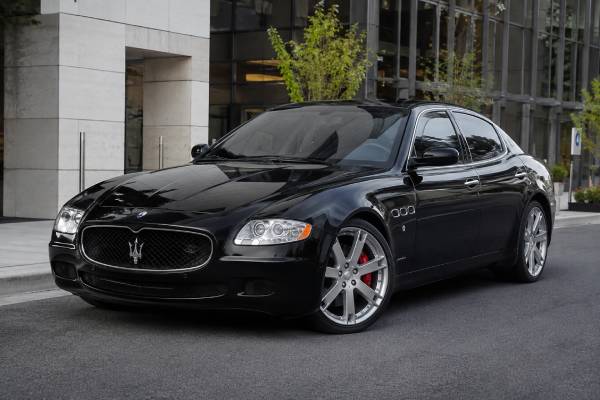
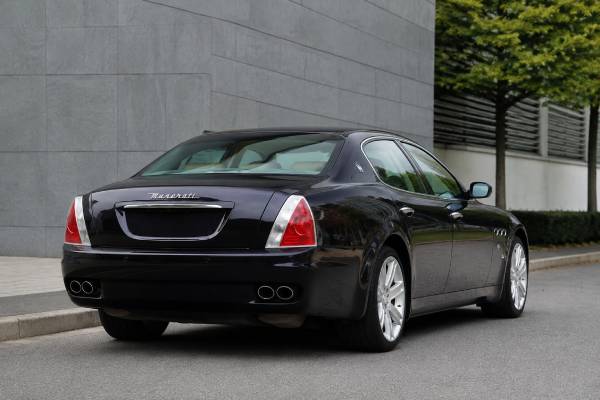
The 2007–2008 Maserati Quattroporte Sport GT S is the most focused 4.2-liter pre-facelift M139. Unveiled at the 2007 Frankfurt Motor Show, it retained the 400 hp wet-sump V8 and six-speed ZF automatic but replaced the Sport GT’s adaptive Skyhook dampers with fixed-rate units. Maserati also fitted stiffer springs, lowered the body, widened the rear tires, and added Brembo dual-cast front discs with red six-piston calipers. The changes targeted body control, braking consistency, and steering response rather than a higher power figure.
This car is often confused with both the milder Sport GT and the later facelifted 4.7-liter Sport GT S. The assignment’s F136UD identifier belongs to the 4.2-liter, 400 hp specification, though engine stamping and factory build data should still be verified because parts systems may group wet-sump 4.2 engines under wider F136UC-family terminology. The model rewards correct fixed suspension, 20-inch wheels, 295-section rear tires, dual-cast brakes, hydraulic steering, and a healthy ZF. Bent wheels, tired dampers, worn discs, mismatched tires, or startup timing noise can erase its advantage.
Table of Contents
- The Final 4.2-Liter Pre-Facelift Sports Sedan
- F136UD, ZF, and GT S Hardware
- Model Identity, Brakes, and Original Equipment
- Fixed-Damper Engineering and Lower Stance
- How the 4.2 Sport GT S Feels
- Maintaining Dual-Cast Brakes and Fixed Suspension
- Buying the Correct Pre-Facelift GT S
The Final 4.2-Liter Pre-Facelift Sports Sedan
The 4.2 Sport GT S represents the last and most aggressive development of the original M139 body before the 2008 facelift and 4.7-liter engine. Its significance comes from chassis and brake engineering, not an increase beyond 400 hp.
The fifth-generation Quattroporte began as a rear-transaxle DuoSelect sedan in 2003. Maserati added Executive GT and Sport GT trims in 2005, then introduced the conventional ZF automatic in 2007. The Sport GT S arrived later that year as an automatic-only dynamic flagship for the pre-facelift range.
Maserati retained the Pininfarina body and wet-sump 4.2 V8. The company instead concentrated on the contact points between the car and road. Fixed-rate dampers replaced Skyhook’s adjustable units. Stiffer springs reduced movement, and the ride height fell by approximately 10 mm at the front and 25 mm at the rear according to period information.
Rear tire width increased to 295/30 on 20-inch wheels, improving traction and creating a more planted stance. The front brakes adopted dual-cast discs that joined an iron friction ring to an aluminum center. Red six-piston monobloc calipers replaced the smaller four-piston arrangement used on less extreme cars.
The result was not intended as a limousine. It sacrificed some compliance and adjustability for precision. Buyers who prefer soft ride and rear-seat calm may be better served by an Executive GT or standard Automatica. The GT S is for drivers who accept low-profile tires, reduced ground clearance, and more expensive brake hardware.
Its short production window makes correct examples uncommon, but no reliable production number should be invented without factory evidence. The broader Automatica family totaled 6,050 cars, not all Sport GT S models. Rarity claims must distinguish the specific derivative from the whole automatic run.
Confusion with the facelifted car is widespread. The later 4.7 Sport GT S has 440 hp, revised vertical-slat grille, different lights, updated cabin, altered exhaust, and further chassis development. A 2007–2008 pre-facelift car should have the earlier front and rear styling and the 4,244 cc 400 hp engine.
The model’s desirability depends on remaining a system. A car with generic dampers, incorrect springs, ordinary front brakes, narrow rear wheels, or aftermarket ride height may still be fast, but it no longer represents the factory GT S engineering that justifies its name.
F136UD, ZF, and GT S Hardware
The Sport GT S combines a 4,244 cc wet-sump V8 with the ZF 6HP26 automatic, rear limited-slip differential, fixed-rate suspension, 20-inch wheels, and upgraded dual-cast front brakes. Power remains 400 hp at 7,000 rpm.
| Item | Specification |
|---|---|
| Model code | M139 |
| Engine identifier | F136UD, wet-sump 4.2-liter V8 specification |
| Engine | 90-degree aluminum V8, DOHC, 32 valves |
| Displacement | 4,244 cc |
| Induction | Naturally aspirated with electronic multipoint injection |
| Maximum power | 400 hp at 7,000 rpm |
| Maximum torque | Approximately 460 Nm at 4,250 rpm |
| Transmission | ZF 6HP26 six-speed automatic with paddle control |
| Drive | Rear-wheel drive with limited-slip differential |
| Weight distribution | Approximately 49 percent front, 51 percent rear |
| Construction | Steel monocoque with front and rear subframes |
| Front suspension | Double wishbones, stiffer springs, fixed-rate dampers |
| Rear suspension | Double wishbones, stiffer springs, fixed-rate dampers |
| Ride height | Approximately 10 mm lower front and 25 mm lower rear than core versions |
| Front brakes | Brembo dual-cast iron/aluminum discs with red six-piston calipers |
| Rear brakes | Ventilated discs with ABS and stability control |
| Wheels | 20-inch alloy wheels |
| Rear tires | 295/30 R20 factory-size specification |
| Steering | Hydraulic power-assisted rack and pinion |
| Wheelbase | 3,064 mm |
| Length | 5,052 mm |
| Width | 1,895 mm |
| Kerb weight | Approximately 1,970 kg |
| 0–100 km/h | Approximately 5.6 seconds |
| Top speed | Approximately 270 km/h |
The naturally aspirated V8 uses a cross-plane crankshaft, aluminum-silicon construction, chain-driven camshafts, and variable intake timing. It shares the broad wet-sump architecture of automatic 4.2 M139s, while the assignment identifies the GT S engine as F136UD. Parts and procedures should be confirmed by the individual engine and VIN.
The ZF automatic provides smooth torque-converter launch and six ratios. Steering-column paddles let the driver command gears, though electronic protection may refuse an unsuitable shift. The transmission’s refinement makes the chassis changes easier to exploit without upsetting the car during a gear change.
Dual-cast front discs reduce unsprung mass by using aluminum where a conventional rotor uses a heavy iron hat. The friction ring remains iron for durability and heat capacity. Replacement requires the correct dimensions and construction; a cheap one-piece substitute changes mass and potentially brake behavior.
The fixed dampers remove Skyhook valves, sensors, and mode variation from the damping function. They are not “failed Skyhook replacements” on a genuine GT S. Correct spring and damper rates are central to originality.
Model Identity, Brakes, and Original Equipment
Authenticating a GT S means proving its engine, automatic driveline, lowered fixed suspension, widened rear tire package, and six-piston dual-cast brakes. Cosmetic cues alone are not enough.
Begin with the VIN and factory build record. Confirm production date, trim designation, engine identifier, transmission, original colors, wheels, brakes, interior materials, and market. A seller’s use of “GTS” can refer to later 4.7 cars or be added casually to any Sport GT.
The front brake calipers should be red six-piston Brembo units matched to dual-cast discs. Inspect casting marks and disc construction. A two-piece appearance does not prove factory dual-cast technology because bolted aftermarket rotors use a different design.
Measure ride height on level ground and inspect spring and damper part numbers. Lowering springs are common modifications on ordinary Sport GTs. A genuine GT S should also show the wider 295/30 rear tire specification and correct 20-inch wheel widths and offsets.
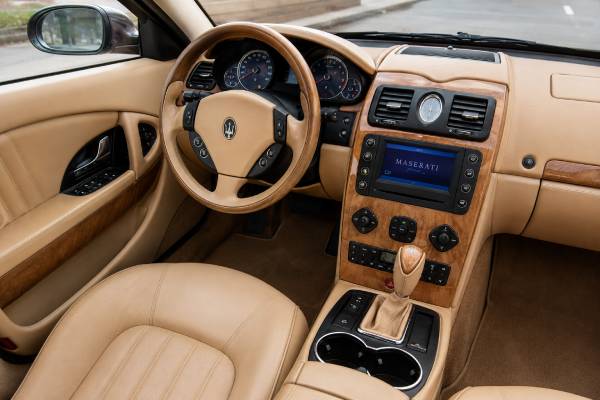
Interior and exterior details continue the sport theme with dark mesh, red Trident accents, carbon-fiber trim, sports controls, and aluminum pedals, subject to market variation. Use documents rather than one rigid visual formula.
Parts frequently changed during ownership
Potential originality losses include:
- Skyhook or generic coilover conversions.
- One-piece replacement front rotors.
- Standard four-piston calipers.
- Non-original springs that alter rake.
- Incorrect wheel widths or spacers.
- Narrower or mixed rear tires.
- Carbon wrap over damaged original trim.
- Later facelift grilles, badges, or lights.
- Loud exhaust systems represented as factory.
Some changes may be sensible when original parts are unavailable, but they should be documented and priced honestly. Preserve removed GT S components even when worn; calipers, discs, springs, dampers, wheels, and trim can support future restoration.
Because ground clearance is reduced, inspect the front bumper, lower trays, exhaust, crossmembers, and jacking points. Repeated contact can crack panels, bend mounts, or remove cooling ducts.
Fixed-Damper Engineering and Lower Stance
The GT S uses passive hardware to create predictable control instead of varying damper force electronically. The lower body, stiffer springs, wider rear tires, and lighter front rotor centers work together to improve response.
Fixed-rate dampers provide the same calibrated behavior every time. They remove the comfort-to-sport range of Skyhook but allow engineers to target one setting closely. On a smooth road, this creates cleaner body control and a more direct relationship between steering input and chassis response.
Lowering reduces the center of gravity and suspension travel. The front drops less than the rear, changing the visual stance and body attitude. Correct bump stops and damper lengths are essential; improvised lowering can cause the suspension to strike its stops or lose tire contact on rough surfaces.
Stiffer springs resist roll, pitch, and squat. They also send more force into bushings, mounts, wheels, and the body. A worn joint becomes more obvious in a GT S than in a softer model. Creaks, knocks, or rear steer should never be dismissed as normal firmness.
The 295-section rear tires increase the contact patch and support traction, but width alone does not guarantee grip. Tire age, compound, temperature, pressure, load rating, and alignment determine performance. Mixed brands or hard old tires can make the rear unpredictable.
Dual-cast discs reduce rotating and unsprung mass at the front. Less unsprung mass helps the wheel follow the road, while six-piston calipers distribute pressure across a larger pad. The system still needs fresh fluid, healthy hoses, free pistons, correct pads, and sound rear brakes.
The 49:51 balance means the car remains slightly rear-biased despite its front-mounted automatic. Steering is hydraulic, giving natural effort and feedback. Correct front geometry and matched tires are essential because the stiffer chassis transmits defects directly to the wheel.
The exterior remains restrained. There is no large wing or aggressive body kit; the lower stance, wheels, red calipers, dark details, and Pininfarina shape communicate the model. This makes an authentic chassis easier to overlook—and a replica easier to create without close inspection.
How the 4.2 Sport GT S Feels
The 4.2 GT S feels tauter, more immediate, and less forgiving than other pre-facelift Quattroportes. Its speed is similar on paper, but braking, body control, and tire response make it faster and more confident on a demanding road.
The ZF transmission gives smooth launch and quick access to the V8’s torque. In automatic operation it can be relaxed; manual paddle use holds lower gears and lets the engine reach 7,000 rpm. Shifts should be clean and consistent, not violent.
The engine responds immediately because it is naturally aspirated. It lacks the large low-rpm torque of modern turbo engines, yet its linear delivery makes throttle adjustment precise. The sound deepens under load and hardens as revs rise.
Turn-in is the model’s defining sensation. Reduced body movement and wide tires make the response feel quicker than the car’s size suggests. The long wheelbase keeps the transition stable, while the limited-slip differential helps drive out of corners.
Ride quality is firm. On smooth roads it feels controlled and expensive; on sharp urban surfaces it can become busy. A healthy car should still absorb one impact without repeated bouncing or crashing. Bent wheels, tired dampers, worn mounts, or hardened tires can make it far worse than intended.
Ground clearance requires planning around steep ramps and speed humps. Scraping is not only cosmetic because lower ducts and undertrays influence cooling and airflow.
The brakes should provide a solid pedal and resist fade on the road. Six-piston calipers do not compensate for cracked discs, wrong pads, old fluid, or overheated tires. Test progressive stops first, then firmer braking after the system warms.
At high speed the GT S tracks securely when alignment is correct. Tramlining can result from the wide tires and road grooves, but excessive pull or nervousness points to geometry, wheel, bearing, or joint issues.
Rear passengers feel more road texture than in an Executive GT. The car remains a spacious sedan, but this derivative prioritizes the driver. Buyers should experience it on their usual roads before assuming the most sporting version is automatically the best one.
Fixed damping changes the inspection method. A diagnostic scan cannot tell the whole story because there are no Skyhook valves to command at each corner. The examiner must compare ride height, damper leakage, rebound control, spring identification, bump-stop condition, and response over the same surface. One tired damper can make the car feel nervous even when no warning lamp is present.
The dual-cast front discs also deserve measurement rather than a visual glance through the wheel. Record thickness at several points, inspect both faces, check the iron ring for heat checking and deposits, and examine the aluminum center and joining interface. Confirm that replacement pads have the correct shape and friction specification. A seller may describe ordinary two-piece aftermarket rotors as equivalent, but the construction, mass, thermal behavior, and originality can differ.
Finally, measure all four wheels for runout and inspect the inner barrels. The 20-inch package places little sidewall between the road and rim, while the wide rear tires amplify alignment errors. Correct tires fitted to straight wheels often transform a car that initially feels tramline-prone or harsh.
Maintaining Dual-Cast Brakes and Fixed Suspension
GT S maintenance adds expensive chassis-specific parts to the normal automatic M139 checklist. Brake and suspension originality should be inspected as carefully as the engine and transmission.
Suspension, wheels, and brakes
Check dampers for leakage, weak control, or mismatched part numbers. Inspect springs for breakage and verify ride height side to side. Examine wishbones, ball joints, bushings, links, tie rods, wheel bearings, subframe mounts, and steering rack.
Remove all wheels to inspect inner barrels, cracks, welds, straightening, corrosion, and runout. Date and identify every tire. Correct 295/30 rear fitment and matching front tires are essential.
Measure dual-cast discs and inspect the friction ring for cracks, heat spots, lips, scoring, and uneven deposits. Check aluminum centers, interfaces, caliper pistons, seals, pads, hoses, fluid, rear brakes, ABS, and stability control. Price genuine-quality replacements before purchase.
F136UD V8 and ZF transmission
Start cold and listen for cam-variator or timing noise. Inspect oil leaks at cam covers, timing case, filter area, pan, and cooler connections. Verify hot pressure, service history, mounts, belts, pulleys, coils, plugs, injectors, and catalysts.
Test cooling in traffic with air conditioning operating. Clean heat exchangers and inspect fans, relays, thermostat, tank, cap, hoses, and coolant.
For the ZF, examine pan, filter, connector sleeve, cooler lines, and seals. Test Drive and Reverse engagement, converter lock-up, manual shifts, and hot behavior. Shudder, flare, harsh downshifts, or delayed selection need specialist diagnosis.
Electrical and trim
A strong battery and charging system are essential. Scan all modules and test windows, seats, locks, mirrors, parking sensors, climate, audio, navigation, paddles, stability control, and warning lights. Inspect carbon clearcoat, headliner, leather, sticky switches, and modified wiring.
Confirm rear tie-rod recall status and other campaigns by VIN. Recall completion does not replace current physical inspection.
Buying the Correct Pre-Facelift GT S
Buy only after proving that the car is the 4.2-liter pre-facelift GT S and that its unique suspension and brake hardware remain present. The wrong model with the right badge is not a bargain.
Request the VIN, build sheet, engine code evidence, ZF identification, original invoice, production date, wheel and tire specifications, brake photos, spring and damper numbers, trim details, and complete service records.
A specialist inspection should include:
- Confirming the pre-facelift body and 4,244 cc engine.
- Verifying F136UD assignment data and actual engine stamping.
- Identifying fixed dampers, correct springs, ride height, and wide rear fitment.
- Authenticating dual-cast discs and six-piston calipers.
- Cold-start listening and full diagnostic scan.
- ZF leak, adaptation, converter, and hot-shift testing.
- Wheel runout, tire age, alignment, and suspension-joint checks.
- Cooling, oil pressure, steering, differential, and mount inspection.
- Paint depth, underside damage, recalls, corrosion, and structural review.
- Operation of all cabin and safety systems.
Avoid severe startup rattle, low oil pressure, overheating, transmission slip, cracked wheels, unsafe disc cracks, incorrect suspension, structural underside damage, mixed old tires, or warning lights that a seller has normalized.
A genuine car with worn original brakes and dampers may still be worth restoring, but price the correct components first. Conversely, a documented high-quality replacement using original specification can be preferable to failing factory parts retained only for appearance.
After purchase, establish a baseline, preserve removed components, and resist further lowering. Repair geometry before aligning, warm the engine before hard use, and cool the brakes through ordinary driving rather than parking immediately after repeated heavy stops.
The 4.2 Sport GT S is valuable because it shows how much Maserati could change through chassis engineering alone. It does not need more than 400 hp to feel distinct. Correct fixed dampers, stance, rear tires, dual-cast brakes, and a healthy ZF make the difference—and those are the details a buyer must prove.
References
- Quattroporte V Automatica – Quattroporte models | Maserati 2026 (Manufacturer Heritage Specifications)
- Maserati TechInfo 2026 (Manufacturer Technical Information)
- Maserati Quattroporte Sport GT S (2007) – Car Keys 2007 (Period Driving Review)
- Maserati Quattroporte V buyer’s guide: what to pay and what to look for | Classic & Sports Car 2026 (Model Buying Guide)
Disclaimer
This article is for informational purposes only and is not a substitute for factory documentation, professional diagnosis, authentication, valuation, or a pre-purchase inspection. Engine identifiers, equipment, brake parts, ride heights, recalls, and service procedures vary by VIN, market, and repair history. Verify every car and component with official records and qualified Maserati and brake specialists.
Please share this article on Facebook, X/Twitter, or your preferred enthusiast community if it was useful. Sharing supports the creation of more detailed specialist-car guides.