
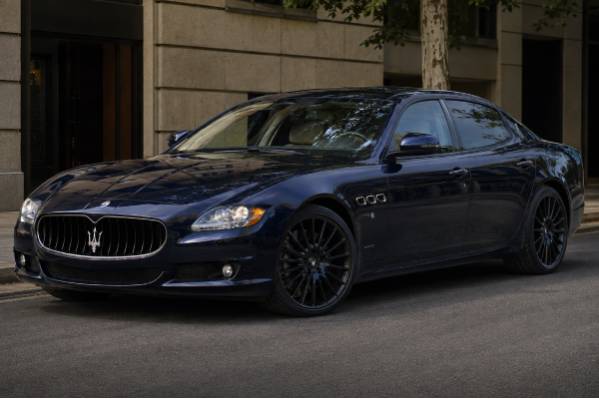
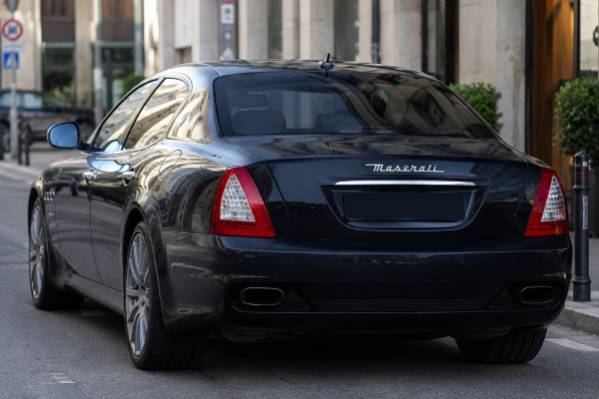
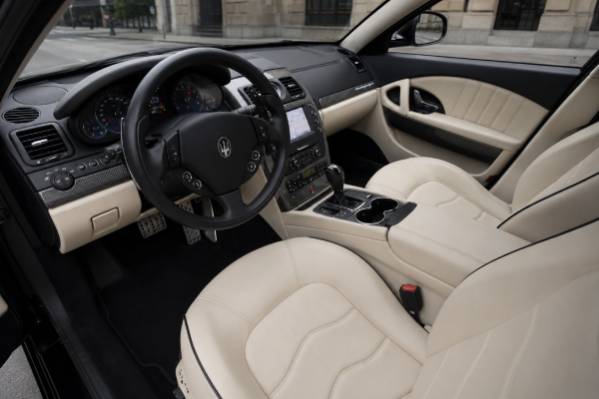
The 2012 Maserati Quattroporte Sport GT S with 450 hp is the final and most powerful naturally aspirated production evolution of the M139. It combines the late 4.7-liter F136Y V8, now rated at about 450 hp and 510 Nm, with the Sport GT S package of fixed-rate dampers, stiffer springs, lower ride height, dual-cast Brembo brakes, aggressive transmission software, and valve-controlled exhaust. The improvement over the earlier 440 hp car is modest on paper, but the broader torque and end-of-run specification make it the ultimate regular M139 for many collectors. Its rarity also creates confusion: some 2012 cars are earlier 440 hp versions registered late, while ordinary Quattroporte S models are sometimes advertised with Sport GT S figures. Verification through the VIN, build record, engine calibration, original invoice, and correct model-specific hardware is essential. Buyers must also account for expensive age-related needs, especially camshaft variators, cooling components, fixed dampers, suspension joints, brakes, wheels, tires, and electronic modules.
Table of Contents
- The Final M139 Performance Sedan
- 450 hp F136Y and Sport Chassis
- End-of-Run Production and Verification
- Final-Form Design and Engineering
- Driving the 450 hp GT S
- Maintenance Risks at Collector Age
- Buying the Ultimate M139
The Final M139 Performance Sedan
The 450 hp Sport GT S is the M139’s closing statement: a naturally aspirated, rear-drive luxury sedan sharpened through engine, chassis, exhaust, and transmission changes rather than turbocharging or all-wheel drive.
Maserati introduced the fifth-generation Quattroporte in the early 2000s with Pininfarina styling and a rear-transaxle DuoSelect drivetrain. It was dramatic, beautifully balanced, and demanding in traffic. The later ZF automatic made the platform more usable, and the 2008 facelift created a clear hierarchy around the 4.2, 4.7 S, and Sport GT S.
The first facelifted Sport GT S produced 440 hp. It replaced Skyhook with fixed dampers, lowered the body, stiffened the springs, revised the gearbox software, and added a sports exhaust. By 2012, the final version received an engine tune associated with approximately 450 hp and 510 Nm. It remained naturally aspirated and retained the six-speed ZF automatic.
This final specification matters because the next Quattroporte generation changed direction. The M156 became larger, lighter for its size, turbocharged, electronically more advanced, and available with all-wheel drive or diesel power. It was faster and more practical, but it did not reproduce the M139’s hydraulic steering, Pininfarina body, or naturally aspirated V8 response.
The 450 hp car is therefore desirable both as a performance model and as the end of an era. Its rarity is difficult to quantify across markets because model years, registrations, and output conventions overlap. Some references use metric horsepower, some quote mechanical horsepower, and some dealers round figures. A buyer should not rely on a “450” badge, which was not the sole proof of factory specification.
A correct car offers a unique balance of elegance and aggression. It is less comfortable than a Skyhook-equipped S and less technologically advanced than a modern sports sedan, but its controls feel direct and its powertrain has a coherent mechanical character.
450 hp F136Y and Sport Chassis
The final Sport GT S pairs a 4,691 cc naturally aspirated V8 producing about 450 hp and 510 Nm with a six-speed automatic, rear-wheel drive, a limited-slip differential, fixed dampers, lower springs, and large Brembo brakes.
| Item | Specification |
|---|---|
| Generation | M139 facelift, final evolution |
| Engine code | F136Y |
| Engine type | 90-degree naturally aspirated V8 |
| Displacement | 4,691 cc |
| Bore × stroke | 94.0 × 84.5 mm |
| Construction | Aluminum block and heads |
| Valvetrain | DOHC, 32 valves, variable intake timing |
| Maximum power | Approximately 450 hp at 7,000 rpm |
| Peak torque | Approximately 510 Nm at 4,750 rpm |
| Transmission | Six-speed ZF automatic with sport calibration |
| Drive | Rear-wheel drive with limited-slip differential |
| Front suspension | Double wishbone, fixed dampers, stiffer springs |
| Rear suspension | Multi-link, fixed dampers, stiffer springs |
| Front brakes | 360 mm dual-cast discs, six-piston calipers |
| Rear brakes | 330 mm ventilated discs |
| Wheels | 20-inch Multi Trident in typical specification |
| Wheelbase | 3,064 mm |
| Overall length | Approximately 5,052 mm |
| Claimed 0–100 km/h | Approximately 5.0 seconds |
| Claimed top speed | Approximately 287 km/h |
The F136Y remains an all-aluminum cross-plane V8 with four valves per cylinder and variable timing on the intake camshafts. The final calibration raises both power and torque over the earlier 440 hp car. The additional 20 Nm is noticeable in the middle range, where the heavy sedan responds more readily without a downshift.
The engine’s defining quality is still progression. At low speed it is smooth and controlled. Through the middle range it becomes muscular. Above roughly 5,000 rpm, the intake and exhaust harden, and the engine continues pulling to its 7,000 rpm power peak. There is no turbocharger to soften or delay the relationship between pedal and torque.
The ZF 6HP uses a torque converter and six planetary ratios. Sport-specific software keeps the engine active and answers paddle commands more quickly than the standard S calibration. It should still shift smoothly. Harsh engagement or flare is a fault, not a performance feature.
Fixed dampers, stiffer springs, and lower ride height define the chassis. This setup removes the comfort range of Skyhook but provides consistent body control. Original damper specification is important because the balance between rebound, compression, spring rate, and tire sidewall was carefully chosen.
The dual-cast front brakes provide strong road performance. An aluminum hat reduces unsprung mass while the iron ring handles friction and heat. The system’s age and replacement cost make measurements essential. Visual inspection alone cannot establish remaining disc life.
Published acceleration figures should be treated as factory references, not guarantees. A healthy car on correct tires should feel urgent and cohesive. A dragging brake, weak engine, poor fuel, old tires, or transmission issue can erase much of the final calibration’s advantage.
End-of-Run Production and Verification
The 450 hp Sport GT S requires careful verification because 2012 registrations can include several mechanical specifications. A correct identity depends on factory records and hardware, not the seller’s interpretation.
Obtain a VIN build record from a recognized Maserati source. Match the production date, market, engine code, model designation, original color, interior, wheels, and options. Review the first invoice and any homologation or registration document that states power in kilowatts or metric horsepower.
Key distinctions include:
- The final 450 hp engine should be supported by factory or market documentation.
- Peak torque is approximately 510 Nm rather than the earlier 490 Nm.
- The chassis should have Sport GT S fixed dampers and lower springs, not Skyhook.
- The car should carry the black concave-fin grille, red Trident accents, darker trim, oval exhaust outlets, and sport interior details expected of a Sport GT S.
- Diagnostic identification and ECU software should be consistent with the vehicle.
- The build sheet should explain any unusual paint, leather, or wheel choices.
Do not assume that a late 440 hp Sport GT S is fraudulent. Production and market transitions can create legitimate overlap. The important issue is whether the advertised specification matches the car and price.
The Awards Edition is also a 440 hp Sport GT S derivative in its original form. It has special paint, burnished trim, polished calipers, distinctive Alcantara and leather, trunk details, and a B-pillar plaque. A car with some Awards Edition parts should not be described as the limited edition without documentation.
Factory options on the final GT S can include audio, navigation, rear comfort equipment, blinds, heated seats, parking assistance, and customized leather or stitching. The model-specific Titantex trim and Alcantara deserve particular scrutiny because replacements are scarce.
Modifications are common. ECU tunes, decat pipes, aftermarket mufflers, wheel spacers, lowering components, and updated head units may change the experience. They also complicate emissions compliance, diagnostics, drivability, and collector value. Demand invoices and original parts.
A complete history is especially valuable for an end-of-run car. It can show whether the vehicle sat unsold, moved between markets, was used as a demonstrator, or received software and service updates. Rarity without traceable history should not command a premium.
End-of-run authentication also requires restraint when interpreting registration dates and badges. The 450 hp Sport GT S was associated with the closing phase of M139 production, yet cars could be titled, imported, or first registered on different schedules. Confirm the VIN, engine specification, factory equipment record, transmission, suspension calibration, exhaust arrangement, brakes, wheels, and cabin details as one coherent package. A later-style badge or replacement trim piece proves very little on its own. Period invoices are especially useful because they establish how the car was described before collector interest encouraged optimistic relabeling. When documentation is incomplete, a marque specialist should inspect the physical specification and explain any inconsistencies. Correctly repaired or serviced parts do not destroy authenticity, but an accumulation of undocumented substitutions should be reflected in both valuation and the confidence placed in the advertisement.
Final-Form Design and Engineering
The 450 hp Sport GT S preserves the Pininfarina M139 at its most purposeful. Dark details and a lower stance sharpen the shape without adding large spoilers or decorative aerodynamics.
The body’s long hood, low grille, rearward cabin, frameless windows, and broad rear shoulders make the five-meter sedan look compact in photographs. The facelift’s vertical grille bars are rendered in black and curved inward, giving the nose depth. Red Trident details, titanium-effect lamps, reduced chrome, and dark oval exhausts provide contrast.
The design’s elegance depends on correct ride height and wheels. Sagging springs, nonstandard lowering, spacers, or incorrect offsets can make the car look aggressive while damaging geometry and tire clearance. Measure ride height side to side and inspect inner tire surfaces.
Under the skin, double-wishbone front suspension manages camber through cornering, while the rear multi-link system balances traction and compliance. Hydraulic steering communicates tire load directly. The limited-slip differential helps the rear axle deliver power without relying entirely on electronic braking.
The fixed-damper decision is central. A luxury sedan normally uses adaptive suspension to broaden comfort. Maserati instead chose a stable mechanical calibration for the Sport GT S. That makes the car’s responses consistent, especially during rapid transitions, but increases noise and impact on broken roads.
The cabin uses M-design seats, leather, perforated Alcantara, an Alcantara headlining, and Titantex trim. The materials signal sport without stripping away luxury. Large fixed paddles sit behind the steering wheel. The analog clock and flowing dashboard retain the Quattroporte’s formal identity.
Ergonomics reflect the era. The infotainment screen is small, menu speed is slow, and storage is limited. Rear passengers have generous legroom but less headroom than the exterior length suggests. Every electrical feature should work even if the technology is outdated.
The sports exhaust uses pneumatic control to preserve two personalities. Quiet operation allows long-distance travel; Sport opens the flow and adds a deep, resonant note. A permanently loud system may have missing valves or aftermarket modifications. Listen for rattles, leaks, and uneven operation between sides.
Cooling airflow must remain intact. Inspect the low front opening, condensers, radiators, ducts, undertrays, and bumper mounts. Track debris, curb damage, or poor accident repair can reduce cooling efficiency and disturb high-speed stability.
Driving the 450 hp GT S
The final Sport GT S feels cohesive rather than dramatically faster than the 440 hp car. Its extra torque improves response, while the fixed chassis, steering, gearbox, and exhaust create the main performance impression.
In normal traffic, the torque converter keeps takeoff smooth. The 510 Nm output means the car moves with less effort than earlier 4.7 versions, but the engine remains quiet below the middle range. It is possible to drive gently without constant noise or abruptness.
Sport mode holds gears, sharpens throttle response, and opens the exhaust more readily. The engine then feels immediate and increasingly intense. A full-throttle run through second and third gears should be smooth, free of misfire, and accompanied by a clean rise in oil and coolant temperature.
The column paddles suit the car. Because they remain fixed, the driver can find them during cornering. The gearbox responds best to deliberate inputs. It will not shift like a modern dual-clutch unit, but it should not hesitate unpredictably or slam ratios.
Steering feel is outstanding by luxury-sedan standards. The wheel is stable near center and gains effort as the front tires load. The car turns in with measured accuracy, then settles quickly because of the fixed dampers. The rear follows predictably and can be balanced with throttle.
On smooth roads, the body control makes the car feel smaller than it is. On rough surfaces, mass and 20-inch wheels become obvious. The ride is firm, and sharp edges enter the cabin. That is acceptable; crashing, bouncing, rattling, or severe tramlining is not. Check wheel bends, tire pressure, damper condition, arms, and alignment.
The dual-cast brakes offer a strong, progressive pedal. Their performance should remain consistent after several stops. Vibration, smell, pulling, or a softening pedal indicates work. High-performance use accelerates pad, disc, tire, and fluid wear quickly.
At speed, the car is remarkably stable. The long wheelbase and low stance resist float, while the V8 has enough reserve for overtaking. Wind noise around frameless glass and wheel vibration should be minimal. A proper test drive must include sustained speed where legal.
City use requires patience. The nose is low and difficult to judge, the turning circle is large, and the rear quarters are hard to see. Parking sensors, mirrors, windows, and steering assistance are essential. Inspect the bumper underside and wheel rims after any urban life.
Maintenance Risks at Collector Age
The final GT S is now old enough that preservation and mechanical renewal overlap. A low odometer does not eliminate age-related failure; it may increase storage-related problems.
Camshaft variators remain the first engine check. Require a fully cold start. A persistent metallic rattle can indicate worn variators or oil-drainback issues. Updated repairs are expensive but valuable when documented.
Powertrain inspection should cover:
- Cam-cover and timing-cover oil leaks.
- Cooling hoses, expansion tank, radiator, thermostat, and water pump.
- Fan motors, relays, and control behavior.
- Ignition coils, spark plugs, injectors, and misfire history.
- Engine and transmission mounts.
- Exhaust valves, vacuum supply, joints, and mufflers.
- Battery, alternator, grounds, and module voltage history.
Annual oil changes are prudent. Brake fluid and coolant require time-based replacement. The ZF gearbox benefits from correct fluid and pan/filter service, particularly if the car has seen high-temperature use. A specialist should assess shudder, adaptations, and valve-body behavior.
Fixed dampers and springs are model-defining parts. Inspect for leaks, sag, mismatched replacements, and damaged bump stops. Check front control arms, ball joints, tie rods, rear links, anti-roll-bar hardware, wheel bearings, and subframe mounts. Alignment should be performed only after worn parts are corrected.
Brakes are a major cost driver. Measure the dual-cast front rotors and rear discs, inspect pads and caliper seals, and test the parking brake. If the car has polished or specially finished calipers, preserve them with suitable cleaning methods.
The 20-inch wheels are vulnerable to bends and cracks. Inspect inner barrels and previous welds. Fit matched premium tires with current date codes, correct load ratings, and factory-appropriate sizes. Old tires can make the car dangerous even with deep tread.
Electrical and cabin concerns include parking sensors, window regulators, locks, seat modules, climate actuators, infotainment, audio, alarm, keys, sticky switches, leather shrinkage, Alcantara wear, and headliner sag. Full diagnostics should be repeated after a long road test.
Parts availability is uneven. Routine mechanical items can be sourced through specialist networks, while correct fixed dampers, Titantex trim, seat materials, and model-specific exterior parts may take time. Buy completeness when possible.
Buying the Ultimate M139
The right 450 hp Sport GT S is verified, original in its defining systems, and supported by detailed maintenance. Do not let the final-model story override evidence.
Before viewing, request the VIN, build sheet, original invoice, production date, service file, cold-start video, diagnostic scan, brake measurements, tire dates, wheel photographs, and underside images. Confirm the 450 hp and 510 Nm specification with market-appropriate factory documentation.
Commission an M139 specialist to perform:
- Model and engine-calibration verification.
- Overnight cold start and variator assessment.
- Full module scan before and after driving.
- Cooling-system pressure and fan test.
- ZF shift, fluid, adaptation, and torque-converter evaluation.
- Inspection of fixed dampers, springs, joints, bearings, and ride height.
- Brake-disc measurement and caliper inspection.
- Wheel crack check, tire-age review, and alignment assessment.
- Paint-depth and structural inspection.
- Verification of Sport GT S trim, exhaust, seats, paddles, and Titantex.
| Desirable evidence | Serious concern |
|---|---|
| Factory record confirms late 450 hp specification | Seller combines figures from different M139 variants |
| Original fixed chassis is tight and correctly aligned | Unknown lowering kit, mismatched dampers, or uneven height |
| Quiet cold start or documented updated variators | Pre-warmed engine and no repair history |
| Recent tires, straight wheels, measured brakes | Old rubber, welded wheels, thin rotors, or track abuse |
| Complete GT S trim and clean diagnostics | Missing special parts and repeated electronic faults |
Maintain a substantial reserve after purchase. Variators, brakes, tires, dampers, and cooling work can overlap. A cheaper car needing several of these jobs may cost more than a premium example with strong records.
For the right owner, the 450 hp GT S is the ultimate M139: naturally aspirated, rear-driven, hydraulically steered, elegantly styled, and mechanically direct. Its value comes from that complete formula, not from ten extra horsepower alone.
References
- Strong representation of Maserati Benelux at Brussels Motor Show 2012 2012
- Maserati unveils new Quattroporte Sport GT S on the 70th anniversary of its first Indianapolis 500 win 2009
- Geneva Motor Show 2010 – Worldwide debut for the Maserati Quattroporte Sport GT S Awards Edition 2010
- Maserati Guides & Documentation for your vehicle 2026 (Owner’s Manual Portal)
Disclaimer
This article is for informational purposes only and is not a substitute for professional diagnosis, inspection, maintenance, or repair. Specifications, torque values, service intervals, procedures, software requirements, and equipment can vary by VIN, production date, market, and configuration. Before buying, servicing, or modifying any vehicle, verify the relevant details against its official service documentation and consult a qualified Maserati specialist when necessary.
Please share this article on Facebook, X/Twitter, or another platform to support our work and help other owners and enthusiasts find it.