
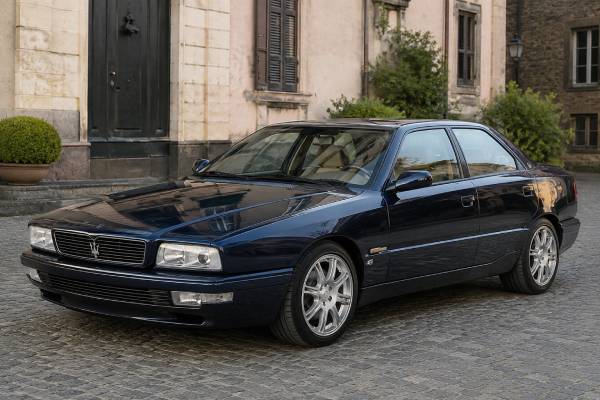
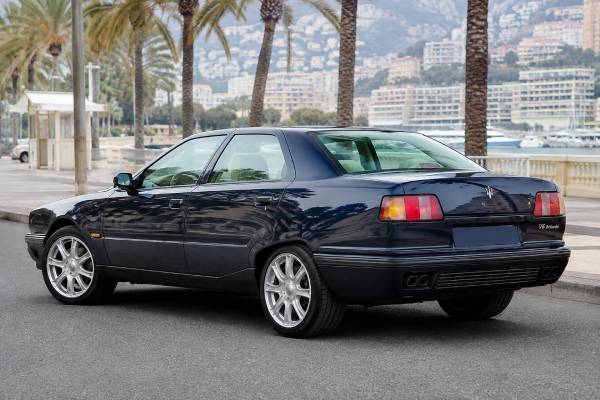
The Maserati Quattroporte V6 Evoluzione is the Ferrari-era refinement of the AM337’s 2.8-liter twin-turbo formula. Introduced at the 1998 Geneva Motor Show, it retained the compact Marcello Gandini body, rear-wheel drive, and AM574 V6, but arrived after a factory overhaul that changed or revised roughly half of the car’s principal components. Output is commonly listed at 280 hp at 6,000 rpm with about 397 Nm at 3,500 rpm, delivered through a six-speed manual or an electronically controlled four-speed BTR automatic.
The Evoluzione was not a clean-sheet replacement. Its value lies in combining the Quattroporte IV’s distinctive scale and character with better assembly methods, revised electrical systems, updated trim, and tighter quality control. Visual identifiers include Evoluzione fender badges, new mirrors, and the deletion of the traditional oval dashboard clock. Approximately 390 V6 Evoluzione cars were built from 1998 to 2001, including some of the final Cornes Serie Speciale examples for Japan. Buyers should still approach one as a complex low-volume twin-turbo Maserati. Improved manufacture did not remove timing-belt risk, turbo wear, cooling demands, aging electronics, adjustable-damper costs, rear-subframe deterioration, or the consequences of years of deferred service.
Table of Contents
- Ferrari-Era Refinement of the AM337
- AM574 Evoluzione Specifications and Chassis
- Production Changes, Transmissions, and Identification
- What the Evoluzione Redesign Actually Changed
- Driving the Late V6 Quattroporte IV
- Maintenance Priorities for the V6 Evoluzione
- Choosing a Correct 1998–2001 Example
Ferrari-Era Refinement of the AM337
The V6 Evoluzione is best understood as a deep production and quality revision, not a new generation. It preserved the compact proportions, twin-turbo performance, and analog feel of the original Quattroporte IV while addressing many details that had made early cars inconsistent.
Fiat transferred a controlling stake in Maserati to Ferrari in 1997. Ferrari modernized the Modena factory, introduced stricter production controls, and reviewed the AM337 at component level. The resulting Evoluzione debuted in March 1998. Contemporary descriptions state that about 400 of the car’s roughly 800 principal parts were new or modified.
The changes touched assembly processes, wiring, connectors, trim, controls, engine-bay details, calibration, and quality assurance. They did not transform the architecture. The car remained a steel monocoque derived from the Biturbo and Ghibli II line, with a longitudinal front engine, rear-wheel drive, MacPherson-strut front suspension, independent tubular rear arms, a limited-slip differential, and a rear subframe.
The V6 range was simplified. The high-output Italian-market 2.0 was dropped, leaving the 2.8 as the sole six-cylinder Evoluzione. This made sense as Maserati prepared the 3200 GT and aimed for a more internationally coherent lineup. The 2.8 continued to offer strong torque without the V8’s extra mass and servicing complexity.
The AM574’s nominal output changed from the earlier car’s 284 hp to 280 hp in many specifications, with approximately 397 Nm rather than 413 Nm. These small differences reflect calibration and published-rating variations more than a dramatic loss of performance. The late car still reaches roughly 255–260 km/h depending on transmission and market data.
Ferrari’s involvement improved repeatability, but the Evoluzione should not be mistaken for a mass-produced modern saloon. Each example is now more than two decades old. Heat, corrosion, poor repairs, incorrect parts, infrequent use, and low-value years can erase the advantages of better original assembly.
Production records generally identify 390 V6 Evoluzione cars. That total makes the model rarer than the pre-Evoluzione 2.8 and gives well-preserved examples collector interest. The best cars combine Evoluzione completeness with evidence of continuous specialist maintenance rather than long periods of static display.
AM574 Evoluzione Specifications and Chassis
The late AM574 remains a 2,790 cc, 90-degree twin-turbo V6 with 24 valves, two overhead camshafts per bank, intercooling, and electronic multipoint injection. It develops approximately 280 hp at 6,000 rpm and 397 Nm at 3,500 rpm.
| Item | Specification |
|---|---|
| Model code | Tipo AM337 |
| Engine code | AM574 |
| Production years | 1998–2001 |
| Engine layout | 90-degree V6, 24 valves, double overhead camshafts |
| Displacement | 2,790 cc |
| Induction | Twin turbochargers with intercooling |
| Fuel system | Electronic multipoint injection |
| Maximum output | Approximately 280 hp at 6,000 rpm |
| Maximum torque | Approximately 397 Nm at 3,500 rpm |
| Manual transmission | Six-speed Getrag |
| Automatic transmission | Four-speed electronically controlled BTR |
| Drivetrain | Rear-wheel drive with limited-slip differential |
| Front suspension | MacPherson struts with coil springs |
| Rear suspension | Independent tubular trailing arms on subframe |
| Brakes | Four-wheel ventilated discs with ABS |
| Steering | Power-assisted rack and pinion |
| Wheelbase | 2,650 mm |
| Length | Approximately 4,550 mm |
| Width | Approximately 1,810 mm |
| Dry weight | Approximately 1,570 kg, depending on equipment |
| Top speed | Approximately 255–260 km/h, depending on transmission |
The engine’s two small turbochargers serve the cylinder banks and feed through intercoolers. This arrangement produces quicker response than one large turbo but doubles many heat- and oil-sensitive components. Both sides must build boost evenly and receive adequate lubrication.
The six-speed manual remains the most direct transmission. Its close ratios help the driver keep the V6 above the softest off-boost range. The Evoluzione automatic changed to the BTR unit already used with the V8, replacing the ZF 4HP22 found in early 2.8 cars. The BTR’s electronic control integrates more closely with the late car but still depends on correct fluid, cooling, sensors, wiring, and voltage.
A limited-slip differential sends torque to the rear wheels. The differential and independent rear suspension are supported by a tubular subframe. This gives the compact saloon good traction and controlled geometry, but aging mounts can allow movement that feels like rear steering.
Many examples have electronic four-position damping. The system adjusts damper firmness rather than spring rate. It should produce a noticeable change without warning lamps, bouncing, or unequal behavior. Replacement cost makes a complete test essential.
The ventilated disc brakes and ABS are appropriate for the car’s mass and speed when maintained. Brake performance depends heavily on fresh fluid, free calipers, straight discs, correct pads, functioning ABS sensors, and modern matched tires.
The published top-speed difference between manual and automatic cars is small, yet the driving difference is clear. The manual uses six ratios and gives stronger acceleration control. The automatic delivers smoother low-speed behavior but has four broad ratios. Mechanical condition can create a larger performance difference than the transmission choice itself.
Production Changes, Transmissions, and Identification
A genuine V6 Evoluzione should combine the AM574 engine with late AM337 details, not simply wear Evoluzione badges. The mirrors, clock deletion, controls, trim, wiring, transmission equipment, and production records should tell one consistent story.
The exterior revisions were subtle. Evoluzione badges replaced the earlier seicilindri script, mirror housings changed, and detail finish improved. Panel fit and paint quality were generally more consistent than before, although age and repair history now matter more than original tolerances.
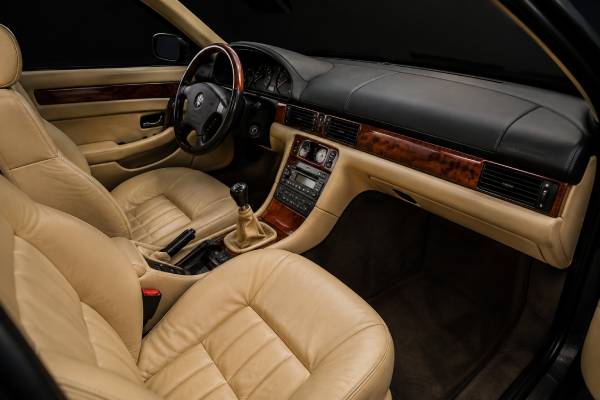
Inside, the most obvious change is the missing oval Maserati clock. The dashboard center section was revised, and some switchgear and trim details changed. Leather and wood remained central to the atmosphere, but the late cabin can feel slightly more standardized than the highly individual early cars.
Typical equipment included:
- Full leather upholstery with extensive wood veneer.
- Automatic climate control.
- Electric seats, windows, and mirrors.
- Central locking and market-specific immobilizer systems.
- Anti-lock brakes and limited-slip differential.
- Four-position adjustable damping on many cars.
- Six-speed manual or BTR four-speed automatic transmission.
The manual is often considered more desirable, but rarity should not override condition. A car with worn synchros, a slipping clutch, failed hydraulics, or gearbox noise may cost more to correct than an excellent automatic. Conversely, a BTR car with delayed engagement, shift flare, wiring faults, or contaminated fluid is not a low-risk substitute.
Factory options and regional specifications varied. Wheel style, interior color, wood finish, audio equipment, alarm systems, and convenience features may differ legitimately. Owners should use build records, period literature, and original invoices rather than relying on internet photographs of one car.
Modifications remain common. Engine chips, boost controllers, exhaust systems, intake changes, lowered suspension, larger wheels, and replacement alarms can all affect reliability. A late car’s improved wiring is easily compromised by poor accessory installation.
Approximately 390 V6 Evoluzione cars were built. Some final 2001 examples formed part of the 50-car Cornes Serie Speciale ordered for Japan, all of which used automatic transmissions. A normal V6 Evoluzione should not be represented as a Cornes car without its numbered identity, market history, and special-edition documentation.
Authenticity should be evaluated alongside usability. A replaced radiator, modern relay, or correctly rebuilt turbo can improve reliability without harming character. Changes that raise boost, alter emissions equipment, cut wiring, or remove scarce trim need much closer scrutiny.
What the Evoluzione Redesign Actually Changed
The Evoluzione’s real improvement is consistency. Ferrari-era work reduced the number of weak production details and improved how the car was assembled, but it did not redesign the fundamental engine, suspension, or body structure.
The Modena factory received investment in tooling, work flow, component control, and inspection. Wiring routes, connectors, fasteners, seals, and trim attachment were reviewed. Mechanical components and calibrations were revised where needed. These changes help explain why a good Evoluzione often feels tighter and less improvised than an early AM337.
The body remains Gandini’s compact wedge. The angled rear wheel openings, low hood, high rear deck, and restrained grille make it instantly recognizable. At around 4.55 meters long, it occupies much less road space than later Quattroportes. This gives it city usability and an intimate driving position, though rear-seat room is modest.
Engine packaging is dense. The radiator, air-conditioning condenser, oil cooling, twin intercoolers, fans, ducts, and undertrays must work together. Evoluzione changes did not eliminate heat. Any missing shroud or slow fan can raise temperatures around turbo oil lines, wiring, hoses, and seals.
The V6 sits longitudinally, with the gearbox directly behind it and the differential at the rear. This conventional layout is simple in concept but supported by model-specific subframes and suspension geometry. The limited-slip differential gives strong traction, while the tubular rear arms help control wheel movement.
The cabin continues to mix leather, veneer, and analog instruments. Deleting the oval clock disappointed traditionalists, but the revised center section is a useful identification point. Seat comfort is good for touring, and the compact body keeps major controls close to the driver.
The engine’s sensory character remains old-school. At low speed it is relatively muted, with some valvetrain texture. As boost develops, intake rush and turbo whistle combine with a sharper V6 exhaust note. A standard exhaust allows quiet cruising; very loud replacements often create drone and conceal mechanical noises.
Compared with a pre-Evoluzione 2.8, the late car feels more finished rather than radically faster. Compared with a contemporary German luxury saloon, it feels smaller, more responsive, and less isolated. The engineering compromise is clear: greater involvement and rarity in exchange for more attention to temperature, voltage, fluids, and age-related detail.
Driving the Late V6 Quattroporte IV
The V6 Evoluzione delivers strong mid-range speed in a compact, communicative chassis. It is easier to use than the 2.0 and lighter in character than the V8, making it one of the best-balanced versions for regular road driving.
A sound AM574 should start promptly from cold and settle without smoke, hunting, or prolonged mechanical noise. The driver should wait for oil temperature before asking for boost. The turbochargers depend on clean, warm oil and suffer when a stored car is immediately driven hard.
Below boost, the 2.8 moves the car adequately. Around the middle of the rev range, torque builds firmly and overtaking becomes effortless. The delivery should be progressive. Surging, a sudden cut, pinging, smoke, or inconsistent pull between runs suggests a problem with wastegates, hoses, fuel pressure, ignition, sensors, or turbo condition.
The six-speed manual lets the driver choose exactly when the engine reaches boost. Its action is mechanical and deliberate rather than light. A healthy clutch engages cleanly without judder. Second- and third-gear shifts should remain smooth when the oil is hot.
The BTR automatic suits traffic and motorway travel. The torque converter fills the off-boost gap at low speed, and kickdown brings the engine into its stronger range. The transmission should not delay when selecting Drive or Reverse, flare between gears, or become harsh after warming.
Steering is direct by luxury-saloon standards. With fresh tires and accurate alignment, the car turns in eagerly and feels narrower than most four-doors. Worn front strut mounts, steering joints, or rear-subframe bushes make it vague and can cause instability as boost arrives.
Ride quality ranges from compliant to firm through the adjustable dampers. The system cannot mask worn bushings or aged tires. Oversized wheels create tramlining and harsh impacts, while old tires reduce wet grip long before tread disappears.
The brakes have good power and acceptable feel. A soft pedal, pull, vibration, or ABS warning should be investigated. Repeated high-speed use requires fresh fluid and quality pads rather than cosmetic caliper work.
The car is at its best on flowing roads and long journeys. It cruises quietly, accelerates hard in the middle gears, and fits through narrow spaces. Its limitations appear in stop-start heat, poor weather, and abrupt throttle use. No modern stability system will rescue careless boost application on old rear tires.
Maintenance Priorities for the V6 Evoluzione
Evoluzione build improvements do not change the maintenance hierarchy: timing drive, oil pressure, cooling, turbo health, fueling, transmission, rear suspension, and electrical voltage must all be verified. Preventive work is much cheaper than rebuilding a damaged AM574.
Timing belt and engine health
Replace an undocumented timing belt before normal use. A proper service should address tensioners, idlers, seals, and related components identified in the official procedure. Low annual mileage does not stop rubber and grease from aging.
Check compression, leak-down, hot oil pressure, coolant pressure, and crankcase condition. Look for oil in coolant, combustion gases in the expansion tank, fuel dilution, and evidence of repeated overheating. Persistent tapping, knock, or uneven bank temperatures deserves investigation.
Oil changes should reflect time and use, not only distance. Short trips contaminate oil; extended boost heats it. Warm the engine gently and avoid shutting it off immediately after sustained high load.
Turbos, fuel, and cooling
Inspect both turbos for shaft movement, oil leakage, damaged blades, and equal response. Pressure-test intercoolers, hoses, clamps, and vacuum lines. Verify wastegate control and standard calibration before assuming low boost is safe or high boost is desirable.
Test fuel pressure under load. Aging pumps, filters, injectors, relays, grounds, and ignition components may fail only when cylinder pressure rises. A lean or misfiring turbo engine can suffer damage rapidly.
Radiators, fans, thermostats, hoses, caps, and air-conditioning condensers deteriorate. A known radiator weakness on some cars makes leak inspection important. Confirm fan operation at all required temperatures and with the climate control engaged.
Transmission, suspension, and electrics
Manual cars need clutch-slip, hydraulics, synchro, bearing, and mount checks. BTR automatics need correct fluid, prompt engagement, stable hot shifts, sound wiring, and functional control inputs. Do not accept “they all shift like that” without comparison to a healthy car.
Rear subframe mounts, differential bushes, trailing arms, front struts, wheel bearings, steering joints, brakes, and adjustable dampers all age. A damping warning can mean expensive hardware, not merely a reset.
Electrical diagnosis should begin with battery state, alternator output, and grounds. Test windows, seats, locks, mirrors, lights, instruments, fans, climate control, ABS, immobilizer, and damping controls. Poor aftermarket alarm work can defeat the advantages of the late wiring.
Inspect sills, jacking points, floor seams, arches, door bottoms, glass surrounds, trunk floor, and suspension pickup points for corrosion. Verify panel gaps and underbody geometry after any accident repair.
Specialist parts support is better than production volume suggests, but some trim, glass, dampers, modules, and castings are scarce. Completeness is therefore valuable. A missing interior piece can be harder to source than a routine mechanical consumable.
Choosing a Correct 1998–2001 Example
Choose a V6 Evoluzione for documented condition, not for a low odometer or the Evoluzione badge alone. The strongest purchase has recent belt work, stable temperatures, clean boost, a healthy transmission, quiet rear suspension, functioning electrics, and a straight rust-free shell.
Verify the chassis and engine identity, Evoluzione badging, late mirror design, absence of the oval clock, transmission type, and market specification. A claimed Cornes Serie Speciale requires separate numbered documentation and Japanese-market history.
Ask for records covering:
- Timing-belt, tensioner, seal, and related services.
- Oil type, oil-pressure checks, and engine repairs.
- Turbocharger, intercooler, hose, and wastegate work.
- Radiator, fan, thermostat, hose, and coolant replacement.
- Fuel pumps, filters, injectors, coils, and sensors.
- Clutch and gearbox work or BTR automatic servicing.
- Adjustable dampers, rear subframe, differential, and brakes.
- Electrical, alternator, alarm, and immobilizer repairs.
- Rust, paint, glass, and collision work.
Arrange an AM337 specialist inspection. It should include a cold start, fully hot running, compression or leak-down testing where practical, oil-pressure measurement, cooling-system pressure test, diagnostic scan, boost and fuel-pressure testing, and a lift examination.
Road-test gently until temperatures stabilize. Then use several gears and loads. The car should pull evenly without surging, smoke, detonation, warning lamps, or temperature movement. For the manual, test synchros and high-gear clutch slip. For the automatic, test cold and hot engagement, kickdown, and every shift.
Operate all four damper settings and every electrical feature. Check tire brand, size, age, and wear across each axle. Uneven rear wear or a steering wheel that does not center can indicate alignment, subframe, or accident issues.
Avoid cars with low hot oil pressure, coolant pressurization, major turbo smoke, uncontrolled boost, severe gearbox faults, structural corrosion, incomplete wiring, or an unknown performance chip. These defects can overwhelm the apparent saving in purchase price.
Once purchased, establish a service baseline before exploring performance. Renew questionable fluids and filters, verify belt age, inspect fuel and coolant hoses, measure boost, check charging voltage, and fit fresh matched tires. Keep original parts when making reversible upgrades.
The V6 Evoluzione is a smart choice for an enthusiast who wants the most developed six-cylinder Quattroporte IV without the heavier V8. Its rarity, compact Gandini form, Ferrari-era production improvements, and usable torque make it historically important. The best examples feel cohesive and special, proving that the final development of an old architecture can be more compelling than a completely new car.
References
- Quattroporte IV Evoluzione – Quattroporte models | Maserati 2026 (Manufacturer Heritage Specifications)
- Maserati TechInfo 2026 (Manufacturer Technical Information)
- Buying Guide: 1994–2001 Maserati Quattroporte IV | Hagerty UK 2025 (Buying Guide)
Disclaimer
This article is for informational purposes only and is not a substitute for professional diagnosis, repair, tuning, or restoration advice. Specifications, torque values, belt intervals, boost settings, and procedures vary by VIN, market, production date, and equipment. Verify all work against official service documentation and consult a qualified Maserati specialist.
Please share this article on Facebook, X/Twitter, or your preferred enthusiast community if it was useful. Sharing supports the creation of more detailed specialist-car guides.