
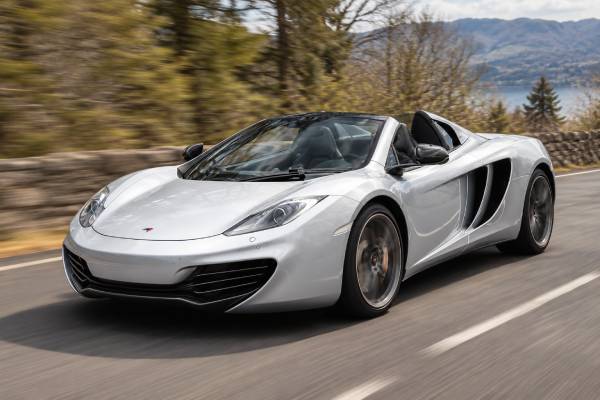
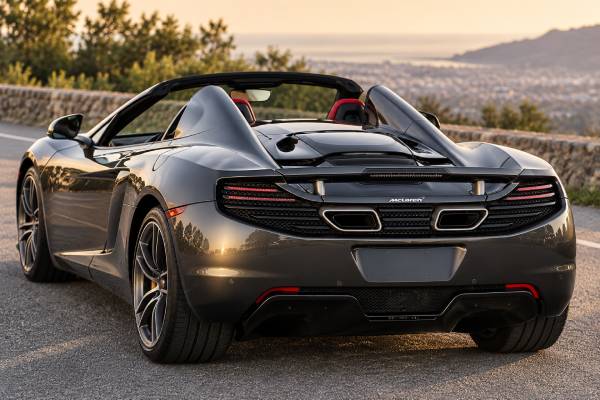
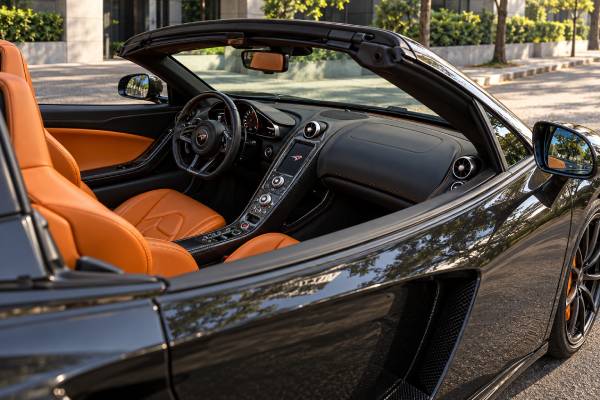
The 12C Spider is a rare kind of open supercar because its defining structural work was already done before the roof disappeared. McLaren’s one-piece carbon-fiber MonoCell did not depend on the coupe roof for torsional strength, so converting the P11 platform into a Spider required no extra tub reinforcement. The retractable hard-top system added about 40 kg, yet the Spider retained the 625 PS/616 hp M838T V8, seven-speed dual-clutch gearbox, ProActive Chassis Control, Brake Steer, and active Airbrake. Its two-piece roof can be raised or lowered in under 17 seconds and operated at low road speed, while the powered rear glass can serve as either a wind deflector or an engine-sound window. Those features make roof condition central to a used-car inspection. This guide covers the 616 hp 12C Spider through the requested 2012–2014 period, including its technical data, open-roof engineering, road behavior, maintenance priorities, failure checks, and the evidence worth demanding before purchase.
Table of Contents
- Why the Spider Needed So Little Structural Compromise
- 12C Spider Technical Specifications
- Roof, Rear Glass, Storage, and Cabin Operation
- What Changes on the Road With the Roof Mechanism
- Maintenance Priorities for the Spider
- Spider-Specific Fault Checks and Pre-Purchase Inspection
- Choosing and Documenting the Right 12C Spider
Why the Spider Needed So Little Structural Compromise
The 12C Spider starts with exactly the advantage a convertible engineer wants: a passenger cell that was already self-supporting without a metal roof. McLaren used the same roughly 75 kg carbon-fiber MonoCell as the coupe, so the Spider did not need the heavy sill, floor, or cross-bracing reinforcements common in open versions of conventional aluminum or steel cars.
That decision shaped almost every other Spider tradeoff. The retractable hard top and its associated hardware add about 40 kg, taking the lightest dry figure to 1,341 kg and DIN weight to 1,474 kg. The mass increase is real, but it is largely the price of the roof system rather than compensation for a weakened body shell. Contemporary testing emphasized that torsional rigidity was effectively unchanged.
The roof itself uses two rigid panels that fold beneath a rear tonneau. Steel rollover structures are built into the buttresses behind the occupants, providing passive rollover protection without a pop-up hoop system. The engine remains visible beneath its rear glass cover, while a separate powered vertical rear window sits behind the cabin.
This architecture gives the rear window an unusually useful second job. With the roof down, raising the glass reduces airflow through the cabin. With the roof up, lowering it opens a more direct acoustic path to the twin-turbo V8. Climate-control and audio calibrations were also adapted for open-roof operation, showing that McLaren treated the Spider as a complete operating environment rather than simply cutting the top from the coupe.
The mechanism can work while the car is moving slowly—up to about 30 km/h (19 mph)—and completes its cycle in under 17 seconds. Those abilities are convenient, but they also mean a used Spider has more switches, sensors, latches, moving panels, seals, and alignment points to inspect than a coupe. Smooth synchronized operation is therefore a mechanical condition check, not merely a demonstration feature.
Another clever detail is the space beneath the tonneau. When the roof is raised and that cavity is not occupied by folded roof panels, it provides about 52 liters of additional luggage space, and McLaren supplied shaped soft bags for it when new. The space cannot be used in the same way with the roof stowed, so a touring owner must plan luggage around roof position.
The Spider’s engineering story is consequently not “convertible with no compromises.” It still weighs more and has more mechanisms to maintain. The more accurate description is that the carbon tub prevented the usual structural penalty, allowing McLaren to concentrate the additional mass and complexity in the hardware that actually makes the car open.
12C Spider Technical Specifications
The 12C Spider uses the 3,799 cc M838T twin-turbo gasoline V8 in 625 PS tune, producing 616 hp at 7,500 rpm and 600 Nm from 3,000 to 7,000 rpm. It remains rear-wheel drive with the seven-speed SSG dual-clutch transmission, and its official performance stays remarkably close to the coupe despite the roof hardware.
| Item | 12C Spider |
|---|---|
| Engine configuration | 90-degree V8, twin turbocharged, dry sump |
| Fuel type | Gasoline, port fuel injection |
| Displacement | 3,799 cc (3.8 L) |
| Bore × stroke | 93.0 × 69.9 mm |
| Compression ratio | 8.7:1 |
| Valve train | DOHC, 32 valves, variable valve timing |
| Maximum output | 625 PS / 460 kW / 616 hp at 7,500 rpm |
| Maximum torque | 600 Nm (443 lb-ft) at 3,000–7,000 rpm |
| Maximum engine speed | 8,500 rpm |
| Measure | Factory specification |
|---|---|
| Maximum speed | 329 km/h (204 mph) |
| 0–100 km/h | 3.3 s; 3.1 s on P Zero Corsa tires |
| 0–200 km/h | 9.2 s; 9.0 s on P Zero Corsa tires |
| 0–60 mph | 3.2 s; 3.0 s on P Zero Corsa tires |
| 0–100 mph | 6.3 s; 6.1 s on P Zero Corsa tires |
| Standing quarter-mile | 11.0 s at 214 km/h (133 mph) |
| CO₂ / combined consumption | 279 g/km / 11.7 L/100 km (24.2 mpg UK) |
Launch material also published slightly quicker quarter-mile data in a direct Spider-versus-coupe comparison, illustrating why factory figures can vary with tire and test specification. For a used car, published tenths are less important than healthy boost delivery, clean shifts, correct tires, and the absence of drivetrain faults.
| Item | Specification |
|---|---|
| Passenger structure | Carbon-fiber MonoCell; no additional roof-loss reinforcement required |
| Roof | Two-piece retractable hard top |
| Roof cycle | Under 17 seconds; operable up to about 30 km/h (19 mph) |
| DIN weight | 1,474 kg (3,249 lb) |
| Dry weight | 1,376 kg (3,033 lb) |
| Lightest dry specification | 1,341 kg (2,956 lb) |
| Weight distribution | 42% front / 58% rear |
| Approximate roof-system mass increase | 40 kg (88 lb) versus coupe |
| System | Specification |
|---|---|
| Suspension | Double wishbones; hydraulically linked ProActive Chassis Control |
| Handling selections | Normal, Sport, Track |
| Steering | Variable-rate electrohydraulic power assistance |
| Front wheels / tires | 8.5J × 19 / 235/35 R19 |
| Rear wheels / tires | 11J × 20 / 305/30 R20 |
| Standard discs | 370 mm front / 350 mm rear cast iron |
| Optional carbon-ceramic discs | 394 mm front / 380 mm rear |
| Item | Specification |
|---|---|
| Fuel tank | 72 L |
| Engine oil system | 8.0 L |
| Cooling system | 20.0 L |
| Washer reservoir | 4.0 L |
| Period preferred fuel | 98 RON unleaded for maximum performance |
| Period minimum fallback fuel | 95 RON where 98 RON is unavailable |
The capacities and period fluid recommendations are useful when checking service invoices, but they should not be treated as universal instructions. Approved products and procedures can be revised, and service requirements may vary with market, VIN, equipment, and later factory guidance.
Roof, Rear Glass, Storage, and Cabin Operation
A sound 12C Spider roof should complete a full open-and-close cycle smoothly, latch cleanly, and leave the panels evenly aligned without warnings. Because the system combines moving hard panels, a tonneau, powered latches, sensors, seals, and control logic, a complete functional test is one of the most important parts of evaluating the car.
Start with the roof closed. Inspect panel gaps from both sides and look across the surface for one panel sitting proud of another. Examine visible seals for tears, compression damage, contamination, or evidence of repeated water ingress. Check the headliner and the areas behind the seats for staining or unusual trim distortion. A freshly detailed cabin can hide an old leak, so ask directly about water history and any roof adjustments.
Then operate the mechanism while stationary on level ground. Watch the tonneau and roof panels throughout the full sequence rather than standing only at the driver’s door. Movement should be coordinated and free of scraping, hesitation, repeated reversals, or a need to “help” a panel. Confirm the roof-open and roof-closed indications and then repeat the cycle. The ability to operate at low speed is useful in traffic, but it is unnecessary during an inspection; stationary testing removes avoidable variables.
The vertical rear glass should be tested independently with the roof both up and down. With the roof open, raising the window should noticeably reduce cabin turbulence. With the roof closed, lowering it provides more engine sound without exposing the cabin to the sky. Listen for abnormal regulator noise and confirm the glass seals and indexes correctly at the end of travel.
Storage under the tonneau needs a physical check too. With the roof raised, verify that the compartment is clean and undamaged and that any original fitted luggage represented in the sale is actually present. Never infer that cargo can remain there when the roof is being stowed; the folding top requires that space. A buyer planning road trips should practice the packing arrangement rather than relying on the quoted volume alone.
Inside the cabin, the Spider is intentionally close to the coupe. The roof switch is the obvious additional control, while McLaren recalibrated climate and audio behavior for open running. Test air-conditioning performance with the roof up and down, all fan settings, audio channels, navigation or IRIS functions, camera if fitted, seat controls, window indexing, both door releases, and the vehicle-lift system where present.
The passive rollover structures are hidden inside the rear buttresses, so condition there is mainly an accident-history question rather than a routine adjustment item. Any evidence of rear-quarter repair, misaligned buttresses, or damaged tonneau components deserves specialist investigation. A roof that merely cycles is not enough; the surrounding structure must also be straight.
What Changes on the Road With the Roof Mechanism
The Spider gives away surprisingly little dynamic ability because the MonoCell retains its stiffness, but its extra 40 kg and slightly more rearward weight distribution are measurable. Officially, it reaches 200 km/h a few tenths later than the coupe and tops out at 329 km/h rather than 333 km/h, differences that matter more on a specification sheet than on public roads.
What remains is the 12C’s unusual combination of acceleration and ride quality. ProActive Chassis Control hydraulically links the dampers to manage roll and pitch while allowing each wheel meaningful freedom over surface imperfections. There are no conventional anti-roll bars doing the familiar job in the familiar way, so the car can stay remarkably composed on broken roads without feeling loose in faster corners.
That behavior is particularly valuable in an open car. A stiff conventional suspension can make a roadster feel busy through the seat and steering column, while a flexible body can add its own secondary shake. The carbon cell and hydraulic chassis help the 12C Spider avoid both extremes. Scuttle shake should not be accepted as “normal convertible behavior”; unusual vibration, steering-column movement, or body noise deserves inspection for wheel, suspension, trim, or accident-related causes.
The electrohydraulic steering remains one of the car’s most informative interfaces. It should be light enough at normal speeds but build load naturally, with no notchiness or unexplained assistance changes. Correct front tires and alignment are critical because a car with mismatched rubber or geometry can disguise its intended steering character.
The engine feels different with the rear glass lowered even when the roof stays in place. More induction, turbo, and exhaust sound reaches the cabin, which addresses one criticism of the early coupe without requiring a louder external exhaust. With the roof down, the sound and airflow make speed feel more dramatic, although the drivetrain calibration remains the same.
The seven-speed dual-clutch gearbox should deliver crisp manual shifts and unobtrusive automatic operation once warm. The later 625 PS package included revised shift calibration, so an evolved Spider should not feel like an early-development transmission. At parking speed, some clutch character is inherent to a dual-clutch system, but persistent shudder, delayed engagement, warning messages, or fluid leakage needs specialist diagnosis.
Brake Steer and the active Airbrake remain part of the dynamic package. The former uses selective braking to help cornering behavior without a conventional mechanical limited-slip differential; the latter changes rear-wing angle under hard deceleration to contribute drag and aerodynamic balance. During an inspection, their importance is less about provoking intervention and more about confirming no relevant faults are stored and that the rear wing cycles correctly.
With the roof open, resist interpreting extra sound as evidence of extra mechanical drama. Wind noise can mask wheel-bearing, tire, trim, or drivetrain sounds. A serious road test should include roof-up and roof-down periods on the same route so the car can be heard and felt in both configurations.
Maintenance Priorities for the Spider
A 12C Spider needs all of the coupe’s powertrain and hydraulic-chassis care plus deliberate attention to its roof hardware, seals, drainage paths, rear glass, and tonneau area. Service history should therefore show consistent mechanical maintenance while the physical inspection confirms that the open-body systems have not been neglected simply because the car covered little mileage.
Period guidance and marque-specialist advice commonly use annual or 10,000-mile servicing as a reference point. For an older Spider, elapsed time is often the more revealing variable. A low odometer can coexist with aged tires, stale fluids, weak batteries, dried seals, or mechanisms that have been cycled very little.
The dry-sump engine carries about 8.0 liters of oil. Review invoices for regular oil and filter work, then inspect for leakage around the engine, turbo lubrication plumbing, and drain areas. Do not accept an undertray that has just been washed as evidence of a dry powertrain. A post-drive reinspection is more informative.
Transmission records should include the appropriate clutch-oil and filter work; McLaren maintenance documentation specifies a 30,000 km (20,000 mile) interval for that service item. Check the gearbox casing and underbody for fluid traces, and evaluate engagement when cold and hot. An old record of a seal or transmission replacement is not automatically negative if the work is documented and the unit now tests correctly.
The hydraulic suspension deserves its own history file. Ask about accumulators, actuators, hose or seal work, and any previous PCC warning. With the car parked, look for unexplained corner-to-corner height differences or self-leveling behavior. During the drive, compare Normal, Sport, and Track responses where safe and legal; a fault-free system should change its control strategy predictably rather than produce warnings.
Roof care is less about arbitrary lubrication than about correct operation and cleanliness. Keep visible seals clean using products approved for the material, keep the tonneau and roof-stowage area free of objects, and investigate unusual noises before repeated cycling causes secondary damage. Do not apply generic grease or adjust latches without the correct service procedure. Water-entry complaints should be traced to their source rather than addressed only by drying carpets.
Battery condition matters because the roof, latches, windows, hydraulic controls, and numerous modules depend on stable voltage. Establish the age and type of battery, verify that the correct maintainer is supplied, and learn the approved connection procedure. A car stored for long periods without proper support may present several unrelated-looking warnings after voltage falls.
Brakes and tires should be identified by exact equipment. Standard iron discs and optional carbon ceramics require different condition assessments, while the 19-inch front and 20-inch rear tires should be correctly sized, matched, undamaged, and within a sensible age window. Inspect inner shoulders as well as the visible outer tread.
Finally, treat software and campaign history as maintenance evidence. A Spider can have later factory updates that materially affect usability. Document what is installed rather than assuming every 12C received every available change.
Spider-Specific Fault Checks and Pre-Purchase Inspection
The most useful Spider inspection works outward from the convertible system and then through the known 12C mechanical areas. A specialist familiar with McLaren diagnostics should verify the roof and body electronics, suspension hydraulics, transmission, brakes, powertrain, and recall status before money changes hands.
Begin with a dry car before the seller has demonstrated the roof repeatedly. Look under mats and behind accessible trim for moisture, smell for dampness, and examine seals and roof joints. Check the tonneau surface and edges for contact marks that could indicate misalignment. Inspect rear-window operation and confirm that the side windows index correctly around the roof and door openings.
Cycle the roof more than once. A one-off successful movement can miss an intermittent sensor or latch problem. Watch both sides for symmetry and listen for motors or pumps continuing abnormally after a movement should have finished. Any warning, hesitation, manual assistance, or seller instruction to “hold the switch a certain way” deserves diagnosis.
Next inspect the shared 12C systems. Hydraulic-suspension warnings or unexplained self-leveling can point to actuator or accumulator issues. Gearbox oil traces deserve investigation because seal leakage has been reported on the platform. Rear-lamp condensation, IRIS instability, and low-voltage warnings are less dramatic but should still be understood rather than bundled together as harmless quirks.
Body condition has an extra dimension on the Spider because rear-quarter and tonneau alignment interact with the roof. Measure paint where appropriate, look beneath the car for impact damage, inspect wheel rims and tire sidewalls, and request documentation for any collision repair. The carbon tub should be examined by someone competent in composite structures if there is any reason to suspect damage.
On the road, start gently and listen with the roof closed. Check steering straightness, ride consistency, brake feel, gearbox engagement, boost delivery, and warning behavior. Then open the roof and repeat part of the route, paying attention to new rattles around the header rail, buttresses, rear glass, and tonneau. Some open-car wind and trim noise is normal; hard knocks, panel movement, or a persistent seal whistle from one location are reasons to look closer.
Safety campaigns must be checked by VIN and jurisdiction. Affected U.S.-market 12Cs were included in Takata passenger-airbag recall activity, and certain 2012–2014 12C coupe and Spider vehicles in specified hot-humid states were covered by a windshield-wiper campaign. Do not infer completion from age or a clean dashboard. Use the appropriate official recall lookup and obtain proof of completed remedies.
The final inspection should include a full diagnostic scan and an underbody examination after the road test. Stored faults, recently cleared faults, fluid traces that appear only when hot, brake condition, tire dates, suspension leakage, and roof-related body alignment can turn an attractive Spider into either a well-documented purchase or an expensive project.
Choosing and Documenting the Right 12C Spider
The right 12C Spider is not necessarily the lowest-mileage or most option-heavy example; it is the one whose roof system, mechanical condition, software state, and documentary history make sense together. Because so many important 12C improvements were software-driven or retrofittable, evidence is more useful than assumptions based on registration year.
Ask for the VIN before viewing and obtain a chronological packet of service invoices, repair orders, recall records, option information, and update documentation. Note whether the car has vehicle lift, iron or carbon-ceramic brakes, its wheel design, seat type, infotainment generation, and any nonfactory modifications. Confirm that both keys, charging equipment, manuals, and any claimed Spider luggage are present.
A complete history should explain periods of storage as well as periods of use. Several years of very low mileage can place more emphasis on battery management, tire age, seal condition, fluid age, and roof operation. Conversely, a higher-mileage car with regular maintenance may reveal its condition more transparently. Neither pattern should be judged without inspection.
Use the roof itself as a provenance clue. Even panel gaps, clean seals, unmarked storage surfaces, correct rear-glass movement, and an owner who understands how the luggage space changes with roof position suggest attentive use. Freshly adjusted panels with no paperwork, unexplained water marks, or intermittent warnings call for deeper investigation.
The same principle applies mechanically. An invoice for replacement accumulators, a resolved transmission leak, or updated infotainment hardware can be more reassuring than a claim that “nothing has ever needed doing,” provided the work was correctly completed. The 12C platform was developed rapidly and supported through updates; a transparent maintenance story is part of the car’s identity.
Before agreeing a price, turn inspection findings into a near-term work list. Include service due dates, tire replacement by age or condition, brake wear, battery needs, hydraulic work, roof adjustment, cosmetic repairs, and missing equipment. That makes comparisons between cars meaningful without pretending that all options or all repairs carry the same value.
The Spider makes the most sense for an owner who will actually use its dual character. Roof raised, rear glass up, and suspension in Normal, it can cover distance with surprising calm. Roof lowered or rear glass dropped, it exposes far more of the M838T soundtrack without sacrificing the carbon structure that gives the chassis its precision. The purchase decision should protect both sides of that personality: the car should be a properly functioning convertible and a properly maintained McLaren, not merely one or the other.
References
- McLaren Automotive reveals details and images of 2013 12C Spider 2012
- McLaren Stages Global Unveil of Dramatic 12C Spider at Gooding & Company Preview at Pebble Beach 2012
- Used McLaren 12C Spider 2012-2014 review | Autocar 2012
- 2013 McLaren MP4-12C Spider Driven: Can You Spare Another $26K? 2012
- MCLAREN MP4-12C USER INSTRUCTIONS Pdf Download | ManualsLib 2011
- Takata Air Bag Recall Spotlight | NHTSA 2026
Disclaimer
This article provides general research and ownership information, not repair instructions or a substitute for inspection by a qualified McLaren technician. Specifications, fluids, torque settings, service intervals, roof procedures, software, recall applicability, and repair methods can differ by VIN, market, equipment, and later factory revisions. Confirm the current official information for the individual vehicle before maintenance, diagnosis, modification, or repair.
Share this guide with a 12C Spider owner or shopper who needs a roof-specific reference rather than a coupe guide with the word “Spider” added.