
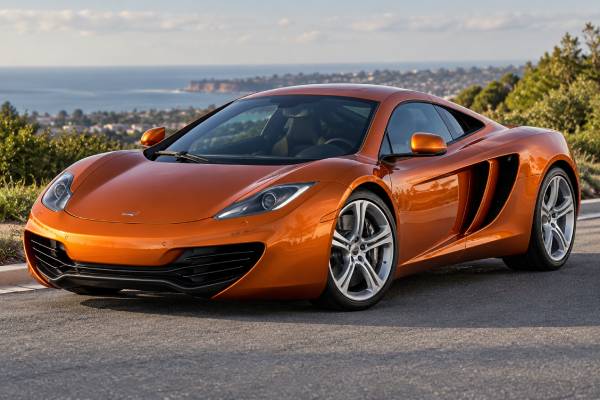
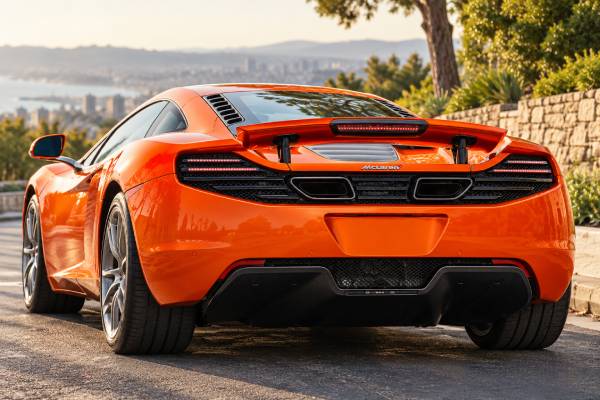
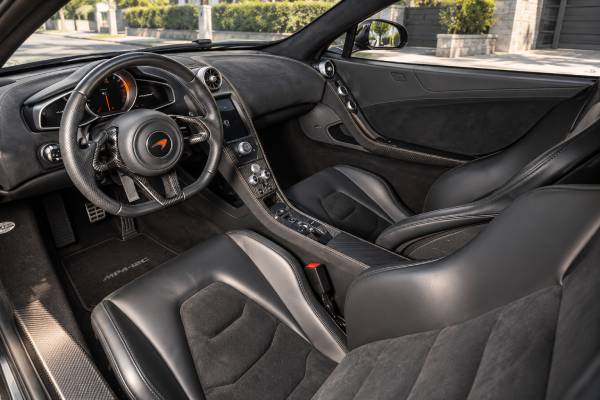
The 616 hp McLaren MP4-12C is best understood as the first major evolution of the 12C rather than a different mechanical model. McLaren announced the higher-output calibration in June 2012, raising the M838T twin-turbo V8 from 600 PS to 625 PS while leaving peak torque at 600 Nm. The company paired the extra top-end power with revised transmission calibration, a programmable Intake Sound Generator, and several usability updates. There is one labeling trap for buyers: McLaren described the upgraded specification as the 2013 model year in its launch material, even though the package was announced and began appearing during calendar year 2012. Earlier owners were also offered the powertrain upgrade at no charge, so a 2012-built MP4-12C may have started life at 592 hp and later received the 616 hp software. This article covers the 625 PS/616 hp configuration associated with that 2012 update and explains how to verify, maintain, inspect, and buy one accurately.
Table of Contents
- How to Identify the 2012 616 hp MP4-12C
- Technical Specifications for the 625 PS Update
- What Changed Beyond the Extra 25 PS
- How the Updated Car Delivers Its Performance
- Service, Fluids, Software, and Storage
- Age-Related Risks Worth Inspecting Closely
- Buying the Right 616 hp Car on Provenance, Not Claims
How to Identify the 2012 616 hp MP4-12C
The defining feature is the 625 PS engine calibration, equivalent to roughly 616 bhp, with peak power moved to 7,500 rpm while torque remains 600 Nm (443 lb-ft). The safest way to identify this specification is through build and service records plus a diagnostic check, because outward appearance does not prove which calibration is installed.
McLaren’s June 2012 enhancement announcement compared the outgoing 600 PS/592 hp specification with the new 625 PS/616 hp version and referred to the latter as the 2013 model-year car. That matters because registration year, production date, and model-year terminology do not always align across markets. For this assignment, “2012” refers to the year the 616 hp update was introduced, not a claim that every 2012 model-year 12C left the factory with 616 hp.
The upgrade was also unusual because McLaren offered the principal performance changes to existing owners without charge. The package included the higher engine output and revised seven-speed SSG calibration, along with software-driven comfort and technology changes. As a result, two cars with the same early build date can have different current specifications.
A buyer should therefore ask three separate questions:
- Was the car originally built as a 600 PS or 625 PS example?
- If it began at 600 PS, was the official factory upgrade applied?
- Has later software or hardware work altered the vehicle again?
Those questions are more useful than asking whether the seller calls it a “2012,” “2013,” “MP4-12C,” or simply “12C.” McLaren began dropping the MP4 prefix around the same period, so naming conventions can overlap in advertisements and historical paperwork.
Mechanically, the car remains the same basic P11 platform: a carbon-fiber MonoCell with aluminum front and rear structures, a mid-mounted M838T 3.8-liter twin-turbocharged V8, rear-wheel drive, and the seven-speed Graziano-supplied dual-clutch Seamless Shift Gearbox. The character changed through calibration and detail refinement rather than through a wholesale redesign.
Technical Specifications for the 625 PS Update
The 616 hp version is a conventional gasoline ICE car with no hybrid system. Its key technical difference from the launch tune is the 625 PS output at 7,500 rpm; the 3,799 cc engine architecture, 600 Nm torque figure, carbon structure, rear-drive layout, and core chassis systems remain fundamentally the same.
| Specification | Value |
|---|---|
| Engine code | M838T |
| Configuration | 90° V8, longitudinal mid-engine |
| Displacement | 3,799 cc (3.8 L) |
| Induction | Twin turbochargers |
| Lubrication | Dry sump |
| Valvetrain | 32-valve DOHC with variable valve timing |
| Bore × stroke | 93.0 × 69.9 mm (3.66 × 2.75 in) |
| Compression ratio | 8.7:1 |
| Maximum power | 625 PS / 460 kW / 616 hp at 7,500 rpm |
| Maximum torque | 600 Nm (443 lb-ft) at 3,000–7,000 rpm |
| Maximum engine speed | 8,500 rpm |
| Fuel requirement | 98 RON/88 MON EN 228 unleaded preferred; 95 RON/85 MON minimum where 98 RON is unavailable |
| Specification | Value | Notes |
|---|---|---|
| Maximum speed | 333 km/h (207 mph) | 625 PS coupe |
| 0–100 km/h (0–62 mph) | 3.3 s | 3.1 s with P Zero Corsa tires |
| 0–200 km/h (0–124 mph) | 9.0 s | 8.8 s with P Zero Corsa tires |
| 400 m / quarter mile | 10.8 s at 218 km/h (135 mph) | Manufacturer technical specification |
| 1,000 m | 19.5 s at 274 km/h (170 mph) | Manufacturer technical specification |
| 100–0 km/h braking | 30.5 m (100 ft) | Manufacturer technical specification |
| EU combined consumption | 11.7 L/100 km (24.2 mpg UK) | Period European figure |
| CO₂ emissions | 279 g/km | Period European figure |
| Specification | Value |
|---|---|
| Transmission | 7-speed dual-clutch Seamless Shift Gearbox (SSG) |
| Shift feature | Pre-Cog paddle functionality |
| Drive type | Rear-wheel drive |
| Final-drive ratio | 3.3:1 |
| Differential | Open differential with Brake Steer |
| Suspension | Double wishbones with ProActive Chassis Control |
| Damping/roll modes | Normal, Sport, and Track |
| Steering | Variable-rate electro-hydraulic rack and pinion |
| Active aerodynamic device | Rear Airbrake |
| Driver aids | ABS, traction control, ESC, launch control |
| Specification | Value |
|---|---|
| Body | 2-door, 2-seat coupe |
| Body structure | Carbon-fiber MonoCell with aluminum front and rear structures |
| Length | 4,509 mm (177.5 in) |
| Width | 1,908 mm (75.1 in) |
| Height | 1,199 mm (47.2 in) |
| Wheelbase | 2,670 mm (105.1 in) |
| Front/rear track | 1,656 / 1,583 mm (65.2 / 62.3 in) |
| DIN weight | 1,434 kg (3,161 lb) |
| Dry weight | 1,336 kg (2,945 lb) |
| Lightweight-option dry weight | 1,301 kg (2,868 lb) |
| Weight distribution | 42.5% front / 57.5% rear |
| Specification | Value |
|---|---|
| Front wheels | 8.5 × 19 in |
| Rear wheels | 11 × 20 in |
| Front tires | 235/35 R19 Pirelli P Zero |
| Rear tires | 305/30 R20 Pirelli P Zero |
| Standard brakes | 370 mm front / 350 mm rear iron discs with forged aluminum hats |
| Optional carbon-ceramic brakes | 394 mm front / 380 mm rear discs |
| Fuel capacity | 72 L (15.8 UK gal; 19.0 US gal) |
| Engine-oil capacity | 8.0 L (8.5 US qt) |
| Cooling-system capacity | 20.0 L (21.1 US qt) |
| Period handbook engine oil | Mobil 1 New Life 0W-40 |
| Period handbook power-steering fluid | Pentosin CHF202 |
| Wheel-bolt torque | 130 Nm (96 lb-ft) |
The dimensions above reflect the later 625 PS technical sheet, which lists 4,509 mm length and 1,908 mm width rather than the 4,507/1,909 mm figures in the earliest launch material. The difference is small but worth preserving rather than mixing source sets indiscriminately.
What Changed Beyond the Extra 25 PS
The 2012 enhancement was mainly a calibration and usability program, not a new engine or chassis. The increase from 600 to 625 PS came with changes intended to make the car feel sharper at high rpm and more polished in daily operation.
The power increase did not raise the 600 Nm torque plateau. Instead, the updated engine carried stronger power farther toward the top of the rev range, with peak output now quoted at 7,500 rpm. That helps explain why the published 0–100 km/h figure barely moved while higher-speed acceleration improved more clearly. McLaren’s comparison with optional Corsa tires showed 0–200 km/h improving from 8.9 to 8.8 seconds and the 0–300 km/h run improving by about a second.
The SSG also received revised software. The dual-clutch hardware already shifted quickly, but calibration determines clutch pressure, shift timing, throttle coordination, and how the transmission reacts in different modes. McLaren specifically included revised SSG calibration in the complimentary upgrade offered to existing customers.
Another visible change was the programmable Intake Sound Generator. The 12C had been criticized by some reviewers for sounding too restrained inside the cabin relative to its performance. The update allowed the driver to alter how much induction character was fed into the cockpit, giving more control over sound without changing the basic exhaust hardware.
Other announced refinements included automatic headlamp logic linked to the rain sensor, an Easy-Exit seat function with seat return where the appropriate electric seats were fitted, and revised Meridian audio equalizer settings on equipped cars. These sound minor beside a 207 mph top speed, but they reveal the purpose of the update: McLaren was reacting quickly to feedback from the first production cars.
For collectors, the update creates a nuanced originality question. A 2011 or early-2012 car that received the official 625 PS package is not “modified” in the same sense as a third-party tune. It is a factory-supported evolution. Yet a buyer specifically seeking the earliest 600 PS driving experience may still prefer a car that never received it. Neither choice is inherently correct; the paperwork should simply match the claim.
How the Updated Car Delivers Its Performance
The 616 hp MP4-12C feels faster mainly because it keeps pulling harder at the top end, while the broad 600 Nm torque band preserves the flexible character of the original. It remains a car that can be driven smoothly at moderate speed and then accelerate with startling force without a dramatic change in mechanical behavior.
The engine’s dry-sump lubrication allows a low installation height and supports sustained high lateral loads. Its oversquare 93.0 mm bore and 69.9 mm stroke suit an engine that revs to 8,500 rpm despite being turbocharged. The result is different from a large-displacement turbo V8 that relies mainly on low-rev torque; the M838T wants to be used across a wide rev range.
Power reaches the rear wheels through an open differential, but the car does not simply spin the lightly loaded inside wheel and surrender. Brake Steer can apply braking to an individual rear wheel to influence yaw and traction. This is a software-and-brake solution rather than a conventional clutch-type limited-slip differential, so brake condition matters to more than stopping distance alone.
The ProActive Chassis Control system is equally central. Its hydraulically interconnected dampers resist roll while allowing more independent vertical wheel movement over bumps. A healthy car therefore has a striking split personality: Normal can be unexpectedly supple, Sport tightens control, and Track makes the car much more immediate.
That range is useful on real roads. Low ride height and wide tires still demand care, but the 12C was not designed as a weekend-only punishment device. The seating position is centered around the driver, outward visibility is better than the low roofline suggests, and the gearbox can be left in automatic mode.
The electro-hydraulic steering remains one of the car’s most valued analog-feeling systems. It provides meaningful road texture without excessive kickback, and its weighting changes naturally as load builds. Later supercars often became more configurable while moving to electrically assisted steering; the 12C’s arrangement is comparatively simple and communicative.
Braking hardware is also more sophisticated than a quick options list suggests. The standard iron discs use aluminum hats to reduce mass, while carbon ceramics were optional. On the road, a well-maintained iron setup is entirely appropriate. For repeated track work, carbon ceramics can offer thermal advantages, but condition and replacement cost must be considered before treating them as a premium buying point.
The active rear Airbrake adds aerodynamic stability during heavy braking. Because it is an active system, correct operation should be verified during a specialist inspection rather than assumed from the spoiler moving during a showroom demonstration.
Service, Fluids, Software, and Storage
A 616 hp 12C needs maintenance that treats software status and electrical health as seriously as oil and filters. The mechanical platform is durable when cared for, but deferred service and low-voltage events can turn a straightforward car into a confusing diagnostic project.
The period owner documentation specifies 8.0 liters of engine oil and names Mobil 1 New Life 0W-40. It also lists a 20.0-liter cooling system, Pentosin CHF202 power-steering fluid, and Pentosin DOT 5.1 brake fluid. Those references are useful for understanding the original engineering requirement, but modern owners should confirm currently approved fluids through the latest McLaren documentation for their VIN.
A practical service plan should cover five categories.
First, establish a chronological baseline. Gather invoices, not just dealer stamps. Identify when engine oil, gearbox service items, brake fluid, coolant, filters, tires, battery, and hydraulic suspension components were last addressed. Low mileage can hide long time gaps.
Second, preserve battery voltage. The owner’s manual gives specific charging guidance and identifies the appropriate luggage-compartment connection. A correctly connected conditioner is not optional equipment for a car that spends weeks parked. Many electronic complaints become harder to diagnose after repeated low-voltage events.
Third, inspect thermal systems. Radiators and condensers live in exposed airflow paths and can collect debris. Cooling hoses and fittings age. A car that holds temperature during a brief road test may still need preventive work if coolant history is poor.
Fourth, track software and campaign history. Because this exact version may owe its 616 hp output to an official update, service records can help establish whether the engine and SSG calibration was applied and whether later software work has been performed. An experienced McLaren specialist may also be able to read relevant diagnostic information.
Fifth, service by use. Track driving justifies shorter inspection cycles for brake fluid, pads, discs, tires, wheel fasteners, and general underbody condition. Conversely, a garage-kept car that travels very little still ages by calendar time. Brake fluid absorbs moisture, tires harden, seals age, and batteries degrade even when odometer growth is minimal.
The maintenance manual also shows that periodic servicing includes far more than oil. Checks cover wheel and tire condition, brake components, underbody inspection, fault memory, airbrake function, navigation, keys, locks, and other systems. That breadth is a useful model for pre-purchase inspection.
Age-Related Risks Worth Inspecting Closely
The main risks are predictable: hydraulic suspension deterioration, drivetrain leakage, aging electronics, door and window faults, infotainment limitations, and neglected recall work. None should be diagnosed from a single symptom without a proper scan and physical inspection.
ProActive Chassis Control wear
Hydraulic accumulators and related components can lose effectiveness with age. A failed or weak system may make the car ride extremely firmly, display suspension warnings, or reduce the difference between handling modes. The correct response is diagnosis of pressure, accumulators, lines, and related components, not random replacement of conventional shock absorbers.
A healthy 12C in Normal mode should not feel like a fixed-rate track suspension. If a seller describes a punishing ride as normal, arrange an independent drive in another known-good car or have a specialist evaluate it.
SSG leaks and behavior
Look for fluid traces around the gearbox and inspect after removing enough underbody coverage to see relevant areas. On the road, judge cold and warm engagement separately. Jerky parking behavior alone does not prove failure because dual-clutch systems can feel different from torque-converter automatics, but persistent warnings, delayed selection, severe shudder, or fluid leakage deserve investigation.
IRIS and electrical functions
The earliest IRIS system is technologically dated and can be temperamental. Later hardware upgrades exist on some cars. Test the screen, navigation, audio, Bluetooth, camera or parking-assistance functions if fitted, and all steering-column or console controls. A nonfunctioning convenience feature can become expensive when the cause is a discontinued module rather than a simple switch.
Door sensors, glass indexing, and seals
The dihedral doors use electronic sensing and frameless glass. Check exterior entry, interior release, window drop, full closure, locking, mirror operation, and water sealing on both sides. Inconsistent behavior may stem from sensors, alignment, voltage, or control hardware.
Brakes and tire age
Carbon-ceramic brakes deserve specialized inspection because surface appearance does not always reveal remaining service life. Iron rotors are less exotic but still costly in a supercar context. Tire date codes matter: a 12C with old low-mileage tires can feel nervous or lack wet grip even when tread depth looks excellent.
Recall completion
Takata passenger-airbag campaigns affect 12C vehicles in the United States, and a separate wiper-motor campaign applied to certain 2012–2014 cars in hot, humid regions. Recall eligibility and completion should be checked by VIN with the relevant authority or McLaren retailer.
Buying the Right 616 hp Car on Provenance, Not Claims
The best 616 hp example is the one whose exact specification can be proved and whose complex systems work together correctly. Mileage, color, and options matter, but they should come after version identity, structural condition, service history, and diagnostic health.
Start by reconciling every date. Compare VIN data, build information, first registration, invoices, and any paperwork for the 625 PS update. If a seller advertises a “factory 616 hp 2012,” ask whether that means a late-2012 build in the new specification, a 2013-model-year car registered during 2012, or an earlier 600 PS car that received the factory upgrade. Those are different histories even if all now make the same quoted power.
Then commission a McLaren-specific pre-purchase inspection. A useful inspection should include:
- diagnostic scan with stored and current faults;
- inspection of the MonoCell interfaces and aluminum structures for repair evidence;
- underbody inspection with attention to leaks and impact damage;
- PCC operation and hydraulic condition;
- cold and fully warm gearbox behavior;
- cooling-system condition and evidence of leakage;
- brake-disc, pad, and tire assessment;
- battery condition and charging history;
- operation of doors, windows, mirrors, climate control, IRIS, lighting, parking sensors, and Airbrake;
- confirmation of recall and campaign status.
Road testing should include more than one drive mode. Use Normal on rough pavement, then Sport on a smoother section. Confirm that the suspension meaningfully changes without producing warnings. Allow the gearbox and engine to reach proper temperature before judging shift quality. Listen for wheel-bearing or tire noise on a steady cruise and check whether the steering tracks cleanly without vibration.
Do not overvalue cosmetic perfection at the expense of mechanical evidence. A stone-chipped but properly maintained 12C can be a better car than a freshly detailed low-mileage example with old tires, weak battery history, overdue fluids, and intermittent PCC faults. Conversely, extensive repainting on a car with vague accident history deserves careful structural examination because the carbon tub and its attachment points are central to the vehicle.
Finally, decide what the 616 hp specification means to you. If you want the improved calibration regardless of how the car acquired it, a documented factory-upgraded early example can be entirely sensible. If you want a car built in the later specification from new, insist on records that support that. The important thing is not to pay for a historical story that the paperwork cannot prove.
References
- Even more powerful and usable: the enhanced McLaren MP4-12C 2012
- mp4–12C DIMENSIONS 2012 (Technical Specification)
- McLaren MP4-12C Spider 2012
- MCLAREN MP4-12C USER INSTRUCTIONS Pdf Download | ManualsLib 2011 (Owner’s Manual)
- MCLAREN MP4-12C AUTOMOBILE MAINTENANCE MANUAL | ManualsLib 2014 (Maintenance Manual)
- McLaren Automotive 2017 (Recall Notice)
Disclaimer
This article is for informational purposes only and does not replace professional diagnosis, repair, or a qualified pre-purchase inspection. Specifications, torque values, software, service intervals, fluids, and procedures can differ by VIN, market, production date, and equipment, so verify all work against current official McLaren service documentation for the exact car.
If you found this guide helpful, please share it on Facebook, X/Twitter, or another automotive community to help support our work.