


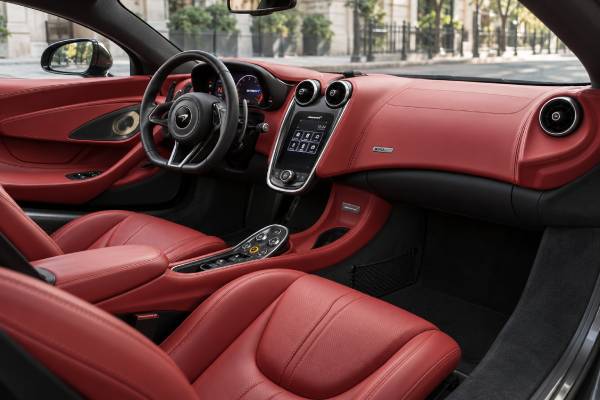
The McLaren 570GT takes the Sports Series hardware in a direction the 570S never tried to prioritize: long-distance comfort and usable luggage space without abandoning mid-engine performance. It keeps the 570 PS, or 562 bhp, 3.8-litre twin-turbo V8 and seven-speed SSG, but adds a taller panoramic glass roof, a side-opening rear Glass Hatch and a leather-lined Touring Deck behind the seats. Combined with the front compartment, the original factory launch material described up to 370 litres of storage. McLaren also softened the spring rates, slowed the steering slightly, fitted quieter Pirelli tires and used cast-iron brakes as standard to make the car calmer and more practical on the road. The result still reaches 100 km/h in 3.4 seconds and has a claimed 328 km/h top speed. Used buyers have one especially important model-specific item to verify: U.S. recall 20V-231 covered certain 2017–2019 570GTs for possible fuel-tank corrosion caused by moisture retained in an NVH foam pad.
Table of Contents
- What Makes the 570GT Different from a 570S
- 570GT Technical Data and Specifications
- Glass Hatch, Touring Deck, and Long-Distance Packaging
- Softer Chassis, Steering, Brakes, and Tire Strategy
- V8 Performance, Gearbox Behavior, and Touring Range
- Maintenance, Fuel-Tank Recall, and Inspection Priorities
- Choosing a 570GT for Real-World Ownership
What Makes the 570GT Different from a 570S
The 570GT is not merely a 570S with extra leather. McLaren changed the rear body, storage layout, roof, steering, spring rates, tires, brake specification and cabin refinement to create a Sports Series car intended for longer trips and more frequent road use.
The largest visual change is behind the cabin. Instead of the 570S’s open flying-buttress treatment around the engine cover, the GT uses a taller roofline that flows into a large glazed rear hatch. Beneath it sits the Touring Deck, a luggage area above and behind the engine bay. This transforms the way the car can be packed because soft bags no longer have to fit entirely in the front trunk.
The Glass Hatch is side-hinged and was engineered to open toward the curb according to left- or right-hand-drive configuration. Its carbon-fibre frame helps preserve stiffness around the new opening. The design is practical but also adds inspection points that do not exist on a 570S: hatch struts, latch operation, seals, heating elements, trim alignment and water management all deserve attention on an older car.
McLaren’s comfort changes were equally deliberate. Contemporary technical material described front spring rates reduced by 15 percent and rear spring rates by 10 percent relative to the 570S. The electro-hydraulic steering ratio was made about 2 percent slower, and the car received Pirelli P Zero tires developed with noise-reduction technology. Standard cast brakes replaced the 570S’s carbon-ceramic setup, a choice more in keeping with road mileage and touring use.
Those changes do not turn the 570GT into a soft luxury coupé. The carbon-fibre MonoCell II, mid-mounted V8, rear-wheel drive and dual-clutch gearbox remain closely related to the 570S. The GT is better understood as a different calibration of the same architecture: one that gives up a small amount of immediacy in exchange for luggage capacity, refinement and a less busy demeanor on long roads.
That makes the buying logic different, too. A prospective 570GT owner should care about luggage-deck condition, hatch sealing, panoramic-roof trim, seat comfort and cabin electronics just as much as brake or tire wear. A track-focused inspection alone misses much of what makes this model valuable.
570GT Technical Data and Specifications
The 570GT uses the same basic M838TE 3,799 cc twin-turbo V8 architecture as the 570S, with 570 PS and 600 Nm sent to the rear wheels through a seven-speed SSG dual-clutch transmission. It is non-hybrid and has no driven front axle.
| Specification | Factory data |
|---|---|
| Engine | M838TE 90-degree V8 |
| Displacement | 3,799 cc (3.8 L) |
| Induction | Twin turbochargers |
| Lubrication | Dry sump |
| Maximum power | 570 PS (562 bhp / 419 kW) |
| Maximum torque | 600 Nm (443 lb-ft) |
| Transmission | 7-speed Seamless Shift Gearbox plus reverse |
| Drive | Rear-wheel drive |
| Measure | Factory figure |
|---|---|
| 0–100 km/h (0–62 mph) | 3.4 seconds |
| 0–200 km/h (0–124 mph) | 9.8 seconds |
| Maximum speed | 328 km/h (204 mph) |
| 100–0 km/h braking | 33 m (108 ft) |
| 200–0 km/h braking | 133 m (436 ft) |
| Specification | Factory data |
|---|---|
| Lightest dry weight | 1,350 kg (2,976 lb) |
| DIN kerb weight | 1,498 kg (3,303 lb) |
| Length | 4,530 mm (178.3 in) |
| Width at widest point | 2,095 mm (82.5 in) |
| Height | 1,202 mm (47.3 in) |
| Fuel tank | 72 L (15.8 UK gal / 19.0 US gal) |
| Specification | Factory data |
|---|---|
| Primary structure | Carbon-fibre MonoCell II |
| Suspension | Double wishbones with adaptive dampers |
| Differential | Open differential with Brake Steer |
| Standard brakes | Cast-iron discs with aluminium hubs |
| Roof | Fixed panoramic glass roof |
| Rear access | Side-opening Glass Hatch with carbon-fibre frame |
| Touring Deck capacity | 220 L in original launch specification |
| Front luggage capacity | 150 L |
| Total launch-rated storage | 370 L |
| Cycle | Figure |
|---|---|
| NEDC combined fuel consumption | 10.7 L/100 km (26.6 UK mpg) |
| NEDC combined CO₂ | 249 g/km |
| WLTP combined CO₂ | 276 g/km |
The 570GT’s numbers illustrate its role. It gives away only two tenths of a second to the 570S in the 0–100 km/h claim and three tenths to 200 km/h, yet adds useful storage and greater refinement. Its 1,350 kg lightest dry figure also remains low for a glass-roofed touring car with this performance.
Glass Hatch, Touring Deck, and Long-Distance Packaging
The 570GT’s most important engineering feature is the rear storage system, because it changes how a mid-engine McLaren can be used. The 220-litre Touring Deck sits behind the seats and is reached through the side-opening Glass Hatch, supplementing the 150-litre front compartment.
Packing the Touring Deck requires more thought than loading a conventional hatchback. It is a sculpted, leather-lined area close to the engine bay rather than a deep rectangular trunk. Soft luggage works best, and heavy objects should be secured and placed according to the owner’s handbook. Heat-sensitive items deserve caution after spirited driving because the powertrain sits below and behind the storage surface even though insulation is provided.
The hatch itself should operate smoothly from fully closed to fully open without binding. Inspect the latch, hinges, gas struts and carbon frame for evidence of adjustment or impact. The heating element in the glass, weather seals and trim around the opening should all be tested. Water staining or musty odor in the rear luggage area can indicate previous sealing or drainage problems even if the car is dry when viewed.
The panoramic roof contributes as much to cabin character as the hatch. McLaren made it higher and extended it farther rearward than the 570S roof, creating more light and a greater sense of space. The glass includes solar and acoustic treatment, but its large area still means the climate-control system and headliner condition matter in hot markets. Check for bubbling trim, discoloration, unusual creaks and evidence of non-factory tint or film installation.
Soft-close doors, heated seats and upgraded cabin materials were part of the GT’s more luxurious brief. These features should be viewed as systems to verify, not just sales-sheet bonuses. Cycle the door closing function several times, test seat memory and heating where fitted, run the climate control through temperature changes and inspect the touchscreen. A car can drive perfectly while accumulated comfort-system faults undermine the reason for choosing the GT version.
Long-distance usability also depends on noise. Pirelli developed tires with internal noise-cancelling foam for the 570GT, and McLaren added sound-deadening measures. Replacement tires may have the correct dimensions without matching the original noise characteristics. That is not necessarily a problem, but a buyer who values the GT’s quieter motorway behavior should check the exact tire model rather than judging only brand and tread depth.
Softer Chassis, Steering, Brakes, and Tire Strategy
The 570GT deliberately softens the 570S formula rather than simply adding weight. Reduced spring rates, recalibrated steering and road-oriented tires give the car a less abrupt response over broken pavement while preserving the same double-wishbone layout and adaptive damping concept.
The front springs were specified about 15 percent softer and the rear springs about 10 percent softer than the 570S at launch. Anti-roll and damper calibration were also revised for the touring brief. In Normal mode, the car should therefore feel composed rather than brittle. If it crashes over small bumps or wanders at speed, tire pressure, tire construction, alignment, wheel condition and dampers should be checked before accepting the behavior as normal.
McLaren also slowed the electro-hydraulic steering ratio by roughly 2 percent. The difference is subtle, but it reduces the nervousness that a very quick rack can create during long motorway runs. The steering should still have strong self-centering and clear feedback. Play, clunks, uneven assistance or a wheel that sits off-center deserve investigation.
Standard cast-iron brake discs are another purposeful GT choice. They are heavier than carbon-ceramic discs but generally less costly to replace and can suit repeated road mileage well. Check rotor thickness, surface condition and corrosion, particularly on cars stored in damp garages. A low-mileage GT that sits for long periods can develop brake issues unrelated to hard use.
Tire age is equally important. Touring cars may accumulate long periods of straight-line mileage or extended storage rather than track heat cycles. Look for inner-edge wear, flat spotting, sidewall cracking and production dates. A matched set of appropriate tires contributes to both the refinement and the steering feel McLaren intended.
Owners sometimes retrofit sportier exhausts, wheels or carbon-ceramic brakes. Such changes can be attractive, but they alter the balance McLaren designed. Confirm that modifications are documented, correctly installed and legal in the registration market. If originality matters for resale, determine whether the factory parts remain with the car.
For touring use, the GT-specific hardware also changes how consumables should be judged. A set of iron discs with normal road wear is not a downgrade simply because another Sports Series car has carbon ceramics, and a quiet road tire is not automatically inferior to a more aggressive track-oriented compound. What matters is whether the fitted parts match the car’s intended duty, axle specifications and approved sizes. A previous owner who has chased a more extreme setup may have created extra road noise, tramlining or cold-brake behavior that works against the 570GT’s purpose. During the test drive, separate desirable feedback from modification-related harshness.
V8 Performance, Gearbox Behavior, and Touring Range
The 570GT is still a very fast McLaren despite its touring focus. Its 570 PS twin-turbo V8 and seven-speed SSG deliver the same peak output as the 570S, with slightly slower acceleration caused mainly by added mass and calibration rather than a reduced engine rating.
The M838TE’s torque arrives high enough in the rev range that the car retains a purposeful, rev-seeking feel. It can cruise quietly in automatic mode, then respond quickly when the driver requests a lower gear. The transmission’s manual paddles are useful on mountain roads because they let the engine stay in its strongest range without waiting for automatic logic.
A test drive should include both urban and faster-road conditions. At low speed, the dual-clutch gearbox should engage consistently and maneuver without excessive shudder. Once warm, shifts should remain clean under moderate and stronger acceleration. Any transmission warning, repeated refusal to select a ratio or violent engagement warrants specialist diagnosis.
The GT’s 328 km/h claimed top speed is academically impressive, but touring owners will feel the car’s performance more through overtaking response and the ability to cover distance without strain. The 72-litre fuel tank helps, although real range varies dramatically with traffic, speed and boost. Official NEDC consumption of 10.7 L/100 km should not be treated as a personal fuel-economy promise.
Cooling condition becomes especially important on a car used for long trips. Inspect front heat exchangers for debris and damage, confirm temperatures stay stable in traffic and during sustained driving, and look for coolant residue after the test drive. Service invoices can reveal whether radiators, hoses or pumps have been replaced and whether the work was preventive or fault-driven.
The dry-sump engine also means oil checks and service should follow McLaren procedures. Avoid generic assumptions about level checking or fluid specification. If the car has been maintained outside the dealer network, confirm that the specialist has genuine Sports Series experience and can document the correct fluids and parts.
Maintenance, Fuel-Tank Recall, and Inspection Priorities
The 570GT should receive regular time-based maintenance even when annual mileage is low, and U.S.-market 2017–2019 examples require careful verification of recall 20V-231. That campaign addressed potential fuel-tank corrosion caused by moisture trapped in an NVH foam pad beneath the tank.
McLaren’s recall filing described a foam pad that could retain corrosive moisture against the underside of the fuel tank. Over time, corrosion could create micro-porations and allow fuel vapor or liquid to escape. The remedy was to remove the foam pad, inspect the tank and replace the tank if corrosion warranted it. NHTSA identified 373 potentially involved 2017–2019 570GT vehicles in the U.S. population.
Recall status must be checked by VIN because model year alone does not show whether a particular car was included or whether the remedy was completed. A fuel smell around the tank area was cited as a possible warning in the recall documentation. Any current fuel odor deserves immediate professional attention rather than assumption that it is normal for a high-performance car.
Beyond the recall, annual service history matters. Sports Series literature recommended servicing every 12 months or 10,000 miles (15,000 km), whichever came first. For a GT used sparingly, time may be the dominant trigger. Brake fluid, battery condition, tires and seals continue to age even when the odometer barely moves.
A thorough inspection should include:
- Cold start and diagnostic scan. Record startup behavior and scan every major module after the road test.
- Fuel-system recall proof. Confirm the exact VIN status and retain the retailer invoice or campaign record.
- Glass Hatch and Touring Deck. Check opening, support struts, latch, seals, trim and evidence of water entry.
- Panoramic roof and climate control. Look for headliner damage, excess heat, glass issues and weak air conditioning.
- Brakes, wheels and tires. Measure wear, age and alignment patterns; do not equate low mileage with fresh rubber.
- Underbody and front aero. Inspect jacking points, floor panels and splitter for contact damage.
- Cooling system. Examine accessible hoses and heat exchangers and verify stable operating temperature.
Battery care is a recurring ownership theme. Cars that sit for weeks should use an appropriate conditioner, and repeated deep discharge should prompt battery testing. Low voltage can create multiple warning messages, so faults should be diagnosed after electrical health is established rather than simply erased.
Choosing a 570GT for Real-World Ownership
The best 570GT is the car that still performs its original grand-touring job: it should be fast and precise, but also dry inside, quiet enough for distance, easy to pack and free from unresolved comfort-system or recall issues.
Start by checking the rear storage area in the way you intend to use it. Bring representative luggage if necessary. The quoted 370 litres is a volume figure, not a guarantee that every suitcase shape fits. Confirm that the Glass Hatch opens in a convenient direction for your garage and that the Touring Deck trim has not been damaged by hard or poorly secured items.
Loading technique matters more here than it does in a conventional hatchback. The Touring Deck sits close to the cabin and powertrain environment, so soft bags are usually easier to position than rigid cases, and loose objects should be secured rather than allowed to move under acceleration or braking. Inspect the deck’s carpet, edge trim and glass for marks that suggest repeated overloading or careless loading. Also check the hatch from several positions: it should release, rise, remain supported and close cleanly without needing an unusual slam. Water staining beneath the deck or around adjacent trim is a stronger warning than cosmetic scuffing because it can point to seal, drainage or alignment work.
Then assess specification. A panoramic privacy roof, upgraded audio, power seats, parking cameras and front lift can make a large difference to touring comfort. Conversely, a Sport Pack or sports exhaust may move the car slightly back toward 570S character. There is no universally best combination; there is only the configuration that matches your roads and expectations.
Service access should be planned before purchase. A GT may be bought for road trips, but recovery and transport logistics become important if the nearest qualified workshop is several hours away. Identify a retailer or respected Sports Series specialist, ask about parts lead times and understand how imported-car campaigns are handled in your region.
Before committing to long-distance use, build a simple travel-day routine around the car rather than treating it like an ordinary coupe. Check cold tire pressures and sidewalls, inspect fluid or coolant traces where visible, confirm that the battery is healthy, and make sure the front-lift system operates if the car is equipped with it. Test the air conditioning and hatch before packing, not after departure. On unfamiliar routes, steep ramps and abrupt road crowns can be more relevant than outright ground clearance figures, so approach them slowly and use lift only as the owner’s documentation permits. These checks are basic, but they address the small problems most likely to turn a touring advantage into an inconvenient stop.
A pre-purchase inspection should quantify immediate expenditure. Tires that are old but unworn, rusty cast rotors, a weak battery, overdue annual service or failing hatch struts can each be manageable. Several of them together can erase the apparent saving in a cheap example. Get written estimates before negotiating.
The 570GT is distinctive because it expands the Sports Series brief rather than simply making the car faster. Its glass rear body, extra luggage deck and softer calibration give it a genuine role within the family. Buy one with a dry and correctly operating hatch area, verified fuel-tank campaign status, strong annual service history and healthy road-focused consumables, and it can deliver the rare combination McLaren intended: mid-engine involvement with enough comfort and storage to justify taking the long way somewhere far from home.
References
- McLaren 570GT – Everyday Performance Sports Car 2026 (Manufacturer Specifications)
- McLaren Owners 2026 (Owner Documentation)
- Sports Series 2017 (Manufacturer Brochure and Service Interval)
- Part 573 Safety Recall Report 20V-231 2020 (Fuel-Tank Recall)
- IMPORTANT SAFETY RECALL 2020 (Owner Recall Notice)
- Press release 2016 (570GT Storage and Touring Specification)
Disclaimer
This guide is for informational and buying-research purposes, not a substitute for professional diagnosis or repair. Specifications, torque values, service intervals, and procedures may vary by VIN, market, and equipment, so confirm the exact 570GT in official McLaren service documentation before maintenance or repair work.
If this 570GT article helped with your research, please share it with a McLaren group, touring-car community, Facebook page, X/Twitter audience, or another enthusiast considering one.