


The McLaren 620R is the Sports Series car that asks to be inspected like track equipment, not merely like a faster 570S. Developed from the 570S GT4 program, it combines a road-legal MonoCell II chassis with GT4-derived aerodynamics, center-lock wheels, motorsport dampers, carbon-ceramic brakes and a 620 PS version of the M838TE twin-turbo V8. McLaren quoted 0–100 km/h in 2.9 seconds and 0–200 km/h in 8.1 seconds, but the more revealing number is 185 kg of maximum downforce at 250 km/h. The hardware is adjustable, and its condition depends heavily on how previous owners used and set up the car. That changes the buying process: wing position, damper settings, track inspections, tire history, underbody condition and original equipment matter as much as ordinary service stamps. The 620R can be driven on the road, yet its handbook devotes unusual attention to circuit preparation and cooling. This guide covers the exact specifications, race-derived engineering, setup logic, maintenance and purchase checks for 2020–2021 examples.
Table of Contents
- What the 620R Takes from the 570S GT4
- 620R Technical Data and Factory Specifications
- Rear Wing, Front Aero, and High-Speed Balance
- Motorsport Dampers, Center-Lock Wheels, and Tires
- 620 PS V8, SSG, Brakes, and Track Heat
- Cabin Equipment and Road-Use Compromises
- Maintenance, Track History, and Buying the Right 620R
What the 620R Takes from the 570S GT4
The 620R is best understood as a road car engineered around GT4 concepts rather than a 570S with a cosmetic track package. It shares the Sports Series carbon-fibre MonoCell II foundation, but McLaren added race-derived suspension, functional aero and track hardware that require a different standard of ownership care.
The connection to the 570S GT4 is visible immediately. A large adjustable carbon-fibre rear wing sits high in clean airflow, while the front bumper, splitter, bonnet and dive planes manage downforce and brake cooling. The suspension uses lightweight aluminium wishbones and uprights with stiffer springs and anti-roll bars. Solid stainless-steel top mounts replace the more compliant rubber arrangement used on less extreme Sports Series versions, sharpening the path between tire forces and the driver.
The result is not a homologation race car in the legal sense; the 620R is free of the competition restrictions that govern the GT4. That freedom allowed McLaren to recalibrate engine and turbocharger management for 620 PS, fit road-required equipment and tune the aerodynamic balance for a car that can travel to a circuit under its own power.
That dual purpose matters when looking at a used example. A road-only car may have suffered speed bumps, steep ramps and stone impact without ever seeing a race circuit. A heavily tracked car may have clean paint yet accumulated heat cycles, curb strikes, tire changes and suspension adjustments. Neither history is automatically bad. What matters is whether the condition and documentation match the use.
McLaren’s own supplement treats the 620R differently from the regular Sports Series. It tells owners to consult a retailer before track use, recommends inspection before and after circuit driving, gives specific cooling-down advice, explains slick-tire settings, and warns that wing and damper changes affect stability. Those instructions are a useful guide for a buyer: modifications to setup should have an understandable reason, and the car should not arrive with unknown adjustments simply because they look “more race car.”
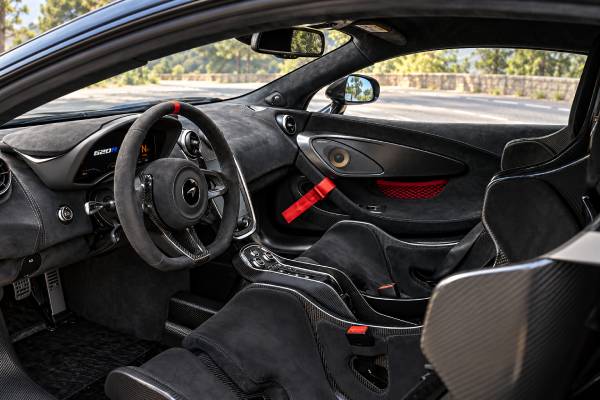
The cabin reinforces the intent. Carbon-fibre racing seats, six-point harnesses, road belts, door pull straps and McLaren Track Telemetry are part of the concept, while comfort features such as air conditioning and navigation could be optional. A 620R with a different equipment mix is not necessarily incorrect, but factory build specification becomes especially important because lightweight, road-friendly and MSO configurations can differ significantly.
620R Technical Data and Factory Specifications
The 620R is a petrol-only, rear-wheel-drive ICE coupé with a longitudinal mid-mounted M838TE 3.8-litre twin-turbo V8 and seven-speed Seamless Shift Gearbox. Factory launch material rated it at 620 PS, 611 bhp and 456 kW; some market listings and conversions round the output to 612 hp, which is the figure used in this article’s vehicle identifier.
| Specification | 620R |
|---|---|
| Engine | M838TE twin-turbocharged V8 |
| Displacement | 3,799 cc (3.8 L) |
| Maximum power | 620 PS (611 bhp / 456 kW) at 7,000 rpm |
| Maximum torque | 620 Nm (457 lb-ft) at 3,500 rpm |
| Maximum engine speed | 8,500 rpm |
| Transmission | 7-speed Seamless Shift Gearbox (SSG), dual-clutch |
| Drivetrain | Longitudinal mid-engine, rear-wheel drive |
| Recommended fuel for maximum performance | 99 RON |
| Fuel tank | 72 L (19.0 US gal) |
| Measure | Factory figure or configuration |
|---|---|
| 0–100 km/h (0–62 mph) | 2.9 seconds |
| 0–200 km/h (0–124 mph) | 8.1 seconds |
| Maximum speed | 322 km/h (200 mph) |
| Maximum total downforce | 185 kg (408 lb) at 250 km/h (155 mph) |
| Front aero package contribution | Up to 65 kg (143 lb) of downforce |
| Dive-plane contribution | Up to 30 kg (66 lb) within the front package |
| Rear wing | Carbon fibre, three adjustable angles |
| Measure | Figure |
|---|---|
| Length | 4,557 mm (179.4 in) |
| Width without mirrors | 1,944.5 mm (76.6 in) |
| Width with mirrors | 2,095 mm (82.5 in) |
| Height | 1,194 mm (47.0 in) |
| Wheelbase | 2,670 mm (105.1 in) |
| Front / rear track | 1,680.5 / 1,618 mm (66.2 / 63.7 in) |
| Lightest dry weight | 1,282 kg (2,826 lb) |
| DIN kerb weight | 1,386 kg (3,056 lb) |
| Front luggage capacity | 120 L |
| Specification | Factory configuration |
|---|---|
| Structure | Carbon Fibre MonoCell II |
| Suspension | Double wishbone with motorsport coilover dampers |
| Damper adjustment | Two-way manual compression and rebound adjustment |
| Brakes | Carbon ceramic with forged aluminium calipers |
| Brake disc diameter | 390 mm front / 380 mm rear |
| Wheel type | Forged center-lock |
| Wheel size | 8J x 19 front / 11J x 20 rear |
| Road tire | Pirelli P Zero Trofeo R |
| Tire size | 225/35 R19 front / 285/35 R20 rear |
| Item | Practical detail |
|---|---|
| Race restraints | Six-point harnesses plus road seat belts |
| Seats | Super-lightweight carbon-fibre racing seats |
| Telemetry | McLaren Track Telemetry standard |
| Slick tires | Track-only option; same nominal tire sizes |
| Rear wing road setting | Lowest angle of attack recommended for overall road aero balance |
| Air conditioning | Optional rather than part of the stripped standard specification |
| Navigation | Optional rather than part of the stripped standard specification |
A useful detail appears when launch publicity is compared with the production owner’s supplement. Early material broadly described 32 clicks of damper adjustment, while the supplement specifies 32 compression positions and 35 rebound positions. For setup work, the handbook and the individual car’s installed hardware should therefore take priority over simplified launch descriptions.
Rear Wing, Front Aero, and High-Speed Balance
The 620R’s aero parts are functional setup components, so their condition and position affect more than appearance. The complete package can generate 185 kg of downforce at 250 km/h, and McLaren explicitly warns that changing rear-wing angle changes handling and stability.
The carbon-fibre rear wing comes from the GT4 concept and is raised into cleaner airflow. It has three available angles. The factory/road recommendation is the lowest angle of attack because it balances front and rear downforce against drag. Steeper settings increase rear load, but more rear wing is not automatically “better” if the rest of the car and the circuit do not call for it.
That point is important on used cars because the wing can become a visible badge of track seriousness. A seller may advertise an aggressive position without knowing who set it or why. The owner’s supplement says rear-wing adjustment should be carried out by a McLaren retailer, and it specifies that the wing and mounting should be checked regularly for damage. During a pre-purchase inspection, identify the current position, examine the supports and fasteners, and look for cracking, impact marks or repairs to the wing element.
At the front, the 620R uses a redesigned bumper, large splitter, bonnet nostrils and dive planes. The frontal package contributes up to 65 kg of downforce, with the dive planes responsible for as much as 30 kg of that figure while also helping brake cooling. These parts sit exactly where road debris, loading ramps and curbs can hurt them.
Inspect the splitter from below, not just from standing height. Scraping is expected on a low track-oriented car, but deep gouges, delamination, broken mounting points or mismatched repairs are different. The bonnet vents and brake-cooling paths should be clear rather than packed with leaves, rubber debris or track pickup.
Aero damage can also hint at a larger event. A replaced dive plane is relatively minor; a front corner with fresh carbon parts, altered panel gaps and underfloor damage deserves a more careful geometry check. Ask for invoices and photographs if a seller discloses circuit contact. Functional repairs done correctly are preferable to unexplained pristine parts on an otherwise heavily used car.
The 322 km/h top-speed figure is slightly lower than less aero-heavy Sports Series variants despite the stronger engine. That is not a weakness; it reflects the 620R’s priority. The car was designed to create grip and confidence at speed around a circuit rather than to minimize drag for a headline maximum-speed number.
Motorsport Dampers, Center-Lock Wheels, and Tires
The suspension is the feature most likely to be misunderstood by a road-car buyer. The standard 620R uses manually adjustable motorsport dampers, and McLaren warns that adjustment must be symmetrical because incorrect settings can alter handling and stability.
The production supplement separates compression and rebound. Compression controls how the damper resists being shortened when the wheel moves upward relative to the body; rebound governs how it controls extension afterward. The manual gives 32 compression positions and 35 rebound positions, plus factory-recommended combinations for road/track, bumpy-road and smooth-track use. Those settings are a disciplined starting point, not an invitation to turn adjusters randomly.
A buyer should record the settings found on the car before anyone changes them. If left and right sides do not match, ask why. The factory notes that knocking and hydraulic-valve noise can be heard with the motorsport suspension and may be normal, which is useful because a regular-road-car inspection could misclassify every mechanical sound as a worn joint. Even so, normal damper noise does not excuse leaking units, play, bent components or impact damage.
Some cars were configured differently, including examples ordered with more road-oriented adaptive damping in place of the motorsport setup. That makes the original build sheet important. Do not assume an adaptive-damper 620R has been modified after delivery, and do not assume a motorsport-damper car has every other lightweight option.
Center-lock wheels add another race-derived maintenance point. The owner’s supplement places wheel-nut tools in the front luggage compartment but states that a wheel change should be carried out by a McLaren retailer. Check that the correct tools and accessories remain with the car, inspect the wheel centers and locking hardware for damage, and look for evidence of careless impact-tool use.
Trofeo R semi-slick road tires are the standard road-focused choice. They can deliver high dry grip, but their age, heat cycles and conditions of use matter greatly. The handbook warns that grip drops rapidly on wet or icy roads, especially near minimum tread depth. A barely worn tire that has spent years through repeated heat cycles may be a worse track and road proposition than its tread depth suggests.
McLaren also engineered the 620R to accept optional track-only slick tires without additional mechanical changes. The supplement instructs the driver to select the slick-tire type in the instrument-cluster menu, which changes TPMS behavior; it also makes clear that slicks are not road legal. If a used car comes with extra wheels, document which tires are mounted, their age and history, and whether transport to the track is required under local law.
Alignment should be measured, not guessed from steering feel. Track curb contact or aggressive setup can shift toe and camber, while inner-edge tire wear may not be obvious from outside the car. A specialist alignment report is especially valuable if the seller emphasizes lap use or supplies multiple wheel sets.
620 PS V8, SSG, Brakes, and Track Heat
The engine is familiar Sports Series architecture pushed into a more circuit-focused calibration, but heat management is the ownership issue that separates a healthy fast lap from an abused car. The 3.8-litre twin-turbo V8 produces 620 PS and 620 Nm, and McLaren’s own handbook gives explicit warm-up and cool-down guidance for track driving.
Before circuit running, engine oil and coolant should be at normal operating temperature and tires should remain within safe temperature limits. After hard running, McLaren advises a lower-speed cooling period with reduced braking and fewer gear changes so airflow can remove heat. The supplement also says not to switch the ignition off immediately after performance driving and recommends allowing the engine to idle before shutdown.
Those instructions are valuable when interviewing a seller. Ask how the car was cooled after sessions, whether pre- and post-track inspections were performed, and how often brake fluid, pads, tires and alignment were checked. “Only a few track days” means little without knowing session length, ambient temperature, circuit layout and maintenance afterward.
The seven-speed SSG uses McLaren’s rapid dual-clutch architecture and includes track-oriented shift behavior. Stiffer powertrain mounts reduce movement under load, increasing the direct feel but also transmitting more vibration. A test drive should therefore distinguish normal mechanical presence from actual faults: shifts should execute cleanly, gear selection should be reliable, and there should be no persistent warning or abnormal clutch behavior once temperatures are correct.
Carbon-ceramic discs measure 390 mm at the front and 380 mm at the rear. Their resistance to repeated heat is central to the 620R’s track mission, but they are not maintenance-free. Inspect discs and pads for wear, edge or surface damage, and evidence of debris impact. Because replacement costs are meaningful, a specialist condition measurement is preferable to a visual “percentage remaining” guess.
Brake cooling links back to the aero package. Front dive planes and ducts help manage airflow, so damaged or blocked front hardware can affect more than downforce. Rubber pickup, stones or other debris should be cleared carefully after track use according to suitable procedures. A car wearing new brakes but carrying obvious neglected duct damage raises questions about the quality of prior maintenance.
Cooling-system inspection should include heat exchangers, hoses, visible connections and evidence of fluid residue. A road test needs enough time to reach stable operating temperature, followed by another inspection after shutdown. Track cars often receive proactive component replacement; good invoices should show why the work was done rather than leaving a buyer to decide whether a new radiator represents careful preparation or the aftermath of overheating.
Cabin Equipment and Road-Use Compromises
The 620R can be registered and driven on the road, but its standard cabin was deliberately stripped. Before buying, confirm which comfort features were actually specified rather than assuming every car has the equipment familiar from a 570S.
McLaren deleted items such as the floor carpet and glovebox from the core specification, while air conditioning and navigation were optional. The owner’s supplement specifically identifies navigation and air conditioning as equipment that may not apply to a given 620R. A build sheet is therefore more trustworthy than an online option list copied from another car.
The carbon racing seats adjust fore and aft for the driver, while height and tilt require retailer setup according to the supplement. That is an important fit question. Sit in the car long enough to test pedal reach, helmet clearance if relevant and visibility. A seat that was positioned for a previous owner may need proper adjustment rather than improvised spacers or hardware.
Six-point harnesses support circuit use, but road belts are also provided. Inspect harness dates, webbing, buckles, attachment points and any harness bar fitted to the individual specification. Track-day organizations may have their own rules about restraint age and use, so road legality alone does not establish circuit eligibility.
McLaren Track Telemetry is part of the car’s track purpose. Test the display and any installed camera equipment rather than assuming it works because the menu appears. Optional roof-scoop and camera configurations can make two superficially similar cars materially different, especially if the buyer values lap recording or originality.
Practicality is limited but not zero. The front luggage compartment is quoted at 120 litres, reduced compared with some other Sports Series cars because the 620R’s front aero uses open ducts through the luggage area. The supplement even notes that occasional water droplets may enter when the lid is opened in wet conditions. That is a model-specific characteristic worth knowing before mistaking every trace of moisture for a failed seal.
Ground clearance is another daily-use concern. The handbook warns about curbs, steep inclines, rough roads and car-park elevation changes. Inspect the front aero before purchase and plan transport ramps carefully. A road-legal plate does not make the splitter tolerant of the same entrances as an ordinary sports coupe.
If decals are fitted, their care is also special. McLaren warns that optional decals can be fragile and recommends hand washing, with jet-wash flow kept away from decal edges. Original race-inspired graphics can be part of a car’s identity, so damaged or replaced decals deserve documentation if originality is important to the buyer.
Maintenance, Track History, and Buying the Right 620R
A good 620R has a traceable setup history as well as a service history. The most important buying question is not “Has it been tracked?” but “Can its use, inspections, consumables and current configuration be explained?”
Begin with the factory build specification. Confirm paint or livery, seats, harnesses, damper type, air conditioning, navigation, telemetry cameras, roof scoop, exhaust and MSO equipment. Because owners often personalize track-focused cars, compare current hardware with invoices and original configuration. Retained factory parts add value even when a modification is sensible.
Next, reconstruct circuit use. Ask which tracks the car visited, whether it ran slicks, whether it was transported or driven there, and which shop performed alignment and setup. Look for pre- and post-event inspection records. A log of tire changes, brake measurements and damper settings is much more useful than an owner’s broad claim that the car was “never pushed.”
A specialist pre-purchase inspection should cover these areas in particular:
- Aero hardware and underbody. Check the splitter, dive planes, bonnet, wing, mounts, floor and jacking areas for impact or repair.
- Suspension setup. Record damper type and settings, inspect for leaks or play, and measure alignment rather than assuming symmetry.
- Center-lock wheels. Examine wheel centers, nuts and threads as permitted by the correct procedure; confirm the supplied tools and wheel history.
- Tires and brakes. Record tire production dates and heat-cycle history where known, and measure carbon-ceramic components rather than judging by appearance.
- Powertrain and cooling. Scan control modules, test the SSG from cold through operating temperature, and inspect heat exchangers and fluids after the drive.
- Track equipment. Test telemetry and cameras, inspect harnesses, and verify extra wheel sets or slicks are the correct specification.
- Road equipment. Confirm lights, belts, climate control if fitted, lift or parking equipment if specified, and any market-specific legal requirements.
Service timing should follow the documentation for the exact VIN and market, with track use treated as a reason for additional inspection rather than permission to stretch routine maintenance. The 620R supplement explicitly recommends inspection before and after track use. Fluid condition can matter long before a normal mileage threshold when the car repeatedly sees high brake and transmission temperatures.
Recovery planning deserves more thought than on a standard road car. The supplement says the front tow strap is for track use and that the vehicle should not be towed in the normal sense because gearbox damage could result; it should be winched onto a trailer or transporter using the specified recovery method. Before a track day, know where the road recovery equipment is and how your insurer or assistance provider will handle a low, center-lock-equipped car.
For collection-focused examples, low mileage should not end the inspection. Tires age, batteries discharge, seals deteriorate and adjustable hardware can corrode or seize while the odometer barely changes. Conversely, a higher-mileage example with consistent specialist records may be mechanically easier to assess because its needs have been addressed in regular use.
Do not pay a premium for an aggressive setup you cannot verify. The lowest road wing angle, factory-recommended damper baseline and road-legal Trofeo R tires are coherent starting points. A car with maximum wing, unknown clicks at each damper and old slicks may look circuit-ready while actually requiring a full setup session before safe hard use.
The 620R rewards this extra diligence because its special parts are the reason to own it. The big wing, motorsport dampers, front aero, center-lock wheels and stripped cabin are not accessories layered over an ordinary Sports Series car; they form a system designed around track response. Find an example with documented setup changes, careful warm-up and cooling habits, measured brake and tire condition, intact aero and complete original equipment, and the car’s GT4 connection remains something you can use rather than merely display.
References
- McLaren 620R 2020 (Owner’s Handbook Supplement)
- McLaren Owners 2026 (Manufacturer Owner Documentation Portal)
- McLaren 620R │Used vehicle – Hong Kong – MDX-GQBAJPW 2026 (Manufacturer Technical Data)
- McLaren 620R 2019 (McLaren Retailer Launch Information)
- Maclaren 620R road legal version of the GT4 race car available from February | Modus Vivendi News | Creative Digital Solutions | Racecar 2019 (Launch Technical Information)
- McLaren Bids Farewell to Sports Series With Last Examples of the 620R 2021 (Manufacturer-Supplied Model History)
Disclaimer
This guide is for informational purposes and is not a substitute for professional diagnosis or repair. Specifications, setup values, torque values, service intervals, and procedures can vary by VIN, market, and equipment; verify the exact 620R in official McLaren service documentation before adjustment, maintenance, track preparation, or repair.
If this 620R guide was useful, please share it with a McLaren club, track-day group, Facebook community, X/Twitter audience, or another enthusiast researching the model.