
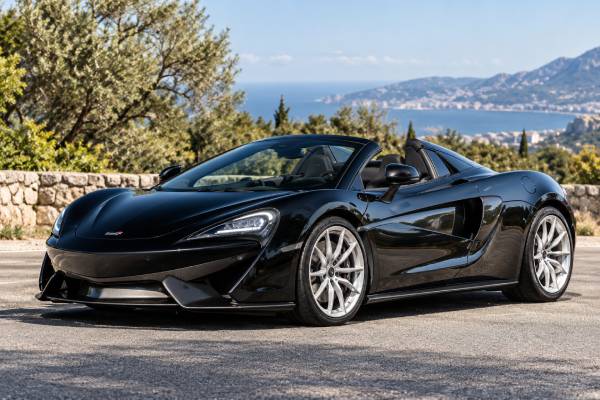
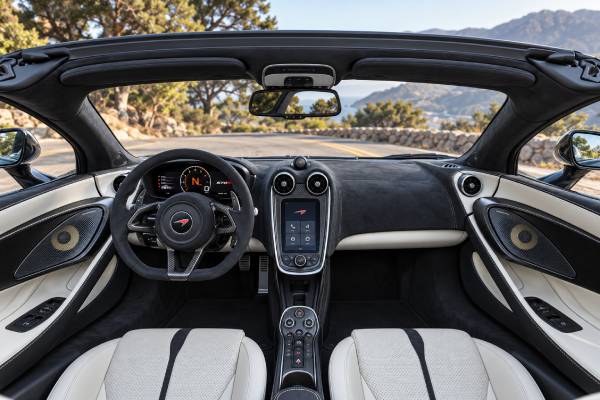
The McLaren 570S Spider is the open-roof version of the Sports Series car without the usual convertible penalty of a heavily reinforced body. Its carbon-fibre MonoCell II already supplies the structural stiffness, so McLaren could add a two-piece retractable hardtop while keeping the same 570 PS (562 bhp) twin-turbo V8, seven-speed SSG transmission, steering concept and core chassis behavior as the 570S Coupé. The roof mechanism adds 46 kg, yet factory acceleration to 100 km/h remains 3.2 seconds, and top speed is still 328 km/h with the roof raised. That combination makes the Spider unusually useful as both a fast road car and an open-air supercar. Ownership, however, adds several checks that a Coupé buyer never has to make: roof operation, tonneau alignment, seals, rear-glass function, water management and the condition of the extra storage area. This guide covers the engineering, exact specifications, performance, maintenance priorities and pre-purchase checks that matter most on 2017–2021 570S Spider examples.
Table of Contents
- How the 570S Spider Avoids the Usual Convertible Compromise
- 570S Spider Specifications and Technical Data
- Retractable Roof, Tonneau, and Everyday Usability
- Chassis, Aerodynamics, Brakes, and Road Behavior
- M838TE V8, SSG Gearbox, and Open-Air Performance
- Servicing and Age-Related Systems to Watch
- How to Inspect and Buy a 570S Spider
How the 570S Spider Avoids the Usual Convertible Compromise
The central fact about the 570S Spider is that its roof is an added mechanism, not a structural substitute for a missing steel roof. The MonoCell II carbon-fibre tub carries the car’s primary structural loads, so McLaren said no extra chassis stiffening was required when it turned the 570S into a Spider.
That engineering choice explains why the car feels so closely related to the Coupé. Traditional convertibles often need additional underfloor members, thicker sills or other reinforcements to recover stiffness lost when a metal roof is removed. Those measures add mass in places that can affect ride and response. In the 570S Spider, the carbon tub was already a rigid passenger cell, allowing the retractable hardtop and its operating hardware to account for the principal weight difference.
McLaren quoted a 46 kg weight premium for the roof system compared with the 570S Coupé. Lightest dry weight is 1,359 kg, while later official specification material gives a 1,498 kg DIN kerb weight. The distinction matters when comparing listings: dry weight and DIN kerb weight are different measurement states, so a seller should not present the lower number as the car’s ready-to-drive mass.
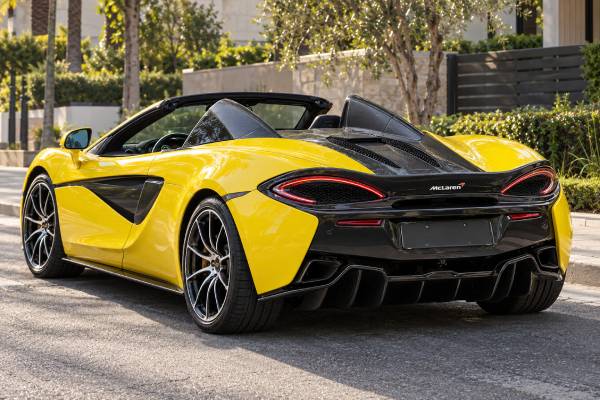
The Spider also retains the dihedral doors, mid-engine packaging and electro-hydraulic steering that define the Sports Series driving position. Two rear buttresses stay in place whether the roof is up or down. Rather than redesign the entire rear aero package, McLaren raised the Spider’s rear spoiler by 12 mm relative to the Coupé to account for the altered body shape and preserve high-speed aerodynamic balance.
For a used buyer, this architecture has two implications. First, a healthy Spider should not feel like a loose or flexing version of the Coupé; unexplained creaks, rattles or alignment changes deserve investigation rather than being dismissed as normal convertible behavior. Second, the roof mechanism is a separate complex system attached to a very stiff base. A roof fault can be expensive and annoying without necessarily indicating a problem with the carbon tub itself.
The appeal is therefore more specific than simply “570S with no roof.” The Spider gives access to engine sound, air and visibility while preserving the base car’s major dynamic ingredients. Its extra ownership burden is concentrated around moving roof components, seals and trim rather than wholesale structural compromise.
570S Spider Specifications and Technical Data
The 570S Spider is a rear-wheel-drive, mid-engined ICE sports car powered by McLaren’s M838TE 3.8-litre twin-turbocharged V8. It uses a seven-speed dual-clutch Seamless Shift Gearbox (SSG), an open differential supported by Brake Steer, adaptive double-wishbone suspension and standard carbon-ceramic braking in factory specification.
| Specification | 570S Spider |
|---|---|
| Engine | M838TE, petrol twin-turbo V8 |
| Displacement | 3,799 cc (3.8 L) |
| Location / drive | Longitudinal mid-engine / rear-wheel drive |
| Maximum power | 570 PS (562 bhp / 419 kW) at 7,500 rpm |
| Maximum torque | 600 Nm (443 lb-ft) at 5,000–6,500 rpm |
| Transmission | 7-speed Seamless Shift Gearbox (SSG), dual-clutch |
| Fuel tank | 72 L (19.0 US gal) |
| Measure | Claimed figure |
|---|---|
| 0–100 km/h (0–62 mph) | 3.2 seconds |
| 0–200 km/h (0–124 mph) | 9.6 seconds |
| 0–60 mph | 3.1 seconds |
| 0–400 m (1/4 mile) | 11.0 seconds |
| Top speed, roof raised | 328 km/h (204 mph) |
| Top speed, roof lowered | 315 km/h (196 mph) |
| 100–0 km/h braking | 32 m (105 ft) |
| 200–0 km/h braking | 130 m (426 ft) |
| Specification | Factory configuration |
|---|---|
| Body structure | Carbon Fibre MonoCell II |
| Suspension | Double wishbone with adaptive dampers |
| Differential | Open differential with Brake Steer |
| Brakes | Carbon ceramic, 6-piston front / 4-piston rear aluminium calipers |
| Brake disc diameter | 394 mm front / 380 mm rear |
| Wheel size | 8J x 19 front / 10J x 20 rear |
| Tire size | 225/35 R19 front / 285/35 R20 rear |
| Measure | Figure |
|---|---|
| Length | 4,530 mm (178.3 in) |
| Width without mirrors | 1,930 mm (76.0 in) |
| Width with mirrors | 2,095 mm (82.5 in) |
| Height | 1,202 mm (47.3 in) |
| Wheelbase | 2,670 mm (105.1 in) |
| Lightest dry weight | 1,359 kg (2,996 lb) |
| DIN kerb weight | 1,498 kg (3,303 lb) |
| Weight distribution | 42% front / 58% rear |
| Luggage capacity | 150 L front; 52 L tonneau area with roof raised |
| Measure | Figure |
|---|---|
| NEDC combined consumption | 10.7 L/100 km (26.4 mpg UK) |
| NEDC CO₂ | 249 g/km |
| WLTP combined consumption | 12.2 L/100 km |
| WLTP CO₂ | 276 g/km |
| Roof type | Electrically operated two-piece retractable hardtop |
| Roof cycle | 15 seconds |
| Roof operating speed | Up to 40 km/h (25 mph) |
The NEDC and WLTP figures come from different test procedures and should not be mixed into a single comparison. Real fuel use can be much higher in traffic or frequent boost, and the official figures are best treated as standardized benchmarks rather than an ownership promise.
Retractable Roof, Tonneau, and Everyday Usability
The hardtop is the Spider’s defining convenience feature, but it should be treated as a system to inspect rather than a party trick to demonstrate once. McLaren designed it to open or close in about 15 seconds and to operate at vehicle speeds up to 40 km/h (25 mph), while the electrically adjustable rear glass can be used separately to change airflow and sound.
With the roof raised, the two roof panels leave a 52-litre luggage area beneath the tonneau cover behind the cabin. With the roof stored, that volume is occupied by the roof mechanism, so trip packing must be planned around the 150-litre front compartment. This is a meaningful difference from a conventional trunk: the Spider can carry extra soft luggage on a roof-up journey, but the driver cannot assume that space will still be available after deciding to lower the top.
Test the roof from a stable, level position and follow the operating conditions in the owner’s handbook. Watch the complete sequence rather than only checking that the panels disappear. The tonneau should release and move smoothly, the panels should fold without hesitation, and the final latch sequence should complete without warnings. Repeat the cycle in both directions after the car has been driven, because an intermittent position sensor or marginal voltage condition may not appear on one cold demonstration.
The rear glass deserves its own test. Raised with the roof down, it helps reduce turbulence in the cabin; lowered with the roof up, it can let more engine and exhaust sound into the passenger compartment. A slow, noisy or non-responsive rear window therefore affects more than convenience. Check the switch, movement, sealing edge and the surrounding trim for evidence of prior adjustment.
Water management is equally important. Examine the roof-panel seals, upper windscreen area, side-window contact points, buttress trim and tonneau compartment for staining, musty odor or damp carpet. A car can look dry on a sunny dealer forecourt yet reveal a history of leakage underneath removable trim. Ask whether any seal, latch, hydraulic or roof-control work has been performed and request invoices rather than relying on a verbal description.
The roof also changes how the car should be stored. A healthy battery matters because complex body systems depend on stable voltage. If the Spider sits for extended periods, use the charging equipment and procedure appropriate to the vehicle. Do not repeatedly cycle the top merely to diagnose a low-voltage car; establish battery condition first so electrical symptoms are not confused with mechanical roof faults.
Finally, look at panel fit with the roof both raised and stowed. Even gaps, clean seal contact and consistent latch behavior are more reassuring than cosmetic perfection alone. Accident repairs around the rear bodywork, buttresses or windscreen frame should be investigated carefully because the roof depends on accurate geometry even though the carbon tub itself does not require convertible bracing.
Chassis, Aerodynamics, Brakes, and Road Behavior
A sound 570S Spider should retain the precision of the Coupé while feeling slightly heavier rather than fundamentally softer. The carbon tub keeps the suspension working from a rigid base, and adaptive dampers provide Normal, Sport and Track settings without changing the car into a grand tourer.
The steering is electro-hydraulically assisted rather than a fully electric system. That contributes to the detailed front-end feel for which the Sports Series became known, but it also means a test drive should include slow parking maneuvers as well as faster corners. Assistance should be consistent, with no unusual groan, warning message or sudden change in effort. Uneven steering behavior can come from tires or alignment as well as the steering system, so do not diagnose it from sensation alone.
Aerodynamically, the Spider is not simply the Coupé body with panels removed. The fixed buttresses shape air around the open cabin, and the rear spoiler is 12 mm higher than on the Coupé. The factory’s separate top-speed figure of 315 km/h with the roof lowered also shows that roof position changes the aerodynamic operating condition even though acceleration and roof-up top speed remain very close to the closed car.
Standard carbon-ceramic brakes use six-piston front and four-piston rear calipers. They provide substantial heat capacity and low unsprung mass, but used-car inspection should focus on condition rather than reputation. Look for disc damage, chips, unusual surface appearance, pad life and evidence of contaminated or neglected hardware. Carbon-ceramic replacement costs can be significant, so a specialist measurement is more useful than a seller saying the discs “look fine.”
Factory wheel and tire sizing is staggered: 225/35 R19 at the front and 285/35 R20 at the rear. Tire age, model, heat history and alignment have a strong effect on how this chassis feels. A mixed set of brands or specifications can introduce behavior that a buyer may mistakenly blame on suspension wear. Inspect inner shoulders carefully, because aggressive alignment and low ride height can hide wear from a casual walk-around.
Road clearance also deserves practical attention. Factory literature lists 93 mm of ground clearance and a better ramp angle when the optional/installed vehicle-lift function is raised. Inspect the front splitter and underfloor for scrapes, then test the lift if fitted. A lift that operates slowly, produces warnings or sits unevenly needs diagnosis before purchase.
The most revealing road test uses varied surfaces. On smooth pavement, check steering response and brake stability; on broken pavement, listen for knocks and trim movement; under steady highway load, feel for vibration through the wheel or seat. The Spider’s open roof can mask noises with wind, so repeat part of the drive with the roof raised before accepting any rattle as normal.
M838TE V8, SSG Gearbox, and Open-Air Performance
The Spider keeps the 570S powertrain unchanged: a 3,799 cc twin-turbo V8 producing 570 PS and 600 Nm, driving the rear wheels through a seven-speed dual-clutch SSG. The important ownership question is therefore not whether the open car is detuned, but whether its engine, cooling and transmission systems still behave cleanly across temperature and load.
Factory performance is serious even by later standards. The claimed 3.2-second 0–100 km/h time matches the Coupé, while 0–200 km/h takes 9.6 seconds. The roof-up maximum of 328 km/h is also unchanged. Those numbers are useful for specification verification, but on a used example the healthier clues are smooth boost delivery, stable temperatures, clean shifts and an absence of drivetrain warnings.
Start the inspection with the engine genuinely cold if possible. Observe startup, idle quality and the instrument display before anyone clears messages. Look under the car and around accessible areas for fluid residue, then repeat the check after a full road test. A warm engine bay can reveal coolant or oil traces that are invisible after the car has been detailed and parked.
The SSG should be tested in automatic operation, manual paddle shifts and low-speed maneuvering. Dual-clutch transmissions can feel different from torque-converter automatics at parking speed, but repeated harsh engagement, refusal to select a gear or warnings are not features. Allow the drivetrain to reach operating temperature before judging higher-load shifts.
The powertrain does not need a different tune to feel more dramatic in the Spider. With the hardtop stowed, the cabin is exposed to sounds that the Coupé filters more heavily; even with the roof raised, dropping the separate rear glass gives the driver a direct acoustic path to induction, turbo and exhaust noise. That feature is worth testing before assuming the car needs an aftermarket exhaust. If a non-factory system is already fitted, identify the manufacturer and installation quality, then check for drone, excess heat, warning lights and any approval requirements in the registration market.
Cooling-system condition matters because the engine sits tightly packaged behind the cabin. Inspect front cooling apertures and heat exchangers for debris or impact damage and confirm that temperatures remain stable in slow traffic as well as faster driving. Ask whether hoses, pumps, radiators or air-conditioning components have been replaced. The fact that a car has low mileage does not protect rubber parts, seals or electrical connectors from time.
Fuel quality and fluid specifications should follow the handbook for the vehicle’s market. This is not a car on which generic “supercar” advice should override McLaren documentation. The same principle applies to oil-level procedures: use the published method rather than extrapolating from a conventional wet-sump engine.
Servicing and Age-Related Systems to Watch
Time matters almost as much as mileage on a 570S Spider. Factory Sports Series literature recommended service every 12 months or 10,000 miles (15,000 km), whichever came first, so a low odometer reading is not a substitute for a continuous annual record.
A strong history should show more than oil changes. Ask for evidence of brake-fluid servicing, battery replacement or testing, tire dates, air-conditioning work and any repairs to the roof or its seals. Cars that cover only a few hundred miles per year may still need attention because fluids absorb moisture, rubber ages, batteries cycle and mechanisms can stiffen through disuse.
The retractable top adds a useful inspection schedule of its own. Keep seal surfaces clean, watch for deformation or contamination, and investigate changes in operating speed or sound early. If the roof pauses unexpectedly, do not force it. Electrical diagnosis, calibration or mechanical inspection is preferable to repeated cycling that could leave the panels in an awkward position.
Check the climate-control system with the roof raised. Air conditioning is easy to overlook during an exciting open-top test drive, but it is important for demisting and closed-roof comfort. Confirm that vents respond, the cabin reaches the commanded temperature and no persistent warning is present. Likewise, test window indexing, door operation, mirrors, infotainment, cameras and front lift if equipped; several small electronic faults can turn a seemingly cheap car into a long workshop list.
U.S. buyers should also run the VIN through the official recall system. NHTSA campaign 21V-561 involved a very small population of certain 2020 McLaren 570S, GT, 600LT and 720S vehicles because some brake flexi-hose banjo bolts might have been manufactured without the required fluid passages. NHTSA’s acknowledgement listed only 19 vehicles across the affected models, and model-name coverage does not prove that a particular Spider was included. The remedy was inspection and replacement where necessary. Treat this strictly as a VIN-specific check, not as a defect assumed to exist on every 570S Spider.
Battery condition deserves emphasis because low voltage can create misleading symptoms across multiple control modules. Before authorizing expensive repairs for a car showing numerous intermittent messages, have the battery and charging condition established and the faults read with appropriate diagnostic equipment. Erasing codes before documenting them removes useful evidence.
For cars used on track, ask more questions. Heat cycles, curb strikes, aggressive tire wear and heavy braking can occur without huge odometer accumulation. Track use is not automatically disqualifying if maintenance is excellent, but the inspection standard should rise: alignment, wheel condition, brake measurements, fluid history and underbody checks become especially important.
How to Inspect and Buy a 570S Spider
Buy the individual car, not the color combination or odometer. A well-documented Spider with a roof that operates perfectly, fresh matched tires and a clean diagnostic record is usually easier to understand than a lower-mileage example with gaps in history and several “minor” electrical or trim faults.
Begin with provenance. Match the VIN across the car and records, review ownership and accident history available in the market, and verify that service invoices correspond to the stated mileage. Ask an authorized retailer or qualified McLaren specialist to check outstanding campaigns. If the seller says a recall or technical action was completed, request the work record.
Then inspect the Spider-specific hardware before the engine distracts you. Cycle the roof fully up and down, operate the rear glass separately, examine the tonneau space, and check for water marks. Confirm that both door glasses meet the roof seals correctly when closed. Look across the rear body panels for inconsistent gaps or paint evidence that might explain a roof-alignment problem.
Use the luggage areas too. The front compartment is the dependable 150-litre storage space regardless of roof position; the additional 52 litres behind the cabin is available only when the roof is up. Make sure the trim, latches and compartment condition suit the way you intend to travel. A weekend car that cannot carry your actual bags is less useful than its specification sheet suggests.
A professional pre-purchase inspection should include a full diagnostic scan, underbody review, cooling check, brake measurement, tire-age assessment and road test from cold to normal operating temperature. The inspector should be familiar with Sports Series cars rather than simply exotic cars in general. McLaren-specific knowledge helps distinguish normal operating behavior from a fault and identifies whether modifications are correctly integrated.
Budget from the inspection report, not from the asking price alone. A set of tires, annual service, weak battery, lift repair, roof adjustment and carbon-ceramic brake work can create very different first-year costs. Get written estimates for immediate needs before agreeing on value. Also establish insurance, transport and qualified service access in your region; these practical costs can matter more than a small difference between two purchase prices.
Specification should come last, after condition. Carbon-fibre exterior parts, premium audio, sports exhaust, upgraded seats and MSO finishes can make one car more appealing, but they do not compensate for uncertain service history or roof faults. Check that expensive options are original and that aftermarket changes are documented and reversible where possible.
The 570S Spider’s strongest trait is that opening the roof does not erase what makes the 570S engaging. It remains a light, stiff, mid-engined sports car with hydraulic steering feel, strong carbon-ceramic brakes and the full 570 PS V8 output. The right example should add an effortless 15-second roof cycle and clean open-air operation to that base. Prioritize roof integrity, annual maintenance, healthy tires and brakes, stable electronics and a VIN-specific campaign check, and the Spider can deliver its intended advantage without turning the convertible hardware into the focus of ownership.
References
- McLaren 570S Spider – Light Convertible Sportscar 2026 (Manufacturer Specifications)
- Sports Series 2017 (Manufacturer Brochure, Technical Data, and Service Interval)
- McLaren 570S Spider: a convertible without compromise – McLaren 2017 (Manufacturer Retailer Launch Information)
- McLaren Owners 2026 (Owner Documentation)
- Vehicle May Pull To One Side During Braking 2021 (NHTSA Recall Acknowledgement)
- McLaren 570S Spider – Search Used McLaren Qualified Cars For Sale 2026 (Manufacturer Pre-Owned Standards)
Disclaimer
This article is intended for informational purposes and is not a substitute for professional diagnosis or repair. Specifications, torque values, intervals, and procedures can vary by VIN, market, and equipment; verify the individual 570S Spider against official McLaren service documentation before servicing, adjusting, or repairing it.
If this guide clarified the 570S Spider, share it with another Sports Series owner, a McLaren club, an enthusiast forum, or someone comparing open-top supercars.