
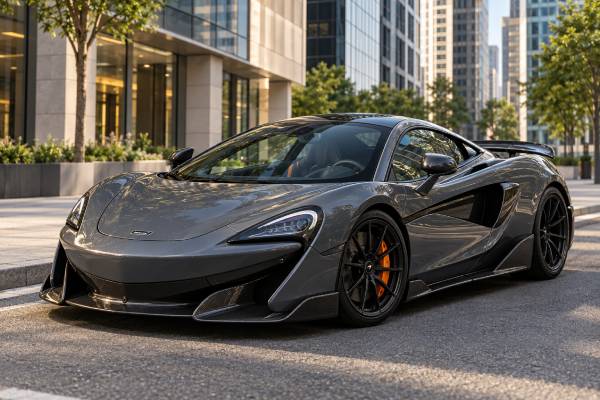
The McLaren 600LT Coupé is the most focused road-going evolution of the Sports Series before the later 620R pushed even closer to a racing car. It takes the carbon-fibre MonoCell II, mid-mounted M838TE 3.8-litre twin-turbo V8 and seven-speed SSG transmission familiar from the 570S, then changes the priorities: less weight, more power, more downforce, shorter gearing, sharper responses and far less concern for everyday softness. Factory output is 600 PS, or 592 bhp, with 620 Nm of torque, while the lightest dry specification is quoted at 1,247 kg. Those figures matter, but the 600LT is defined just as much by its top-exit exhausts, fixed rear wing, Trofeo R tires and more aggressive chassis calibration. As a used purchase, condition and history matter more than mileage alone. A well-serviced road car can be a very different proposition from an example that has lived on circuits, overheated consumables and missed recall work.
Table of Contents
- What Makes the 600LT a Longtail
- 600LT Coupé Technical Data and Specifications
- Engine, Aerodynamics, and Chassis Engineering
- Performance on Road and Track
- Maintenance, Tires, Brakes, and Track Consumables
- Known Risk Areas, Recalls, and Pre-Purchase Inspection
- How to Buy the Right 600LT Coupé
What Makes the 600LT a Longtail
The 600LT is not simply a 570S with an ECU tune. McLaren reworked the car around the Longtail idea: reduce mass, increase aerodynamic load, sharpen the chassis and intensify the driver’s connection to the car without turning it into a non-road-legal racer.
The 600LT Coupé arrived as the fourth McLaren to wear the LT name, following the F1 GTR Longtail lineage and the 675LT road cars. Its basic architecture still belongs to the Sports Series. The engine sits longitudinally behind the cabin, drive goes only to the rear wheels, and the central structure is the carbon-fibre MonoCell II tub. That common foundation is useful for ownership because many service principles are familiar to McLaren specialists, but the 600LT adds components that are more expensive and more sensitive to hard use.
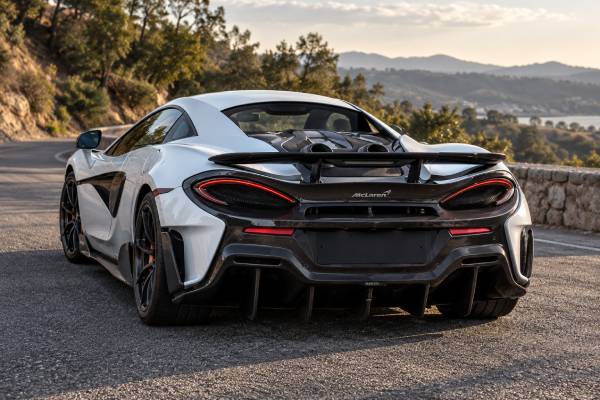
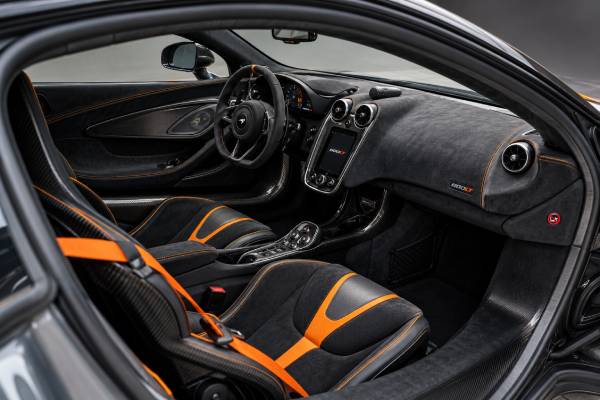
The most visible changes are functional. The body is longer than the 570S, the front splitter and side treatment are more aggressive, and the fixed rear wing contributes to greater high-speed stability. The top-exit exhausts shorten the exhaust path and create one of the car’s defining visual and acoustic features. McLaren also removed weight from the interior, glazing, exhaust and trim, with lightweight seats and additional carbon-fibre options available depending on specification.
The result is a car that rewards accurate inputs. Steering remains electro-hydraulic rather than fully electric, the brake pedal is firm, and the suspension communicates surface changes clearly. That makes the 600LT unusually transparent by modern supercar standards, but it also means setup, tire condition and alignment are immediately noticeable. A car with tired tires or poor geometry can feel nervous rather than precise.
Production was deliberately limited in duration rather than built as an unlimited regular Sports Series model. For buyers today, the important point is not to treat every 600LT as identical. Cars vary widely in seats, carbon-fibre packages, air conditioning, telemetry, vehicle lift and MSO content. Those options affect usability, replacement cost and resale appeal, so the original build specification should be part of any purchase review.
600LT Coupé Technical Data and Specifications
The 600LT Coupé is a pure internal-combustion, rear-wheel-drive car. Its M838TE 3,799 cc twin-turbo V8 uses dry-sump lubrication and sends power through a seven-speed dual-clutch Seamless Shift Gearbox; there is no hybrid system, traction battery or driven front axle.
| Specification | Value |
|---|---|
| Engine | M838TE 90-degree V8 |
| Displacement | 3,799 cc (3.8 L) |
| Induction | Twin turbochargers |
| Lubrication | Dry sump |
| Valvetrain | 32-valve DOHC with variable valve timing |
| Maximum power | 600 PS (592 bhp / 441 kW) at 7,500 rpm |
| Maximum torque | 620 Nm (457 lb-ft) at 5,500–6,500 rpm |
| Maximum engine speed | 8,500 rpm |
| Transmission | 7-speed SSG dual-clutch, plus reverse |
| Driven wheels | Rear-wheel drive |
| Measure | Factory figure |
|---|---|
| 0–100 km/h (0–62 mph) | 2.9 seconds |
| 0–200 km/h (0–124 mph) | 8.2 seconds |
| Quarter mile | 10.4 seconds |
| Top speed | 328 km/h (204 mph) |
| 100–0 km/h braking | 31 m (102 ft) |
| 200–0 km/h braking | 117 m (384 ft) |
| Specification | Value |
|---|---|
| Lightest dry weight | 1,247 kg (2,749 lb) |
| DIN kerb weight | 1,356 kg (2,989 lb) |
| Front/rear weight distribution | 42.5% / 57.5% |
| Fuel tank | 72 L (15.8 UK gal / 19.0 US gal) |
| WLTP combined fuel consumption | 12.2 L/100 km |
| WLTP combined CO₂ | 277 g/km on later published data |
| Specification | Value |
|---|---|
| Body structure | Carbon-fibre MonoCell II |
| Suspension | Double wishbones with adaptive dampers |
| Differential | Open differential with Brake Steer |
| Front brakes | Carbon-ceramic discs with 6-piston aluminium calipers |
| Rear brakes | Carbon-ceramic discs with 4-piston aluminium calipers |
| Front wheels | 8J x 19 |
| Rear wheels | 11J x 20 |
| Front tires | 225/35 R19 |
| Rear tires | 285/35 R20 |
| Factory performance tire | Pirelli P Zero Trofeo R |
| Specification | Value |
|---|---|
| Body style | 2-door, 2-seat coupé |
| Length | 4,604 mm (181.3 in) |
| Width at widest point | 2,095 mm (82.5 in) |
| Wheelbase | 2,670 mm (105.1 in) |
| Front luggage capacity | 150 L |
| Approach/ramp angle | 6.1 degrees; greater with optional vehicle lift |
These figures should be read with specification context. “Lightest dry” is not the same as a road-ready kerb weight, and some equipment that makes a 600LT easier to live with adds mass. Likewise, Trofeo R tires deliver excellent dry grip but are not an all-weather solution. A road-biased replacement tire can change steering feel, breakaway character and wet-weather confidence even when the dimensions are correct.
Engine, Aerodynamics, and Chassis Engineering
The engineering changes work as a system: the extra output would mean less without the shorter gearing, lower mass, additional aero load and firmer body control. That systems approach is why a 600LT feels substantially different from a 570S even though their basic engine architecture is related.
The M838TE engine is a 3.8-litre twin-turbo flat-plane-crank V8 developed for high specific output and rapid response. Peak power arrives at 7,500 rpm, while the 620 Nm torque plateau sits much higher in the rev range than the effortless low-speed delivery of many modern turbo engines. The car therefore encourages the driver to use revs. In Track mode, shift behavior becomes more aggressive and the drivetrain feels more urgent, especially when the engine is already on boost.
The top-exit exhaust layout is more than theatre. Moving the outlets upward shortens the system and helps reduce mass. It also puts heat in an unusual area of the rear deck, which is why buyers should inspect surrounding trim, carbon-fibre finishes and heat shielding carefully. Normal heat exposure is expected; distorted, damaged or poorly repaired material is not.
Aerodynamics are equally important. The extended front splitter, altered side treatment, longer rear bodywork and fixed rear wing generate more downforce than the standard Sports Series body. The benefit is confidence at speed and under heavy braking, but low ride height and protruding carbon-fibre aero parts create ownership risks. Front splitters, lower corners and underbody pieces can be damaged by ramps, parking blocks or steep driveways. The optional vehicle lift is therefore a practical feature, not merely a convenience.
The suspension retains double wishbones and adaptive dampers rather than the hydraulically interconnected system used by some Super Series McLarens. McLaren gave the LT its own geometry, spring, damper and anti-roll calibration, with a lower ride height and a greater focus on track response. Steering is electro-hydraulic, preserving the light but detailed feedback that became a Sports Series strength.
Brake Steer is another defining McLaren feature. Instead of relying on a conventional limited-slip differential, the system can brake an inside rear wheel to help the car rotate and manage traction. The physical differential remains open. This arrangement saves the behavior and weight of a mechanical LSD while allowing stability and brake-control software to help the car put power down.
Performance on Road and Track
The 600LT is brutally fast by road standards, but its strongest trait is not straight-line speed. The combination of low mass, accurate steering and stable braking gives the driver unusually clear information about grip and load transfer.
A 2.9-second 0–100 km/h time places the car in modern supercar territory, while 0–200 km/h in 8.2 seconds shows how strongly it continues accelerating after the launch phase. The 328 km/h top speed is actually less important to the LT brief than corner entry, braking consistency and response. The fixed aero package adds drag, and McLaren did not chase a headline maximum-speed number at the expense of circuit performance.
On a road, Normal mode is the sensible starting point. The car still rides firmly and follows cambers, but keeping the dampers and powertrain in their calmer settings reduces unnecessary harshness. Sport mode is more useful on a smooth, fast road, while Track settings make most sense when the surface and tire temperature justify them. The controls are sensitive enough that using the most aggressive mode everywhere can make the car feel busier rather than better.
On circuit, tire management becomes central. Trofeo R tires need temperature to work properly and offer limited margin in standing water. They also age and heat-cycle even when tread remains. A buyer should therefore look beyond tread depth and check date codes, surface condition and evidence of repeated track heat. If the car is fitted with a different approved tire, assess it as part of the setup rather than assuming it is automatically a downgrade.
Carbon-ceramic brakes provide exceptional thermal capacity, but they are not immune to wear or damage. Track debris can chip discs, improper wheel handling can mark them, and repeated high-energy stops can accelerate wear of pads and related hardware. An inspection should consider disc condition, measured wear and pad thickness, not simply whether the brakes feel strong on a short test drive.
The 600LT also rewards proper warm-up and cool-down habits. A high-output turbocharged engine, track-oriented tires and carbon-ceramic brakes all perform best when temperature is managed progressively. A conscientious owner who lets fluids come up to operating temperature and gives the car a cool-down lap is preferable to one who treats every cold start as an invitation to full boost.
The transmission calibration is part of the same character. McLaren’s seven-speed SSG is a dual-clutch gearbox, but the 600LT’s shorter final-drive strategy and aggressive shift programming make it feel more immediate than a conventional grand-touring automatic. In normal traffic, that means smooth inputs matter: creeping for long periods and repeatedly shuffling between forward and reverse are poor substitutes for decisive low-speed maneuvering. On a test drive, shifts should remain consistent as the drivetrain warms, with no unexplained warnings, severe shunt or reluctance to select a gear.
Geometry deserves equal attention because the car communicates alignment changes so clearly. A 600LT that has been optimized for repeated circuit work may carry settings that increase inner-shoulder tire wear or make the car follow road cambers more strongly. That is not automatically evidence of damage, but it should match the owner’s story and service records. Inspect wheel rims for impact marks and ask for alignment measurements if suspension components, wheels or tires have recently been replaced. The correct setup is the one that suits the car’s actual use while remaining inside McLaren’s approved range.
There is also a practical consequence to the aero package: the parts closest to the ground become condition indicators. A scarred splitter can simply record steep driveways, while repeated heavy abrasion, broken fasteners or mismatched panels may point to more substantial impacts. Because the carbon tub itself is central to the car’s value, any evidence of structural repair deserves documentation and specialist assessment rather than visual guesswork.
Maintenance, Tires, Brakes, and Track Consumables
For normal ownership, the most important maintenance rule is simple: keep the car on schedule even if annual mileage is low. McLaren’s Sports Series guidance called for servicing every 12 months or 10,000 miles (15,000 km), whichever comes first, and many 600LTs now accumulate far fewer miles than that in a year.
A low odometer should not be mistaken for low maintenance demand. Fluids age, batteries discharge, tires time out and seals still experience heat cycles. Cars stored for long periods also need careful battery management. McLaren commonly supplied or recommended a battery conditioner for infrequently used cars, and a healthy 12-volt system matters because voltage instability can create confusing warning messages and module faults.
For a used 600LT, ask for invoices rather than a stamped book alone. The paperwork should establish dates, mileage, the identity of the servicing retailer or specialist and what was actually replaced. Track use is not automatically a problem if maintenance reflects it. In fact, a frequently exercised car with meticulous fluid, brake and tire care can be a better purchase than a garage queen with old consumables.
Key ownership items include:
- Engine oil and filter: follow the car’s market- and VIN-specific service documentation. Avoid extending the interval simply because annual mileage is low.
- Brake fluid: track driving raises fluid temperature dramatically. If the car sees circuit use, fluid condition and boiling-point margin deserve more attention than a road-only schedule suggests.
- Carbon-ceramic brake system: inspect discs, pads and calipers for heat damage, chips and uneven wear. Replacement cost is high enough to affect the value of the car materially.
- Tires: check the correct size, approval, age and condition. Trofeo R tires trade wet security and longevity for dry grip.
- Alignment: uneven tire wear can indicate aggressive track geometry, curb strikes or suspension issues. A geometry printout is useful evidence after repair or setup work.
- Battery: confirm correct charging behavior and test battery health. Repeated deep discharge can create starting and electronics problems.
- Underbody and aero: inspect the front splitter, diffuser, jacking points and floor for impact damage. Carbon-fibre cosmetic repairs should be distinguished from structural repairs.
Before approving expensive work, use a technician familiar with the Sports Series. Generic supercar experience is helpful, but McLaren-specific diagnostic equipment, service procedures and knowledge of factory campaigns can save time and prevent parts replacement by guesswork.
Known Risk Areas, Recalls, and Pre-Purchase Inspection
The 600LT should be inspected as a high-performance used car with possible track history, not as a low-volume collectible that is assumed to be perfect. The most important checks are recall completion, cooling-system integrity, body and aero condition, brake wear, tires, suspension and a full electronic diagnostic scan.
A major model-specific safety campaign in the United States is NHTSA recall 23V-484 for 2019–2020 600LT Coupé and Spider vehicles. The campaign addresses a joint between a temperature-sensor housing and an outboard radiator hose that may not seal correctly. Coolant can leak into the engine compartment, creating a fire risk in the presence of an ignition source. The remedy involves replacement of the relevant hose, temperature-sensor housing and clamp. Because recall applicability is VIN-specific, a buyer should verify the individual car rather than assume that model-year coverage means every repair is complete.
A separate 2021 McLaren recall involved a very small population of vehicles with improperly manufactured brake-hose banjo bolts; the associated service material included 600LT inspection procedures. Again, VIN confirmation matters. A clean dashboard warning display is not evidence that recall work was completed.
Beyond formal campaigns, inspect the car methodically:
- Start cold. Listen for abnormal mechanical noise, watch for warning messages and confirm stable idle once the initial flare settles.
- Look underneath. Check for coolant, oil or gearbox-fluid traces, damaged floor panels and scraped aero components.
- Inspect heat-affected rear areas. The top-exit exhausts concentrate heat near the rear deck. Check shields, finishes and adjacent panels for signs of improper repair.
- Measure brake and tire condition. Do not rely on visual impressions alone if the car has documented track use.
- Operate every convenience feature. Air conditioning, lift system, cameras, telemetry, infotainment and seat functions can all be expensive distractions if faults accumulate.
- Scan all control modules. Stored or historic faults can reveal low-voltage events, intermittent sensor issues and problems erased from the instrument display.
- Review paint and carbon fibre. A professional paint-depth and body inspection can separate stone-chip correction from accident repair.
A pre-purchase inspection should ideally be done by a McLaren retailer or established independent specialist with access to appropriate diagnostics. The goal is not to reject any car that has been tracked; it is to price the car according to the condition of the parts that track use consumes.
How to Buy the Right 600LT Coupé
The best 600LT is the one with a coherent history, correct specification and current consumables, not automatically the lowest-mileage example. Service continuity and evidence of careful use are more valuable than an odometer number that cannot explain how the car was stored or driven.
Start by confirming identity and factory specification. Match the VIN, build sheet and option list. Pay attention to seat type, lift system, air conditioning, telemetry, camera package, carbon-fibre exterior pieces and MSO content. Lightweight options can be desirable, but a stripped specification may be less pleasant for road use. Conversely, a buyer who intends regular track days may value the lighter seats and telemetry more than luxury equipment.
Next, divide the purchase budget into the car itself and the first-year reserve. Even a good example may need tires because of age, an annual service, brake work, alignment or cosmetic repair to low carbon-fibre parts. If the inspection identifies a large carbon-ceramic brake bill, price it before negotiating. The same applies to damaged wheels, lift-system problems or incomplete recall history.
Consider how you will use the car. For occasional road driving, a 600LT with front lift, air conditioning and a road-friendly tire choice can be easier to enjoy. For circuit use, focus on brake condition, fresh high-performance tires, alignment, cooling-system health and evidence that previous owners respected service intervals. Do not buy a track-focused configuration for its rarity and then discover that the seats, noise and ride discourage you from using it.
Finally, verify recalls by VIN in the market where the car is registered. Imported cars can have different campaign histories, documentation and emissions specifications. A specialist should also confirm that software levels, replacement parts and modifications are appropriate for the exact VIN.
The 600LT remains compelling because its performance is delivered through relatively simple ingredients by current supercar standards: no hybrid assistance, no driven front axle and no artificial need to hide mass. The car is light, fast and highly communicative. That purity also means neglect is easy to feel. Buy on evidence, inspect the expensive consumables carefully and budget for specialist maintenance; do that, and the 600LT Coupé can provide the intense, mechanical character that made the Longtail badge matter in the first place.
References
- McLaren 600LT – Fast & Light Road-Legal Track-Day Supercar | McLaren Automotive 2026 (Manufacturer Specifications)
- PERFORMANCE SPECIFICATION 2018 (Technical Specification)
- McLaren Owners 2026 (Owner’s Manual Portal)
- Extended Service Plans 2026 (Service Information)
- Part 573 Safety Recall Report 23V-484 2023 (Recall Report)
- Check for Recalls: Vehicle, Car Seat, Tire, Equipment | NHTSA 2026 (Recall Database)
Disclaimer
This article is for informational purposes only and is not a substitute for professional diagnosis or repair. Specifications, torque values, service intervals, and procedures can vary by VIN, market, and equipment; verify every applicable value and procedure against official McLaren service documentation for the specific vehicle.
If this guide helped you, please consider sharing it on Facebook, X/Twitter, or another automotive community to support our work.