
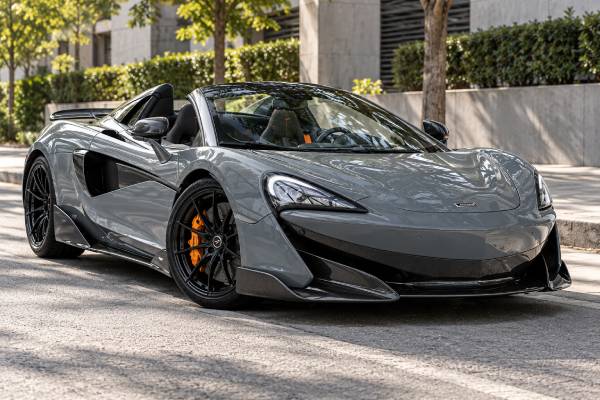

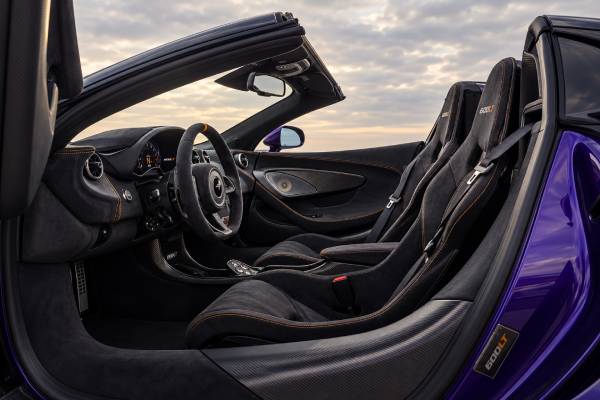
The McLaren 600LT Spider is a rare combination: an open-roof supercar engineered with the same Longtail priorities as the 600LT Coupé. Its retractable hard top adds weight and mechanism, yet the carbon-fibre MonoCell II structure means McLaren did not need the heavy structural reinforcements that often separate a convertible from its closed-roof counterpart. The result keeps the 600 PS, or 592 bhp, twin-turbo 3.8-litre V8, top-exit exhausts, fixed rear wing, carbon-ceramic brakes and track-oriented chassis that define the LT. Factory data quotes 0–100 km/h in 2.9 seconds, 0–200 km/h in 8.4 seconds and a 324 km/h top speed. For a used buyer, however, the roof adds an entire system that deserves inspection alongside the usual tires, brakes, suspension and cooling hardware. The 2019–2020 model is also covered by a significant U.S. coolant-hose safety recall, making VIN-specific campaign verification essential rather than optional.
Table of Contents
- How the Spider Preserves the Longtail Formula
- 600LT Spider Technical Data and Specifications
- Retractable Roof, Carbon Structure, and Aerodynamics
- Engine Performance, Exhaust Heat, and Track Pace
- Brakes, Tires, Fluids, and Track-Day Service
- Roof Checks, Cooling Recall, and Pre-Purchase Inspection
- Buying and Owning a Used 600LT Spider
How the Spider Preserves the Longtail Formula
The 600LT Spider is not a relaxed convertible wearing aggressive bodywork; it was developed to keep the Longtail car’s low mass, aerodynamic focus and circuit ability while adding open-air driving. The extra roof hardware raises weight, but the underlying carbon tub allows the core chassis concept to remain intact.
That distinction is important because many convertibles start with a coupé shell and then need structural reinforcement after the fixed roof is removed. McLaren’s MonoCell II already provides its main stiffness through the carbon-fibre passenger cell. The Spider therefore retains the same basic structural philosophy as the Coupé and can concentrate its weight increase in the roof mechanism rather than extra bracing.
The rest of the car remains unapologetically LT. A deep front splitter, extended side treatment, longer rear bodywork and fixed wing increase aerodynamic load. The twin exhaust outlets exit through the upper rear deck instead of low in the bumper. Weight-saving measures appear throughout the cabin and body, and equipment could vary significantly depending on whether the original buyer prioritized minimal mass or everyday convenience.
Factory figures make the relationship clear. The lightest dry Spider is quoted at 1,297 kg, only 50 kg above the 1,247 kg lightest dry Coupé figure. Acceleration to 100 km/h is identical at 2.9 seconds, while the 0–200 km/h figure changes from 8.2 to 8.4 seconds. Those small differences help explain why the Spider feels like an LT first and a convertible second.
Open-roof driving changes the sensory experience more than the performance identity. With the roof down, the top-exit exhausts are physically and acoustically closer to the occupants, turbocharger and intake sounds are easier to hear, and speed feels more dramatic. That can make the Spider especially engaging on the road, but it also increases the importance of checking heat-affected trim, roof seals and the rear-deck area on an older car.
Used examples vary from heavily optioned road cars to sparse specifications with racing seats and minimal comfort equipment. Neither is inherently better. The key is to match the configuration to how the car will actually be driven and to judge every expensive component on condition rather than assuming low mileage guarantees freshness.
600LT Spider Technical Data and Specifications
The 600LT Spider uses the M838TE 3,799 cc twin-turbo V8, a seven-speed Seamless Shift Gearbox and rear-wheel drive. There is no hybrid motor or high-voltage traction battery; factory output is 600 PS with 620 Nm of torque.
| Specification | Factory data |
|---|---|
| Engine | M838TE 90-degree V8 |
| Displacement | 3,799 cc (3.8 L) |
| Induction | Twin turbochargers |
| Lubrication | Dry sump |
| Maximum power | 600 PS (592 bhp / 441 kW) |
| Maximum torque | 620 Nm (457 lb-ft) |
| Transmission | 7-speed SSG dual-clutch plus reverse |
| Drive layout | Mid-engine, rear-wheel drive |
| Measure | Factory figure |
|---|---|
| 0–100 km/h (0–62 mph) | 2.9 seconds |
| 0–200 km/h (0–124 mph) | 8.4 seconds |
| Maximum speed | 324 km/h (201 mph) |
| 100–0 km/h braking | 32 m (105 ft) |
| 200–0 km/h braking | 121 m (397 ft) |
| Specification | Factory data |
|---|---|
| Lightest dry weight | 1,297 kg (2,859 lb) |
| DIN kerb weight | 1,404 kg (3,095 lb) |
| Fuel tank | 72 L (15.8 UK gal / 19.0 US gal) |
| WLTP combined fuel consumption | 12.2 L/100 km |
| WLTP combined CO₂ | 277 g/km |
| Specification | Factory data |
|---|---|
| Passenger structure | Carbon-fibre MonoCell II |
| Suspension | Double wishbones with adaptive dampers |
| Differential strategy | Open differential with Brake Steer |
| Front brakes | Carbon-ceramic discs, 6-piston aluminium calipers |
| Rear brakes | Carbon-ceramic discs, 4-piston aluminium calipers |
| Front wheel | 19-inch LT lightweight wheel |
| Rear wheel | 20-inch LT lightweight wheel |
| Factory track-focused tire | Pirelli P Zero Trofeo R |
| Specification | Value |
|---|---|
| Body style | 2-door, 2-seat Spider |
| Roof | Power-operated retractable hard top |
| Length | 4,604 mm (181.3 in) |
| Width at widest point | 2,095 mm (82.5 in) |
| Front luggage compartment | 150 L |
| Primary aerodynamic features | Extended splitter, LT bodywork, fixed rear wing |
| Exhaust layout | Twin top-exit outlets |
As with the Coupé, the lightest dry number represents a minimum-mass configuration rather than the weight of every road-ready car. Comfort equipment, carbon packages, audio, cameras, lift hardware and seat choice can all change the individual vehicle’s mass and usability.
Retractable Roof, Carbon Structure, and Aerodynamics
The Spider’s engineering story centers on the relationship between the retractable hard top and the carbon MonoCell II. Because the tub carries the primary structural load, opening the cabin did not require a wholesale redesign of the chassis, allowing McLaren to keep the suspension and aero concept close to the Coupé.
The roof folds away beneath the rear tonneau rather than leaving fabric exposed. That gives the car coupé-like weather protection when closed and a clean airflow path when open, but it adds motors, linkages, seals, position sensors and moving body panels. Those components make the roof an important part of any pre-purchase inspection even if the car has spent most of its life with the roof raised.
Operate the roof through complete cycles with the vehicle positioned according to the owner’s handbook. Watch both sides of the mechanism, listen for unusual strain and verify that the instrument display reports completion correctly. The rear glass, tonneau and seals should finish flush without needing hand pressure. Water staining behind trim, unexplained cabin dampness or wind noise after closure deserves investigation.
Aerodynamically, the fixed rear wing remains central to the Longtail package. It is not decorative trim and should be inspected accordingly. Check its mounts, end plates and surrounding deck for cracks, poor refinishing or evidence that the car has been pushed or lifted incorrectly. Front splitters and lower side pieces sit in vulnerable positions and often reveal how carefully a car has been used around ramps and curbs.
Roof-down driving can make minor cabin noises easier to ignore, so repeat the test drive with the roof closed. Listen for rattles, whistles and seal noise over different surfaces. A Spider that is mechanically sharp but poorly sealed can become tiring on longer journeys, especially because the LT already transmits more road and drivetrain sound than a 570S Spider.
The rear screen and roof position also give the owner useful control over airflow and sound. Different configurations change how much exhaust note reaches the cabin, so test each permitted position rather than judging the mechanism only as fully open or fully shut. If a roof-related message appears, note exactly when it occurs; intermittent position-sensor or latch faults are easier for a technician to trace when the operating sequence is documented instead of summarized as “sometimes it does not work.”
Drainage deserves attention on any retractable hard-top car. Water must be directed away from the cabin and roof stowage area, and blocked or disturbed drainage paths can turn a minor sealing issue into wet trim or electrical trouble. During an inspection, look for tide marks, musty odor, damp carpet and corrosion on exposed fasteners around storage areas. A dry car on the day of viewing is not proof that it has never leaked, particularly if it was freshly detailed.
The fixed LT wing creates another Spider-specific inspection interaction because roof movement, rear-deck panels and aerodynamic hardware occupy the same visual area. Panel gaps should be even, fasteners should match, and nothing should show rubbing caused by misalignment. If rear bodywork has been removed for roof or engine-bay service, ask why and verify that the resulting fit remains correct. Cosmetic disassembly is not automatically concerning, but unexplained tool marks and mismatched hardware deserve a closer look.
The carbon structure also changes how accident history should be judged. Replaceable exterior panels can be repaired after ordinary cosmetic damage, but structural repair to the tub is a different matter. Any seller claiming that an impact was “only cosmetic” should be able to support that statement with repair invoices, photographs or a specialist inspection. On a low-volume car, documentation is part of the asset.
Engine Performance, Exhaust Heat, and Track Pace
The 600LT Spider retains the Coupé’s 600 PS output and 620 Nm torque figure, so its performance is limited more by the modest roof-system weight increase than by any engine detune. The M838TE rewards revs and responds most strongly when the driver keeps it in the part of the tachometer where the turbos and short gearing work together.
Its seven-speed SSG uses dual clutches to preselect ratios, and the LT calibration emphasizes speed and immediacy. In calm traffic the car can still be driven automatically, but manual shifts better reveal the drivetrain’s character. On a road test, assess the gearbox when cold and again after the car is fully warm. Engagement should remain predictable, and warning messages or persistent harshness deserve diagnostic attention rather than being dismissed as “race-car behavior.”
The top-exit exhaust is a defining piece of the package. It shortens the exhaust path and concentrates sound close to the cabin, but it also places exhaust heat high in the rear bodywork. McLaren engineered shielding and heat-resistant materials for that environment; buyers should nevertheless inspect nearby carbon surfaces, seals, grille areas and trim for signs of distortion, poor repainting or non-standard exhaust work.
Performance claims show how little the open roof costs in acceleration. The Spider reaches 100 km/h in the same claimed 2.9 seconds as the Coupé, and 200 km/h in 8.4 seconds. At those speeds the limiting factor on a road is rarely engine output. Tire temperature, surface condition, driver visibility and braking margin matter more than chasing the published number.
Track driving adds a different set of loads. Repeated high-speed runs elevate coolant pressure and temperature, brake temperature and tire carcass temperature at the same time. The 2023 U.S. coolant-hose recall is especially relevant because McLaren’s filing specifically discussed heat and pressure cycling under high vehicle loads as a factor that could challenge the original hose joint. Recall completion therefore deserves priority for any car that sees circuit use.
Warm-up and cool-down practice are part of responsible ownership. Avoid demanding full boost, maximum braking and peak tire load immediately after startup. After hard running, give the car time to stabilize rather than arriving in the paddock with every system at maximum temperature and switching off instantly. The owner’s handbook remains the authority for operating limits, but mechanical sympathy is valuable on any high-output turbocharged car.
Brakes, Tires, Fluids, and Track-Day Service
The 600LT Spider’s expensive consumables can determine whether an apparently attractive used car is actually good value. Carbon-ceramic brakes, ultra-high-performance tires and track-oriented alignment should be measured and documented, not judged only from low mileage.
Carbon-ceramic discs provide strong thermal performance and low unsprung mass, but replacement cost is substantial. Inspect for chips, surface damage, abnormal wear and evidence of mishandling during wheel changes. Pad thickness should be measured, and a specialist should assess the discs using the method specified for the system rather than relying on the appearance of the braking surface alone.
Trofeo R tires are another major clue. They are designed for dry grip and track-capable response, not for long life or heavy standing water. Check production dates, heat-cycle appearance, inner shoulders and sidewalls. A car may have plenty of center tread while the inner edge is worn from aggressive geometry. If road-focused tires have been fitted instead, confirm the size, load and speed rating and understand that steering and breakaway characteristics may differ from the original setup.
Annual maintenance should continue even on collector-mileage cars. McLaren’s Sports Series service guidance used a 12-month interval with a mileage limit depending on the applicable program and market. Time matters because brake fluid, engine oil, batteries, tires and seals continue to age while the odometer stays still.
For a car used on track, routine checks should extend beyond the annual service:
- inspect brake pads, discs and fluid condition before and after events;
- look over wheel rims and tire shoulders after curb strikes or debris contact;
- check underbody aero and fasteners for scraping or looseness;
- review coolant level and any evidence of leakage only when it is safe to do so;
- scan for stored drivetrain, suspension and stability-control faults;
- verify wheel alignment if tire wear or steering behavior changes.
Battery condition also deserves attention. Low-voltage events can produce multiple electronic warnings and can make roof operation unreliable. A battery that repeatedly requires rescue charging should be tested rather than treated as an unavoidable feature of occasional supercar use.
Service invoices tell a better story than a simple stamp sequence. A track-used car with frequent fluid, tire and brake attention can be a stronger purchase than a low-mileage car whose annual services were skipped. What matters is whether maintenance matches the loads the vehicle experienced.
Roof Checks, Cooling Recall, and Pre-Purchase Inspection
The pre-purchase inspection for a 600LT Spider has two unusually important focal points: the retractable roof system and the model-specific coolant-hose recall. Both should be verified before price negotiation because either can materially change the ownership experience.
In the United States, NHTSA recall 23V-484 covers 2019–2020 600LT Coupé and Spider vehicles within the defined production population. McLaren reported that the joint between an outboard radiator hose and temperature-sensor housing could lose sealing and leak coolant into the engine compartment. The remedy replaces the relevant hose, sensor housing and clamp with updated components. Recall eligibility and completion should be checked by VIN; a seller’s statement that “all recalls were done” is not enough documentation.
Cooling-system inspection should go beyond the recall record. Start the car cold, observe the coolant level only according to safe handbook procedure, allow the engine to reach full operating temperature and look for residue or odor around accessible areas. After the road test, recheck for fresh traces without opening a hot pressurized system. If the car has a long track history, ask whether any cooling components have been replaced and why.
The roof should be tested repeatedly rather than once for show. Confirm the windows drop and raise correctly as part of the sequence, the latches complete their cycle, the tonneau panel settles evenly and no warning remains after closure. Inspect rubber seals for cuts, flattening or poor seating, then look behind seats and in trim recesses for signs of previous water entry.
A full specialist inspection should also cover:
- Diagnostic scan: active and historic codes across roof, suspension, transmission, stability and body-control modules.
- Underbody condition: front splitter, floor, jacking points, diffuser and lower carbon pieces for impact damage.
- Brake measurement: pad and disc condition with an estimate of remaining service life.
- Tire and wheel assessment: age, matching specification, alignment wear and rim damage.
- Body and paint review: refinishing is not automatically a problem, but repairs should be consistent with the documented history.
- Option operation: front lift, cameras, telemetry, climate control and seat functions where fitted.
A cold start is useful because it prevents warmed-up behavior from hiding starting or idle problems. Ask the seller not to move the car before the inspection. Then drive long enough for the engine, gearbox and suspension to reach normal conditions before drawing conclusions.
Buying and Owning a Used 600LT Spider
A good 600LT Spider should be bought as a complete system rather than a specification sheet. Its appeal comes from the interaction of a light carbon chassis, 600 PS engine, open roof and LT aero; its cost risk comes from the same concentration of specialized components.
Begin with provenance. Confirm VIN, original market, build specification, service history and campaign status. Track cars are not automatically bad purchases, but the maintenance record must support that use. Conversely, a car that has been stored as a collectible needs proof of annual servicing, battery care and fresh age-sensitive consumables.
Choose the equipment for your actual roads. Front lift can be valuable around steep entrances. Air conditioning matters in a Spider because roof-down driving is not always comfortable in extreme heat. Racing seats can transform support on circuit but may be inconvenient for frequent short trips. Parking cameras are useful because the rear deck, fixed wing and low seating position limit close-range visibility.
Budget immediately for anything near the end of its life. Tires, brake pads, carbon-ceramic discs, annual service, alignment and cosmetic carbon repairs can dwarf the apparent saving between two asking prices. A pre-purchase inspection that quantifies those items gives you a realistic first-year cost rather than a vague “needs nothing” description.
Roof condition should influence the choice more heavily than it would on a fixed-roof 600LT. A perfect drivetrain does not compensate for an intermittently failing roof on a car purchased specifically for open-air use. Likewise, complete recall work does not replace inspection of the rest of the cooling system.
The 600LT Spider succeeds because the convertible hardware does not erase the qualities that made the Longtail special. It remains extremely fast, communicative and focused, yet can expose occupants to the engine and exhaust in a way the Coupé cannot. That dual character is worth preserving. Buy the car with the clearest history, verify the coolant campaign, test the roof as carefully as the engine and reserve enough budget to maintain the tires, brakes and chassis at the standard its performance demands.
References
- McLaren 600LT Spider – Fast & Light Convertible Supercar | McLaren Automotive 2026 (Manufacturer Specifications)
- McLaren Owners 2026 (Owner Documentation)
- Extended Service Plans 2026 (Maintenance Information)
- Part 573 Safety Recall Report 23V-484 2023 (Safety Recall)
- IMPORTANT SAFETY RECALL 2023 (Owner Recall Notice)
- McLaren 600LT │Used vehicle – Ascot – MDX-QBDUC2LY 2026 (Manufacturer Pre-Owned Specification Example)
Disclaimer
This article is informational and does not replace professional diagnosis or repair. Specifications, torque values, service intervals, and procedures for the 600LT Spider can vary by VIN, market, and equipment, so verify the exact vehicle against official McLaren service documentation before maintenance or adjustment.
Please share this guide with a McLaren club, track-day group, Facebook community, X/Twitter audience, or another enthusiast who may be researching a 600LT Spider.