
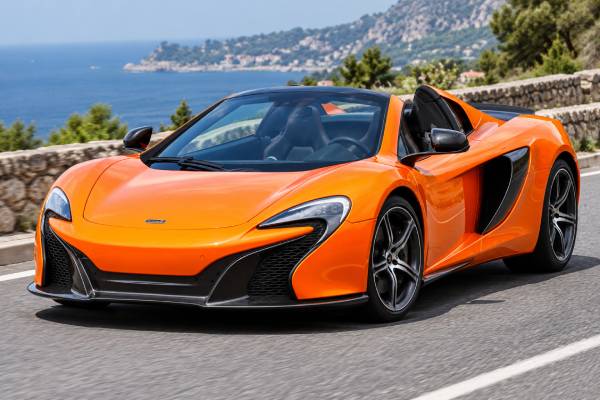
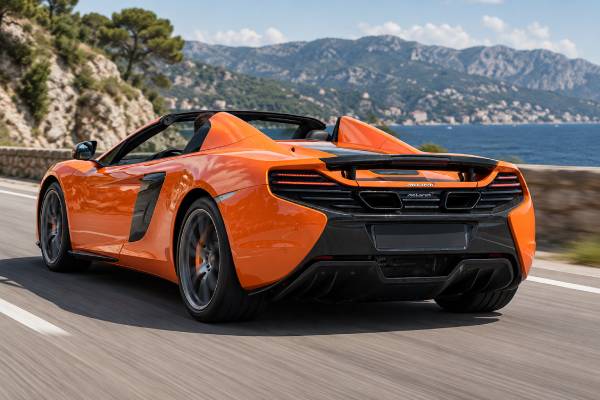
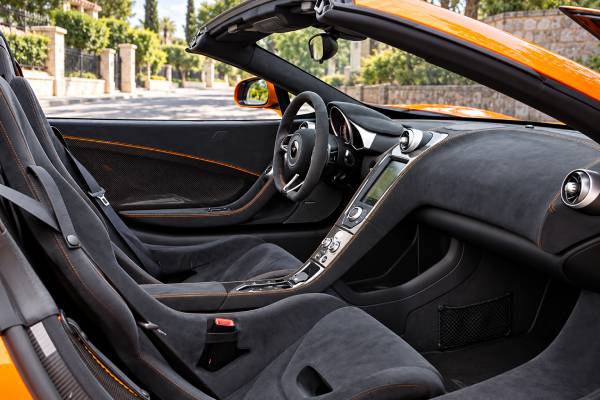
The McLaren 625C Spider is a rare answer to a very specific question: how could McLaren make its carbon-tub open-top supercar more forgiving on everyday Asian roads without giving away the speed and precision that defined the Super Series? The result combined the 625C’s 625 PS (616 bhp) engine tune, 610 Nm torque output, revised dampers, softer rear spring rate, and cast-iron brakes with the retractable hardtop architecture of the 650S Spider. Factory data still quoted 3.1 seconds to 100 km/h on optional P Zero Corsa tires, 9.0 seconds to 200 km/h, and 329 km/h flat out. Those figures make “Club” sound almost misleadingly mild. More important today is the Spider’s added layer of ownership complexity: roof hydraulics and seals, rear-window operation, drainage, added mass, and a market history that often includes export from its original Asia-Pacific destination. This guide explains what is unique about the 625C Spider and how to assess one properly.
Table of Contents
- The Open-Top Club Concept
- 625C Spider Data and Factory Figures
- Roof, Structure, and Chassis Balance
- How the 625C Spider Drives
- Service Priorities Beyond the Engine
- Pre-Purchase Roof and Import Audit
- Living With the Rare Spider
The Open-Top Club Concept
The 625C Spider combines two separate McLaren ideas: the Asia-focused 625C calibration and the carbon-tub Spider body with a powered retractable hardtop. It is therefore not merely a 625C Coupé with its roof removed; open-air operation adds mechanisms, sealing systems, and mass that change both the driving experience and the inspection process.
McLaren launched the 625C in 2014 for Hong Kong before planned expansion to selected Asia-Pacific markets. The C stands for Club, and the model was deliberately positioned as a more accessible, more refined alternative to the 650S. That did not mean abandoning the technology that made the Super Series distinctive. The carbon-fiber MonoCell, mid-mounted M838T V8, seven-speed SSG, hydraulically interconnected ProActive Chassis Control, and active Airbrake all remained.
The Spider body makes unusual sense in that brief. With the roof down, the 625C becomes more of a road car in character, giving the driver engine and exhaust sound at speeds where the chassis is not being exploited to its limits. With the roof raised, the rigid carbon cell means the basic passenger structure does not depend on a conventional steel roof for torsional strength in the way many older convertibles did.
McLaren’s 650S Spider engineering material says the hardtop mechanism itself was reduced to 40 kg. That figure is useful when understanding why the Spider’s factory dry mass rose to 1,376 kg versus 1,336 kg for the 625C Coupé: roughly 40 kg separates the two published 625C dry-weight figures. The open car remains light by retractable-hardtop standards, but the additional hardware is still real and needs to function correctly.
The model’s rarity can cause confusion in the used market. Some sellers describe a 625C Spider as an “Asian 650S Spider,” which is directionally understandable but technically incomplete. Output, torque, suspension calibration, rear spring rate, and standard brake hardware differ. A correct evaluation begins by accepting the car on its own specification rather than trying to make every component match a 650S parts list.
625C Spider Data and Factory Figures
The 625C Spider produces 625 PS (616 bhp) from its 3.8-liter twin-turbo M838T and sends 610 Nm through a seven-speed SSG to the rear wheels. McLaren’s period technical data lists a 1,376 kg dry weight, 329 km/h top speed, and 0–200 km/h time of 9.0 seconds with the specified optional P Zero Corsa tires.
| Item | 625C Spider |
|---|---|
| Engine | M838T 90-degree twin-turbocharged V8 |
| Displacement | 3,799 cc (3.8L) |
| Engine position | Longitudinal, mid-mounted |
| Power | 625 PS / 616 bhp (460 kW) at 7,250 rpm |
| Torque | 610 Nm (450 lb-ft) from 3,000–7,000 rpm |
| Transmission | 7-speed Seamless Shift Gearbox |
| Drive | Rear-wheel drive |
| Test | Factory figure |
|---|---|
| 0–100 km/h (0–62 mph) | 3.1 seconds with optional P Zero Corsa tires |
| 0–200 km/h (0–124 mph) | 9.0 seconds with optional P Zero Corsa tires |
| 0–300 km/h (0–186 mph) | 27.7 seconds with optional P Zero Corsa tires |
| 400 m / quarter mile | 10.8 seconds at 134 mph |
| Maximum speed | 329 km/h (204 mph) |
| System | Factory configuration |
|---|---|
| Core structure | Carbon-fiber MonoCell with aluminum front and rear frames |
| Suspension | ProActive Chassis Control |
| Chassis settings | Normal / Sport / Track |
| 625C tuning | Revised dampers and softer rear spring rate |
| Front brake discs | 370 mm cast iron with forged aluminum hubs |
| Rear brake discs | 350 mm cast iron with forged aluminum hubs |
| Aerodynamic device | Active McLaren Airbrake |
| Measure | Metric | Imperial |
|---|---|---|
| Length | 4,512 mm | 177.6 in |
| Width including mirrors | 2,093 mm | 82.4 in |
| Height | 1,199 mm | 47.2 in |
| Wheelbase | 2,670 mm | 105.1 in |
| Track, front / rear | 1,656 / 1,583 mm | 65.2 / 62.3 in |
| Dry weight | 1,376 kg | 3,034 lb |
| Axle | Wheel | Standard listed tire |
|---|---|---|
| Front | 19 x 8.5J | Pirelli P Zero 235/35 R19 |
| Rear | 20 x 11J | Pirelli P Zero 305/30 R20 |
| Quoted acceleration setup | Optional Pirelli P Zero Corsa tires | |
| Measure | Published figure |
|---|---|
| Combined fuel consumption | 24.2 mpg UK (approximately 11.7 L/100 km) |
| CO2 emissions | 275 g/km |
| Power-to-weight with lightweight options | 466 PS per tonne (459 bhp per tonne) |
The most important specification caveat is tire-dependent acceleration. McLaren marked the published sprint figures as achieved with optional P Zero Corsa tires. A car on newer road-focused tires may offer better wet-weather or temperature versatility without matching an old magazine-style launch number, and that is not evidence of a mechanical problem by itself.
Roof, Structure, and Chassis Balance
The 625C Spider’s retractable hardtop should be thought of as a vehicle system, not a cosmetic option. It adds moving panels, hydraulic or electro-hydraulic actuation, sensors, seals, drains, latches, and rear-window functions that all deserve inspection before purchase.
The carbon MonoCell is the reason McLaren could create a Spider without the large reinforcement penalty associated with many traditional convertibles. The passenger cell was designed around carbon-fiber rigidity, so removing a fixed upper roof did not require rebuilding the whole central structure. That allowed McLaren to keep the mass increase between the published 625C Coupé and Spider dry weights to 40 kg.
In use, the roof should complete its entire cycle cleanly and consistently. Test it from fully closed to fully open and back again, listening for asymmetric movement, pump strain, creaks that sound structural rather than trim-related, or pauses that are not part of the normal sequence. Do the test more than once if the seller and conditions allow. A mechanism that works once after a battery charge can still reveal an intermittent position sensor or weak electrical supply on repeated cycles.
Inspect the meeting points between roof panels, header rail, side glass, and rear deck. Look for compressed or damaged seals, witness marks from poor alignment, water staining, and wind-noise complaints in the history. The car should also be checked after washing or rain, not only in a dry showroom. Damp carpet, condensation, or staining behind trim can indicate a drainage or sealing issue that has existed longer than a seller realizes.
The rear window is useful in an open McLaren because it can influence airflow and lets more engine sound into the cabin. Verify its operation independently where the car’s controls permit. A window or roof fault that seems minor can involve trim removal and careful adjustment, so it should be priced into the purchase rather than accepted as an easy future fix without diagnosis.
Chassis behavior must be judged with the roof both up and down where practical. The difference should mainly be noise, airflow, and a small shift in perceived refinement—not scuttle shake or obvious structural movement. Rattles from roof trim may appear on poor surfaces, but clunks, latch movement, or water leaks deserve investigation.
The 625C’s softer rear springing and revised damper calibration add another layer. A healthy example should feel more compliant than the harder-edged 650S in Normal mode, yet it should still settle quickly after a bump. If the car crashes over minor imperfections or feels oddly floaty, do not blame the Spider body automatically; inspect hydraulic accumulators, suspension pressures, tires, alignment, and damper condition.
How the 625C Spider Drives
The 625C Spider is best understood as a very fast road car with a broader comfort setting, not as a slow version of the 650S. Its 3.1-second 0–100 km/h time and 329 km/h maximum speed place it firmly in supercar territory even after McLaren reduced output to 625 PS.
The 610 Nm torque plateau from 3,000 to 7,000 rpm gives the V8 strong response across a wide band. Roof down, that midrange is often more relevant than chasing the final few hundred rpm because the sound and acceleration become intense quickly. The open cabin also makes mechanical noises more obvious, which can be useful on a test drive: abnormal turbo, belt, suspension, or brake sounds are harder to hide when there is less insulation between the driver and the surroundings.
The seven-speed SSG should be tested in automatic and manual operation. Use low-speed parking maneuvers, normal part-throttle shifts, downshifts, and—where safe and legal—strong acceleration after full warm-up. The gearbox should not produce repeated warnings, severe shudder, or inconsistent engagement. A dual-clutch transmission can feel different from a conventional automatic at crawling speed, but “they all do that” is not a diagnosis for a car that behaves poorly.
The contrast between Normal and the firmer chassis settings is central to the 625C identity. On a broken road, Normal should allow more wheel movement and reduce the sharpest impacts. Sport and Track increase control and should feel purposeful rather than simply punishing. If all three modes feel almost identical, there may be a fault or age-related loss of hydraulic function worth investigating.
Brakes also shape the driving character. Cast-iron discs can provide progressive response from cold and make routine condition assessment easier than carbon-ceramic rotors, but they still operate on a 300-plus km/h car. Pedal travel should be stable, there should be no steering pull, and repeated stops should not reveal vibration. Surface corrosion after storage may clean away with use; deep scoring, cracking, or a persistent lip calls for measurement.
With the roof raised, listen at motorway speeds for air leaks around seals and check cabin temperature control. With it lowered, assess turbulence and whether trim remains secure. Neither test is a substitute for mechanical inspection, but together they reveal whether the Spider systems make the car enjoyable or turn every journey into a list of deferred repairs.
Service Priorities Beyond the Engine
For an aging 625C Spider, roof condition, hydraulic suspension health, battery voltage, cooling integrity, brakes, and tires deserve equal attention with the engine. Low annual mileage does not prevent seals, fluids, accumulators, electrical storage systems, or rubber components from aging.
Use the appropriate Asia-Pacific or market-specific McLaren owner documentation for operating procedures, then have servicing planned by VIN. The 625C shares much with the 650S, but workshops should not assume every brake, suspension, software, or trim part is identical. Keeping copies of the original build sheet and market documentation with the service file can prevent incorrect assumptions years later.
A healthy battery is particularly important in a Spider. The car already has numerous control modules, and the roof adds a system that depends on stable electrical supply and accurate sensor inputs. If the vehicle will sit, use the specified type of conditioner. When roof or chassis warnings appear after storage, capture fault codes before clearing them and confirm battery health before replacing expensive assemblies.
Roof care should include clean seals and drainage paths, inspection for pinching or tears, and careful observation of panel alignment. Avoid forcing a stalled mechanism by hand unless the official procedure specifically instructs it. If the roof stops mid-cycle, secure the vehicle, consult the handbook, and diagnose the cause rather than repeatedly cycling controls until a component overheats or loses synchronization.
The ProActive Chassis Control system needs specialist attention when ride quality changes. Hydraulic accumulators can lose effectiveness with age, producing a hard or unsettled ride. Inspect for leakage and use diagnostics capable of reading the relevant chassis modules. Because the 625C was designed around improved refinement, a harsh example is especially likely to be masking maintenance needs.
Cooling-system checks should be methodical in hot-climate cars. Inspect radiator faces for debris, check hoses and connections for dried residue, monitor coolant level, and pressure-test unexplained losses. Heat from the twin-turbo V8 plus stop-start city use gives the cooling package little reason to be neglected. After a full-temperature road test, look beneath the car and around the engine bay rather than ending the inspection as soon as the drive is over.
Brake fluid is time-sensitive, and iron discs should be measured rather than judged only by appearance. Check pads, disc thickness, corrosion, cracks, and hub condition. Confirm whether the car remains on its factory iron system. If a previous owner installed carbon-ceramic brakes, obtain documentation for the parts and work, then maintain those components according to their own limits.
Tires can age out while still showing deep tread, especially on collection cars. Read all four date codes and inspect inner shoulders. A matched, recent set of appropriately rated tires is a better foundation than old period-correct rubber. Alignment should be checked after tire replacement or if the car follows road cambers excessively, shows irregular wear, or has a steering wheel that does not sit straight.
Pre-Purchase Roof and Import Audit
A 625C Spider inspection should begin with identity and roof function before moving into the usual powertrain checks. The model’s regional distribution means paperwork can be as consequential as paint condition when a car has crossed borders.
Confirm the VIN and original build specification through appropriate McLaren records. Establish where the car was first delivered, when it moved markets, and whether the registration trail is continuous. A clean import should have documentation for duties, conformity or inspection requirements, and any alterations needed for lighting or instruments. Missing paperwork does not prove a problem, but it raises the amount of independent verification required.
Then examine the roof before the car is driven. Check panel fit with the roof closed, glass alignment, seal condition, headliner, rear deck, and luggage/storage areas for signs of water. Cycle the roof through its complete sequence, confirm warning messages clear, and repeat after the test drive when the car is warm. A fault that appears only after heat soak is more informative than a single cold demonstration.
A useful pre-purchase sequence includes:
- diagnostic scan before fault codes are erased;
- battery and charging-system test;
- complete roof and rear-window operation check;
- water-ingress inspection around seals, drains, carpets, and trim;
- hydraulic suspension function in every chassis mode;
- full-temperature engine, gearbox, and cooling assessment;
- iron brake measurement and tire age inspection;
- underbody, front splitter, lift-point, wheel, and suspension inspection;
- body-repair review with special attention to carbon and aluminum structures;
- verification of 625C-specific specification and any later conversions.
Road-test the car long enough for the drivetrain and cooling system to stabilize. Watch for warnings that appear after repeated acceleration, braking, or chassis-mode changes. Test steering around center, over cambered roads, and during braking. A short drive around a dealer block cannot reveal the systems that make this car expensive to repair.
Body repairs require context. The central MonoCell is carbon fiber, but exterior panels and supporting structures use different materials. Stone-chip repainting on a low supercar is common; structural damage is a different matter. Obtain photographs and invoices for significant work and have unfamiliar repairs assessed by someone who knows McLaren construction.
Check the underside for careless lifting. Damage around jacking points, floor panels, or cooling ducts can reveal poor workshop practice. Inspect the front bumper and splitter for repeated grounding. Spider owners may have used steep hotel entrances, underground garages, and city parking ramps frequently, so low-speed underside damage can be more likely than a dramatic accident record.
Finally, confirm exactly what is included in the sale. Spare keys, handbook material, battery charger, original parts removed during upgrades, and complete service invoices all reduce future uncertainty. On a relatively obscure regional derivative, documentation has practical value because it helps the next technician understand what the car is supposed to be.
Living With the Rare Spider
The 625C Spider works best for an owner who values open-air usability and the Super Series hydraulic chassis but prefers a calmer factory road setting than the 650S. Its rarity is interesting, yet day-to-day satisfaction depends far more on roof reliability, service quality, and correct maintenance than on production obscurity alone.
Compared with the 625C Coupé, the Spider adds 40 kg to the published dry weight and gives up 4 km/h of maximum speed, while its 0–200 km/h time lengthens from 8.8 to 9.0 seconds. Those differences are small enough that the choice should be based on whether the retractable roof is genuinely useful to the owner. If it will never be opened, the Coupé removes a layer of mechanisms and sealing concerns.
Compared with a 650S Spider, the 625C offers less power and torque but a chassis calibration designed around refinement. For road use, that may be the more meaningful distinction. The car still has enough performance that there is little opportunity to exploit full output in normal traffic, while ride quality is experienced on every journey.
Insurance should reflect both supercar repair costs and the possibility that 625C-specific components or market parts may be less familiar to local suppliers. Discuss declared value, choice of repairer, use of genuine components, and coverage for cross-border touring if relevant. Photograph the vehicle’s specification and keep those images with the policy records.
Owners should also resist making rarity an excuse for inactivity. A mechanically healthy car benefits from proper heat cycles and regular operation of the roof, Airbrake, gearbox, brakes, and suspension. That does not mean unnecessary mileage or poor-weather use; it means avoiding years of static storage followed by an expectation that every seal and hydraulic component will behave as new.
The strongest examples will have a consistent story. Their VIN and original market are clear, the roof moves correctly and stays dry, the 625C suspension still delivers its intended compliance, the iron brakes are healthy or any conversion is documented, the cooling system is stable, and the service history shows time-based care. In that condition, the 625C Spider is not merely an obscure 650S relative. It is a distinct McLaren built around fast, open-top road use, with a factory calibration that becomes more relevant—not less—as these cars move into their second decade.
References
- The McLaren 625C Coupe, A regionally Tailored Vehicle 2014 (625C Coupé and Spider Technical Data)
- McLaren previews Asia-only 625C | evo 2014
- New McLaren 625C revealed | Autocar India 2014
- McLaren 650S Spider – Interior, Specs & Performance 2026 (Shared Spider Architecture)
- 2014 McLaren 625C Spider Specifications – Ultimatecarpage.com 2014
- McLaren Owners 2026 (Owner Documentation Index)
Disclaimer
This article provides general information and cannot substitute for a professional McLaren inspection, diagnosis, service, roof repair, or import-compliance assessment. Procedures, specifications, torque values, service intervals, control software, and equipment can vary with VIN and destination market, so confirm the specific vehicle against official McLaren documentation before maintenance or parts replacement. If the article helped your research, please consider sharing it on Facebook, X/Twitter, or another platform.