
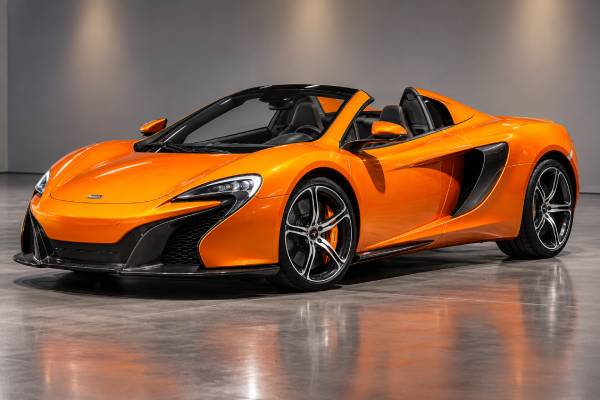
The McLaren 650S Spider gives away remarkably little to the Coupé while adding a powered two-piece hardtop and an independently operable heated rear window. Its carbon MonoCell carries the structural load, so McLaren did not need the heavy reinforcement strategy typical of many convertibles; the roof mechanism adds about 40 kg, yet the Spider still matches the Coupé’s 3.0-second 0–100 km/h time. Maximum speed is 329 km/h and 200 km/h arrives in 8.6 seconds. Those are the easy numbers. A used Spider has a second set of systems that matter just as much as the 641 bhp twin-turbo V8: roof actuation, latches, seals, drainage, rear glass, tonneau alignment, and battery health. As examples age, a roof that works only intermittently can change the economics of an otherwise attractive car. This guide therefore treats the 650S Spider as an open-top system first and a specification sheet second, while also covering its hydraulic chassis, carbon-ceramic brakes, cooling, transmission, service needs, and the inspection sequence that reveals whether the whole car works together.
Table of Contents
- What the Spider Adds
- 650S Spider Factory Data
- Hardtop, Rear Glass, and Weather Sealing
- Open-Roof Driving With PCC
- Service Routine for the Spider
- A Spider-Specific Buying Test
- Matching Condition to Use
What the Spider Adds
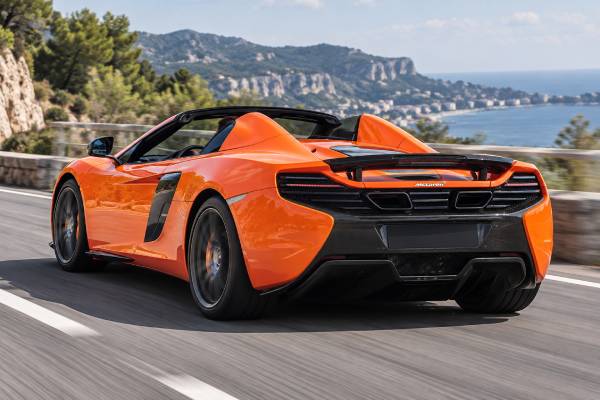
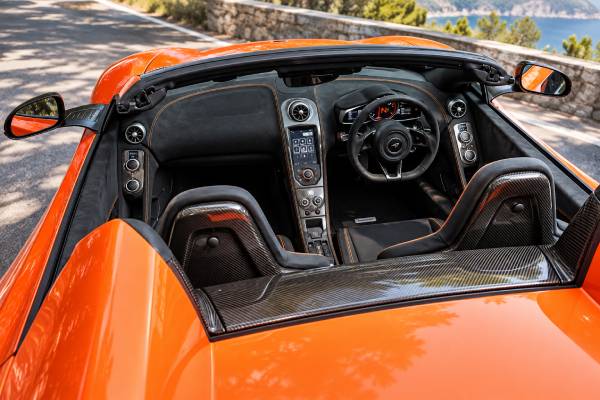
The 650S Spider is mechanically very close to the Coupé but adds a powered retractable hardtop, roll-over protection hardware, a rear deck shaped around roof storage, and a rear glass panel that can be controlled independently. The carbon MonoCell lets those additions work without changing the basic structural concept.
McLaren spent six months reducing the mass of the hardtop mechanism from 50 kg to 40 kg. That effort matters because roof hardware sits relatively high in the car, where unnecessary weight would have a larger effect on the center of gravity. In period figures, the Spider’s standard dry weight was around 40 kg above the Coupé, while the lightest official dry specification is 1,341 kg.
The two-piece hardtop can be raised or lowered while the car is moving slowly. Period launch information quoted a 17-second cycle and operation at up to 19 mph (about 30 km/h). Those details turn the roof into a practical road feature rather than something that requires a full stop and a long roadside procedure. More than a decade later, however, that convenience depends on the health of pumps, sensors, latches, electrical supply, and panel alignment.
The heated rear glass is a particularly useful part of the design because it is independent of the roof. With the hardtop up, lowering the rear glass lets more engine and exhaust sound into the cabin. With the roof down, raising it can reduce turbulence. It should therefore be tested as a separate function rather than assumed to be working because the roof itself cycles.
Performance remains close to the fixed-roof car. The 0–100 km/h time is unchanged at 3.0 seconds, 0–200 km/h is two tenths slower at 8.6 seconds, and maximum speed falls from 333 to 329 km/h. Those differences are minor in normal use. The larger ownership difference is simply that the Spider has more moving weather-exposed hardware to inspect and maintain.
That distinction should guide shopping. A buyer choosing the Spider specifically for roof-down use should place roof reliability and water sealing near the top of the pre-purchase list. A buyer who rarely plans to open the roof may be better served by a Coupé rather than carrying extra systems that provide little personal value.
650S Spider Factory Data
The 650S Spider uses the 3,799 cc M838T twin-turbo V8 at 650 PS (641 bhp) and 678 Nm, a seven-speed SSG, rear-wheel drive, ProActive Chassis Control, and an active Airbrake. Official performance is 3.0 seconds to 100 km/h, 8.6 seconds to 200 km/h, and 329 km/h maximum speed.
| Item | 650S Spider specification |
|---|---|
| Engine code | M838T |
| Configuration | 90-degree twin-turbocharged V8, dry sump |
| Displacement | 3,799 cc (3.8L) |
| Maximum power | 650 PS / 641 bhp (478 kW) at 7,250 rpm |
| Maximum torque | 678 Nm (500 lb-ft) at 6,000 rpm |
| Transmission | 7-speed Seamless Shift Gearbox |
| Drive | Rear-wheel drive |
| Measure | Factory figure |
|---|---|
| 0–60 mph | 2.9 seconds |
| 0–100 km/h (0–62 mph) | 3.0 seconds |
| 0–100 mph | 5.8 seconds |
| 0–200 km/h (0–124 mph) | 8.6 seconds |
| Maximum speed | 329 km/h (204 mph) |
| System | Specification |
|---|---|
| 100–0 km/h braking | 30.7 m (101 ft) |
| 200–0 km/h braking | 124 m (407 ft) |
| Suspension | Double wishbone with ProActive Chassis Control |
| Chassis modes | Normal / Sport / Track |
| Active aero | McLaren Airbrake |
| Structure | Carbon-fiber MonoCell with aluminum front and rear structures |
| Item | Published information |
|---|---|
| Roof type | Powered two-piece retractable hardtop |
| Roof mechanism mass | Approximately 40 kg (88 lb) |
| Roof cycle time | Approximately 17 seconds in period launch information |
| Roof operation speed | Up to about 19 mph (30 km/h) in period launch information |
| Rear window | Heated glass, independently operable |
| Lightest dry weight | 1,341 kg (2,956 lb) |
| DIN kerb weight | 1,468 kg (3,236 lb) |
| Axle | Wheel | Tire |
|---|---|---|
| Front | 8.5 x 19 in | 235/35 R19 |
| Rear | 11 x 20 in | 305/30 R20 |
| Period performance fitment | Pirelli P Zero Corsa | |
| Measure | Published figure |
|---|---|
| Urban | 16.1 mpg UK (17.5 L/100 km) |
| Extra urban | 33.2 mpg UK (8.5 L/100 km) |
| Combined | 24.2 mpg UK (11.7 L/100 km) |
| CO2 | 275 g/km |
The factory figures should be used as reference points, not inspection shortcuts. The 1,341 kg number is a lightest dry specification rather than an everyday curb weight, and 17-second roof operation describes a properly functioning system under suitable conditions. A used car that strains or stops during the cycle needs diagnosis even if it eventually closes.
Hardtop, Rear Glass, and Weather Sealing
A 650S Spider roof inspection should be performed as a sequence, because a mechanism can appear healthy when only the final open and closed positions are checked. Panel motion, latch timing, seal compression, rear-window behavior, tonneau movement, and electrical warnings all provide evidence.
Begin with the roof fully closed and the car dry. Look along the panel gaps from both sides and compare how the side glass meets its seals. Check the header rail, roof-panel joins, rear deck, and the trim behind the seats. Water stains, tide marks, discolored Alcantara, or a musty smell justify a closer moisture check even if no active leak is visible.
Operate the roof using the normal control and watch the complete sequence. The movement should be symmetrical and deliberate, with no panel striking adjacent paint or trim. Listen for a pump that sounds increasingly labored, repeated latch attempts, or abrupt pauses. A single successful cycle is not enough on a car that may have been placed on a charger immediately before a viewing; repeat the operation after the road test.
Battery voltage and roof behavior are closely related. A marginal battery can make a complex mechanism appear defective or create warnings that disappear after charging. Test the battery and charging system before treating every roof fault as a mechanical failure. The reverse is also true: do not dismiss a consistent sensor or latch error merely because the battery is old.
With the roof up, operate the rear glass independently through its full range. Check the heater function where conditions make that practical and listen for irregular regulator noises. Then drive at urban and motorway speeds. Excessive wind noise from one corner can point to glass alignment or seal compression even when the car remains dry in a stationary wash test.
Drainage paths need physical inspection. Leaves, detailing debris, or old sealant can divert water into areas that were never intended to stay wet. Check carpets and hidden storage areas after wet testing. A previously repaired leak may leave old staining, so the goal is to determine whether moisture is current and whether any control modules or connectors have been exposed.
Roof service work should be documented with parts and calibration details. If a previous owner replaced a sensor, hydraulic component, latch, or seal, the invoice can explain why panel alignment differs from untouched cars. Repeated roof work without a durable fix is a stronger warning than one properly documented repair.
Open-Roof Driving With PCC
The Spider retains the 650S’s defining hydraulic chassis behavior, so removing the roof should change the sensory experience more than the structural one. The car should still steer precisely, control roll tightly, and show clear differences between its Normal, Sport, and Track settings.
The carbon MonoCell does most of the work here. Because the central carbon structure carries substantial torsional stiffness, McLaren did not need to chase rigidity with large amounts of added metal reinforcement. On the road, that should mean no obvious cowl shake, dashboard tremor, or body flex simply because the roof is open.
Roof-down driving also makes the engine’s behavior easier to hear. The rear glass can be positioned to admit more of the V8’s sound, and the turbocharged power delivery becomes a larger part of the experience. Listen for consistency rather than theatrics: smooth boost buildup, clean shifts, and no abnormal rattles from the rear deck or roof storage area.
ProActive Chassis Control should remain supple in Normal. The 650S uses hydraulically interconnected dampers rather than conventional anti-roll bars for much of its roll management, allowing the wheels to deal with bumps while the body stays composed. A car that pounds over every surface may have pressure or accumulator problems, not simply “supercar suspension.”
The extra roof mass produces only a small performance difference versus the Coupé. That is useful because it lets the buyer focus on preferred body style instead of treating the Spider as a fundamentally compromised version. At real road speeds, tire condition and alignment will affect steering and grip far more than the 40 kg roof mechanism.
Carbon-ceramic brakes need confidence as well as power. The pedal should stay stable, the car should stop straight, and vibration should not build during repeated braking. Surface condition is only part of the evaluation; serviceability must be assessed with the proper measurement procedure. A lightly used Spider can still have costly brake needs if it has been tracked or stored poorly.
When testing with the roof down, listen for rattles from the tonneau and rear trim over broken surfaces. Some minor trim noise can develop with age, but hard knocks, latch movement, or metal-on-metal sounds deserve investigation. Close the roof afterward and drive the same route again; the comparison can help localize what is body-related and what is suspension-related.
Service Routine for the Spider
Spider maintenance is easiest to manage when the roof and weather systems are treated as a scheduled inspection category alongside engine, transmission, hydraulics, brakes, cooling, and electronics. Waiting until rain enters the cabin or the roof stops halfway turns small issues into urgent ones.
At routine service, have the roof seals cleaned and inspected for cuts, deformation, or hardening. Examine visible pivots and panel edges without applying unapproved lubricants. Confirm drains are open and glass alignment is correct. Cycle the mechanism and rear window while battery voltage is stable, then record any fault codes rather than erasing them without explanation.
The battery is part of preventive roof maintenance. A 650S that sits for extended periods should use the specified conditioner. Record battery age and test its condition during annual service. If the car is stored somewhere difficult to access, plan for a low-voltage event rather than discovering afterward that the normal entry or roof procedure is unavailable.
Engine servicing should follow the official schedule and correct dry-sump oil-level procedure. Ask the workshop to inspect for fluid seepage around the engine and gearbox while undertrays are removed. A clean garage floor does not prove a dry powertrain if the underbody panels are retaining residue.
Cooling checks deserve particular attention before summer roof-down use. Inspect front heat exchangers for blockage, verify coolant level and condition, and investigate any sweet smell or dried deposits. Traffic with the roof open can mean long periods at low road speed while the engine bay remains hot, so fans and cooling controls need to work correctly.
For PCC, note ride quality from year to year. Accumulators can lose effectiveness gradually, and owners may adapt to the deterioration. A specialist can check hydraulic pressures and stored chassis faults. If the ride becomes suddenly severe, limit aggressive driving until the system is diagnosed.
Brake fluid and tire age are calendar items regardless of mileage. Read all four tire date codes, inspect the hidden inner shoulders, and confirm the tires match appropriately across axles. On a 641 bhp rear-drive Spider, old rubber is a larger safety issue than preserving a period-correct brand name.
Interior maintenance should include checking for moisture under mats and around storage areas, especially after washing. Electronic modules and connectors dislike chronic dampness. A small roof leak discovered early may require seal adjustment; the same leak ignored for years can create electrical faults that are harder to trace.
Finally, keep roof work separate in the service file. A concise record of seal replacement, latch adjustment, sensor work, water testing, and battery-related faults makes future diagnosis far easier than a stack of invoices that merely say “roof checked.”
A Spider-Specific Buying Test
A pre-purchase inspection for a 650S Spider should be designed around changing states: cold to hot, roof up to roof down, dry to water-tested, low voltage risk to verified battery health, and soft to firm chassis modes. Problems often appear during the transitions rather than in one static snapshot.
Before the engine starts, inspect the closed roof, seals, side-glass fit, tonneau, rear window, cabin trim, carpets, and visible drains. Photograph panel gaps if something looks uneven. Check the battery state, then run a diagnostic scan so stored faults are captured before anyone clears them.
Perform a complete roof cycle and independent rear-window operation. If possible, water-test the roof while it is closed and inspect the cabin afterward. Then road-test the car until coolant, oil, transmission, brakes, and hydraulic systems are fully warm. Use the lift system if fitted, operate each chassis mode, and verify Airbrake behavior through the appropriate test method.
With the roof closed, listen for wind leaks. With it open, listen for tonneau or rear-deck noises and check whether the rear glass alters airflow as expected. Run climate control in both configurations because roof position can change how the cabin system compensates.
The mechanical PPI still needs full depth. Test SSG engagement and shifts, steering, braking, boost response, cooling stability, and suspension behavior. On a lift, inspect the front splitter, floor, lift points, hydraulic lines, wheel barrels, brake discs, suspension joints, heat exchangers, and any fluid traces.
Bodywork should be reviewed with the material mix in mind. The central tub is carbon, while exterior panels and supporting structures use composites and metals. Look for inconsistent fasteners, paint edges, overspray, cracked mounting tabs, altered panel gaps, and evidence the roof-storage area has been disturbed. Obtain repair photos for significant accident work.
For U.S. vehicles, verify recall status with the VIN. NHTSA lists affected McLaren 650S vehicles within specified production ranges for the Takata passenger frontal airbag campaign. A later registration date does not establish whether a particular chassis was included or repaired; use the VIN record.
Do not end the inspection immediately after the drive. Heat soak is useful. Cycle the roof again, scan the car a second time, inspect for fresh coolant or hydraulic residue, and check whether the battery still shows healthy voltage. A Spider that passes both cold and fully warm states inspires more confidence than one demonstrated only in a prepared showroom condition.
Matching Condition to Use
The right 650S Spider depends on how it will be used, because touring, occasional weekend driving, collection storage, and track work place different demands on the same roof, tires, brakes, hydraulics, and electronics. Buying a car whose recent maintenance matches the intended duty cycle can save immediate corrective work.
For frequent road use, prioritize a fault-free roof, recent tires, strong air conditioning, a healthy battery, working front lift where fitted, and comfortable seats. Cosmetic perfection matters less than systems that work every time. A small, documented stone-chip repaint may be easier to live with than an untouched car whose roof leaks.
For collection use, documentation and originality become more prominent, but mechanical exercise still matters. Preserve original trim and parts, maintain the battery, cycle the roof, move the rear glass, bring fluids fully to temperature periodically, and replace age-expired tires even if tread appears new. Static preservation is not the same as mechanical preservation.
For track use, the Spider remains highly capable, but consumables and heat history become central. Monitor carbon-ceramic brakes with the proper method, use appropriate tires, replace brake fluid on a suitable schedule, inspect alignment, and check the hydraulic chassis after hard use. Record events and maintenance so future condition is understandable.
Insurance should reflect the cost of composite bodywork and roof components as well as the car’s market value. Photograph roof panels, seals, rear deck, wheels, carbon trim, interior, and underbody before transport or storage. If a repair is needed, choose a facility familiar with McLaren roof alignment and material-specific body procedures.
Recheck that photo record after any enclosed transport or long-distance delivery.
A good service relationship is especially valuable for a Spider because small symptoms can involve several systems. Wind noise might be glass alignment, a seal, or panel fit; a roof warning might be voltage, a sensor, or a latch; a harsh ride may be hydraulic rather than mechanical spring failure. Technicians who know the platform can test causes instead of replacing parts by guesswork.
The 650S Spider makes the strongest ownership case when its added complexity is actually used. With the roof functioning correctly, rear glass responsive, cabin dry, PCC healthy, brakes measured, drivetrain warm and clean, and history complete, the car delivers nearly Coupé-level performance with a genuinely different sensory experience. That is the condition to buy—not merely a low mileage number paired with a roof that happened to work once during the viewing.
References
- McLaren 650S Spider – Interior, Specs & Performance 2026 (Manufacturer Specifications)
- McLaren 650S Spider: Geneva 2014 | evo 2014
- Used McLaren 650S Spider 2014-2016 review | Autocar 2026
- Used McLaren 650S (2014 – 2017) review – a 207mph supercar for Audi RS3 money | evo 2025
- McLaren Owners 2026 (Owner Documentation Index)
- Takata Air Bag Recall Spotlight | NHTSA 2026 (U.S. Recall Information)
Disclaimer
This guide is informational only and cannot replace a professional McLaren inspection, diagnosis, roof-system evaluation, structural assessment, service, or repair. Specifications, torque values, procedures, service intervals, software, recall applicability, and equipment differ by VIN and destination market; verify the exact Spider with official McLaren documentation before ordering parts or performing work. If this guide was useful, please share it on Facebook, X/Twitter, or another platform.