
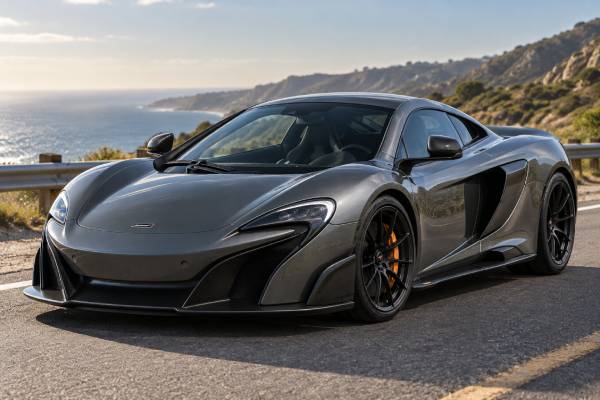

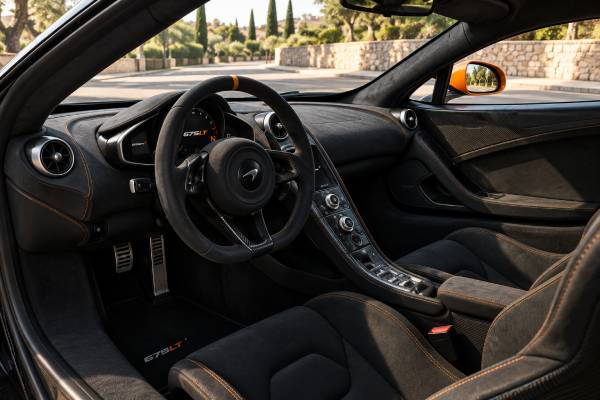
The McLaren 675LT Coupé is not a 650S with a software tune and a larger wing. McLaren reworked the engine, suspension, steering, aerodynamics, body panels, exhaust, glazing, interior, and electrical content around a Longtail brief of lower mass, greater downforce, stronger response, and closer driver involvement. The M838TL 3.8-liter twin-turbo V8 makes 675 PS (666 bhp) and 700 Nm, while the lightest dry specification is 1,230 kg—100 kg below the 650S benchmark used by McLaren. It reaches 100 km/h in 2.9 seconds and 200 km/h in 7.9, despite a 330 km/h top speed that is slightly lower than the 650S Coupé because the LT prioritizes aerodynamic load over minimum drag. Production was capped at 500 Coupés, giving originality and documented condition unusual importance. This guide separates the 675LT-specific hardware from ordinary Super Series parts, explains what its weight and aero program achieved, and sets out maintenance and pre-purchase checks for cars now entering their second decade.
Table of Contents
- What the Longtail Program Changed
- 675LT Coupé Technical Data
- Engine, Mass, and Aerodynamics
- Chassis, Steering, and Track Use
- Age-Related Maintenance
- Authenticating and Inspecting a 675LT
- Ownership and Preservation
What the Longtail Program Changed
The 675LT was McLaren’s first modern road-going Longtail and a substantially re-engineered derivative of the 650S platform. Its defining changes are measurable: 25 PS more power, 22 Nm more torque, a 100 kg weight reduction, wider tracks, sharper steering, much more aggressive aero, and extensive use of lighter components.
The LT name reaches back to the 1997 F1 GTR Longtail, but the 2015 car did not simply extend its rear bodywork to imitate that racer. McLaren applied the idea more broadly: reduce mass, increase aerodynamic effectiveness, improve cooling, sharpen response, and remove unnecessary isolation. Period engineering accounts state that roughly a third of the car’s parts differed from the 650S and that more than half of the V8’s components were changed.
The revised engine carries the M838TL designation. Changes included more efficient turbochargers, altered cylinder heads and exhaust manifolds, new camshafts, lighter connecting rods, and a higher-capacity fuel system. The result was 675 PS at 7,100 rpm and 700 Nm, with a lighter engine assembly. A titanium crossover exhaust saved additional mass while giving the pipework the length McLaren wanted within the tight rear packaging.
The weight program reached areas that owners rarely see. Carbon-fiber body panels, lighter suspension hardware, a thinner windscreen, polycarbonate rear glazing, reduced interior content, and lighter wheels all contributed. The official lightest dry figure of 1,230 kg is configuration-dependent, so it should not be treated as the scale weight of every road car. Air conditioning and other equipment can add mass.
Aerodynamics changed the visual identity because function drove the surfaces. The front splitter grew substantially, the rear Airbrake became larger, the side treatment managed front-wheel wake, and the rear diffuser worked with a more aggressive body shape. Contemporary McLaren-derived figures put total downforce about 40 percent above the 650S at high speed. That helps explain why top speed did not rise with power: the LT used its extra output partly to push through greater aerodynamic load.
Production scale also matters. McLaren limited the Coupé to 500 examples, followed later by 500 Spiders. That makes a 675LT more sensitive to missing original components, undocumented crash repair, non-reversible modifications, and incomplete provenance than a standard 650S. Mechanical health still comes first, but factory-specific parts have their own value and replacement challenges.
675LT Coupé Technical Data
The 675LT Coupé combines a 3,799 cc M838TL twin-turbo V8 with a seven-speed SSG, rear-wheel drive, ProActive Chassis Control, and an active rear Airbrake. Official figures are 675 PS (666 bhp), 700 Nm, 1,230 kg lightest dry weight, 2.9 seconds to 100 km/h, and 330 km/h maximum speed.
| Item | McLaren 675LT Coupé |
|---|---|
| Engine code | M838TL |
| Configuration | 90-degree V8, twin turbocharged, dry-sump lubrication |
| Displacement | 3,799 cc (3.8L) |
| Maximum power | 675 PS / 666 bhp (497 kW) at 7,100 rpm |
| Maximum torque | 700 Nm (516 lb-ft) |
| Transmission | 7-speed Seamless Shift Gearbox (SSG) |
| Drive | Rear-wheel drive |
| Measure | Factory figure |
|---|---|
| 0–100 km/h (0–62 mph) | 2.9 seconds |
| 0–200 km/h (0–124 mph) | 7.9 seconds |
| Maximum speed | 330 km/h (205 mph) |
| 100–0 km/h braking | 30.2 m (99 ft) |
| 200–0 km/h braking | 115 m (377 ft) |
| Measure | Published value |
|---|---|
| Lightest dry weight | 1,230 kg (2,712 lb) |
| DIN kerb weight | 1,328 kg (2,927 lb) |
| Weight reduction versus 650S benchmark | 100 kg |
| Power-to-weight | 549 PS per tonne (542 bhp per tonne) |
| Area | 675LT treatment |
|---|---|
| Front and rear track | 20 mm wider than 650S |
| Front ride height | 20 mm lower than 650S |
| Front spring rate | 27 percent stiffer than 650S |
| Rear spring rate | 63 percent stiffer than 650S |
| Steering rack | Approximately 10 percent faster than other contemporary Super Series models |
| Downforce | Approximately 40 percent higher than 650S at high speed |
| Rear Airbrake | Enlarged carbon-fiber active aero surface |
| Position | Size |
|---|---|
| Front tire | 235/35 ZR19 |
| Rear tire | 305/30 ZR20 |
| Wheel construction | Lightweight forged alloy, LT-specific designs depending on specification |
| Track-focused factory tire option | Pirelli P Zero Trofeo R associated with Club Sport Pro specification |
| Measure | Figure |
|---|---|
| Urban | 16.0 mpg UK (17.8 L/100 km) |
| Extra urban | 34.6 mpg UK (8.2 L/100 km) |
| Combined | 24.2 mpg UK (11.7 L/100 km) |
| Combined CO2 | 275 g/km |
These figures describe factory test conditions and specific configurations, not a promise that a used car will reproduce them. Tire type, optional equipment, temperature, surface, fuel load, and mechanical condition all matter. The weight figure is especially important to label correctly because “lightest dry” omits operating fluids and depends on specification.
Engine, Mass, and Aerodynamics
The 675LT’s performance gain comes from simultaneous changes rather than one headline modification. More engine output, less mass, quicker shifts, stronger cooling airflow, and greater aerodynamic load all reinforce one another, which is why an aftermarket-tuned 650S is not mechanically equivalent.
The M838TL engine was a major development step. McLaren did not merely increase boost pressure and call the job finished. Revised turbochargers and airflow hardware, lighter reciprocating components, cylinder-head work, camshaft changes, and fueling upgrades supported the 675 PS target. The engine’s lower mass also contributed to the car-wide reduction effort.
Its titanium crossover exhaust is easy to identify visually and aurally, but condition matters more than appearance. Heat cycles, mounting points, clamps, and surrounding components should be inspected for fatigue or contact. A 2026 independent specialist report describes age-related cracking and mounting wear on some cars it has serviced. That is useful inspection evidence, but it should be treated as workshop experience rather than proof that every 675LT will suffer the same failure.
Weight saving extended to the body. Much of the LT-specific exterior is carbon fiber, while the rear glazing is lightweight material and the windscreen was made thinner. These parts deserve careful treatment because replacing or refinishing them may be much more complicated than repairing an ordinary painted panel. Inspect edges, mounting points, clearcoat, weave consistency, and evidence of previous removal.
The aerodynamic program is equally important to authentication. The longer front splitter, end plates, side-sill treatment, rear-quarter intake, diffuser, and large active rear wing work together. Damage to one component can affect fit and airflow elsewhere. A front splitter that has repeatedly grounded may hide cracked mounts behind an acceptable outer surface.
The rear Airbrake must deploy and retract correctly. During a pre-purchase inspection, exercise the system through appropriate diagnostic and road-test procedures and look for hydraulic leakage or hesitation. An active wing that has been coded out, pinned in one position, or repaired poorly is not a cosmetic defect on this model; it removes part of the designed braking and aero system.
Cooling also benefits from the LT airflow treatment. The side and front aerodynamic changes direct air toward radiators more effectively without simply enlarging every heat exchanger. This makes intact ducting and underbody panels important. Missing fasteners, damaged seals, or incorrectly refitted liners can compromise more than appearance.
Chassis, Steering, and Track Use
The 675LT chassis is intentionally much more focused than the 650S, with wider tracks, stiffer springs, a lower front ride height, lighter suspension hardware, and a faster steering rack. A healthy car should feel alert and tightly controlled, but it should not feel broken, crash over every bump, or display suspension warnings.
McLaren retained ProActive Chassis Control, so hydraulic health remains fundamental. The LT’s spring-rate increases—27 percent at the front and 63 percent at the rear in contemporary technical accounts—work with revised damping and PCC calibration. If hydraulic accumulators have lost charge or the system has a pressure fault, the car’s ride and platform control can change dramatically.
The steering rack is roughly 10 percent faster than the contemporary Super Series setup and the tracks are 20 mm wider. Alignment therefore has an outsized effect on how the car feels around center and under braking. Before declaring a nervous car “normal for an LT,” check tire condition, pressures, wheel runout, ride height, suspension joints, and geometry.
Track use is not inherently a problem for a 675LT. The car was engineered for it. Undocumented or poorly maintained track use is the issue. A car with circuit history should have evidence of fluid changes, brake inspections, tire replacement, geometry checks, and post-event servicing. Heat cycles can be more informative than odometer mileage on carbon-ceramic brakes and tires.
Braking performance is exceptionally strong, but carbon-ceramic components must be assessed using the correct procedure. Do not rely on surface appearance alone. Check pad condition, rotor wear criteria, chips, heat damage, and caliper function. A stored car can also develop issues unrelated to track wear, such as moisture-aged fluid or sticking caliper components.
The lightweight wheel designs should be inspected inside and out for cracks, bends, prior welding, and poor refinishing. Track curbs and potholes can damage a wheel without leaving dramatic external marks. Tire date codes are equally important. Collector-mileage cars frequently retain old rubber because tread depth looks generous, but age can make high-speed driving unsafe.
A meaningful road test should include enough time for the hydraulic, gearbox, brake, and cooling systems to reach stable temperatures. Test Normal, Sport, and Track chassis behavior where appropriate. The car should change character between modes while remaining mechanically composed. Recurring warnings, inconsistent ride height, or an Airbrake that fails to cycle need diagnosis before purchase.
Age-Related Maintenance
Time is now as important as mileage for 675LT maintenance. Cars built in 2015 and 2016 can have very low odometer readings while still carrying decade-old tires, fluids, seals, hydraulic components, cooling connectors, and electrical storage history.
Follow the correct McLaren service documentation for the VIN and market rather than a generic online interval chart. An annual inspection rhythm is sensible even when mileage is minimal because engine oil, brake fluid, coolant, filters, and rubber components age on the calendar. Retain every invoice; on a limited-production LT, service documentation also supports provenance.
Battery management deserves discipline. Low voltage can create multiple warning messages and interfere with systems that depend on stable control-module communication. Use the specified conditioner during storage and confirm battery condition before chasing faults that appeared immediately after a long lay-up. A diagnostic scan should record stored and historic codes before anyone clears them.
Hydraulic suspension accumulators and related pressure behavior are a recurring inspection area across this McLaren generation. Symptoms can include a very hard ride, inconsistent mode changes, or chassis warnings. Diagnose pressure, leakage, and accumulator condition with the proper equipment. Replacing unrelated suspension parts without testing the hydraulic system can waste money and leave the root cause untouched.
Cooling must be inspected for leakage and heat-ageing. Pressure-test the system when levels move unexpectedly, check connections and hoses, inspect radiator faces, and look for dried coolant residue. The LT’s tightly packaged engine bay sees significant thermal cycling, so brittle plastic or rubber components should be treated seriously even if they have not yet failed on the road.
The transparent rear engine-cover area deserves close visual examination under good light. Independent specialists have reported delamination, clouding, or ageing on some 675LT rear glazing. Check the panel cold as well as warm, inspect its perimeter and adjacent paint, and determine whether marks are superficial, within the material, or evidence of heat-related deterioration. Replacement availability should be confirmed before purchase if a panel is already affected.
Inspect the titanium exhaust at every service, including mounts and surrounding heat shielding. Listen during a cold start and again after full warm-up for rattles that change with thermal expansion. Because LT-specific exhaust parts are both functional and identity-defining, a repair should be documented clearly.
Gearbox fluid leakage deserves immediate identification. Any trace near the bellhousing or tell-tale drainage areas should be examined rather than cleaned away for sale. The seven-speed SSG is costly to repair, and small leaks can provide early warning of seal problems. Test clutch engagement cold and hot, full-range shifting, reverse, and low-speed maneuvering.
Storage strategy should avoid preserving the odometer at the expense of the machinery. Tires flat-spot, brake fluid absorbs moisture, seals sit dry, and hydraulic pressure can bleed down when a car remains static for very long periods. Proper periodic driving, full heat cycles, roofless Coupé simplicity aside, and post-drive checks generally provide better mechanical stewardship than occasional idling in place.
Authenticating and Inspecting a 675LT
A 675LT should be authenticated through VIN-linked factory records before its condition or price premium is judged. With only 500 Coupés built and many 650S cars later modified with LT-style body parts, visual similarity is not enough.
Obtain the original build specification, delivery documentation, service history, and records for any MSO content. Check that the car’s exterior carbon, wheels, seats, interior trim, roll-cage or Club Sport equipment, and other options correspond to the build sheet. Modifications are not automatically undesirable, but the seller should be able to explain what was changed and provide original parts when practical.
A specialist pre-purchase inspection should be performed from a true cold start. Scan all modules, not just the engine controller. Record fault history, check battery state, observe initial hydraulic behavior, and then road-test the car until the powertrain and chassis are fully warm. Some faults only become visible after temperature and pressure rise.
Inspect these LT-specific areas particularly closely:
- carbon front splitter, end plates, side sills, diffuser, and rear wing for impact damage or poor repair;
- active Airbrake movement, hydraulic lines, hinges, and full retraction;
- lightweight rear glazing for haze, delamination, scratches, or edge damage;
- titanium crossover exhaust, mounts, heat shielding, and evidence of non-factory replacement;
- forged wheels and track-focused tires for impact, age, heat cycling, and prior repair;
- suspension ride height, accumulators, joints, alignment, and mode changes;
- carbon-ceramic brakes using manufacturer-appropriate wear criteria;
- cooling-system pressure, connectors, radiator condition, and dried residue;
- SSG behavior and any leakage around the transmission or bellhousing.
Bodywork should be assessed with knowledge of carbon construction. A paint-depth gauge does not tell the whole story on composite panels. Examine fasteners, panel edges, weave, clearcoat, mounting tabs, and repair documentation. Structural damage around the MonoCell or suspension mounting areas is far more consequential than a documented cosmetic respray of a stone-chipped bumper.
For U.S.-market examples, check outstanding safety recalls by VIN. NHTSA’s Takata campaign information includes specified 2016 675LT vehicles in the affected McLaren population. Completion status belongs in the safety record and can be verified rather than guessed from model year alone.
Track telemetry or use history, where available, should be read without automatic suspicion. A properly serviced car that has been driven on circuit may be mechanically healthier than a neglected display car. What matters is whether heat-sensitive consumables, brakes, tires, fluids, and alignment were managed appropriately and whether incidents were documented.
Ownership and Preservation
Owning a 675LT responsibly means preserving the engineering changes that make it an LT while continuing to use and service the car as machinery. The worst outcome is a cosmetically immaculate example whose hydraulics, cooling system, tires, brakes, and drivetrain have aged unnoticed through years of static display.
Original components deserve special care because the 675LT’s identity depends on them. Store any factory parts removed for reversible changes, including wheels, exhaust pieces, seats, trim, or aero items. Photograph modifications before and after installation and retain part numbers and invoices. Future technicians and owners should not have to reverse-engineer the car’s history.
Insurance should account for limited production and the replacement cost of LT-specific carbon components. Detailed dated photographs of the splitter, side elements, rear wing, diffuser, wheels, engine cover, interior specification, and underbody can support an agreed-value discussion and provide a condition record before transport or repair.
Consumable planning should reflect how the car is actually used. A road-driven 675LT on appropriate contemporary tires may need a different replacement rhythm from a car doing repeated circuit days on more aggressive rubber. Brake fluid, pads, rotors, alignment, and tire temperatures should be reviewed after track use rather than postponed until the next annual service. Keep separate notes for track mileage and road mileage if that helps document wear. The same principle applies to lightweight options: air conditioning, audio equipment, seats, and Club Sport hardware affect configuration and sometimes mass, so future comparisons should be made against the car’s own build sheet instead of assuming every 675LT left Woking at the published minimum weight.
Transport planning matters because the front is low and the carbon aero is expensive. Use appropriate ramp angles and tie-down procedures, and never allow a transporter to improvise lifting points. After unfamiliar transport, inspect the splitter, floor, wheels, and suspension before driving hard.
Driving the car regularly enough to exercise its systems can be part of preservation. Warm the engine and gearbox fully, use the brakes progressively, operate the chassis systems, and inspect for leaks afterward. Avoid full-load operation on cold fluids. If the car has been dormant for months or years, recommission it methodically with fresh fluids and a specialist inspection before attempting performance driving.
The 675LT’s place in the P11 family is clear in engineering terms: it is the most extensively reworked fixed-roof road derivative of the 650S generation, not simply its highest-output badge. A well-kept car should show that transformation in every system—lighter responses, stronger aero support, sharper steering, faster acceleration, and a chassis that still works cohesively. The safest buying strategy is therefore to prioritize verified identity, complete history, intact LT-specific hardware, and current mechanical health over an unusually low mileage figure or a striking option list.
References
- McLaren 675LT: A Lighter, Yet More Powerful Supercar 2026 (Manufacturer Specifications)
- McLaren 675LT (2015-2017) review – McLaren’s answer to the Ferrari 458 Speciale | evo 2026 (Technical Retrospective)
- Under the skin of the track-focused McLaren 675LT | Autocar 2015
- McLaren 675LT Common Problems: A Specialist’s Notes | Foreign Automotive 2026 (Independent Specialist Observations)
- McLaren Owners 2026 (Owner Documentation Index)
- Takata Air Bag Recall Spotlight | NHTSA 2026 (U.S. Recall Information)
Disclaimer
This guide is for informational use and is not a replacement for professional diagnosis, authentication, inspection, servicing, or repair. Specifications, torque settings, software, service intervals, recall applicability, procedures, and equipment can differ by VIN, country, and factory option content; confirm the specific 675LT against current official McLaren documentation before performing work. If the guide is useful, please share it on Facebook, X/Twitter, or another platform with other owners and buyers.