
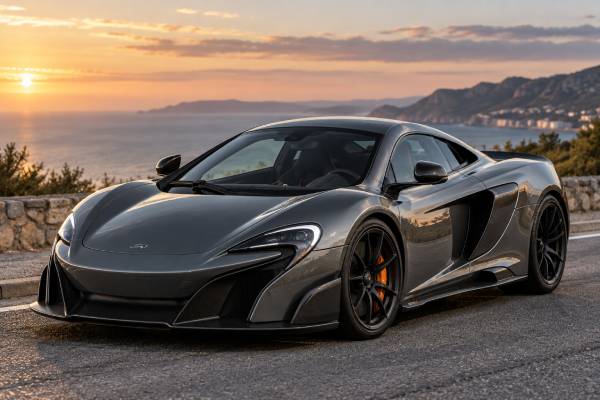
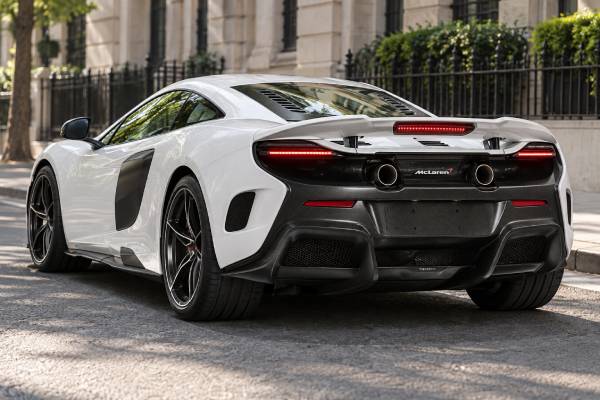
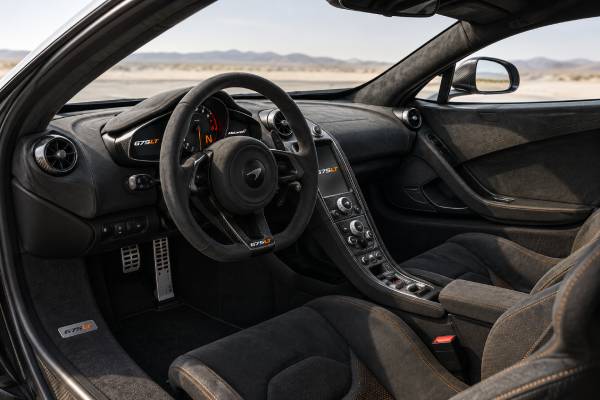
The McLaren 675LT Coupé is the car that turned “LT” from a piece of F1 GTR history into a modern McLaren road-car philosophy. Based on the 650S but extensively reworked, it pairs a 3.8-liter M838TL twin-turbo V8 with a lighter body, sharper chassis settings, more downforce, shorter gearing, and a cabin stripped of equipment that did not serve performance. McLaren limited the Coupé to 500 examples, making originality and documented history as important to a buyer as raw condition. Its headline figures remain serious: 675 PS (666 bhp), 700 Nm (516 lb-ft), 0–100 km/h in 2.9 seconds, and a 330 km/h (205 mph) maximum speed. Yet the 675LT’s significance is less about one acceleration number than the way weight reduction, steering, aerodynamics, tires, and powertrain calibration work together. Today, a good example needs specialist inspection, recall verification, careful battery management, and evidence that age-sensitive systems have been maintained rather than merely polished.
Table of Contents
- Why the Coupé Earned the LT Name
- 675LT Coupé Specifications and Technical Data
- Engine, Gearbox, and Aerodynamic Engineering
- Chassis, Brakes, and Track-Focused Road Behavior
- Maintenance Priorities as the Car Ages
- Campaigns, Recalls, and Faults Worth Checking
- How to Buy a 675LT Coupé Well
Why the Coupé Earned the LT Name
The 675LT Coupé is not simply a 650S with more boost. McLaren changed the car around five priorities—lower mass, more power, stronger aerodynamic performance, sharper responses, and greater driver engagement—and the combined result is what separates an LT from a normal Super Series derivative.
The historical reference is the 1997 McLaren F1 GTR “Longtail,” but the modern 675LT does not copy that race car literally. Its tail is only part of a wider aerodynamic rework. A larger front splitter, revised side structures, exposed carbon-fiber elements, a deeper rear diffuser, and a substantially larger active rear airbrake all manage airflow more aggressively. McLaren stated that downforce increased by 40 percent relative to the 650S.
Weight reduction was equally systematic. The lightest dry figure fell to 1,230 kg (2,712 lb), about 100 kg below the 650S Coupé benchmark McLaren used. Carbon-fiber body components, lightweight forged wheels, thinner glass, a titanium exhaust, reduced sound insulation, and P1-derived carbon-shell racing seats all contributed. Air conditioning was deleted from the most stripped specification but could be reinstated, so equipment varies from car to car.
The scale of the rework becomes clearer in the details. The front splitter is about 80 percent larger than the comparable Super Series item, and the Longtail airbrake has roughly 50 percent more area while still benefiting from light carbon-fiber construction. The track was widened, the body uses a more aggressive rake, and cooling openings grew to feed the higher-output engine. McLaren also made the windscreen thinner and used lightweight glazing around the rear of the cabin. These are small savings individually, but they show that the quoted 100 kg reduction did not come from deleting one convenient system; it came from dozens of decisions spread through the whole car.
The same approach applies underneath. LT engine mounts are dramatically stiffer than the regular Super Series mounts, so the powertrain moves less relative to the carbon tub when the driver loads and unloads the throttle. The suspension received stiffer springs and revised hardware, while the steering rack is faster. None of those changes adds much to a brochure’s headline power figure, yet all reduce the delay between the driver’s input and the car’s reaction. That immediacy is central to the 675LT’s character.
Inside, the standard racing seats are more than a visual link to the P1. Their carbon shells remove meaningful mass high in the cabin, while extensive Alcantara is lighter than heavily padded leather trim. Depending on original order, a car may have climate control, audio upgrades, a sliding passenger seat, harnesses, Track Telemetry cameras, or additional MSO carbon. Buyers should therefore resist assuming that two genuine 675LTs must have identical equipment. Factory documentation is the safest way to separate legitimate no-cost or paid options from parts added later.
The engine remained a 3,799 cc twin-turbo V8 from the M838T family but received the LT designation and extensive internal and breathing changes. McLaren quoted 675 PS and 700 Nm, delivered through a seven-speed Seamless Shift Gearbox. More important for the car’s personality, the final-drive and transmission calibration emphasize acceleration and immediacy rather than relaxed cruising.
Production scarcity matters. The 500 Coupés were sold as a limited series, and they arrived before the later 500-car 675LT Spider run. For a collector, that means a standard Coupé should be evaluated as a numbered, model-specific configuration rather than as a generic member of the broader 12C/650S family.
675LT Coupé Specifications and Technical Data
The 675LT Coupé is a conventional gasoline ICE vehicle: a longitudinal mid-mounted 3.8-liter twin-turbo V8 drives the rear wheels through a seven-speed dual-clutch transmission. There is no hybrid system or driven front axle. The specification that matters most is the relationship between its 496 kW output and low mass, backed by LT-specific gearing, carbon-ceramic brakes, track-oriented tires, and McLaren’s hydraulically linked ProActive Chassis Control.
| Specification | Value |
|---|---|
| Engine | M838TL 90-degree V8, twin-turbocharged, dry-sump |
| Displacement | 3,799 cc (3.8 L) |
| Maximum power | 675 PS (666 bhp; 496 kW) at 7,100 rpm |
| Maximum torque | 700 Nm (516 lb-ft); owner handbook lists 3,500–6,500 rpm |
| Fuel delivery | Electronic multi-point/port fuel injection |
| Transmission | 7-speed Seamless Shift Gearbox (SSG), dual clutch |
| Drive | Rear-wheel drive |
| Specification | Value |
|---|---|
| 0–100 km/h (0–62 mph) | 2.9 seconds |
| 0–200 km/h (0–124 mph) | 7.9 seconds |
| Maximum speed | 330 km/h (205 mph) |
| 100–0 km/h braking distance | 30.2 m (99 ft) |
| 200–0 km/h braking distance | 115 m (377 ft) |
| NEDC combined fuel consumption | 11.7 L/100 km (24.2 mpg UK) |
| NEDC urban / extra-urban | 17.8 / 8.2 L/100 km |
| Official combined CO₂ | 275 g/km |
| Specification | Value |
|---|---|
| Body | 2-door, 2-seat Coupé |
| Structure | Carbon-fiber MonoCell passenger cell with aluminum structures and carbon-fiber body components |
| Length | 4,546 mm (179.0 in) |
| Width, including mirrors | 2,095 mm (82.5 in) |
| Height | 1,188 mm (46.8 in) |
| Wheelbase | 2,670 mm (105.1 in) |
| Ground clearance | 94 mm (3.7 in) |
| Lightest dry weight | 1,230 kg (2,712 lb) |
| Unladen weight, fluids and 90% fuel | 1,328 kg (2,928 lb) |
| Specification | Value |
|---|---|
| Suspension | Aluminum double wishbones with hydraulically interconnected adaptive dampers |
| Chassis control | ProActive Chassis Control with Normal, Sport, and Track settings |
| Steering | Hydraulic power-assisted rack-and-pinion; LT-specific faster ratio |
| Front brakes | 394 mm carbon-ceramic discs, 6-piston calipers |
| Rear brakes | 380 mm carbon-ceramic discs, 4-piston calipers |
| Aerodynamic brake | Active rear airbrake integrated into enlarged rear wing |
| Stability control | ESC with LT-specific dynamic modes |
| Specification | Value |
|---|---|
| Front wheel diameter | 19 in forged alloy |
| Rear wheel diameter | 20 in forged alloy |
| Front tire | 235/35 ZR19 Pirelli P Zero Trofeo R |
| Rear tire | 305/30 ZR20 Pirelli P Zero Trofeo R |
| Tire character | Road-legal, track-focused compound developed for the 675LT |
| Original brake/tire intent | High-temperature track capability with strong dry grip; condition and age are critical on used cars |
A few figures deserve context. McLaren’s “dry weight” excludes operating fluids, so it should not be compared directly with another car’s EU/DIN curb figure. The owner handbook’s 1,328 kg unladen figure with fluids and 90 percent fuel is the more useful number for real-world mass comparisons. Likewise, the fuel-consumption figures are NEDC-era certification results, not a promise of what a 675LT will use during road or track driving.
Engine, Gearbox, and Aerodynamic Engineering
The 675LT’s speed comes from reducing inertia as much as from increasing peak output. The engine, transmission, exhaust, and aero package were tuned to make the car respond earlier and more sharply, which is why the LT feels materially different from a 650S even when both are driven below maximum speed.
McLaren reworked the M838TL with changes that included revised turbocharger hardware, cylinder-head and camshaft work, altered fuel delivery, and detail changes to reduce reciprocating mass. The quoted 675 PS arrives at 7,100 rpm, while 700 Nm is available across a broad mid-range. In first gear, torque management helps the rear tires use the available grip instead of simply overwhelming them.
The seven-speed SSG uses the same basic dual-clutch architecture familiar from the Super Series, but its calibration is more aggressive. In the hardest setting, McLaren’s Inertia Push strategy briefly uses the rotating energy in the drivetrain during an upshift, making high-load changes feel exceptionally immediate. The shorter final gearing is another reason the 675LT feels more urgent than its small 25 PS advantage over a 650S might suggest.
The titanium exhaust is not only lighter. The 675LT uses a distinctive crossover layout in which the banks cross before exiting, allowing equalized pipe lengths and creating part of the model’s harder-edged sound. For a used-car inspection, the practical point is to confirm that the expensive LT-specific exhaust hardware is present and undamaged rather than replaced with an unknown aftermarket system.
Aerodynamics are equally functional. The enlarged front splitter and endplates manage front-axle airflow; side intakes and lower-body surfaces feed cooling and stabilize the flow toward the rear; the deeper diffuser works with the larger active wing. The airbrake changes position under braking and at speed, adding stability without requiring a fixed high-drag wing angle all the time.
That aero package also creates ownership realities. The nose and splitter sit very low, and carbon-fiber damage can be costly even when it looks cosmetic. A front lift system helps with ramps and speed humps, but its operation should be tested repeatedly during a pre-purchase inspection because McLaren issued software updates that included improvements to nose-lift function.
Chassis, Brakes, and Track-Focused Road Behavior
The 675LT is best understood as a road-legal track-focused car that still uses McLaren’s hydraulic chassis technology to preserve compliance. It is firm and direct, but the suspension is more sophisticated than a simple stiff-spring conversion.
ProActive Chassis Control hydraulically links the dampers and manages roll without conventional anti-roll bars. That lets McLaren tune vertical wheel movement separately from roll resistance to a greater degree than a passive layout. Normal, Sport, and Track modes alter the damping and control strategy, while the 675LT receives lighter springs, revised geometry, and P1-derived suspension components.
The steering is hydraulically assisted rather than electrically assisted. McLaren fitted a faster rack than even the P1’s, giving the 675LT unusually quick response around center while retaining detailed feedback through the wheel. This is one reason tire choice matters so much: changing to a significantly different compound can alter the steering’s weight, breakaway behavior, and tramlining as well as ultimate grip.
The original Pirelli Trofeo R is a serious dry-weather performance tire. Its advantage is response and grip once temperature is present; its disadvantages are wear rate, limited cold/wet margin compared with a normal road tire, and age sensitivity. A car with very low mileage can therefore need tires even when tread depth looks impressive. Read each DOT date code, inspect for cracking or heat cycling, and budget for a complete matched set rather than judging tires only by remaining grooves.
Carbon-ceramic discs reduce unsprung mass and tolerate repeated high-energy stops well, but they are not “lifetime” components. Inspect disc surfaces for chips, edge damage, impact marks, and signs of overheating. Pad life is important too because worn pads can expose discs to damage. A specialist should assess rotor condition using the correct McLaren method rather than relying on the visual appearance alone.
Track use is not automatically a reason to reject a 675LT. The car was engineered for it. Poorly managed track use is the concern: overheated consumables, repeated curb strikes, underbody damage, stale brake fluid, neglected cooling, or a car stored immediately after hard sessions without proper cool-down and inspection. Evidence of conscientious track preparation can be more reassuring than a “never tracked” claim with no supporting history.
Maintenance Priorities as the Car Ages
Age, storage pattern, and maintenance quality now matter more than odometer reading alone. A 675LT that has covered modest mileage every year with documented servicing can be a safer ownership proposition than an ultra-low-mileage car that spent long periods on an unhealthy battery and old fluids.
A sensible baseline is an annual specialist service or the applicable mileage limit, whichever comes first. The exact schedule depends on market and build documentation, so the service indicator and the official handbook for the individual car remain authoritative. For a performance car of this age, maintenance records should show not only oil changes but inspections of cooling, braking, suspension, tires, electrical systems, and leak points.
Battery condition deserves disproportionate attention. The 675LT’s electronics can become troublesome when system voltage is low, and infrequently driven cars are particularly vulnerable. Confirm that the correct battery type is fitted, that the charger/maintainer supplied or recommended for the car is used correctly, and that the vehicle wakes, unlocks, starts, and cycles its systems without low-voltage warnings. A software campaign introduced Gen2 12-volt-battery software as part of a broader platform update.
Cooling-system inspection should be deliberate. McLaren issued a 675LT-specific campaign for certain turbo coolant feed hoses manufactured from the wrong material, because the affected hose could swell and weep at its joints. Check whether the car fell within the campaign population and whether the updated part was installed. Independent of that campaign, any dried coolant staining, odor, falling coolant level, or evidence of seepage around hoses and pumps deserves diagnosis before purchase.
The hydraulic suspension network is another area where specialist knowledge matters. The system’s accumulators, lines, dampers, and control behavior should be checked for leaks, abnormal ride-height behavior, warning messages, or a car that rides much more harshly than expected in its softer mode. Avoid treating every firm ride as “normal because it is an LT”; the system should still change character between settings.
For cars that see track days, shorten inspection intervals around tires, pads, brake fluid, cooling, underbody fasteners, and alignment. The costliest mistake is often delaying a small issue because the car is seldom driven. Low annual mileage does not stop rubber components, fluids, seals, batteries, and corrosion-sensitive connections from aging.
Campaigns, Recalls, and Faults Worth Checking
A clean pre-purchase inspection should include a VIN-based campaign and recall check, not just a scan for fault codes. Several documented 675LT actions are specific enough that completion can be verified from dealer records.
The most important safety item in the United States is the Takata passenger-airbag recall. NHTSA recall 19V-141 included certain 2015–2016 McLaren 675LT vehicles among several McLaren models using affected passenger inflators. Because recall applicability is VIN-specific and regional history matters, verify completion through an authorized retailer and the appropriate government recall database rather than assuming that a previous owner handled it.
McLaren also issued service campaigns that are useful clues when reviewing a car’s file:
- Turbo coolant feed hose replacement: certain cars received a hose made from incorrect material that could swell and weep coolant at the joints. The campaign called for installation of the design-intent hose.
- Rear wheel-speed-sensor harness routing: extra clips were introduced to route both rear sensor harnesses more securely. A completed campaign reduces the chance of an avoidable sensor or harness issue caused by poor routing.
- Platform 4.5 software update: the update was intended to improve nose-lift operation, HVAC temperature control, IRIS infotainment stability, and Gen2 12-volt battery software.
- Upper seat-belt D-loop securing nut check: McLaren instructed retailers to verify 35 Nm torque at the upper D-loop fastener on affected 675LTs, originally in response to a possible B-pillar-area rattle.
None of these items means every 675LT is unreliable. They are simply better purchasing tools than vague internet lists. A car with dated repair orders showing campaign completion, software updates, and recurring inspections demonstrates a level of stewardship that an immaculate detail job cannot replace.
Beyond documented campaigns, test every expensive convenience system: front lift, air conditioning if fitted, IRIS screen and audio, keyless entry, soft-close function if optioned, parking sensors/camera, active rear wing, and all drive-mode controls. Look underneath for front-splitter damage, floor strikes, damaged cooling ducts, and leaks. Scan all control units with McLaren-capable diagnostic equipment; clearing a warning light immediately before sale is not the same as fixing its cause.
How to Buy a 675LT Coupé Well
Buy on provenance, condition, and specification together. The cheapest 675LT can become the most expensive once carbon bodywork, ceramic brakes, cooling faults, stale tires, missing original parts, or incomplete history are corrected.
Start with identity. Confirm the VIN, build documentation, original market, and that the car is genuinely one of the limited-production 675LT Coupés rather than a modified 650S. Match the VIN to service invoices and option/build records. If the car has been exported or re-imported, understand whether warranty, recall, registration, lighting, emissions, and immobilizer requirements were changed for the destination market.
Then establish originality. Collector buyers often value factory paint, LT-specific carbon pieces, original lightweight wheels, titanium exhaust, P1-style seats, and documented MSO options. Originality does not mean every stone chip must remain untouched; a properly documented cosmetic repair can be preferable to badly damaged original paint. The concern is concealed structural work, unexplained carbon replacement, mismatched finishes, or an aftermarket modification that cannot be reversed.
A specialist inspection should include:
- paint-depth and body-panel assessment, with extra attention to carbon-fiber repairs and the front splitter;
- underside inspection on a lift for floor, diffuser, jacking-point, and cooling-system damage;
- diagnostic scan of all modules plus confirmation of software and campaign status;
- cold start, hot restart, full-temperature road test, and inspection for coolant or oil seepage afterward;
- operation of the front lift, active wing, HVAC, infotainment, keys, windows, locks, and drive modes;
- tire dates and condition, wheel damage, alignment clues, pad thickness, and carbon-ceramic rotor assessment;
- service-history review for annual maintenance, fluid changes, campaign completion, and evidence of how periods of storage were managed.
Specification can affect desirability, but it should come after mechanical quality. Club Sport equipment, harnesses, extensive MSO carbon, rare colors, and tasteful factory combinations can be attractive, yet a desirable option list does not compensate for deferred service or questionable crash repair.
Finally, keep a first-year reserve. Even a very good 675LT may need fresh tires, a battery, fluids, alignment, cosmetic carbon work, or overdue age-related service shortly after purchase. Budgeting for those items makes it easier to reject a compromised car instead of stretching to buy it and then postponing maintenance. The 675LT Coupé rewards that discipline: maintained correctly, its mix of low mass, hydraulic steering, compact dimensions, and explosive M838TL response remains unusually distinct among modern McLarens.
References
- McLaren 675LT: A Lighter, Yet More Powerful Supercar 2026 (Manufacturer Specifications)
- McLaren Ownership – Owner’s Handbooks | McLaren Automotive 2026 (Owner’s Handbook Portal)
- Part 573 Safety Recall Report 19V-141 2019 (Recall Database)
- Turbo Coolant Feed Hose Replacement 2015 (Service Campaign)
- Vehicle Software Update to Platform 4.5 2016 (Service Campaign)
- Wheel Speed Sensor Harness Update 2016 (Service Campaign)
Disclaimer
This article is for informational purposes only and is not a substitute for professional diagnosis, inspection, or repair. Specifications, torque values, maintenance intervals, software, and procedures can vary by VIN, market, production date, and equipment; verify all service work against the official McLaren documentation for the individual vehicle.
If this guide was useful, please consider sharing it on Facebook, X/Twitter, or another enthusiast community to support our work.