


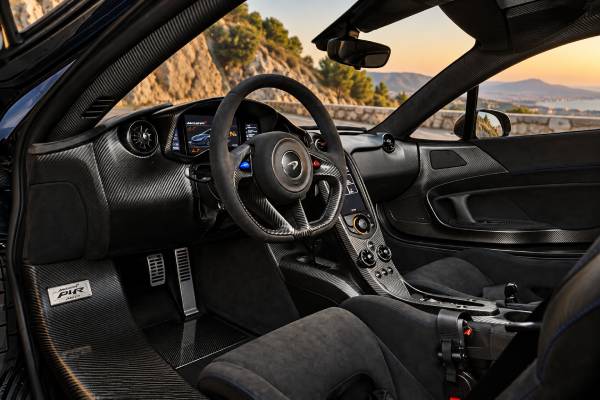
The McLaren MSO Carbon Series LT is a 25-car, exposed-carbon interpretation of the 675LT Spider created by McLaren Special Operations. Its purpose was not to add another step of engine output. Instead, MSO took the open-top LT package and replaced substantially more exterior bodywork with gloss-finished visual carbon fibre, including the electrically retractable roof, tonneau, A-pillars, bonnet, side blades, complete front and rear wings, and even the fuel-filler flap. McLaren described the result as having around 40 percent more carbon-fibre parts than the standard 675LT Spider, and all 25 cars were sold before the model was publicly announced. The familiar 675 PS twin-turbo V8 remained unchanged, with 0–100 km/h in 2.9 seconds, 0–200 km/h in 8.1 seconds, and a 326 km/h maximum speed. Today, the main challenge is not understanding its straight-line performance; it is verifying that a claimed Carbon Series LT is authentic, complete, correctly repaired, and free from expensive cosmetic or structural damage to its unusually extensive exposed-carbon bodywork.
Table of Contents
- What MSO Changed and Why
- Carbon Series LT Technical Specifications
- Visual Carbon Body and Track Telemetry
- Performance and Driving Character
- Preserving an Exposed-Carbon LT
- Authentication, Inspection, and Purchase
What MSO Changed and Why
The Carbon Series LT is best understood as an MSO body and equipment program built on the 675LT Spider, not as a separate higher-output powertrain derivative. McLaren kept the LT mechanical package and concentrated its additional development on visible carbon-fibre bodywork, detailing, and standard track-telemetry equipment.
The project followed customer interest in a visual-carbon McLaren P1 displayed around the 2016 Geneva Motor Show. McLaren Special Operations responded by applying the same exposed-weave idea to the 675LT Spider. The company announced only 25 examples for global sale, all already allocated. Those 25 cars were additional to the 500 standard 675LT Spiders rather than conversions taken from that production allocation.
That distinction is important because McLaren specifically said the Carbon Series treatment could not be retrofitted to an already ordered 675LT Spider. The extra panels required development and craftsmanship beyond simply removing paint from normal parts. A genuine car is therefore more than a Spider wearing aftermarket carbon panels or a clear-coated wrap.
The visual change is extensive. The standard 675LT Spider already used carbon fibre for major aerodynamic pieces such as the front bumper and splitter, front underbody, side skirts, intakes, rear body sections, diffuser, and active Longtail airbrake. On the Carbon Series LT, those pieces are finished so their weave remains visible. MSO then added gloss visual carbon to panels that are not exposed carbon on a normal Spider, including the roof and tonneau, A-pillars, bonnet, side blades, complete wings, and fuel-filler flap.
McLaren also gave the front wings functional louvres inspired by its GT3 racing program. The McLaren Track Telemetry package, including three cameras, became standard equipment. These details make the model easier to distinguish from a normal 675LT Spider with selected MSO carbon options.
The name can create confusion. “Carbon Series LT” does not mean McLaren published a new engine tune, a new top-speed claim, or a separate set of acceleration figures. Contemporary McLaren material states that output remained 675 PS and 700 Nm and quotes the same 2.9-second 0–100 km/h time, 8.1-second 0–200 km/h time, and 326 km/h maximum speed as the 675LT Spider. McLaren did not publish a separate Carbon Series dry-weight figure in the launch material, so it is better not to assign the standard Spider’s weight to this 25-car edition as though it were a trim-specific measurement.
Production was scheduled to begin in autumn 2016, with first deliveries expected before the end of that year. The assignment years 2016–2017 reflect the model period, but the launch information itself centers on late-2016 production and delivery.
Carbon Series LT Technical Specifications
Mechanically, the Carbon Series LT retains the 675LT powertrain: a rear-mid-mounted, 3,799 cc twin-turbo V8 and seven-speed Seamless Shift Gearbox driving the rear wheels. The values below are the figures McLaren published specifically with the Carbon Series LT announcement or clearly identified as unchanged for the model.
| Specification | MSO Carbon Series LT |
|---|---|
| Powertrain type | Internal-combustion petrol engine |
| Engine | 3.8-litre twin-turbocharged V8 |
| Displacement | 3,799 cc |
| Engine position | Rear-mid mounted |
| Maximum power | 675 PS (666 bhp / 496 kW) at 7,100 rpm |
| Maximum torque | 700 Nm (516 lb-ft) at 5,000–6,500 rpm |
| First-gear torque management | Torque limited to 600 Nm for launch traction |
| Transmission | 7-speed dual-clutch Seamless Shift Gearbox |
| Driven wheels | Rear-wheel drive |
The LT engine specification is more than a software calibration. McLaren’s launch material notes that more than 50 percent of the relevant powertrain components were changed from the lower-output application to achieve the LT target. The list included more efficient turbochargers, detailed cylinder-head and exhaust-manifold revisions, a different camshaft, lightweight connecting rods, and a higher-flow fuel-pump and delivery system.
| Measure | Published figure |
|---|---|
| 0–100 km/h (0–62 mph) | 2.9 seconds |
| 0–200 km/h (0–124 mph) | 8.1 seconds |
| Maximum speed | 326 km/h (203 mph) |
| Maximum power | 675 PS (666 bhp) |
| Maximum torque | 700 Nm (516 lb-ft) |
| Mechanical-output change from 675LT Spider | None stated by McLaren |
The Carbon Series LT’s defining specifications are therefore in its construction and equipment rather than in a different power curve. Those features are useful when identifying an authentic example.
| Item | Factory description |
|---|---|
| Base model | McLaren 675LT Spider |
| Division | McLaren Special Operations (MSO) |
| Global production | 25 units |
| Allocation status at announcement | All 25 pre-sold |
| Relationship to standard Spider run | Additional to the 500 regular 675LT Spiders |
| Additional carbon-fibre content | Around 40% more carbon-fibre parts than the standard car |
| Exterior finish concept | Gloss visual carbon fibre with exposed weave |
| Front-wing detail | Functional GT3-inspired louvres |
| Track equipment | McLaren Track Telemetry with three cameras fitted as standard |
| Production timing announced | Autumn 2016, with first deliveries expected before year-end |
Because no separate launch figure was published for Carbon Series mass, this article does not present a unique dry weight for the edition. That is preferable to assuming every specification of the donor Spider transferred unchanged when the very purpose of the program was to change body materials.
Visual Carbon Body and Track Telemetry
The exposed weave is not a decorative skin placed over a conventional body. The Carbon Series LT uses a large collection of actual carbon-fibre components, many of them with complex shapes, functional aerodynamic duties, or powered-roof interfaces.
| Area | Carbon-fibre component or treatment |
|---|---|
| Front | Front bumper, enlarged splitter, end plates, front underbody |
| Upper front body | Bonnet, A-pillars, complete front wings |
| Front-wing aero | Functional GT3-inspired louvres |
| Sides | Side skirts, side intakes, lower side intakes, side blades |
| Roof | Electrically retractable roof in gloss visual carbon |
| Roof storage | Gloss carbon-fibre tonneau |
| Rear body | Rear deck, complete rear wings, rear bodyside lower sections |
| Rear aero | Rear bumper, diffuser, active Longtail airbrake |
| Detail component | Fuel-filler flap |
For a collector, the finish creates a special inspection problem. Painted carbon can hide the weave and minor cosmetic variation; exposed carbon makes the material itself part of the visual specification. Clear-coat condition, weave continuity, panel-to-panel appearance, UV exposure, stone impact, previous refinishing, and repair workmanship can therefore affect both appearance and originality.
Not every apparent pattern change means a repair. Carbon weave naturally changes direction as a preform follows a curved mould, and separate panels need not display one uninterrupted pattern across a gap. The correct standard is not a photograph-driven expectation of perfect symmetry. It is consistency with factory construction, good surface condition, proper fit, and credible documentation.
A specialist should examine areas that are easy to strike: splitter corners, lower bumper edges, side skirts, diffuser fins, wheel-arch lips, and the underside. Look for cracks in the clear coat that stop at the coating versus damage that follows into the laminate. Delamination, crushed mounting points, exposed fibres, resin whitening, or a distorted panel need more attention than superficial stone chips.
The roof adds another layer because it is both a visible-carbon panel set and a moving mechanism. Check it closed, partly through the operating sequence where permitted by the handbook, and fully stowed. Panel alignment, seals, latching, tonneau fit, window indexing, and water management all matter. A cosmetically flawless roof panel does not prove the powered system is healthy.
Track Telemetry should also be present and functional because McLaren identified it as standard on the Carbon Series LT. The three-camera system was intended to record track sessions alongside vehicle data. On an older car, cameras, storage media, infotainment hardware, or configuration may have been repaired or replaced. A buyer should confirm the installed components correspond with the build record and that the system operates as intended rather than assuming old electronics are unimportant on a collector-grade car.
Performance and Driving Character
The Carbon Series LT drives as an open-top 675LT because McLaren did not use the edition to change the engine output or published acceleration. Its special character comes from the combination of the existing LT chassis with a rarer, more visually explicit carbon body and standard telemetry equipment.
The 675LT platform was already highly focused. It pairs a very stiff carbon passenger structure with interconnected hydraulic suspension, carbon-ceramic braking, hydraulic power steering, aggressive aero, and a powertrain calibrated for rapid response. The Carbon Series does not need extra horsepower to feel extreme; 675 PS in a rear-wheel-drive car with LT mass reduction already provides far more performance than can be explored responsibly on public roads.
The engine’s 700 Nm plateau arrives across a useful upper-midrange band, while first-gear torque management helps the rear tyres during launch. Once moving, the close relationship between boost, dual-clutch shifts, and low mass is more important than the peak number. The titanium exhaust and reduced insulation of the broader LT program also make the powertrain more present in the cabin.
A 2.9-second 0–100 km/h figure tells only part of the story. The 8.1-second run to 200 km/h shows how strongly the car continues accelerating beyond ordinary road speeds. The 326 km/h maximum is slightly lower than the fixed-roof 675LT Coupé’s figure, reflecting the Spider-based body rather than a reduction in engine output.
For road testing a used example, maximum acceleration is unnecessary. More useful observations are whether the throttle response is clean, boost builds consistently, the transmission engages smoothly at low speed, shifts execute without warnings, and the steering tracks accurately. Listen for drivetrain vibration that feels out of proportion to the LT’s intentionally firm mounts and reduced isolation. McLaren technical information for P11 cars identifies powertrain-mounting concerns as one possible source of cabin vibration, so persistent symptoms deserve diagnosis.
The active airbrake should not be treated as a showpiece. It is part of the car’s aerodynamic and braking strategy and is controlled through systems that interact with other chassis electronics. McLaren’s later diagnostic guidance for the P11 platform shows that an airbrake warning can involve multiple fault codes and requires systematic diagnosis. A pre-purchase check should therefore include a module scan and a physical inspection of the panel, hinges, surface, and mounting areas.
Tyres and carbon-ceramic brakes can have more influence on how a used car feels than a small difference in mileage. Old or heat-cycled tyres can make steering and traction feel poor even when tread remains. Carbon-ceramic discs should be examined for impact damage and condition by someone familiar with the material. A car that has done track days is not automatically undesirable, particularly because Track Telemetry was standard, but the maintenance record should make sense for its use.
Preserving an Exposed-Carbon LT
Preservation of a Carbon Series LT is partly mechanical maintenance and partly conservation of a factory finish that cannot be duplicated casually. The safest approach is to minimize avoidable damage while keeping the car functional rather than turning it into a static display.
For the exterior, washing technique matters. Remove loose grit before contact washing, use clean soft media, and avoid aggressive polishing without first measuring and understanding the clear coat. Exposed carbon is still protected by a finished surface; abrasive correction removes that surface just as it does on painted panels. If paint-protection film is fitted, its installation quality matters around sharp edges, louvres, panel gaps, and complex carbon contours.
UV protection is also relevant. Modern automotive clear coats are designed for outdoor use, but years of intense sunlight and heat can still change coatings and adhesives. Indoor storage away from prolonged direct sun is sensible. That does not require obsessively avoiding daylight; it means reducing unnecessary exposure when the car is parked for long periods.
Stone protection presents a tradeoff. High-quality film can protect the nose and lower carbon from chips, yet old film can yellow, shrink, leave adhesive, or become difficult to remove around delicate edges. A buyer should identify when film was installed, whether panels were refinished before installation, and whether the film hides cracks or repairs. Removing old film from a rare exposed-carbon panel is work for a specialist, not a test to perform during an ordinary inspection.
Mechanically, low mileage does not suspend aging. Fluids, seals, batteries, tyres, hydraulic components, and roof mechanisms still require attention. The correct service schedule should come from McLaren’s handbook and current service information for the VIN and market. A thick folder of dated invoices is much more useful than a vague claim that the car has been “maintained regardless of cost.”
The 12-volt electrical system deserves particular care because storage is common with rare cars. Proper battery support helps avoid low-voltage events that can confuse roof, lift, infotainment, and other control systems. If a vehicle repeatedly arrives with a flat battery, solving the cause is preferable to clearing warnings after every recharge.
Roof seals and drainage paths should stay clean. Operate the retractable roof periodically under correct conditions so faults are discovered before a sale or journey. Check for water traces behind trim and around the roof-storage area. Do not lubricate seals or roof components with a generic product merely because they squeak; use only materials compatible with the relevant McLaren procedure.
Track use calls for more, not less, documentation. Fresh brake fluid, condition checks of pads and carbon-ceramic discs, tyre inspection, alignment verification, and post-event fluid checks can all be appropriate depending on use. The presence of factory Track Telemetry means recorded circuit use is entirely consistent with the model’s design. Evidence of careful preparation is more informative than a blanket assumption that any track mileage is damaging.
| Area | What to verify |
|---|---|
| Visible carbon | Clear coat, laminate integrity, weave consistency, repair evidence, mounting points |
| Lower aero | Splitter, skirts, diffuser, underbody contact and fasteners |
| Retractable roof | Full operation, seals, latches, tonneau fit, water traces |
| Active airbrake | Surface condition, movement, warnings, stored chassis faults |
| Track Telemetry | Three-camera hardware, correct configuration, recording function |
| Tyres | Date codes, specification, condition, heat cycling, even wear |
| Carbon-ceramic brakes | Disc condition, pad wear, impact damage, fluid history |
| Electrical system | Battery health, low-voltage history, module scan |
| Service history | Invoices, time-based servicing, campaign and recall completion |
Authentication, Inspection, and Purchase
Authentication comes first because a normal 675LT Spider can carry extensive MSO carbon options or later aftermarket parts without being one of the 25 Carbon Series LT cars. The build record, VIN-linked retailer information, and original documentation should establish the identity before cosmetic details are used as proof.
Start by matching the VIN to McLaren records and reviewing the original order or build specification where available. Confirm that the car is recorded as an MSO Carbon Series LT, not simply a 675LT Spider with visual-carbon options. Production plaques, special trim, and seller descriptions are supporting evidence, not substitutes for factory-linked records.
Next, compare the car with the known Carbon Series equipment. The visual-carbon roof and tonneau, A-pillars, bonnet, front and rear wings, side blades, fuel-filler flap, GT3-inspired front-wing louvres, and standard three-camera Track Telemetry are especially useful markers. Missing or painted-over components require an explanation backed by repair records.
Accident history deserves unusual scrutiny because replacing or repairing exposed carbon is difficult to hide well and expensive to execute correctly. Ask for before-and-after photographs for any known repair, invoices naming the panels, and the identity of the repairer. A clean vehicle-history database is helpful but cannot prove that a low-volume supercar has never received unreported cosmetic or structural work.
Inspect the body in diffuse natural light as well as workshop lighting. Look along surfaces for changes in gloss, resin tone, weave appearance, edge finish, and panel fit. Use care with paint-depth tools because readings over carbon and clear coat are not interpreted the same way as readings over conventional metal panels. The objective is not to generate one “correct” number but to identify inconsistency and then investigate it.
A lift inspection should follow. The low splitter, floor edges, diffuser, jacking areas, and suspension pickup surroundings can reveal contact or poor lifting. Verify that undertrays and fasteners are correct and that no repair has trapped heat-sensitive material or altered airflow.
Then assess the car as machinery. Perform a cold start, scan all control modules, operate the roof, check vehicle lift, air conditioning, IRIS functions, Track Telemetry, windows, cameras, and active aero as appropriate. Road-test through low-speed maneuvering, steady cruising, braking, and progressive load. Any warning, vibration, overheating concern, fluid smell, or inconsistent gearbox behavior should be resolved before purchase rather than priced by guesswork.
Recall status should be checked by VIN in the country where the car is registered. In the United States, NHTSA campaign 19V-141 included certain 675 Longtail vehicles for replacement of affected passenger frontal airbag inflators. Imported cars may have different campaign records, so national databases and a McLaren retailer should be consulted rather than assuming U.S. paperwork applies worldwide.
Finally, value originality sensibly. A perfectly preserved factory carbon panel can matter greatly on a 25-car MSO model, but safe, documented replacement after damage is better than retaining a structurally compromised original. The purchase decision should distinguish cosmetic patina from actual laminate damage, reversible protection from permanent modification, and factory MSO content from later additions.
A strong Carbon Series LT should tell one coherent story: factory identity, complete model-specific equipment, consistent exposed-carbon condition, credible service history, functioning roof and telemetry, healthy chassis systems, and repairs that are documented rather than disguised. That is the standard worth pursuing on a car whose rarity lies as much in the body MSO built around it as in the Longtail underneath.
References
- McLaren special operations creates limited edition MSO Carbon Series LT 2016 (McLaren press-release syndication)
- McLaren Special Operations Creates Limited Edition MSO Carbon Series LT 2016 (McLaren press-release syndication)
- McLaren MSO Carbon Series 675 LT Spider announced 2016 (contemporary technical report)
- McLaren Ownership – Owner’s Handbooks | McLaren Automotive 2026 (official owner documentation)
- Passenger Frontal Air Bag Inflator May Explode 2019 (NHTSA recall acknowledgement)
- A guide to aid in the diagnosis of the airbrake system 2026 (McLaren technical information via NHTSA)
Disclaimer
For a 25-car MSO model, the individual factory record takes precedence over any general guide. Do not use this article in place of professional authentication, diagnosis, or repair instructions: specifications, torque values, service intervals, procedures, equipment, and campaign coverage may differ by VIN, destination market, and later technical updates. Confirm the car and any planned work against its McLaren/MSO documentation and the current recall and service information that applies to it. If you know another Carbon Series LT enthusiast who would benefit from these checks, please share the guide.