
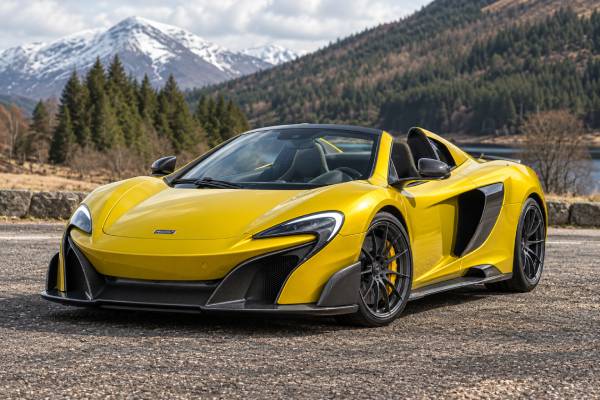
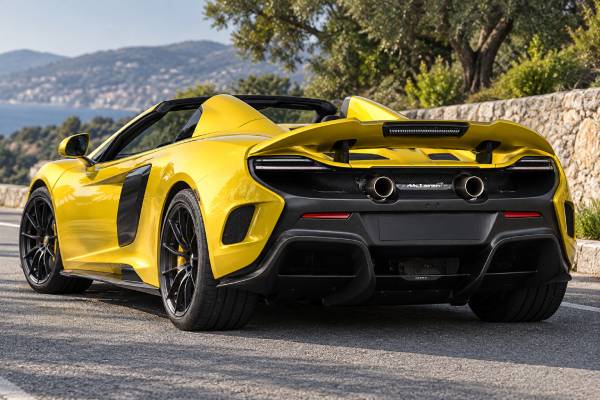
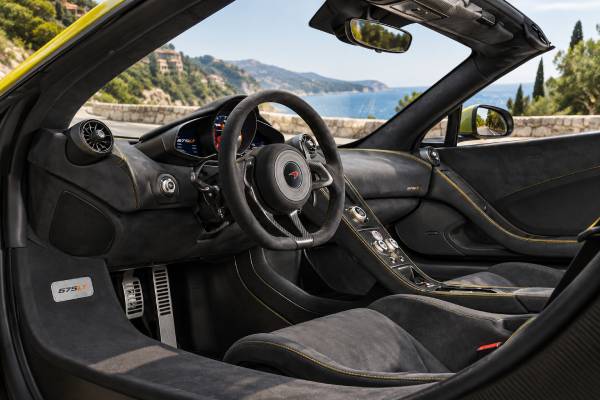
The McLaren 675LT Spider is not simply a 675LT Coupé with a folding roof. It is the open-top version of McLaren’s first modern Longtail road car, built around the same carbon-fibre MonoCell, 675 PS twin-turbo V8, seven-speed dual-clutch transmission, track-focused suspension, carbon-ceramic brakes, and enlarged active airbrake. The important difference is that the Spider adds a three-piece retractable hardtop without requiring structural reinforcement to the carbon tub. Its 1,270 kg lightest dry weight is only 40 kg above the Coupé, while claimed acceleration remains 2.9 seconds to 100 km/h and 8.1 seconds to 200 km/h. Production was limited to 500 cars worldwide, and McLaren said the allocation sold out within two weeks. For an owner or buyer today, that combination of rarity, roof complexity, low mass, and extreme performance makes condition more important than headline mileage. A careful inspection should cover the roof and tonneau, carbon bodywork, active aero, suspension hydraulics, tyres, brakes, software history, recalls, and evidence of correct specialist servicing.
Table of Contents
- Why the Spider Is a Real Longtail
- 675LT Spider Specifications
- Retractable Roof, Carbon Structure, and Aero
- How the Open-Top LT Drives
- Maintenance for Roof, Chassis, and Powertrain
- Recalls, Service Information, and Electronics
- Buying a 675LT Spider Today
Why the Spider Is a Real Longtail
The 675LT Spider preserves the engineering priorities that made the Coupé an LT: reduced mass, greater aerodynamic load, sharper chassis responses, more power, and less insulation between the driver and the machinery. The roof changes the experience, but it does not turn the car into a softer grand tourer.
McLaren revealed the Spider in December 2015 after strong customer demand for an open 675LT. It was the second modern road car to carry the LT badge, and production was capped at 500 examples globally. McLaren later stated that all 500 were sold within two weeks. That scarcity matters in the used market, but it is not the most important technical fact. More significant is how little the roof conversion changed the car’s underlying structure.
The MonoCell carbon-fibre passenger cell was already stiff enough that McLaren did not need to add braces or reinforcement when it removed the fixed roof. The complete retractable hardtop system accounts for the Spider’s extra 40 kg over the Coupé. Even with that hardware, McLaren quoted a lightest dry weight of 1,270 kg, which was 100 kg below the contemporary 650S Spider. The claimed power-to-weight ratio was 532 PS per tonne.
Opening the roof changes one element the specification sheet cannot express well: sound. The titanium exhaust and turbocharged V8 are much less filtered with the roof stowed, especially under load and during downshifts. That additional drama is central to the Spider’s appeal, but the car still has the same basic mission as the Coupé. It is a road-legal supercar that places steering response, braking, body control, and driver involvement ahead of quietness or ride isolation.
The 675LT Spider therefore makes most sense when viewed as a second interpretation of the same Longtail brief rather than a comfort-focused derivative. Its engineering achievement is that it adds open-air operation without discarding the low-mass carbon structure, active aerodynamics, or track-oriented suspension that define the model.
675LT Spider Specifications
The 675LT Spider uses an internal-combustion powertrain: a rear-mid-mounted 3,799 cc twin-turbocharged V8 driving the rear wheels through a seven-speed Seamless Shift Gearbox. Its factory figures place it only slightly behind the lighter, more aerodynamically efficient Coupé at very high speeds.
| Specification | McLaren 675LT Spider |
|---|---|
| Engine family | McLaren M838T-series V8, LT specification |
| Fuel | Petrol |
| Layout | Longitudinal rear-mid engine, rear-wheel drive |
| Displacement | 3,799 cc (3.8 L) |
| Configuration | 90-degree V8, DOHC, four valves per cylinder |
| Induction | Twin turbochargers with charge cooling |
| Fuel system | Electronic multi-point fuel injection |
| Maximum power | 675 PS (666 bhp / 496 kW) at 7,100 rpm |
| Maximum torque | 700 Nm (516 lb-ft) at 5,000–6,500 rpm |
| Transmission | 7-speed Seamless Shift Gearbox dual-clutch transmission |
| Drive | Rear-wheel drive |
| Exhaust | Lightweight titanium crossover exhaust |
The first-gear calibration limits torque to help traction, so the full 700 Nm is not simply dumped into the rear tyres from a standstill. McLaren’s launch-control strategy and the dual-clutch transmission are major reasons the Spider can match the Coupé to 100 km/h despite carrying the roof mechanism.
| Measure | Factory claim |
|---|---|
| 0–100 km/h (0–62 mph) | 2.9 seconds |
| 0–200 km/h (0–124 mph) | 8.1 seconds |
| 0–300 km/h (0–186 mph) | 23.6 seconds |
| Maximum speed | 326 km/h (203 mph) |
| Power-to-weight ratio | 532 PS per tonne, based on lightest dry weight |
| Dry weight | 1,270 kg (2,800 lb), lightest specification |
| Weight distribution | 42% front / 58% rear |
| Specification | McLaren 675LT Spider |
|---|---|
| Body style | Two-seat, two-door retractable-hardtop Spider |
| Passenger structure | Carbon-fibre MonoCell monocoque |
| Length | 4,546 mm (179.0 in) |
| Width including mirrors | 2,095 mm (82.5 in) |
| Height, roof closed | 1,192 mm (46.9 in) |
| Wheelbase | 2,670 mm (105.1 in) |
| Roof | Three-piece powered retractable hardtop |
| Roof operation while moving | Permitted by McLaren at up to 30 km/h (19 mph) |
| Dry-weight increase versus 675LT Coupé | 40 kg (88 lb), attributable to retractable-roof hardware |
| Production limit | 500 examples worldwide |
Aerodynamic and chassis hardware stayed closely aligned with the fixed-roof LT. The Spider uses the extended front splitter, carbon side structures, diffuser, and active Longtail airbrake. The enlarged airbrake is 50 percent larger than the corresponding component on other Super Series models of the period, while carbon construction keeps its mass down.
| Specification | McLaren 675LT Spider |
|---|---|
| Front suspension | Independent double wishbones with interconnected hydraulic damping |
| Rear suspension | Independent double wishbones with interconnected hydraulic damping |
| Front track change | 20 mm wider than 650S-based Super Series geometry |
| Front spring-rate change | 27% stiffer than 650S |
| Rear spring-rate change | 63% stiffer than 650S |
| Steering | Hydraulically assisted rack-and-pinion |
| Front brakes | 394 mm carbon-ceramic discs, six-piston calipers |
| Rear brakes | 380 mm carbon-ceramic discs, four-piston calipers |
| Front tyre size | 235/35 ZR19 |
| Rear tyre size | 305/30 ZR20 |
| Original focused tyre fitment | Pirelli P Zero Trofeo R |
| Measure | Published figure |
|---|---|
| Combined fuel consumption | 11.7 L/100 km |
| Combined fuel economy | 24.2 mpg UK |
| Urban fuel consumption | 17.8 L/100 km |
| Extra-urban fuel consumption | 8.2 L/100 km |
| Combined CO₂ emissions | 275 g/km |
| Test basis | European NEDC-era certification data |
Retractable Roof, Carbon Structure, and Aero
The roof is the defining piece of Spider-specific hardware, but the carbon MonoCell is what makes the conversion technically convincing. Because the tub did not need extra structural bracing, McLaren could add open-air capability with a relatively small mass penalty and preserve the suspension calibration and aerodynamic concept of the LT.
The three-piece hardtop folds beneath a body-coloured tonneau cover behind the seats. McLaren allowed roof movement at speeds up to 30 km/h, which is useful when traffic begins moving during an opening or closing cycle. The engine remains visible beneath a lightweight vented polycarbonate cover rather than being hidden by a conventional rear deck. Airflow management around that cover, the side radiators, rear deck, and louvred rear bodywork is functional: the 675LT’s higher-output engine and track-biased duty cycle demand careful heat rejection.
A prospective owner should understand that the roof is both bodywork and a powered mechanism. Alignment matters. With the car parked on level ground, the panel gaps should look even, the tonneau should sit flush, and operation should be smooth from latch release to final closure. Listen for repeated motor strain, clunks, or a sequence that pauses without an obvious reason. Check the header seal, side-window contact, panel seals, and the carpeted areas behind the seats for signs of water entry. A small squeak over a rough road and a true water leak are not the same problem, so a road test and a controlled water check are more informative than a quick visual inspection.
The roof should also be assessed in the context of battery condition. Like many low-use supercars with multiple control modules and powered functions, the Spider benefits from correct battery support when stored. Low system voltage can create misleading warnings or incomplete operating cycles. A healthy battery does not prove the mechanism itself is healthy, but diagnosing roof behavior with a weak 12-volt supply is poor practice.
The rest of the body deserves equal care because much of it is carbon fibre. McLaren used carbon for the front bumper assembly and splitter, front underbody, side skirts and intakes, rear lower body sections, rear fenders, rear deck, rear bumper, diffuser, and active airbrake. Damage can therefore be expensive even when it looks cosmetic from a distance. Stone chips are normal on a low car, but cracks, cloudy lacquer, distorted weave, mismatched paint texture, repaired mounting points, and poorly fitting aero panels deserve closer investigation.
The active airbrake is particularly important. It works as an aerodynamic device and contributes under hard braking. McLaren’s later technical guidance shows that airbrake faults can involve multiple control systems and diagnostic trouble codes rather than one simple actuator. During a pre-purchase inspection, the goal is not to cycle it repeatedly for spectacle; it is to confirm there are no warning messages, stored relevant faults, abnormal movement, impact damage, or signs that the panel has been handled or adjusted incorrectly.
How the Open-Top LT Drives
The Spider’s dynamic character is dominated by its low mass, hydraulic steering, stiff springing, wide front track, carbon-ceramic brakes, and very fast powertrain response. Opening the roof adds sound and exposure without fundamentally changing the chassis strategy.
The suspension uses McLaren’s interconnected hydraulic ProActive Chassis Control concept rather than conventional anti-roll bars. On the 675LT, the spring rates are substantially higher than on the 650S, particularly at the rear, and the front track is wider. The objective is response: less delay between steering input and body reaction, firmer platform control under braking, and a balance that remains adjustable with throttle once the car is loaded in a corner.
Tyres deserve context. Trofeo R tyres were chosen for grip and response, not for cold-weather security, standing-water performance, or long life. Age, heat cycles, storage conditions, tread depth, and axle matching all matter. A car can have deep tread and still be on old, hardened rubber.
The braking system also needs to be judged by condition rather than mileage alone. Carbon-ceramic discs resist fade and can last a long time in suitable use, but they are expensive and can be damaged by impacts, incorrect wheel handling, severe track use, or debris. Inspection should include disc surfaces and edges, pad thickness, caliper condition, brake-fluid history, and any vibration under repeated stops. A professional familiar with McLaren carbon-ceramic wear assessment is preferable to a generic visual check.
On power, the Spider is brutally quick but should still feel controlled. The seven-speed SSG should engage drive without excessive delay, execute clean shifts under light and heavy throttle, and avoid warning messages. The V8 should pull consistently as boost builds. Hesitation, a persistent misfire, smoke beyond expected cold-start behavior, unusual turbo noise, or a coolant smell all justify diagnosis before purchase.
With the roof down, mechanical noises are easier to hear, which can be useful during a test drive. The challenge is separating normal induction, wastegate, transmission, and suspension sounds from actual faults. That is another reason a knowledgeable inspection has more value than broad claims that “all McLarens make noises.”
Maintenance for Roof, Chassis, and Powertrain
A 675LT Spider should be maintained as a complex, low-volume performance car rather than as a collection piece that merely needs occasional oil changes. Time, heat, fluid condition, battery state, seals, tyres, and hydraulic systems continue to age even when annual mileage is low.
Start with the service record. The useful question is not simply whether stamps exist, but whether invoices show what was inspected, what fluids were renewed, what campaigns were completed, and what age-related parts were replaced. McLaren’s owner documentation and market-specific maintenance schedule should be the controlling reference for intervals because requirements can vary by market and vehicle history.
Engine oil and filter service is basic, but cooling-system condition is equally important on a high-output twin-turbo V8. Look for residue around hose connections, dried coolant traces, staining on undertrays, and unexplained level changes. Any coolant smell after a drive deserves attention. A pressure test and inspection of hoses, tanks, radiators, and connections can be more valuable than guessing from a clean engine bay.
Transmission operation should be checked both cold and fully warm. The SSG is a dual-clutch unit whose behavior depends on software, clutch control, fluid condition, and mechanical health. Harshness during an aggressive commanded shift is not automatically a fault; repeated engagement problems, warnings, or inconsistent behavior are different. Diagnostic scanning should be part of a specialist inspection.
The hydraulic suspension and vehicle-lift system require the same disciplined approach. Confirm that the nose-lift system raises and lowers correctly, that the car does not display chassis warnings, and that there is no visible leakage. If ride height, damping behavior, or hydraulic operation seems wrong, diagnosis should follow the McLaren procedure rather than parts swapping.
For the Spider, add a roof-specific routine to normal service:
- Keep roof-panel and tonneau seals clean and inspect them for damage, flattening, or contamination.
- Operate the roof periodically under suitable conditions instead of leaving it unused for very long periods.
- Keep drain paths and surrounding channels free of debris without forcing tools into them.
- Watch for moisture behind seats, beneath trim, or in luggage areas after washing or rain.
- Do not interrupt roof movement casually, and follow the handbook if an operating cycle is incomplete.
- Maintain the 12-volt battery correctly during storage so powered systems are not repeatedly operated at low voltage.
Wheel and tyre work needs care because of the carbon-ceramic discs and low-profile tyres. A workshop should use correct lifting points, protect the brake discs during wheel removal, apply the specified wheel-fastener procedure, and avoid using an impact tool as a substitute for final torque control. Exact torque values and lifting procedures should come from the correct official documentation for the vehicle and market rather than a generic online chart.
Track use changes the maintenance picture. Heat exposure affects tyres, brake fluid, pads, discs, engine oil, and other components even if the odometer barely moves. A car used responsibly on circuit with documented fluid changes and post-event inspections can be preferable to a neglected garage car, but the record should support that story. Conversely, repeated heavy use without corresponding maintenance can create costs that are not obvious during a short road test.
Recalls, Service Information, and Electronics
The safest way to assess campaigns and recalls is by VIN. Model-wide summaries are useful for identifying what to ask about, but they cannot prove that a particular 675LT Spider is affected or that the required work has been completed.
In the United States, NHTSA campaign 19V-141 covered certain McLaren vehicles including the 675 Longtail range. The issue involved passenger frontal airbag inflators that could degrade after long-term exposure to heat, humidity, and temperature cycling and, in a deployment, could rupture. The remedy was replacement of the affected passenger airbag unit. A buyer should check the VIN through the relevant national recall system or a McLaren retailer, not assume the car is clear because it has been serviced recently.
McLaren technical information also gives useful insight into faults that can occur on P11-platform cars. A knowledge article titled “Vibration, Noise from Engine Bay Area” explicitly lists the 675LT Spider among affected vehicles. It directs technicians investigating rear-originating cabin vibration or noise toward the powertrain mounting system. That does not mean every vibration indicates a failed engine mount. It means persistent buzzing, knocking, or vibration should be diagnosed rather than normalized without evidence.
A later McLaren diagnostic guide for active-airbrake concerns also lists both 675LT Coupé and Spider. The document highlights how the airbrake depends on a network of chassis and electrical systems and can generate several relevant fault codes. For an owner, the practical lesson is straightforward: an airbrake warning is a diagnostic problem, not a cue to replace the rear wing actuator on speculation.
Infotainment history can matter as well. McLaren service information for P11 cars, including the 675LT Spider, documents configuration issues that can appear after replacement of the IRIS head unit. A replacement unit can display features that are not actually fitted unless its configuration is set correctly. Therefore, a car with a replaced head unit should be checked for proper function rather than judged only by whether the screen turns on.
During a pre-purchase scan, ask for faults across all relevant modules, not just engine codes. Clear dashboards can coexist with stored history. At the same time, stored history is not automatically evidence of a current defect; low battery voltage, past repairs, and resolved events can leave records. What matters is whether the codes are current, whether they return, and whether the technician can connect them to symptoms and test results.
Software level matters for the same reason. McLaren issued platform updates during the 675LT era to improve functions such as nose lift, HVAC control, IRIS stability, and battery-management behavior. Exact applicability should be confirmed by VIN and service records because not every bulletin description distinguishes each body variant. The right question is whether the car has the current applicable software and completed campaigns, not whether a seller can name a bulletin number.
Buying a 675LT Spider Today
Buy the condition, documentation, configuration, and quality of previous work before buying the mileage. The 500-car production limit makes the Spider collectible, but rarity does not compensate for unresolved roof problems, damaged carbon, overdue tyres, weak service history, or poorly documented accident repair.
Begin with identity and records. Confirm the VIN, build specification, market origin, options, and service invoices. If the car is described as having MSO content, separate ordinary MSO options from a named factory series such as the later MSO Carbon Series LT. Photographs, build sheets, invoices, and retailer records are more useful than broad sales language.
Then inspect the Spider-specific systems with the roof both closed and open. Check:
- Roof-panel alignment, seal condition, latch behavior, and a complete opening and closing cycle.
- Tonneau-panel fit and the painted surfaces around the roof storage area for contact marks or repair evidence.
- Cabin trim, rear bulkhead areas, and carpets for moisture, staining, or musty odor.
- Side-window indexing and sealing against the roof and header.
- The polycarbonate engine cover for cracking, poor fit, or heat-related damage.
- Warnings or stored faults related to roof, chassis, airbrake, lift, transmission, or battery systems.
Next, inspect every low carbon component. The splitter, side skirts, diffuser, bumper corners, and underbody are vulnerable to ramps, kerbs, road debris, and incorrect loading. Paint-protection film can preserve a car, but it can also make superficial inspection harder. Lift the car correctly and inspect mounting points and the underside rather than relying on exterior photographs.
Tyres should be checked by date code, specification, axle match, damage, and wear pattern. Uneven front wear can point to alignment or suspension issues; heavy rear wear may simply reflect use, but it should still be understood. If the car wears a road-biased tyre instead of Trofeo R rubber, judge whether the size, rating, and suitability match how the owner intends to use the car rather than assuming any departure from original fitment is wrong.
Carbon-ceramic brakes need a specialist assessment because replacement cost is material. Ask for measured pad condition and a reasoned judgment of disc health. The same applies to suspension hydraulics and the active airbrake: absence of a dashboard warning during a five-minute drive is not a substitute for inspection and diagnostic scanning.
A cold start is valuable. Listen before the seller has warmed the car, observe warning-light behavior, let fluids come to temperature normally, then drive it through low-speed operation, full steering lock where appropriate, moderate braking, steady cruise, and progressively higher load where legal and safe. The aim is not to demonstrate maximum performance on public roads. It is to expose issues that only appear as temperatures, loads, and systems change.
Finally, verify recall and campaign status by VIN. Obtain a written pre-purchase report from a McLaren retailer or a specialist with the correct diagnostic equipment and genuine experience of P11 cars. A strong report should distinguish observations from required repairs and from optional preventive work. That makes negotiation more rational and gives the new owner a baseline maintenance plan.
The best 675LT Spider is therefore not necessarily the one with the fewest kilometres or the most expensive paint option. It is the one whose structure, roof, active aero, hydraulic systems, powertrain, software, tyres, brakes, and history agree with one another. When they do, the Spider delivers the unusual combination McLaren intended: genuine Longtail response with a roof that can disappear.
References
- McLaren 675LT Spider review – McLaren’s best driver’s car goes roofless 2016 (evo road test and technical review)
- McLaren Ownership – Owner’s Handbooks | McLaren Automotive 2026 (official owner documentation)
- Passenger Frontal Air Bag Inflator May Explode 2019 (NHTSA recall acknowledgement)
- Vibration, Noise from Engine Bay Area 2019 (McLaren technical information via NHTSA)
- A guide to aid in the diagnosis of the airbrake system 2026 (McLaren technical information via NHTSA)
- After replacing the Infotainment Head-Unit (HU) the Rear View Camera (RVC) and McLaren Track Telemetry (MTT) are displayed on the main menu when they are not fitted to the vehicle 2018 (McLaren technical information via NHTSA)
Disclaimer
Use this guide as orientation for ownership and inspection, not as a workshop procedure or professional diagnosis. A 675LT Spider’s service intervals, torque values, repair steps, campaign eligibility, and even some specifications can differ with VIN, market, equipment, and technical revisions. Before servicing or repairing a car, check the applicable McLaren handbook, workshop data, recall records, and current retailer information for that exact vehicle. Please pass this article to another 675LT Spider owner if it helps them inspect or maintain their car more carefully.