
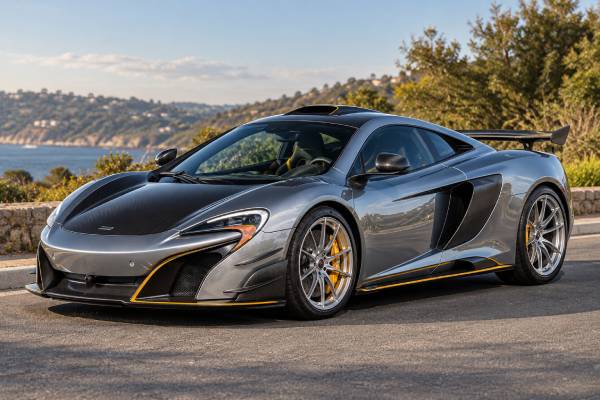

The McLaren MSO HS is one of the most technically ambitious road cars created by McLaren Special Operations during the P11 era. Only 25 customer cars were built, each individually specified, and “HS” stands for High Sport. Rather than merely dressing a 675LT in special trim, MSO developed a distinct carbon body, roof-fed induction system, P1 GTR-inspired active rear wing, dive planes, lighter glazing, polycarbonate engine cover, revised engine hardware and calibration, bespoke shift strategy, and track-focused cabin. The 3.8-litre twin-turbo V8 was officially rated at 688 PS, or 679 bhp, while the aerodynamic package could generate 220 kg of downforce at 150 mph. McLaren did not launch the HS through a normal brochure or public configurator, which is one reason specifications have often been reported inconsistently. Later interviews with former MSO staff clarify much of the engineering story. For buyers today, the central issues are provenance, exact individual specification, integrity of bespoke carbon and aero components, correct electronics, and maintenance by people who understand how far the HS differs from an ordinary Super Series car.
Table of Contents
- Why High Sport Was More Than a Special Edition
- MSO HS Engine and Performance Data
- Active Aero, Roof Scoop, and Carbon Body
- Weight Saving, Cabin, and Track Systems
- Maintaining Bespoke HS Hardware
- Provenance, Authentication, and Pre-Purchase Checks
Why High Sport Was More Than a Special Edition
The MSO HS is a separate engineering project closely related to the 675LT, not simply a numbered paint-and-trim edition. MSO used the P11 Super Series architecture as a starting point, then developed parts and calibrations that did not appear on a normal 675LT.
Contemporary coverage described the HS as an extreme evolution of the 650S/675LT family, but a 2026 retrospective by evo added unusually useful detail from former MSO staff who worked on the program. According to those accounts, some ideas had originally been considered too aggressive for the production 675LT: dive planes, a high-mounted active wing, front-wing louvres, and a roof scoop. MSO could revisit those ideas for a tiny run of hand-finished cars.
The project was not marketed through the normal McLaren route. There was no public configurator and no conventional sales brochure. Former MSO personnel told evo that 27 calls were enough to place all 25 customer cars. Each buyer could then specify the car individually, which means there is no single color, trim combination, or optional-content formula that all genuine HS examples must share.
The build process was unusual too. The cars were assembled on the technical line associated with the P1 rather than the normal Super Series line, according to former MSO personnel. That suited a project in which small-batch parts, individual customer choices, and hand work were normal rather than exceptional.
“High Sport” also has a different meaning from “Longtail.” The HS did not replace the 675LT or become another volume-limited LT derivative. Instead, MSO used the already focused LT concept as a reference point and pushed specific areas further: aerodynamic load, engine breathing and calibration, weight reduction, data acquisition, driver feedback, and visual aggression.
The power increase is modest on paper—679 bhp rather than 666 bhp—but the development behind it was unusually detailed. Former MSO lead engineer Paul Arkesden explained that engines were selected from normal production based on strong dynamometer results, then blueprinted. Cylinder-head ports were enlarged within tolerance and hand-finished by Cosworth. The HS also removed some torque restrictions used in the 675LT and received its own shift mapping and gear-dependent torque curves.
That is why authentication matters so much. An ordinary 675LT can wear a roof scoop, carbon parts, or an aftermarket wing and still not be an HS. Conversely, a genuine HS may differ visibly from another genuine HS because of the freedom owners had during commissioning. Factory-linked records and the car’s original specification are therefore more reliable than a visual checklist alone.
MSO HS Engine and Performance Data
The HS uses McLaren’s 3,799 cc M838TL-family twin-turbo V8 with a seven-speed dual-clutch transaxle and rear-wheel drive. Its official output was 688 PS, equivalent to 679 bhp, making the assignment’s 679 hp figure the correct bhp-based identifier.
| Specification | McLaren MSO HS |
|---|---|
| Powertrain type | Internal-combustion petrol engine |
| Engine code/family | M838TL-family V8 |
| Displacement | 3,799 cc (3.8 L) |
| Configuration | 90-degree V8, twin turbocharged |
| Fuel system | Electronic fuel injection and engine management |
| Engine position | Longitudinal rear-mid engine |
| Maximum power | 688 PS (679 bhp / about 506 kW) at 7,100 rpm |
| Maximum torque | 700 Nm (516 lb-ft) |
| Transmission | 7-speed dual-clutch Seamless Shift Gearbox |
| Driven wheels | Rear-wheel drive |
Sources disagree on the precise published torque band. Contemporary reports often described the 700 Nm as available across a very broad 3,000–7,000 rpm range, while evo’s 2026 specification panel lists 516 lb-ft at 5,500–6,500 rpm. Because the maximum value itself is consistent but the band is not, the table gives the verified peak without presenting one disputed rpm range as definitive.
Gooding Christie’s catalogued one documented HS with the M838TL engine, electronic injection, twin turbochargers, seven-speed dual-clutch transaxle, hydraulic carbon-ceramic brakes, and independent suspension. That auction record is useful because it links technical details to a specific chassis rather than to a generic press description.
The engine changes went well beyond increasing boost. Later testimony from MSO staff describes selecting particularly strong base engines from McLaren’s break-in and pass-off process, blueprinting them, and hand-finishing the head ports. Contemporary Autocar reporting also noted hand-polished exhaust ports and a revised crossover muffler designed to improve gas flow. Twin central titanium outlets complete the exhaust.
Calibration was part of the package. MSO could remove some torque limits imposed on the 675LT, while still retaining traction and stability systems. The HS also gained its own shift map and torque strategy. Those details help explain why a 13 bhp increase understates the intended change in character.
Published acceleration data require careful wording because McLaren did not initially release a conventional performance sheet. Contemporary reporting in 2016 noted that no official acceleration figure had been published. Evo’s 2026 retrospective later listed 0–62 mph in under 3.0 seconds and a 205 mph maximum speed. Those later figures are useful, but they should not be retroactively presented as part of a 2016 factory launch sheet.
| Measure | Verified figure and context |
|---|---|
| Maximum power | 688 PS / 679 bhp at 7,100 rpm |
| Maximum torque | 700 Nm / 516 lb-ft |
| 0–62 mph (0–100 km/h) | Under 3.0 seconds in evo’s 2026 retrospective specification |
| Maximum speed | 205 mph (about 330 km/h) in evo’s 2026 retrospective specification |
| Published weight | 1,328 kg in evo’s 2026 specification; measurement basis not stated |
| Published power-to-weight | 520 bhp per tonne in evo’s 2026 specification |
| Original 2016 launch reporting | No official acceleration figure published in several contemporary reports |
The weight figure needs the same caution. Contemporary reports describe extensive mass reduction and some later specialists state a roughly 40 kg reduction from the 675LT, while evo lists 1,328 kg without identifying whether that is dry, unladen, kerb, or another measurement basis. This article therefore preserves the source’s wording rather than labelling 1,328 kg as a dry weight.
Active Aero, Roof Scoop, and Carbon Body
The HS aerodynamic package is the clearest visual separation from the 675LT. Its centerpiece is a very large rear wing influenced by McLaren’s GT3 and P1 GTR work, yet the wing remains active rather than becoming a simple fixed race-style element.
McLaren gave the wing a bespoke actuation mechanism. It changes position electronically to alter the car’s aerodynamic profile and can rise aggressively as an airbrake under deceleration. The control positions were developed with input from McLaren test driver Chris Goodwin, according to contemporary evo reporting. Combined with the rest of the aero package, the HS was credited with producing up to 220 kg of downforce at 150 mph (241 km/h).
| Component | HS treatment |
|---|---|
| Rear wing | Large P1 GTR/GT3-influenced active carbon-fibre wing |
| Airbrake function | Retained through bespoke active-wing actuation |
| Peak published downforce | 220 kg at 150 mph (241 km/h) |
| Front bumper | HS-specific carbon-fibre component |
| Front splitter | Carbon fibre |
| Front aero | Carbon-fibre dive planes and louvred details |
| Side treatment | Full-length carbon-fibre skirts and revised intake areas |
| Bonnet | Carbon fibre |
| Roof | Carbon fibre with central induction scoop |
| Engine cover | Lightweight polycarbonate |
The roof scoop is functional. Two carbon-fibre channels run behind the seats and feed the V8, while the standard intake paths were altered for the HS arrangement. Former MSO staff described careful work on the scoop aperture to deliver the required airflow and a deliberate increase in induction sound reaching the driver.
For a used-car inspection, the scoop and ducting deserve more attention than an ordinary cosmetic carbon roof. Check that the inlet is free of debris, the visible ductwork and mounting areas are intact, and no repair has introduced loose material or poor sealing. Because the system changes the engine’s air path, an apparently minor repair around the roof can have functional consequences.
The active wing requires similar discipline. Look for impact damage, uneven gaps, cracks near mounting points, evidence of forced movement, or repairs around hinges and actuators. Cycle and test it only through correct procedures. If warning messages or stored faults are present, scan the relevant modules rather than assuming the problem is the wing motor itself.
McLaren’s general P11 airbrake architecture is electronically integrated with chassis systems. The HS mechanism is even more specialized. Current McLaren technical guidance for conventional P11 airbrakes shows that multiple control systems and fault codes can be involved in aero warnings; on an HS, the rarity of the hardware makes careful diagnosis even more important.
Carbon-fibre finish also varies by individual specification. Some HS cars expose substantial areas of weave, while others use paint or distinctive stripes. Gooding’s 2016 example carried an optional F1 Chrome exterior finish and extended carbon package; Broad Arrow has catalogued an HS with full visual gloss carbon and additional bespoke options. Those differences reinforce a core rule: do not use one photographed car as the template for what every HS must look like.
Weight Saving, Cabin, and Track Systems
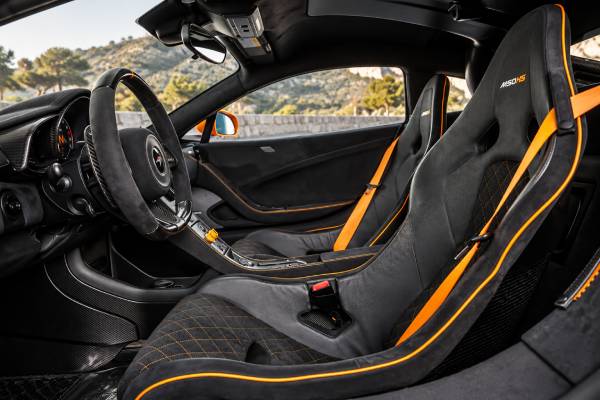
MSO chased mass in many small places rather than relying on one major deletion. The windscreen used lighter glass, the engine cover became polycarbonate, carbon body panels replaced heavier alternatives, and the cabin could shed kilograms through seats and trim.
The P1-derived carbon-fibre seats were a particularly effective change, saving about 15 kg compared with the alternative seat setup cited in contemporary reports. Alcantara trim could save another 3.5 kg compared with equivalent leather. McLaren even moved heating and ventilation controls away from their usual door locations and into the central IRIS interface to reduce parts and mass.
| Area | Measure |
|---|---|
| Seats | P1-derived carbon-fibre racing seats; about 15 kg saving |
| Upholstery | Alcantara could save about 3.5 kg versus equivalent leather |
| Windscreen | Lightweight thinner glass specification |
| Engine cover | Polycarbonate construction |
| Body | Extensive HS-specific carbon-fibre panels |
| Exhaust | Lightweight titanium outlets and revised system |
| Cabin controls | HVAC functions integrated into IRIS instead of separate door controls |
Not every car will match the lightest interior recipe. MSO offered extensive customer choice, and full Nappa leather was available according to Autocar. An HS specified with heavier luxury materials is not automatically incorrect; it is evidence that exact factory specification matters more than generic claims about what the model “should” contain.
The track focus is clearer in the instrumentation. F1-style shift lights were positioned in the driver’s eyeline to encourage manual gear selection. Harness provisions complemented the carbon seats. McLaren Track Telemetry gave the driver real-time timing information and post-session data analysis using GPS and onboard sensors.
Three cameras were integrated with the telemetry system: one at the front, one at the rear, and one looking over the driver’s shoulder. Their purpose was to synchronize video with driving data so a driver could review laps and identify where time was being lost.
| System | Function |
|---|---|
| McLaren Track Telemetry | Lap timing, sector data, GPS mapping, data logging and analysis |
| Front camera | Forward track view linked to telemetry |
| Rear camera | Rear track view linked to telemetry |
| Cabin camera | Over-driver view for synchronized track footage |
| Shift-light array | F1-style red-to-blue visual shift indication |
| Harness provision | Supports track-oriented restraint configuration where fitted |
| IRIS integration | Displays telemetry and relocated climate-control functions |
For an owner today, these electronics are part of the car’s identity. A dead camera, incorrect replacement head unit, or missing telemetry hardware may not stop the car from driving, but it affects completeness on a 25-car bespoke model. Confirm function before purchase and document any replaced components.
Maintaining Bespoke HS Hardware
The HS should be serviced as a P11 McLaren with additional bespoke systems, not as a normal 675LT with cosmetic accessories. Routine engine, gearbox, brake, hydraulic, tyre, and battery care remains essential, but rare HS-only parts change the risk of deferred maintenance.
Start with a complete module scan and service history. The car’s engine mapping, active aero, IRIS functions, telemetry, chassis controls, and other systems depend on correct software and stable electrical voltage. A weak battery can create misleading faults, but clearing low-voltage codes without testing the battery and charging system is not diagnosis.
The engine deserves special attention because of its blueprinting and hand-finished details. Any major previous engine repair should be supported by invoices that identify who performed it and what specification was retained. A replacement or rebuilt engine may be mechanically sound, but on an HS its provenance matters more than on a normal production car because engine selection and finishing were part of the program.
Software history is unusually important on this model. McLaren issued Service Campaign Bulletin SCB 11 M 101, titled “HS Edition Software Update,” with a manufacturer communication date of September 26, 2017. A buyer should ask a McLaren retailer to confirm by VIN whether the applicable HS update and any later superseding software have been completed rather than judging software status from the dashboard alone.
Cooling health is critical for a high-output twin-turbo V8 that MSO calibrated to operate with fewer of the conservative limits used on mainstream cars. Look for dried coolant residue, fluid smells, unexplained level changes, damaged radiators, hose deterioration, and signs of overheating. Diagnostic data and a pressure test are more useful than relying on a seller’s statement that temperatures “always look normal.”
The roof scoop and intake path should be inspected whenever surrounding panels are removed or repaired. Improper sealing, debris, cracked ducts, or loose fasteners can affect airflow or allow unwanted material into the intake route. Original clips, heat shielding, and carbon parts should be treated as model-specific hardware.
The active rear wing is another high-value system. Keep its pivot and actuator areas clean, avoid manually forcing the panel, and investigate any warning or asymmetrical movement promptly. Because replacement HS-specific aero components are scarce, minor play or surface damage should not be ignored until it becomes a larger structural problem.
Carbon bodywork requires repair expertise. Clear-coat cracking, stone impact, or superficial surface marks are different from laminate fracture, crushed cores, and damaged mounts. If repair is needed, obtain photographs, material records, and invoices. A visually perfect repair with no documentation may be harder to authenticate years later than a well-documented professional repair.
Brakes, tyres, and alignment should be evaluated in the context of possible circuit use. Trofeo R tyres were listed for the HS in evo’s current specification, but any car should be judged on its actual tyre size, rating, age, heat history, and condition. Carbon-ceramic brakes need specialist inspection for disc and pad condition. A car that has been tracked is not disqualified; neglected heat cycles and undocumented consumable wear are the concern.
Telemetry can help tell the car’s story if historic data remain available, but it should not be treated as a complete usage log. Owners can change storage media, replace modules, or clear records. Service invoices, tyre and brake history, fluid changes, and a physical inspection remain the stronger evidence of how a car has been used and maintained.
Provenance, Authentication, and Pre-Purchase Checks
A pre-purchase inspection of an MSO HS should begin with documents, not with the engine start button. With only 25 customer cars and extensive individual personalization, provenance is part of the specification.
Request the VIN, original MSO commission information, build sheet, delivery documentation, service invoices, and records of any body or powertrain work. Gooding Christie’s, for example, catalogued chassis SBM11RAA8GW688020 as an MSO HS and documented its engine and bespoke specification. Auction records are not factory certificates, but such cross-references can help establish a continuous history when combined with McLaren records.
Confirm the car’s HS identity with a McLaren retailer or appropriate factory-linked documentation. Numbered plaques and badges are useful but can be reproduced. A roof scoop, large wing, or carbon panels are even less conclusive because similar components have appeared on other MSO commissions or can be added later.
Then verify the individual specification rather than comparing the car with a generic internet list. One HS may have Alcantara and visible carbon; another may have Nappa leather, unusual paint, gold heat shielding, or other bespoke content. The correct question is whether the car still corresponds with its own commissioning record.
| Area | Verification |
|---|---|
| Identity | VIN and McLaren/MSO records confirming HS status |
| Original specification | Build sheet, colors, trim, options, bespoke instructions |
| Engine | Service history, originality or documented replacement/repair, clean diagnostics |
| Carbon body | Panel integrity, mounting points, repair documentation, finish consistency |
| Roof intake | Scoop, duct condition, sealing and correct surrounding hardware |
| Active rear wing | Correct movement, no impact damage, no current aero faults |
| Track Telemetry | Three cameras, IRIS integration, timing/data functions |
| Chassis | Alignment, suspension hydraulics, lift function, underbody condition |
| Brakes and tyres | Carbon-ceramic condition, pad life, tyre age/specification and wear |
| Electrical health | 12-volt battery condition and full-module diagnostic scan |
A cold start and road test come after that documentation review. Observe warning-light self-checks, idle stability, drivetrain vibration, steering behavior, shift quality, brake feel, lift-system operation, climate control, cameras, IRIS, and any active-aero warnings. There is no need to test 679 bhp on a public road. Progressive load, legal speeds, and diagnostic data are enough to expose many faults.
Inspect the underside carefully. The splitter, dive planes, side skirts, floor edges, diffuser, and wing mounts can be damaged by ramps, transport, kerbs, or incorrect lifting. Rare carbon parts turn apparently minor underside contact into a potentially significant repair.
Body repair should be evaluated in two dimensions: structural quality and historical transparency. A properly repaired carbon panel is preferable to unsafe original damage, but factory panels and finish can carry collectible significance. Ask exactly what was repaired or replaced, why, by whom, and whether geometry and aero function were checked afterward.
Do not assume that a very low odometer reading means lower risk. Long storage can age tyres, seals, fluids, batteries, and electrical contacts, while roof-intake channels or active-aero components may go years without meaningful exercise. A regularly maintained car with sensible use can present a more convincing mechanical baseline than a static display car.
Finally, separate documented facts from model folklore. The HS has accumulated conflicting claims about weight, torque bands, performance, and even whether it was “based on” the 650S or 675LT. The most defensible description is that it is a P11 Super Series MSO project closely related to the 675LT, with 25 customer cars, 688 PS/679 bhp, a blueprinting program, bespoke active aero, extensive carbon construction, and individualized specifications. Where a source does not state a measurement basis, do not invent one.
That discipline matters because the HS is rare enough that a single unusual car can become the basis for incorrect generalizations. The strongest purchase is one where the documentation explains the individuality: the build record matches the physical car, bespoke equipment works, repairs are transparent, the carbon and aero systems are sound, and specialist maintenance shows that the owner understood what was unique about High Sport.
References
- McLaren MSO HS: the secret 205mph special born to save the brand 2026 (retrospective with former MSO personnel)
- The McLaren MSO HS is a P1-inspired Long Tail 2016 (contemporary technical report)
- McLaren MSO HS full tech specs and pictures officially revealed 2016 (contemporary technical report)
- 2016 McLaren MSO HS 2020 (documented auction chassis and technical specification)
- HS Edition Software Update 2017 (McLaren service campaign via NHTSA)
- McLaren Ownership – Owner’s Handbooks | McLaren Automotive 2026 (official P11-era owner-documentation portal)
Disclaimer
Every MSO HS was individually commissioned, so no online article can replace the records and technical information for the specific chassis. Have qualified specialists diagnose faults and authenticate major components, and verify specifications, torque settings, service requirements, software, and repair procedures against current McLaren/MSO material for the VIN and market. Bespoke equipment can also change what is correct from one HS to another. Please share this guide with an owner, technician, or collector who is researching one of these cars.