


Thirty years after an F1 GTR won the 24 Hours of Le Mans on McLaren’s first appearance as a constructor, the company created a 750S that does more than borrow a famous name. The 2025 750S Le Mans Special Edition is limited to 50 Coupés and introduces the MSO High Downforce Kit, a functional aerodynamic package that raises downforce by 10 percent over the standard 750S. Its enlarged front splitter, raised active rear spoiler, louvred under-wing panel and roof scoop are joined by five-spoke LM wheels, F1 Gold brake calipers, titanium exhaust finishers and a tightly curated choice of Le Mans Grey or McLaren Orange paint. The 4.0-litre twin-turbo V8 remains at 740 bhp, so the car’s significance is not a higher dyno number. It lies in the combination of real aero hardware, unusually direct visual links to the victorious #59 F1 GTR and a production run small enough to demand careful provenance checking. For buyers, the HDK hardware and the edition’s originality are the key points to understand.
Table of Contents
- Why the 1995 Le Mans Win Matters
- High Downforce Kit and Edition Hardware
- 750S Le Mans Specifications
- Track Behaviour, Road Use, and Aero Tradeoffs
- Service, Tyres, Brakes, and Storage
- How to Inspect and Authenticate One
- Who Should Buy the Le Mans Edition
Why the 1995 Le Mans Win Matters
The Le Mans edition exists to mark a specific result: on June 18, 1995, McLaren F1 GTR #59 won the 24 Hours of Le Mans with Yannick Dalmas, JJ Lehto and Masanori Sekiya. Three other F1 GTRs also finished inside the top five, giving McLaren an extraordinary debut at the race.
That history explains why the 2025 car is more tightly themed than a generic anniversary package. Le Mans Grey recalls the colour of #59, the five-spoke LM wheels echo the race car’s wheel design, the roof scoop evokes the F1 GTR’s intake treatment and the edition’s gold brake calipers reference the period competition look. McLaren Orange is the alternative exterior colour for buyers who prefer the company’s signature hue.
The anniversary also connects to McLaren’s wider motorsport identity. The 1995 victory completed the achievements commonly grouped as McLaren’s motorsport Triple Crown: victories at the Monaco Grand Prix, Indianapolis 500 and 24 Hours of Le Mans. The 750S Le Mans therefore sits at the intersection of the road-car division, McLaren Special Operations and one of the company’s most valuable competition stories.
Production is limited to 50 cars worldwide. Unlike the later Japan-only JC96, which was offered as both Coupé and Spider, the Le Mans edition is a Coupé. This matters for collectors comparing special 750S variants: the 50-car figure applies to one body style, and the HDK debuted here before appearing on the JC96 programme.
McLaren did not position the Le Mans as a higher-output engine derivative. The standard 750S already makes 750 PS, or 740 bhp, and 800 Nm. The meaningful engineering change is aerodynamic. That makes the Le Mans edition unusual among commemorative cars, because the most important special feature can change high-speed balance and track behaviour rather than merely appearance.
High Downforce Kit and Edition Hardware
The MSO High Downforce Kit is the central technical reason to choose the Le Mans edition. McLaren states that the package increases downforce by 10 percent compared with the regular 750S through coordinated front and rear changes rather than a single oversized wing.
At the nose, a revised front bumper accepts an enlarged carbon-fibre splitter. That additional front aerodynamic load is balanced at the rear by a raised carbon-fibre Active Rear Spoiler with integral endplates. Under the wing sits a body-colour carbon-fibre panel with gloss-black louvres. The package preserves active rear-aero functionality while creating a more overtly competition-derived shape.
The roof scoop is visually one of the most distinctive additions. It recalls the intake of the F1 GTR and strengthens the Le Mans identity without pretending the road car has the same engine arrangement as the 1995 racer. Buyers should examine this component particularly carefully because exposed and painted carbon parts can be costly to replace or refinish correctly after stone damage or impact.
Five-spoke LM wheels are another edition-specific identifier. Their design is intentionally reminiscent of the wheels associated with McLaren’s F1 racing era. Wheel centre caps use blue and red detailing, while the brake calipers are finished in a special F1 Gold colour with red McLaren logos. Natural titanium exhaust finishers complete the rear treatment.
The standard exterior specification also includes carbon-fibre front fenders with gloss-black louvres and gloss-black exterior detailing. Taken together, these parts create a distinct aerodynamic and visual package. They also increase the number of areas a buyer must inspect for originality. A replacement standard 750S fender, repaired splitter or incorrectly refinished rear wing can materially change the character of a car that is valuable because of its factory specification.
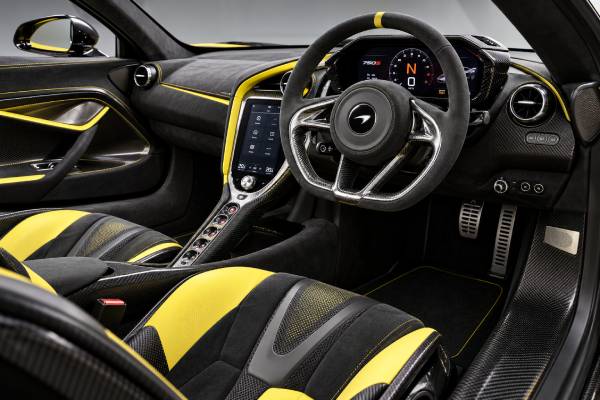
Inside, the factory offered two principal colour combinations: Carbon Black with Dove Grey, or Carbon Black with McLaren Orange. Le Mans branding appears in the cabin and the car carries a dedicated plaque. Buyers could also choose seats ranging from more comfort-oriented shells to highly supportive lightweight options depending on specification, so two genuine cars need not have identical seat hardware.
A useful way to think about the edition is to separate three layers. The first is the standard 750S engineering package: engine, gearbox, chassis and brakes. The second is the functional HDK equipment. The third is the commemorative specification: colours, wheels, badges, trim and plaque. A strong collector example should preserve all three layers coherently.
750S Le Mans Specifications
The 750S Le Mans remains a rear-wheel-drive internal-combustion supercar with the M840T 4.0-litre twin-turbo V8. No factory power increase was announced for the Le Mans edition, so standard 750S Coupé engine and performance figures provide the correct baseline. Aerodynamic loading differs because of the HDK, and McLaren’s 10 percent downforce claim is the key edition-specific performance figure.
| Specification | Value |
|---|---|
| Production | 50 cars worldwide |
| Body style | Coupé |
| Exterior colours | Le Mans Grey or McLaren Orange |
| Aerodynamic package | MSO High Downforce Kit |
| Downforce change | 10% increase versus standard 750S |
| Front aero | Revised bumper with enlarged carbon-fibre splitter |
| Rear aero | Raised carbon-fibre Active Rear Spoiler with integral endplates |
| Additional aero detail | Louvred body-colour carbon-fibre under-wing panel |
| Roof detail | Gloss-black carbon-fibre roof scoop |
| Specification | Value |
|---|---|
| Engine code | M840T |
| Layout | 90° V8, longitudinal mid-engine |
| Displacement | 3,994 cc (4.0 L) |
| Induction | Twin electrically actuated twin-scroll turbochargers |
| Maximum power | 750 PS (740 bhp / 552 kW) at 7,500 rpm |
| Maximum torque | 800 Nm (590 lb-ft) at 5,500 rpm |
| Maximum engine speed | 8,500 rpm |
| Transmission | 7-speed Seamless Shift Gearbox with reverse |
| Drive | Rear-wheel drive |
| Measure | Value |
|---|---|
| 0–100 km/h (0–62 mph) | 2.8 seconds |
| 0–60 mph | 2.7 seconds |
| 0–200 km/h (0–124 mph) | 7.2 seconds |
| Quarter mile | 10.1 seconds |
| Top speed | 332 km/h (206 mph) for standard 750S Coupé |
| 100–0 km/h braking | 30 m (98 ft) |
| 200–0 km/h braking | 113 m (371 ft) |
| Specification | Value |
|---|---|
| Structure | Carbon-fibre Monocage II with aluminium crash structures |
| Suspension | Double wishbones with adaptive dampers |
| Chassis control | Proactive Chassis Control III |
| Steering | Electro-hydraulic power assistance |
| Differential | Open differential with Brake Steer |
| Front brake discs | 390 mm carbon-ceramic |
| Rear brake discs | 380 mm carbon-ceramic |
| Front calipers | 6-piston forged aluminium |
| Rear calipers | 4-piston forged aluminium |
| Specification | Value |
|---|---|
| Length | 4,569 mm (179.9 in) |
| Width without mirrors | 1,930 mm (76.0 in) |
| Width with mirrors | 2,161 mm (85.1 in) |
| Height | 1,196 mm (47.1 in) |
| Wheelbase | 2,670 mm (105.1 in) |
| Front track | 1,680 mm (66.1 in) |
| Rear track | 1,629 mm (64.1 in) |
| Standard 750S lightest dry weight | 1,277 kg (2,815 lb) |
| Standard 750S DIN kerb weight | 1,389 kg (3,062 lb) |
| Specification | Value |
|---|---|
| Fuel tank | 72 L (15.8 UK gal / 19.0 US gal) |
| WLTP combined fuel use | 12.2 L/100 km |
| WLTP combined CO₂ | 276 g/km |
| Front luggage capacity | 150 L |
| Rear luggage capacity | 210 L on standard Coupé packaging |
Because McLaren did not publish a dedicated Le Mans top-speed or acceleration figure alongside the HDK announcement, it is best not to invent one. The standard numbers establish the powertrain’s capability, while the verified edition-specific claim is the increase in downforce. At very high speed, more aerodynamic load can also bring more drag, so a buyer should not assume every standard top-speed value transfers unchanged without an official statement.
Track Behaviour, Road Use, and Aero Tradeoffs
The HDK should matter most when speed is high enough for aerodynamic load to become significant. Its 10 percent downforce increase is intended to improve stability and support higher cornering confidence on circuit, not to make urban driving feel dramatically different.
McLaren’s approach is important because front and rear changes were engineered together. A larger rear wing without enough front load can shift aerodynamic balance rearward and promote high-speed understeer. The Le Mans package adds an enlarged front splitter alongside the raised rear spoiler so the car’s aero balance remains purposeful.
The underlying 750S is already highly responsive. Its final-drive ratio is 15 percent shorter than the 720S’s, the front track was widened by 6 mm, the steering ratio is quicker and the PCC III suspension was recalibrated. Those changes give the car urgency at road speeds before the HDK becomes a major factor.
On a circuit, tyres will determine how much of the chassis and aero capability an owner can actually use. Standard Pirelli P Zero tyres offer a broad road operating window, while P Zero Corsa and Trofeo R options provide more track focus. Trofeo R rubber in particular should be treated as a consumable with sensitivity to temperature, standing water, age and heat cycles. A buyer inspecting a track-used Le Mans should look beyond tread depth and check manufacturing dates, shoulder wear and whether all four tyres match in model and specification.
The carbon-ceramic brakes are also suited to repeated high-energy stops, but they are not maintenance-free. Track driving raises pad and fluid temperatures, and gravel or debris can damage expensive rotors. A pre-purchase inspection should therefore assess rotor condition and not simply rely on a dashboard warning.
Road usability remains one of the 750S’s strengths. The hydraulic suspension architecture gives the car a more compliant secondary ride than the visual drama suggests, while front-axle lift can make ramps and speed humps manageable when fitted and used correctly. The Le Mans splitter deserves extra caution because it is both functional and edition-specific. Scraping a generic plastic lip is inconvenient; damaging a special carbon HDK part has greater repair, originality and value implications.
Visibility is another practical point. The roof scoop and altered rear aero increase the sense of occasion but can affect the driver’s rearward visual environment compared with a standard Coupé. Buyers should test seat position, mirror adjustment and parking-camera operation rather than assuming the collector edition will be as easy to place as a familiar 750S.
Service, Tyres, Brakes, and Storage
Maintaining a Le Mans correctly means treating it as both a 740-bhp supercar and a 50-car limited edition. Mechanical service should follow VIN-specific McLaren documentation, while preservation work should protect the HDK carbon, unique wheels, paint and interior details.
Annual servicing is the safe planning assumption for a low-mileage collector car, even where the market’s mileage interval would not otherwise be reached. Oil absorbs contaminants, brake fluid absorbs moisture and tyres age regardless of odometer reading. Cars that spend most of their life in storage also place greater demands on the 12-volt battery.
Before and after track use, owners should pay attention to:
- engine-oil level and service age;
- brake-fluid condition and any track-specific fluid recommendation from the servicing retailer;
- carbon-ceramic disc and pad condition;
- tyre pressures when cold and after sessions;
- wheel damage, especially around the unique LM rims;
- splitter, floor and rear-aero surfaces for strikes or loose fasteners;
- alignment if kerbs were hit or tyre wear becomes asymmetric;
- cooling inlets and radiators for debris.
The 750S also has a meaningful software layer. McLaren service-campaign documents filed with NHTSA show platform updates across model years, and earlier Federal-market cars received an HVAC-controls campaign to address a potential unresponsive interface. A 2025 Le Mans buyer should ask a McLaren retailer to read the VIN and confirm the current software level rather than assuming a visually perfect car is up to date.
Recall status should be checked the same way. A brake-pipe recall announced in 2025 applied to a small set of McLaren vehicles and included certain 2024 750S examples in some markets. The Le Mans itself was a later 2025 special edition, so the point is not to claim it is affected. The lesson is that build date and VIN govern recall applicability, not the name on the rear badge.
Storage deserves deliberate planning. Use the manufacturer-approved battery-maintenance method, maintain tyre pressures, avoid damp environments and do not repeatedly start the car only to idle for a few minutes. If long-term static display is unavoidable, consult a specialist about tyre flat-spot prevention and fluid management. When exercising the car, allow oil temperature to rise before using heavy boost or high rpm.
Cosmetic care should be conservative. Le Mans Grey, McLaren Orange, exposed carbon, gloss-black carbon and titanium each respond differently to aggressive compounds. Paint-protection film can be sensible on the nose and splitter, but the installer should understand complex carbon edges and avoid cutting directly on the car. Keep invoices and installation photographs because future buyers will want to know whether a cloudy finish is in the clearcoat or only in old film.
How to Inspect and Authenticate One
Authentication starts with provenance and then moves to hardware. A genuine 750S Le Mans should have a VIN-linked build history, the correct edition specification and documentary evidence that connects the car to the 50-unit programme.
First inspect the elements that are hardest to duplicate convincingly: HDK front bumper and splitter, raised active rear spoiler with endplates, louvred under-wing panel, carbon roof scoop, louvred carbon front fenders, LM wheels and the dedicated Le Mans interior identification. Verify paint and trim against the build sheet rather than assuming all cars must look identical.
Then test functionality. The rear spoiler is active, so an attractive static wing is not enough; it should operate correctly under the appropriate test procedure. Inspect mounting points for signs of disassembly or collision repair. The splitter should sit evenly with no cracks at attachment points. Louvred carbon panels should have consistent finish, and the roof scoop should show no evidence of poorly blended repairs.
Wheel inspection is especially important because replacement LM wheels may be expensive and scarce. Look for bends, cracks, excessive refinishing and missing centre-cap details. A cosmetically perfect wheel that has been heavily machined during refurbishment can be less desirable than a lightly marked original.
Mechanical inspection should include cold start, hot restart, gearbox behaviour, hydraulic suspension operation, steering feel, lift-system operation if fitted, air conditioning, central display and camera systems. Ask for diagnostic scans, not merely a road test. Modern McLarens can store useful fault history even when no warning is displayed during a short inspection.
A sensible pre-purchase checklist is:
- Match VIN, build documentation and edition identity.
- Verify the dedicated plaque and original Le Mans specification.
- Inspect every HDK carbon component for repair or replacement.
- Confirm all four LM wheels and correct centre details.
- Check tyre dates, type and track-use wear.
- Measure carbon-ceramic brake condition through an experienced McLaren specialist.
- Obtain full service, software-campaign and recall history.
- Inspect underside and lift points for track or transport damage.
- Review paint-protection-film and body-repair invoices.
- Confirm keys, manuals, accessories and any original removable parts.
Because only 50 exist, advertised prices can be noisy. Asking prices are not transaction prices, and a low-mileage car missing original parts may be less attractive than a carefully used example with perfect provenance. The strongest comparison is another documented 750S Le Mans, not a standard 750S with an estimated premium simply added on top.
Who Should Buy the Le Mans Edition
The 750S Le Mans is most compelling for a buyer who wants a factory-limited 750S with a genuine engineering difference and an unusually clear historic reference. The HDK gives it a purpose beyond commemorative paint, while the #59-inspired details link it to one of McLaren’s defining competition achievements.
It is not the right choice if the only objective is more engine output. The V8 remains at 740 bhp, and the edition’s value proposition is aerodynamic, historical and collectible. Buyers who plan extensive circuit modification should also think carefully before starting with a 50-car special, because replacing edition parts with aftermarket aero or refinishing the unique wheels may erode the very originality they paid to obtain.
For mixed road and occasional track use, the Le Mans has a strong case. It keeps the 750S’s compact dimensions, luggage space, road-compliant suspension and familiar powertrain while adding more aerodynamic load and a cockpit that feels connected to McLaren’s racing history. The result is a car that can still tour but rewards an owner who understands what its aero package is designed to do.
Long-term stewardship should focus on completeness. Keep every original part, preserve the plaque and documents, record all work, maintain the active aero and avoid irreversible cosmetic changes. If track use is part of the plan, log tyres, brake pads and fluid changes rather than hiding the use. Transparent history is more credible than an improbably perfect story.
The key buying insight is simple: the 750S Le Mans is not merely a standard car wearing a Le Mans badge, but neither is it an engine-upgraded LT. Its identity rests on a 50-car production run, the first deployment of the MSO High Downforce Kit and direct visual references to the 1995 F1 GTR victory. Judge the car against those facts, and its place in the 750S family becomes much easier to understand.
A useful ownership rule is to separate cosmetic preservation from aerodynamic condition. The Le Mans edition’s special front splitter, louvred under-wing panel, raised active rear spoiler and carbon-fibre details are functional or edition-defining pieces, so a small impact can matter more than an ordinary bumper scuff. During routine service, photograph the underside of the splitter and its mounting points, then compare those images after long trips or circuit use. If a panel is replaced, keep the original invoice and record the exact McLaren or MSO part fitted. That history helps a later buyer distinguish a properly repaired car from one assembled with visually similar components. The same discipline applies to wheel refinishing and titanium-exhaust work: reversible, documented maintenance protects provenance far better than trying to make every repair invisible.
References
- McLaren | MEDIA Media release 2025
- McLaren 750s 2026
- This very special 750S celebrates McLaren’s 1995 Le Mans victory 2025
- McLaren Ownership – Owner’s Handbooks | McLaren Automotive 2026 (Owner’s Handbook)
- RESTRICTED 2025 (Service Campaign)
- Check for Recalls: Vehicle, Car Seat, Tire, Equipment | NHTSA 2026 (Recall Database)
Disclaimer
This article is for informational purposes only and is not a substitute for professional diagnosis, maintenance, repair, valuation, or inspection. Specifications, torque values, service intervals, campaigns, and procedures vary by VIN, market, model year, and equipment, so verify the exact car against official McLaren service documentation before acting on technical information.
If you found this article helpful, please share it on Facebook, X/Twitter, or with other McLaren enthusiasts to support our work.