
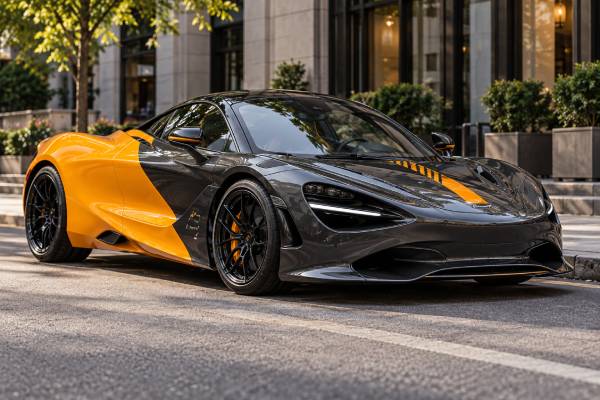
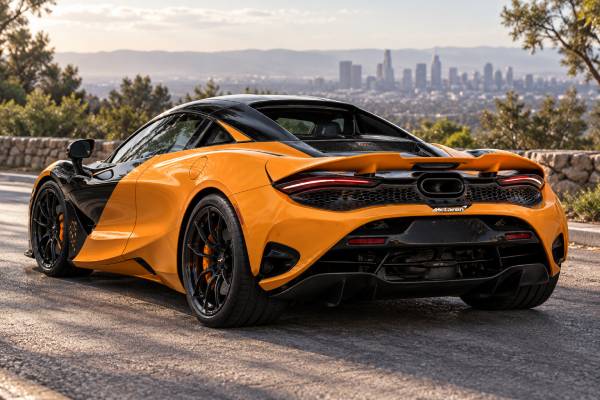
The McLaren 750S MCL38 Celebration Edition turns the company’s 2024 Formula 1 Constructors’ Championship into a physical collector car, right down to genuine carbon fibre from the title-winning MCL38. Announced in February 2025, the programme covered just nine 750S Celebration Edition cars globally, alongside nine Arturas, with the number chosen to mark McLaren’s ninth Constructors’ title. The 750S Coupé uses a Papaya Orange and Anthracite MSO livery, championship graphics, a driver-side carbon sill signed by Lando Norris and Oscar Piastri, and two unusually meaningful plaques: one incorporates an authentic piece of MCL38 Formula 1 bodywork, while another records the race wins, pole positions and fastest laps from the championship season. Mechanically, it remains the 740-bhp 750S rather than a higher-output derivative. That makes provenance the defining issue. A correct car combines standard P28 supercar engineering with irreplaceable championship artefacts, so the buying process should verify signatures, plaque content, original livery and VIN-linked MSO documentation with the same care normally reserved for the engine and chassis.
Table of Contents
- The Championship Behind the Car
- MCL38 Details You Can Physically Verify
- Powertrain, Chassis, and Key Specifications
- What the Celebration Edition Is Like to Use
- Preservation, Service, and Software Care
- Pre-Purchase Authentication and Condition Checks
- Rarity, Value, and the Right Kind of Owner
The Championship Behind the Car
The MCL38 Celebration Edition commemorates McLaren Racing’s 2024 Formula 1 Constructors’ Championship, the team’s ninth such title and its first since 1998. The road car’s name comes directly from the MCL38 Formula 1 machine used by Lando Norris and Oscar Piastri during that season.
McLaren secured the championship at the season-ending Abu Dhabi Grand Prix. Across 2024, Norris and Piastri combined for six Grand Prix victories and eight pole positions, and the team had led the Constructors’ standings from the Azerbaijan Grand Prix in September. Those numbers are not just background trivia: the Celebration Edition records the season’s achievements on a dedicated track-record plaque in the front luggage compartment.
McLaren announced 18 Celebration Edition road cars in total—nine Arturas and nine 750S models. Public launch material does not establish a nine-Coupé allocation for the 750S; it states nine 750S Celebration Editions as a model total. Coupé and Spider examples are known, so buyers should not repeat an unsupported claim that nine Coupés were built. The exact body-style split is something to establish through the individual car’s factory documentation.
That nuance is important because rarity statements influence value. “One of nine 750S Celebration Editions” is supported by McLaren’s announcement. “One of nine Coupés” is not. A precise sales description should separate what the manufacturer confirmed from what a dealer or owner may infer.
The project was created through McLaren Special Operations. MSO did not turn the car into a road-going Formula 1 technical derivative; instead, it translated the MCL38’s visual language and championship story onto the 750S platform. Papaya Orange and Anthracite dominate the exterior, with a chevron transition inspired by the racing livery. A Champions’ Laurel, a Nine-Star emblem and additional orange detailing make the historical reference explicit.
The result is one of the 750S family’s most provenance-driven variants. The Le Mans edition gains a functional High Downforce Kit and the JC96 introduces its own aerodynamic and Japan-market story. The MCL38 Celebration Edition’s special value lies more in direct physical connection to a specific championship-winning Formula 1 car and team than in altered road-car hardware.
MCL38 Details You Can Physically Verify
The most significant feature is the MCL38 dedication plaque containing a genuine piece of carbon-fibre bodywork from a 2024 Formula 1 car. This is not merely a graphic or replica weave; McLaren described it as authentic MCL38 material, which gives the plaque unusual importance for provenance.
A second plaque sits in the bonnet storage area and lists the MCL38’s competitive record from the championship season. Because this plaque is specific to the programme, its presence, condition and correspondence with the original build should be checked on any used example. Reproduction plates may be possible in theory, but the factory documentation and VIN history are what anchor the parts to the car.
The driver-side Visual Carbon Fibre Extended Sill Cover carries the signatures of Norris and Piastri. The sill also incorporates Formula 1-themed graphics, and the seat headrest section carries a Champions’ Laurel. These are high-contact or visually exposed areas, so a buyer should examine them for refinishing, abrasion, clear-film edges or replaced trim.
Outside, the colour treatment mixes Papaya Orange and Anthracite with the chevron transition associated with McLaren’s modern Formula 1 identity. Championship branding includes the Nine-Star logo, representing the nine Constructors’ titles counted at the time, and a Champions’ Laurel. The 750S also received model-specific Papaya accents such as the mirror stripe and front-splitter leading-edge treatment described in launch material.
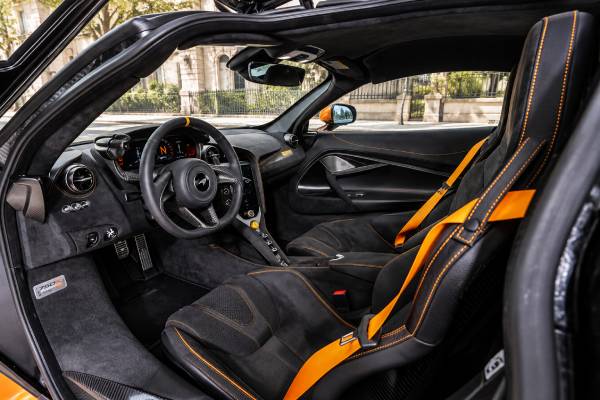
The steering wheel is another identifying detail. The Celebration specification includes visible carbon fibre, a Papaya 12 o’clock marker and Papaya accenting around the clasp. These components should look consistent in colour and finish with the rest of the MSO treatment. A retrimmed wheel may be perfectly usable, but if the car is being sold as an untouched collector example, any deviation deserves documentation.
These details change the normal hierarchy of a pre-purchase inspection. On a standard 750S, a damaged sill cover is chiefly a repair-cost concern. On an MCL38 Celebration Edition, replacing a signed sill can remove part of the car’s direct Formula 1 connection. Similarly, a damaged dedication plaque is not equivalent to replacing an ordinary dashboard badge.
Owners should therefore photograph the car’s special components in detail when they take delivery. High-resolution images of the signatures, carbon insert, plaque serial or identifying marks, headrest embroidery, exterior graphics and steering-wheel details can become useful provenance if a future service requires components to be removed.
Powertrain, Chassis, and Key Specifications
Under the championship livery, the Coupé retains the 750S P28 mechanical package: a 3,994 cc M840T twin-turbo V8, seven-speed Seamless Shift Gearbox and rear-wheel drive. McLaren announced no unique MCL38 Celebration engine calibration, output increase or special final-drive ratio beyond the standard 750S specification, so the correct published output remains 750 PS (740 bhp) and 800 Nm.
| Specification | Value |
|---|---|
| Programme size | 9 McLaren 750S Celebration Edition cars globally |
| Commemorated achievement | 2024 Formula 1 Constructors’ Championship |
| Championship number | McLaren’s ninth Constructors’ title |
| MSO colour theme | Papaya Orange and Anthracite |
| Primary historic artefact | Dedication plaque with genuine MCL38 carbon-fibre bodywork |
| Driver signatures | Lando Norris and Oscar Piastri on driver-side carbon sill |
| Record plaque | Front luggage-compartment plaque documenting 2024 MCL38 results |
| Specification | Value |
|---|---|
| Engine | M840T 90° V8 |
| Displacement | 3,994 cc (4.0 L) |
| Induction | Twin electrically actuated twin-scroll turbochargers |
| Lubrication | Dry sump |
| Valvetrain | DOHC, 32 valves, variable valve timing |
| Maximum power | 750 PS (740 bhp / 552 kW) at 7,500 rpm |
| Maximum torque | 800 Nm (590 lb-ft) at 5,500 rpm |
| Maximum engine speed | 8,500 rpm |
| Specification | Value |
|---|---|
| Transmission | 7-speed Seamless Shift Gearbox with reverse |
| Drive | Rear-wheel drive |
| Differential | Open differential with Brake Steer |
| Body structure | Carbon-fibre Monocage II |
| Suspension | Double wishbones with adaptive dampers |
| Chassis control | Proactive Chassis Control III |
| Steering | Electro-hydraulic power-assisted |
| Final drive | 15% shorter than the preceding 720S application |
| Measure | Value |
|---|---|
| 0–100 km/h (0–62 mph) | 2.8 seconds |
| 0–60 mph | 2.7 seconds |
| 0–200 km/h (0–124 mph) | 7.2 seconds |
| Quarter mile | 10.1 seconds |
| Top speed | 332 km/h (206 mph) |
| Front brakes | 390 mm carbon-ceramic discs, 6-piston aluminium calipers |
| Rear brakes | 380 mm carbon-ceramic discs, 4-piston aluminium calipers |
| Specification | Value |
|---|---|
| Length | 4,569 mm (179.9 in) |
| Width without mirrors | 1,930 mm (76.0 in) |
| Width with mirrors | 2,161 mm (85.1 in) |
| Height | 1,196 mm (47.1 in) |
| Wheelbase | 2,670 mm (105.1 in) |
| Front wheels / tyres | 19 × 9.0J; 245/35 R19 |
| Rear wheels / tyres | 20 × 11.0J; 305/30 R20 |
| Lightest dry weight | 1,277 kg (2,815 lb) for standard 750S Coupé specification |
| DIN kerb weight | 1,389 kg (3,062 lb) for standard 750S Coupé specification |
| Specification | Value |
|---|---|
| Fuel tank capacity | 72 L (15.8 UK gal / 19.0 US gal) |
| WLTP combined fuel consumption | 12.2 L/100 km |
| WLTP combined CO₂ | 276 g/km |
| Front luggage capacity | 150 L |
| Rear luggage capacity | 210 L |
The safest way to quote mass is to distinguish the published standard 750S figures from a specific Celebration car’s as-built weight. Paint, seat choice, audio equipment and other options can change the actual vehicle mass. Unless an MCL38-specific homologated figure is supplied for the exact car, do not label the standard lightest dry weight as the measured weight of every Celebration Edition.
What the Celebration Edition Is Like to Use
The Celebration Edition’s driving experience comes from the standard 750S engineering rather than Formula 1-derived powertrain changes. That is not a weakness: the base car is already one of McLaren’s most responsive road cars, with very low mass, short gearing and unusually communicative steering.
Compared with the 720S it replaced, the 750S gained power and torque while losing roughly 30 kg in comparable form. McLaren also shortened the final drive, widened the front track by 6 mm and revised the steering and dampers. The result is faster response in the middle gears and a more immediate front end without requiring the Celebration Edition to add its own chassis tune.
The electro-hydraulic steering is particularly relevant to ownership. It transmits road texture and tyre load clearly, so worn tyres, alignment errors or bent wheels can be noticeable through the rim. A pre-purchase drive should include smooth roads and rougher surfaces at modest speed, allowing the buyer to distinguish normal feedback from vibration caused by tyre flat spots or wheel damage.
The PCC III suspension uses hydraulically linked dampers to manage roll and ride. Comfort, Sport and Track settings alter the car’s responses, but even the softer mode does not turn it into a conventional GT. Low seating, wide rear haunches and expensive carbon body components still demand attention in car parks and on narrow roads.
In practical terms, the Coupé is the more luggage-friendly 750S body. It combines a 150-litre front compartment with 210 litres of rear storage, useful for a weekend trip. That makes it possible to use the MCL38 edition for touring rather than confining it to static display, provided the owner protects the signed and commemorative components from unnecessary wear.
The temptation with a championship car is to preserve zero mileage at all costs. Mechanically, that can be counterproductive. Seals, tyres and fluids benefit from correct use, and a supercar that sits without battery maintenance can accumulate low-voltage faults. The better objective is controlled use: warm the engine fully, avoid heavy load when fluids are cold, keep mileage documented and service the car by time as well as distance.
Preservation, Service, and Software Care
Service history on an MCL38 Celebration Edition should be both technically complete and collector-grade. Every invoice should identify the VIN, mileage, date and work performed, while any removal of signed or championship-specific trim should be documented with photographs.
For routine maintenance, follow the official handbook and market-specific service schedule. A low-mileage car still needs periodic oil and filter changes, inspection of brake fluid, cooling systems, tyres and battery condition, plus scheduled gearbox or other fluids when due. Track use can justify more frequent inspection, especially for brake fluid and tyres.
Battery care is a recurring supercar ownership issue. The 750S contains numerous control modules, and repeated low-voltage events can create faults that have nothing to do with mechanical wear. Use the approved maintainer connection and do not improvise charging directly through sensitive circuits. If the car has been stored with a flat battery, ask the retailer to scan for stored faults after restoring power.
Software status should be checked during servicing. McLaren has issued service-campaign material for 750S software-platform updates across several model years. Federal-market cars also received an HVAC-controls enhancement campaign addressing a possibility of unresponsive controls. A Celebration Edition that looks untouched but has missed software work can be less satisfactory to use than a correctly updated car with slightly more mileage.
The special livery deserves professional paint care. The Papaya-and-Anthracite transition and graphics are part of the model’s identity, so machine polishing should be conservative around edges. Paint-protection film can reduce stone damage, but installers should map seams so they do not cut through graphics or leave visible edges across significant details. Keep any original film-removal and reinstallation records.
Signed carbon requires still more restraint. Do not use aggressive solvents, compound over signatures or apply products without confirming compatibility with the finish. If a sill is scratched, speak to McLaren or an experienced MSO retailer before refinishing. A perfect-looking repair that removes an authentic signature can be worse for provenance than a small documented blemish.
Recall checks remain VIN-specific. Some early 750S cars were included in a narrow brake-pipe recall in certain markets, and McLaren has also issued non-recall service campaigns. Because the MCL38 edition is a 2025 programme, buyers should not assume it is affected by every earlier 750S action; the correct procedure is to check the actual VIN through an authorised retailer and the relevant national database.
Pre-Purchase Authentication and Condition Checks
The strongest MCL38 Celebration Edition purchase is one whose Formula 1 connection can be verified without relying on the seller’s story. Start with factory records, then confirm the irreplaceable physical details, and only after that move to normal mechanical condition.
Ask for the original order sheet or MSO specification, supplying-retailer invoice and any certificate or correspondence identifying the car as an MCL38 Celebration Edition. The VIN should match every document. If the seller describes the Coupé as “one of nine Coupés,” request factory evidence for that specific claim because McLaren’s public announcement states nine 750S Celebration Edition cars in total rather than nine of each 750S body style.
Inspect the dedication plaque closely. It should contain the genuine MCL38 carbon section associated with the car. Check for evidence the plaque has been removed, refinished or replaced. Do the same with the front-compartment track-record plaque and driver-side signed sill.
Exterior inspection should cover the complete MSO livery in even lighting. Look for colour mismatch between repaired panels, lifting graphic edges, poorly aligned chevrons and paint-protection-film seams that could conceal damage. Measure paint depth on appropriate metal panels, but remember that carbon components cannot be interpreted with the same readings.
Mechanically, insist on a specialist pre-purchase inspection that covers:
- cold-start behaviour and any smoke or unusual valvetrain/turbo noise;
- gearbox engagement when cold and fully warm;
- diagnostic fault history and software level;
- PCC III hydraulic system condition and damper leaks;
- steering play, alignment and tyre wear;
- carbon-ceramic rotor and pad condition;
- lift-system function if fitted;
- active rear-aero operation;
- coolant system and radiator condition;
- underbody and carbon edges for impact damage;
- air conditioning, infotainment, cameras and all switches.
A car that has been displayed extensively may have its own wear pattern: paint swirls from frequent cleaning, door-edge marks, bolster abrasion and stale tyres despite very low mileage. Conversely, a carefully driven example may show small stone chips but be mechanically better exercised. Collector condition should not be reduced to odometer reading alone.
Check completeness as well. Both keys, handbooks, factory accessories, tyre-inflation equipment, battery-maintenance items and any edition-specific presentation material add confidence. For a nine-car model programme, even seemingly minor missing objects can be difficult to source later.
Rarity, Value, and the Right Kind of Owner
The MCL38 Celebration Edition is best suited to an owner who values documentary and physical Formula 1 provenance more than mechanical exclusivity. Its 740-bhp powertrain is shared with the regular 750S, but the signed sill, genuine MCL38 carbon and championship record turn the car into something the standard model cannot easily replicate.
Valuation should therefore reward completeness. A pristine livery, undisturbed signed carbon, original dedication plaque, complete history and factory confirmation of the build are stronger value signals than simply having the lowest mileage. The small nine-car 750S programme also means conventional market guides will struggle: there may be too few public sales to establish a stable premium.
Do not infer value from an Artura Celebration Edition, either. Both commemorate the same title, but they use different powertrains, have different base-market demand and may have different body-style distributions. Likewise, a later MCL39 or other championship-themed car does not make the MCL38’s genuine 2024 artefacts interchangeable.
The owner who intends to drive the car should plan reversible protection. High-quality PPF, careful sill protection and regular detailing can preserve the livery without altering it. Avoid aftermarket badges, wheel refinishing in non-original colours or steering-wheel retrims unless damaged components truly require intervention. Keep anything removed.
Insurance should account for the edition’s special parts. A standard 750S replacement-cost assumption may not reflect the difficulty of replacing signed MSO trim or a plaque containing genuine MCL38 material. Depending on jurisdiction, a specialist agreed-value policy and documented photographic inventory may be worthwhile.
Ultimately, this is a road car built to memorialize one season, not to imitate the MCL38’s engineering. That honesty is part of its appeal. The buyer gets the speed, steering feel and carbon architecture of the 750S together with artifacts tied directly to Norris, Piastri and the championship-winning Formula 1 machine. Preserve those artifacts, verify the car precisely and keep the mechanical service current, and the Celebration Edition remains both usable supercar and unusually tangible piece of McLaren Racing history.
The genuine MCL38 carbon in the dedication plaque deserves a different preservation strategy from ordinary decorative carbon trim. Its significance comes from documented connection to the championship-winning Formula 1 programme, not from the size of the piece or the weave pattern. Avoid polishing, sanding, recoating, or replacing the plaque merely to improve a minor cosmetic mark; any intervention that removes original material can weaken the provenance that makes the feature special. Photograph the plaque, serial or identifying information, signatures, sill treatment, and track-record plaque when taking delivery or buying used. Store copies of the original order form and any MSO documentation separately from the car. If a damaged signed sill or plaque ever needs attention, consult McLaren or an appropriately qualified specialist before authorizing cosmetic restoration. A perfectly glossy replacement can be less desirable to a collector than an original component with honest, well-documented wear.
That distinction also helps when comparing two cars. Mileage is easy to advertise, but a Celebration Edition with complete factory documentation, original signed elements, correct paintwork, and a traceable service history may present a stronger provenance case than a lower-mileage example whose special components have been refinished or replaced without records.
References
- Ultra-exclusive MCL38 Celebration Edition Artura and 750S supercars honour McLaren’s ninth Formula 1 Constructors’ Championship win 2025
- McLaren Special Operations (MSO) – Bespoke McLaren Cars 2026
- McLaren 750s 2026
- McLaren Ownership – Owner’s Handbooks | McLaren Automotive 2026 (Owner’s Handbook)
- McLaren 750S – HVAC Controls Enhancement 2024 (Service Campaign)
- Check for Recalls: Vehicle, Car Seat, Tire, Equipment | NHTSA 2026 (Recall Database)
Disclaimer
This article is for informational purposes only and is not a substitute for professional diagnosis, repair, inspection, authentication, or valuation. Specifications, torque values, intervals, campaigns, and procedures can vary by VIN, market, and equipment; verify the exact vehicle and any collectible components against official McLaren service and build documentation.
If this guide helped you understand the MCL38 Celebration Edition, please consider sharing it on Facebook, X/Twitter, or with other McLaren enthusiasts to support our work.