
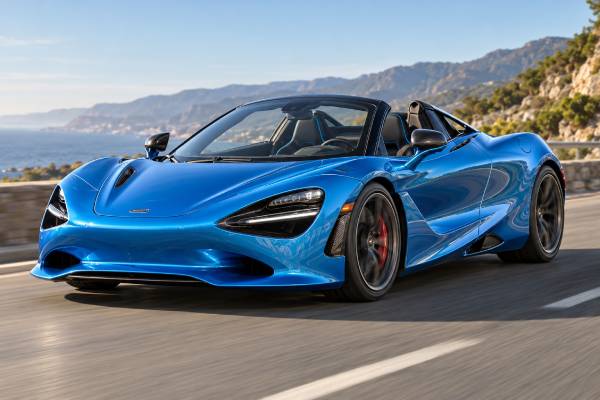
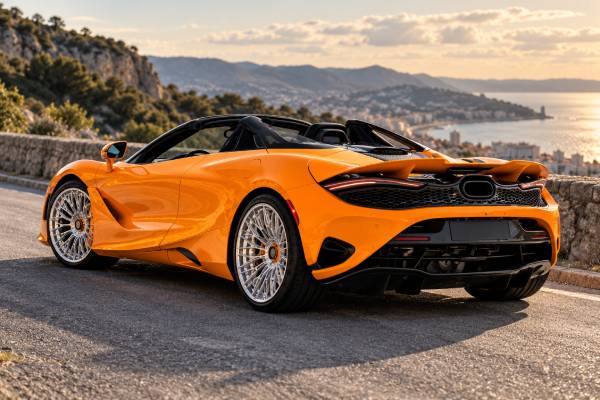
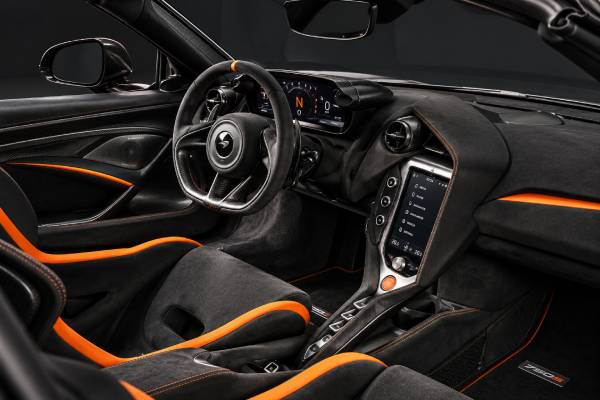
The 2025 McLaren 750S Spider DTM Collectors Model combines two very different ideas: the open-air usability of McLaren’s retractable-hard-top supercar and a six-car MSO programme celebrating Dörr Motorsport’s first full DTM season. Only three of the six DTM Collectors cars were Spiders. They retain the regular 750S Spider’s 740-bhp M840T V8, 800 Nm of torque and 11-second Retractable Hard Top, but add Anniversary Orange paint, Dark Chrome branding, DTM graphics, blue Dörr-team accents, #25 and #85 seat references, harnesses and a roll cage. The package also extended beyond the car itself, with Spider owners offered DTM experiences and collector items including a limited Dörr Motorsport watch, team clothing, a tailored racing suit, a dedicated helmet and vehicle artwork. That makes this variant unusual even by MSO standards. It is not simply a colour-and-badge edition, yet neither is it a mechanically uprated track special. A buyer has to evaluate three things separately: Spider roof and chassis condition, standard 750S mechanical health, and the authenticity and completeness of the tiny DTM collector package.
Table of Contents
- Three Spiders in a Six-Car Programme
- Open-Top Engineering Meets DTM Detailing
- Spider Technical Data and Performance
- Roof, Chassis, and Real-World Use
- Maintenance Points Specific to a Collector Spider
- Buying Checks for Provenance and Completeness
- Driving Versus Preserving This Edition
Three Spiders in a Six-Car Programme
The production story is unusually simple and unusually important: Dörr Motorsport’s DTM Collectors Model was limited to six McLaren 750S cars, split into three Coupés and three Spiders. For the Spider covered here, that makes the announced body-style allocation only three cars.
The edition was created with McLaren Special Operations and presented as a factory-designed, hand-finished programme rather than an aftermarket conversion. That distinction should influence how every used example is judged. A genuine car should be supported by a McLaren/Dörr paper trail, VIN-linked specification and the correct MSO details—not just orange paint and DTM decals.
Dörr’s racing context is the reason for the edition. The German team entered DTM with McLaren machinery and became the first team to field a McLaren in the championship. The road cars commemorate that relationship and the team’s first complete DTM season. The references are specific enough that a knowledgeable buyer can inspect them: numbers #25 and #85 connect to the team’s drivers, while blue interior accents represent Dörr Motorsport’s colours.
The Spider is especially interesting because it packages those motorsport cues into an open-top car rather than pretending to be a stripped race replica. McLaren’s carbon structure allows the roof to open without turning the car into a soft boulevard convertible. The Spider still delivers the same 750 PS and 800 Nm as the Coupé and shares the quoted 2.8-second 0–100 km/h time and 332 km/h top speed.
That parity does not mean the body styles are identical. The Spider’s roof mechanism and Monocage II-S structure add mass, and rear luggage capacity is reduced because of roof packaging. The special edition also carried a distinct owner package for Spider customers. Dörr publicized two DTM season tickets, driver instruction with a DTM driver, a tailored race suit, team clothing, a limited Franck Muller Dörr Motorsport watch, a dedicated helmet, attendance at Dörr events and track days, plus individualized artwork matched to the car.
For a collector, those associated items are not trivial. They can establish a richer provenance trail than a normal supercar possesses. If a seller claims a car is complete “as delivered,” the watch, helmet, artwork, clothing and documentary material should be discussed explicitly rather than assumed to have survived with the vehicle.
Open-Top Engineering Meets DTM Detailing
The Spider DTM model is visually loud but technically disciplined: MSO layered the team identity onto the existing 750S Spider architecture without changing the published engine output. The special features therefore need to be understood as provenance and specification, not confused with a hidden performance tune.
Anniversary Orange is the defining exterior colour. McLaren badges are treated in Dark Chrome, and a DTM signet is integrated into the carbon-fibre spoiler. The Anniversary Orange key also received special Dörr/DTM detailing, turning an everyday object into part of the collector set.
Inside, blue accents give the otherwise dark cockpit a direct connection to the Dörr team. The armrest carries embroidered DTM branding, while #25 and #85 are worked into the seats. These are useful authentication points because they are specific to the programme and should match period photographs and the car’s build documentation.
Harnesses and a roll cage add the strongest competition flavour. They also introduce practical questions that do not arise on every 750S Spider. Harness webbing should be inspected for abrasion, contamination and age, anchorage points should be checked for disturbance, and any cage padding or trim contact should be examined carefully. If a car was used on track, those areas may reveal use that an odometer alone cannot show.
The 12-speaker Bowers & Wilkins audio system remained part of the promoted specification. This is a clue to the edition’s intended character: Dörr and MSO were not trying to make a roofless GT3 car. The car keeps a luxury audio system, powered roof and road-friendly suspension while surrounding the driver with competition references.
The retractable hard top is itself a major part of the experience. McLaren quotes an opening or closing time of 11 seconds, operable at speeds up to 50 km/h (31 mph). With the roof lowered, the central exhaust and twin-turbo V8 are more immediate, and the special interior becomes more visible. With the roof raised, the Spider remains weather-secure and visually close to a fixed-roof supercar.
For long-term originality, inspect roof seals and body interfaces before cosmetic details. A collector-grade orange finish is valuable, but water ingress, roof misalignment or ignored mechanism faults can be far more expensive and can damage the very Alcantara and embroidery that make the edition special.
Spider Technical Data and Performance
The DTM Collectors Spider is an ICE-only, rear-wheel-drive supercar. Its M840T V8, seven-speed Seamless Shift Gearbox and Proactive Chassis Control III systems are the same core architecture as the series-production 750S Spider; the edition’s changes are specification, appearance and collector content rather than a published powertrain re-engineering programme.
| Specification | Value |
|---|---|
| Engine code | M840T |
| Configuration | 90° V8, longitudinal mid-engine |
| Displacement | 3,994 cc (4.0 L) |
| Induction | Twin electrically actuated twin-scroll turbochargers |
| Maximum power | 750 PS (740 bhp / 552 kW) at 7,500 rpm |
| Maximum torque | 800 Nm (590 lb-ft) at 5,500 rpm |
| Transmission | 7-speed Seamless Shift Gearbox with reverse |
| Drive | Rear-wheel drive |
| Measure | Value |
|---|---|
| 0–100 km/h (0–62 mph) | 2.8 seconds |
| 0–200 km/h (0–124 mph) | 7.3 seconds |
| Quarter mile | 10.3 seconds |
| Top speed | 332 km/h (206 mph) |
| 100–0 km/h braking | 30 m (98 ft) |
| 200–0 km/h braking | 113 m (371 ft) |
| Specification | Value |
|---|---|
| Body structure | Carbon-fibre Monocage II-S |
| Roof | Retractable Hard Top |
| Roof operating time | 11 seconds |
| Roof operation speed | Up to 50 km/h (31 mph) |
| Suspension | Double wishbone with adaptive dampers |
| Chassis control | Proactive Chassis Control III |
| Steering | Electro-hydraulic power-assisted |
| Differential | Open differential with Brake Steer |
| Specification | Value |
|---|---|
| Front brake discs | 390 mm carbon-ceramic |
| Rear brake discs | 380 mm carbon-ceramic |
| Front calipers | 6-piston forged aluminium |
| Rear calipers | 4-piston forged aluminium |
| Front wheels | 19 × 9.0J |
| Rear wheels | 20 × 11.0J |
| Front tyres | 245/35 R19 93Y XL |
| Rear tyres | 305/30 R20 103Y XL |
| Specification | Value |
|---|---|
| Length | 4,569 mm (179.9 in) |
| Width without mirrors | 1,930 mm (76.0 in) |
| Width with mirrors | 2,161 mm (85.1 in) |
| Height | 1,196 mm (47.1 in) |
| Wheelbase | 2,670 mm (105.1 in) |
| Lightest dry weight | 1,326 kg (2,923 lb) |
| DIN kerb weight | 1,438 kg (3,170 lb) |
| Front luggage capacity | 150 L |
| Rear luggage capacity | 58 L |
| Specification | Value |
|---|---|
| Fuel tank | 72 L (15.8 UK gal / 19.0 US gal) |
| WLTP combined fuel use | 12.2 L/100 km |
| WLTP combined CO₂ | 276 g/km |
The Spider is about 49 kg heavier than the lightest published Coupé figures, yet McLaren quotes the same 0–100 km/h and top speed. The 0–200 km/h and quarter-mile times are only marginally slower. That performance parity is part of the appeal: lowering the roof does not turn the DTM model into a softer grand tourer.
Roof, Chassis, and Real-World Use
The Retractable Hard Top is the most important mechanical difference between this car and the three DTM Coupés. It should be treated as a primary inspection item rather than a convenience feature to test at the end of a viewing.
Operate it multiple times from fully closed to fully open and back, following the handbook conditions. Watch both sides for synchronized movement, listen for unusual clicking or hydraulic/electric strain, and confirm the system reaches its latched state without warnings. Inspect seals for compression damage, dirt and signs of water tracking. Check the rear glass and surrounding trim for scratches caused by incorrect cleaning or adjustment.
A roof that works once during a sales demonstration is not necessarily healthy. If possible, inspect the car after rain or a careful water test and examine carpets, behind-seat areas and luggage spaces for moisture. Water staining in a three-car collector edition is not merely cosmetic; it can affect electronics and unique interior trim.
The Monocage II-S carbon structure is engineered to retain stiffness without relying on a conventional steel roof. This helps explain why the Spider remains so close to the Coupé dynamically. The 750S also benefits from McLaren’s hydraulically linked PCC III suspension, which controls body movement without making the road ride unnecessarily punishing.
Open-top driving changes the perceived performance more than the timing sheet suggests. With the roof down, the 4.0-litre V8 and sports exhaust sound more immediate, while turbo induction and wastegate noises become easier to hear. This can make modest road speeds feel more dramatic than they do in the Coupé.
At the same time, the DTM car’s harnesses and cage can make access and comfort more complex. Make sure the seating position, harness routing and normal road belt arrangement suit the intended use. Harnesses are not automatically the best restraint choice for every public-road situation, and local regulations can differ. Use the system exactly as approved for the car and market.
The Spider is also less practical behind the cabin: rear luggage capacity drops to 58 litres compared with the Coupé’s 210 litres. The 150-litre front compartment remains useful, so short touring is still realistic, but a buyer planning road trips should pack for the actual car rather than assuming Coupé capacity.
Maintenance Points Specific to a Collector Spider
The maintenance plan should give equal attention to the roof system, high-performance mechanicals and edition-specific trim. Neglect in any one area can undermine a car whose value comes from being exceptionally complete.
Time-based service matters even with very low mileage. Engine oil, brake fluid, coolant condition, 12-volt battery health and tyres all age while the car is parked. The official McLaren handbook and retailer service system should determine the exact VIN-specific schedule; do not rely on a generic supercar interval copied from another model.
For the roof, keep drains and seals clean, avoid harsh products that dry rubber, and do not force operation when battery voltage is weak. Low voltage can create roof or latch faults that mimic a mechanical failure. If the roof stops unexpectedly, follow the handbook rather than repeatedly cycling the switch.
For the drivetrain and chassis, inspect:
- engine and transmission fluid service history;
- radiator and cooler faces for debris or impact damage;
- PCC III hydraulic components for leakage;
- carbon-ceramic rotors and pads for track wear;
- tyre dates, inner shoulders and heat-cycle condition;
- steering alignment and wheel runout;
- front splitter and underside for contact damage;
- lift-system function where fitted.
A 750S Spider service campaign published through NHTSA also addressed door-sensor resealing and door-control-unit inspection on affected P28 Spider vehicles. Another campaign covered 750S software-platform updates, while a Federal-market HVAC-controls campaign addressed a possibility of unresponsive controls. These actions are VIN- and market-dependent; the correct practice is to obtain a retailer campaign printout for the specific car.
Recall status should likewise be checked by VIN. A 2025 brake-pipe recall in several markets included some early 750S vehicles, but a special edition should not be assumed affected simply because it shares the model name. Ask the retailer or national recall authority for the exact build’s status.
The DTM trim requires collector-minded care. Alcantara should be cleaned with products intended for it, embroidery should not be scrubbed aggressively, and Anniversary Orange keys should be protected from wear. If the harnesses need replacement for age or safety reasons, keep the original set labelled and documented if regulations permit. The same principle applies to any unique trim removed during service.
Buying Checks for Provenance and Completeness
A three-car Spider allocation makes authentication more important than ordinary model identification. Do not accept “DTM style,” orange paint or a dealer description as proof; build the evidence from VIN-linked documentation outward.
Start with the original invoice, MSO specification and supplying retailer. Confirm that the car was delivered as a Dörr Motorsport DTM Collectors Model. Compare current paint, badges, interior and race-style hardware with delivery photos. The most persuasive car will have a continuous record from new rather than a collection of loose claims assembled at resale.
Check the Anniversary Orange finish under several light sources. Paint-protection film can obscure chips and repairs, so ask when it was installed and whether panels were repainted first. Inspect carbon edges around the spoiler, doors, splitter and roof interfaces for cracks or mismatched clearcoat.
Inside, verify the #25/#85 seat details, blue accents, DTM armrest embroidery and cage/harness hardware. Look carefully for seat-bolster wear from climbing around the cage. A low odometer reading does not prevent localized wear if the car has been displayed, photographed and entered frequently.
Then inventory the collector package. For the Spider, period Dörr material listed a limited Franck Muller Dörr Motorsport watch, a dedicated helmet, tailored race suit, team clothing, DTM season tickets, driver training, track-day and Dörr event participation, and individualized artwork. Some experiences may have been consumed and tickets may be historical ephemera, but tangible items should be documented when a seller claims completeness.
Mechanical inspection should be as rigorous as it would be for any 750S. A good pre-purchase inspection includes diagnostic scans, roof cycles, steering and suspension checks, tyre and brake measurements, coolant-system inspection, active-aero operation, lift system, cameras, HVAC and infotainment. The vehicle should be driven from cold to full operating temperature if circumstances allow.
Finally, assess whether track use was maintained correctly. Evidence of circuit activity is unsurprising for a car sold with motorsport experiences. Look for responsible follow-up: frequent brake-fluid changes, fresh tyres, wheel inspection, alignment records and clean underbody condition. A seller who documents track days can be more reassuring than one who offers no evidence but insists the car was never used hard.
Driving Versus Preserving This Edition
The central ownership choice is not whether this Spider is collectible—it clearly is—but how to enjoy it without erasing the details that make it collectible. With only three announced Spiders, irreversible personalization carries a higher cost than it would on a series-production 750S.
Use reversible protection wherever possible. Quality paint-protection film can guard the Anniversary Orange nose and carbon splitter. Seat and sill care can reduce wear without changing materials. A battery maintainer and climate-conscious storage preserve the car mechanically rather than merely keeping mileage low.
Driving the car can also be part of preservation. Regular, properly warmed use circulates fluids, exercises seals and reveals developing faults before they become storage surprises. The goal should be disciplined operation, not artificial inactivity. Record mileage and service consistently so later owners can understand how the car was used.
If track days are part of the plan, consider using a separate set of appropriate wheels and tyres only if doing so is compatible with the vehicle and insurer, while storing the original edition wheels safely. Any such change should be reversible and documented. Do not modify cage, harness or airbag-related systems casually.
Insurance should recognize both the 750S Spider’s replacement cost and the scarcity of the DTM specification. Edition-specific trim, collector accessories and memorabilia may need to be listed separately under a specialist or agreed-value policy, depending on jurisdiction.
The Spider DTM Collectors Model ultimately works because its contrasts are genuine: DTM references alongside a powered roof, a roll cage alongside premium audio, and a three-car allocation built on a supercar capable of crossing countries comfortably. Buy it for that complete identity rather than expecting extra horsepower. Maintain the roof as carefully as the V8, preserve the Dörr/MSO details, and document everything that happens to the car. On an edition this small, those habits are part of ownership, not just preparation for resale.
The Spider’s bundled experiences and memorabilia also deserve a separate inventory from the vehicle itself. Dörr publicized a collector package that could include DTM access, driver training, tailored race equipment, team clothing, a limited watch, helmet, and participation in Dörr events. Some of those items may have been used, personalized, or non-transferable, so they should not automatically be assigned the same status as factory-installed parts. A seller describing a “complete” car should specify which physical items remain, which experiences were already consumed, and which documents establish what accompanied that particular Spider. Photographs of the delivery set can be especially useful years later.
For an owner who wants to drive the car, careful use is not incompatible with preservation. Apply paint protection without cutting into the original finish, keep the Anniversary Orange key and special accessories secure, use a second documented wheel set if frequent track work is planned, and record any reversible changes. After roof-down driving, clean dust from the cabin and inspect harness contact points rather than letting abrasive dirt build up on blue trim and Alcantara. Track use should be followed by a brake, tire, underbody, and fluid check appropriate to the intensity of the session. This creates a service history that explains wear instead of leaving a future buyer to guess.
The roof should also be exercised between long storage periods. Operate it only with healthy battery voltage and keep seals and drainage areas clean. If the car spends months in a collection, periodic functional checks of the roof, lift system, active rear wing, air conditioning, windows, and electronic controls are more useful than simply starting the engine for a few minutes. A preserved Spider should remain a fully functioning machine, not merely a low-mileage display object.
References
- Dörr Motorsport stellt exklusive DTM-Edition des McLaren 750S Spider vor 2025
- Dörr Motorsport presents exclusive McLaren 750S DTM Collectors Model 2025
- McLaren 750s Spider 2026
- McLaren Ownership – Owner’s Handbooks | McLaren Automotive 2026 (Owner’s Handbook)
- RESTRICTED 2024 (Service Campaign)
- Transport Canada Recall – 2025183 – MCLAREN 2025 (Recall Database)
Disclaimer
This article is for informational purposes only and does not replace professional diagnosis, repair, inspection, authentication, or valuation. Specifications, torque values, intervals, campaigns, roof procedures, and service requirements can vary by VIN, market, and equipment; verify the exact car against official McLaren documentation before maintenance or repair.
If this guide was useful, please consider sharing it on Facebook, X/Twitter, or with other McLaren enthusiasts to support our work.