

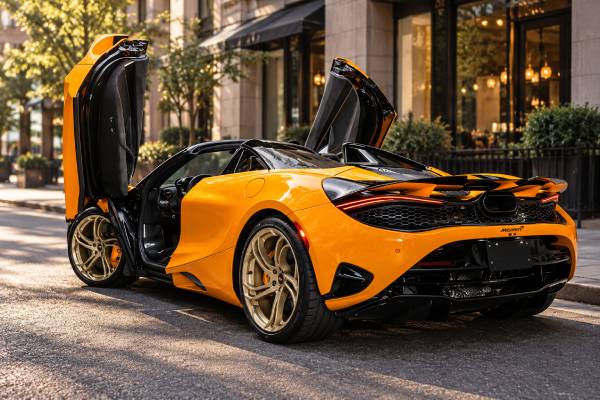
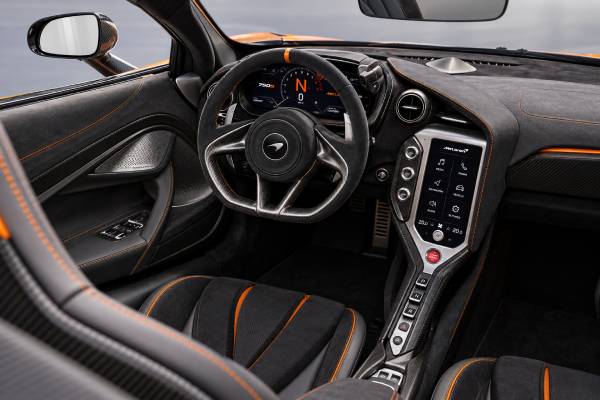
The 2025 McLaren 750S Spider MCL38 Celebration Edition is one of the most unusual ways to connect a road-going McLaren to a specific Formula 1 season. It combines the 750S Spider’s 11-second Retractable Hard Top and 740-bhp twin-turbo V8 with an MSO treatment created to celebrate McLaren Racing’s 2024 Constructors’ Championship. The exterior uses Papaya Orange and Anthracite inspired by the MCL38, while the cabin carries signatures from Lando Norris and Oscar Piastri, championship embroidery, a track-record plaque, and—most importantly—a dedication plaque containing genuine carbon-fibre bodywork from an MCL38 Formula 1 car. McLaren announced only nine 750S MCL38 Celebration Edition cars globally, but did not publicly state a Coupé-versus-Spider split. That point matters because some later descriptions casually call individual Spiders “one of nine Spiders,” which is not what the original launch wording established. For buyers, the right approach is precise: authenticate the individual Spider through its VIN and MSO records, verify the irreplaceable F1-related pieces, then inspect the roof and P28 mechanical systems as carefully as any other 750S.
Table of Contents
- What the Spider Adds to the MCL38 Story
- Championship Livery, Signatures, and Genuine F1 Carbon
- Technical Specifications for the MCL38 Spider
- Roof-Down Driving and Chassis Character
- Care for the Roof, Livery, and Collector Parts
- How to Buy One Without Overpaying for a Story
- Long-Term Ownership and Preservation Priorities
What the Spider Adds to the MCL38 Story
The Spider adds open-air theatre to an edition that is already built around Formula 1 symbolism. Mechanically it is not faster than the normal 750S Spider, but lowering the hard top makes the central exhaust note, turbo sounds and visual drama of the Papaya-and-Anthracite body far more immediate.
The programme itself was announced after McLaren secured the 2024 Formula 1 Constructors’ Championship at Abu Dhabi. That was the team’s ninth Constructors’ title and its first since 1998. Lando Norris and Oscar Piastri had combined for six Grand Prix wins and eight pole positions during the season, and those achievements became part of the road car’s physical specification rather than remaining marketing copy.
McLaren stated that nine MCL38 Celebration Edition Arturas and nine MCL38 Celebration Edition 750S cars would be produced. It did not publicly break the 750S figure into nine Coupés plus nine Spiders. Spider examples unquestionably exist, but the safest and most accurate description is that the Spider belongs to the nine-car 750S Celebration Edition allocation unless the individual factory build record provides a more specific body-style count.
That distinction is more than pedantry. Limited-production claims affect insurance, resale descriptions and collector value. A buyer should prefer factory documentation over a dealer’s “one of nine Spiders” headline if the two conflict.
The open-top body also changes practical ownership. McLaren’s Spider uses the carbon-fibre Monocage II-S structure and a powered Retractable Hard Top that opens or closes in 11 seconds at speeds up to 50 km/h. Unlike an older convertible that needs substantial steel bracing, the carbon tub carries the structural load efficiently, helping the Spider stay close to the Coupé dynamically.
The tradeoff is weight and storage. Published 750S Spider figures show a lightest dry weight of 1,326 kg and DIN kerb weight of 1,438 kg, around 49 kg above the equivalent Coupé numbers. Rear luggage capacity is reduced to 58 litres because of roof packaging, although the 150-litre front compartment remains.
For a collector, these open-top engineering features create more inspection points. Roof seals, latches, mechanisms and rear-glass alignment all matter in addition to the signed carbon and championship plaques. A rare livery cannot compensate for water ingress or an intermittently failing roof.
Championship Livery, Signatures, and Genuine F1 Carbon
The MCL38 Spider’s strongest collector feature is not its paint. It is the genuine section of 2024 MCL38 carbon fibre incorporated into the dedication plaque, giving each Celebration Edition a material connection to the Formula 1 car that won the title.
That makes the plaque more like an embedded piece of race memorabilia than a conventional serial plate. Its condition, mounting and documentary link to the car should be preserved carefully. If it is ever removed for interior service, photograph it in place first and make sure the workshop records the removal and refit.
The driver-side Visual Carbon Fibre Extended Sill Cover is also special because Norris and Piastri personally signed it. Because sills are naturally vulnerable to shoes, luggage and cleaning damage, owners should treat this area with more care than on a normal 750S. Protective film may be sensible if it can be installed without covering or chemically affecting the signatures.
The exterior livery translates the MCL38’s identity through Papaya Orange and Anthracite, with a chevron transition. Championship symbols include a Champions’ Laurel and a Nine-Star logo referring to the nine Constructors’ titles counted when the car was created. Additional orange accents include the bonnet stripe and brake-caliper treatment.
On the 750S, launch material also identified Papaya detailing on the mirrors and the leading edge of the front splitter. These small areas are valuable authentication clues. If a car has had front-end paintwork, the alignment and exact finish of those accents should be compared with original delivery photographs and the MSO specification.
Inside, the Champions’ Laurel appears on the headrest area. The steering wheel combines visible carbon fibre with a Papaya 12 o’clock marker and Papaya detailing around the clasp. The front luggage compartment carries a bespoke track-record plaque listing the MCL38’s poles, wins and fastest laps from 2024.
The livery is not a wrap in the sense of a temporary dealer graphic package; it is part of the MSO identity of the car. That should influence detailing decisions. Paint correction around transitions, logos and edges should be done conservatively, and any PPF installer should understand the car before placing seams or using blades.
Owners should create a digital provenance file early. Include high-resolution images of signatures, carbon insert, plaques, paint transitions, headrest embroidery, wheel finishes and key details, plus scans of the original invoice, MSO build specification and delivery documents. On a nine-car 750S programme, that record can be as important as the odometer in establishing future confidence.
Technical Specifications for the MCL38 Spider
The Celebration Edition keeps the normal 750S Spider’s internal-combustion layout: a 3,994 cc M840T twin-turbo V8, rear-wheel drive and seven-speed Seamless Shift Gearbox. McLaren did not publish an MCL38-specific power increase, so 750 PS (740 bhp) and 800 Nm remain the correct figures. The edition’s unique engineering content is primarily its MSO specification and F1-derived artefacts, not a separate engine tune.
| Specification | Value |
|---|---|
| 750S MCL38 programme | 9 cars globally across the announced 750S allocation |
| Body style covered here | Spider |
| Commemorated title | 2024 Formula 1 Constructors’ Championship |
| MSO colours | Papaya Orange and Anthracite |
| Signed component | Driver-side Visual Carbon Fibre Extended Sill Cover |
| F1 artefact | Dedication plaque incorporating genuine MCL38 carbon fibre |
| Record display | Track-record plaque in front luggage compartment |
| Specification | Value |
|---|---|
| Engine code | M840T |
| Engine type | 90° V8, 3,994 cc |
| Induction | Twin electrically actuated twin-scroll turbochargers |
| Lubrication | Dry sump |
| Maximum power | 750 PS (740 bhp / 552 kW) at 7,500 rpm |
| Maximum torque | 800 Nm (590 lb-ft) at 5,500 rpm |
| Transmission | 7-speed Seamless Shift Gearbox with reverse |
| Drive layout | Longitudinal mid-engine, rear-wheel drive |
| Specification | Value |
|---|---|
| Body structure | Carbon-fibre Monocage II-S |
| Roof type | Retractable Hard Top |
| Roof cycle time | 11 seconds |
| Roof operation | Up to 50 km/h (31 mph) |
| Suspension | Double wishbone, adaptive dampers |
| Chassis system | Proactive Chassis Control III |
| Steering | Electro-hydraulic power-assisted |
| Differential | Open differential with Brake Steer |
| Measure | Value |
|---|---|
| 0–100 km/h (0–62 mph) | 2.8 seconds |
| 0–200 km/h (0–124 mph) | 7.3 seconds |
| Quarter mile | 10.3 seconds |
| Top speed | 332 km/h (206 mph) |
| 100–0 km/h braking | 30 m (98 ft) |
| 200–0 km/h braking | 113 m (371 ft) |
| Specification | Value |
|---|---|
| Front wheels | 19 × 9.0J |
| Rear wheels | 20 × 11.0J |
| Front tyres | 245/35 R19 93Y XL |
| Rear tyres | 305/30 R20 103Y XL |
| Front brakes | 390 mm carbon-ceramic discs, 6-piston aluminium calipers |
| Rear brakes | 380 mm carbon-ceramic discs, 4-piston aluminium calipers |
| Specification | Value |
|---|---|
| Length | 4,569 mm (179.9 in) |
| Width without mirrors | 1,930 mm (76.0 in) |
| Width with mirrors | 2,161 mm (85.1 in) |
| Height | 1,196 mm (47.1 in) |
| Wheelbase | 2,670 mm (105.1 in) |
| Lightest dry weight | 1,326 kg (2,923 lb) |
| DIN kerb weight | 1,438 kg (3,170 lb) |
| Fuel tank | 72 L |
| WLTP combined fuel use | 12.2 L/100 km |
| WLTP combined CO₂ | 276 g/km |
| Luggage capacity | 150 L front, 58 L rear |
These standard Spider figures are the right baseline unless the specific build documentation states otherwise. Optional seats, audio and MSO content can change an individual car’s actual mass, so the published lightest dry figure should not be presented as a measured weight for every MCL38 Spider.
Roof-Down Driving and Chassis Character
The MCL38 treatment changes the sense of occasion far more than the fundamental dynamics. With the roof raised, the car feels like a 750S Spider with a highly special cockpit; with it lowered, the championship livery and central exhaust turn every drive into a much more public experience.
Performance remains startling. The shorter final drive introduced on the 750S makes the car especially urgent through the lower and middle gears, while 800 Nm arrives without the laggy, old-school character associated with early turbo supercars. Launch control can deliver the headline acceleration, but the more relevant road trait is how quickly the car responds from ordinary speeds.
McLaren’s electro-hydraulic steering gives a level of surface detail uncommon in modern rivals. For an owner, that means tyre choice and condition matter. A car stored for months can develop temporary or persistent flat spotting that is immediately noticeable through the wheel. Before diagnosing steering or suspension hardware, check tyre dates, pressures and runout.
PCC III suspension helps the Spider avoid the brittle ride that many people expect from a 206-mph car. Hydraulically linked adaptive dampers manage roll while allowing wheel movement over rough surfaces. Comfort mode can therefore be genuinely usable on a road trip, while Sport and Track progressively tighten body control.
Roof-down aerodynamics are designed into the car, but occupants still experience more wind and sound than in the Coupé. Try the car at several road speeds to make sure the roof, windows and rear glass behave correctly. Unusual buffeting, whistles or rattles can point to seal or alignment issues.
Open-top use also exposes the unique cabin to sunlight, dust and handling. Papaya details, Alcantara and signed carbon can deteriorate faster if the car is routinely parked roof-down in direct sun. Treat the cabin like a collectible interior rather than a disposable trim set.
The Spider’s lower rear luggage capacity affects touring more than performance. Use the front compartment for structured luggage and avoid placing objects where they can contact special sill or seat trim. Owners who travel with the car often should develop a loading routine that protects the signed driver-side area.
Care for the Roof, Livery, and Collector Parts
The maintenance priorities form a triangle: keep the conventional 750S systems current, keep the Retractable Hard Top healthy, and preserve the one-off championship components without over-restoring them.
For the roof, cycle it regularly under the handbook’s conditions, keep seals clean and inspect drains. A battery that is weak enough to cause slow operation can trigger warnings or incomplete cycles, so maintain the 12-volt system properly during storage. Never force panels by hand unless the official emergency procedure specifically instructs it.
Mechanical servicing should follow the VIN-specific schedule. For low-mileage cars, time can be more important than distance. Engine oil and filter, brake fluid, coolant condition, tyre age and the battery all need attention even if the odometer barely changes. Cars used on track or driven hard should be inspected more frequently for pads, carbon-ceramic rotors, tyre heat cycles and fluid condition.
Software also matters. McLaren has issued 750S platform-update service campaigns, and Federal-market vehicles have had targeted campaigns for items such as HVAC-control behaviour. Spider-specific service material has addressed door-sensor sealing and door-control-unit inspection on affected cars. These actions are not proof that every Celebration Spider needs the work; they are reasons to obtain a VIN-specific retailer campaign report.
The livery should be washed with safe techniques that minimize scratching and edge wear. If paint-protection film is installed, use a specialist familiar with low-volume MSO finishes. Ask the installer to photograph the paint before covering it, because future buyers may otherwise wonder whether film hides repairs.
Do not polish over driver signatures or use solvents around the MCL38 plaque. If the signed sill becomes scratched, consult McLaren before refinishing. Preserving a minor mark may be preferable to removing original signatures in pursuit of a cosmetically perfect surface.
The genuine F1 carbon insert deserves documentation even if it never moves. Photograph it at each major service inspection and note any repair or interior disassembly near the plaque. If the car changes owners, include those images with the provenance file.
Tyres are another age-sensitive component. Deep tread does not make a six- or seven-year-old ultra-high-performance tyre ideal for a 740-bhp car. Replace by condition and age according to manufacturer guidance, and preserve invoices showing the exact specification fitted.
How to Buy One Without Overpaying for a Story
The market for a nine-car 750S programme cannot be analysed like a normal used-car market. There may be too few public transactions to establish a stable premium, so buyers need to value the individual car rather than rely on broad asking-price trends.
First, verify what is being sold. Request the VIN, original sales invoice, MSO build specification and any certificate or delivery paperwork. Confirm that the car is a factory MCL38 Celebration Edition Spider, not a standard 750S Spider later wrapped in similar colours.
Second, separate supported rarity claims from sales language. The supported figure is nine 750S MCL38 Celebration Edition cars globally. If a seller says “one of nine Spiders,” ask for the document proving that body-style allocation. Accuracy protects both buyer and seller.
Third, inspect the F1-related components before becoming distracted by mileage. Verify:
- the dedication plaque and genuine MCL38 carbon section;
- the signed driver-side carbon sill;
- the track-record plaque in the front luggage compartment;
- Champions’ Laurel headrest detail;
- Nine-Star and championship exterior graphics;
- Papaya mirror/front-splitter accent treatment;
- carbon steering wheel and Papaya 12 o’clock marker.
Fourth, inspect the Spider-specific hardware. Run the roof several times, test windows and rear glass, check seals and carpets for water traces, and listen for unusual roof noises. Scan all control modules for stored faults. A rare special edition is still a complex machine.
Fifth, assess the normal 750S consumables. Carbon-ceramic brakes, high-performance tyres, wheels and suspension parts are expensive. A seller may emphasize collectible status while ignoring old tyres or worn brakes because the car has low mileage. Condition, not mileage alone, should drive the budget.
Finally, compare the whole provenance package. A car with modest mileage, complete documents, perfect signatures and continuous servicing may be stronger than an almost undriven example that changed dealers repeatedly and lost paperwork. With so few cars, transparency is a value feature.
Long-Term Ownership and Preservation Priorities
The ideal owner will use the Spider enough to keep it mechanically healthy while treating the MSO and Formula 1 components as irreplaceable. That balance is more sustainable than either extreme of daily neglect or permanent museum storage.
A climate-controlled garage, correct battery maintainer and sensible tyre management are foundational. Keep direct sunlight off the cabin during long storage. If the car sits for extended periods, consult a specialist about tyre loading and do not rely on occasional short idling sessions to “exercise” the drivetrain.
When driving, let fluids reach temperature before high load. The M840T is designed for enormous performance, but cold oil and immediate boost are poor habits in any high-output engine. After hard use, allow temperatures to stabilize and inspect tyres and brakes rather than parking the car indefinitely.
Maintain a collector log separate from the service book. Record roof maintenance, PPF installation, software updates, recalls, tyre changes, wheel refinishing, detailing and any movement of the special plaques or sill trim. Save every replaced original component if practical.
Insurance should specifically account for the Celebration Edition specification. Agreed-value or specialist policies may be appropriate, and the MCL38 carbon plaque and signed trim should be included in the documented inventory. Track use usually needs separate coverage.
Avoid modifications that erase the original story. Exhaust changes, aftermarket wheels or reversible protection can be undone, but cutting carbon, changing the livery or retrimming signed components cannot. If personalization is essential, choose reversible parts and retain originals in labelled storage.
The Spider makes the championship celebration more theatrical than the Coupé, but its appeal is still grounded in accuracy. It is a 750S road car with 740 bhp, not a detuned Formula 1 machine. What makes it rare is the MSO design, the nine-car 750S programme, the signatures, the recorded 2024 achievements and the genuine piece of MCL38 carbon. Preserve those elements and maintain the roof and chassis properly, and the car can remain both a compelling open-air supercar and a credible artifact of McLaren’s return to the top of the Constructors’ standings.
Open-top use creates one more preservation question for the Celebration Edition: how to enjoy the signatures, special upholstery, and championship graphics without accelerating UV and handling damage. When parked for extended periods, raising the roof and avoiding strong direct sunlight reduces exposure on the signed sill area, headrests, and interior surfaces. Cleaning should be conservative; aggressive solvents, dressings, or polishing around printed, painted, signed, or plaque surfaces can alter the very details that establish the car’s identity. Before any detailing correction, photograph the condition and make sure the technician understands which marks are original design elements rather than defects to remove.
A roof-down car also brings more dust and airborne grit into the cabin. Vacuum gently before wiping Alcantara or carbon surfaces so particles are not dragged across them. If the Spider is used for celebratory events or track gatherings, document that use and inspect the sill, seat bolsters, headrests, and plaque afterward. Honest, traceable use is easier to evaluate than unexplained cosmetic restoration, particularly on an edition whose value depends heavily on original championship-specific components.
References
- Ultra-exclusive MCL38 Celebration Edition Artura and 750S supercars honour McLaren’s ninth Formula 1 Constructors’ Championship win 2025
- McLaren Special Operations (MSO) – Bespoke McLaren Cars 2026
- McLaren 750s Spider 2026
- McLaren Ownership – Owner’s Handbooks | McLaren Automotive 2026 (Owner’s Handbook)
- RESTRICTED 2024 (Service Campaign)
- Check for Recalls: Vehicle, Car Seat, Tire, Equipment | NHTSA 2026 (Recall Database)
Disclaimer
This article is for informational purposes only and is not a substitute for professional diagnosis, repair, inspection, authentication, or valuation. Specifications, torque values, intervals, campaigns, and roof procedures can vary by VIN, market, and equipment; verify all work against official McLaren service documentation for the exact car.
If this article was useful, please consider sharing it on Facebook, X/Twitter, or with other McLaren and Formula 1 enthusiasts to support our work.