
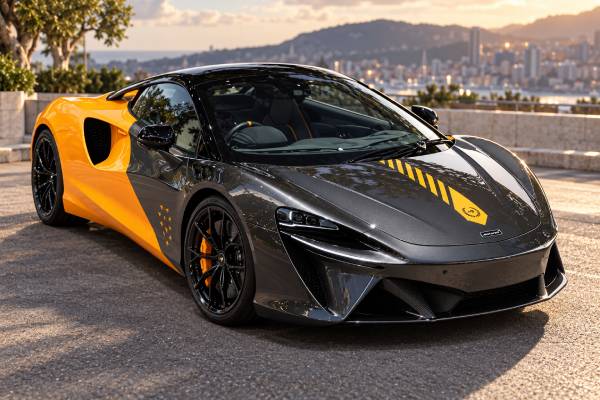
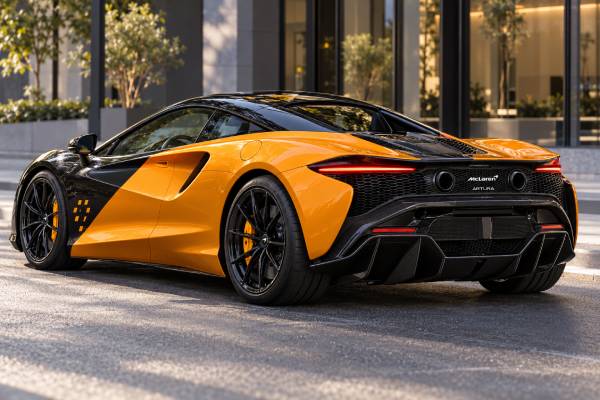
The 2025 McLaren Artura MCL38 Celebration Edition is a factory-backed McLaren Special Operations tribute to the MCL38 Formula 1 car that delivered McLaren’s ninth Constructors’ Championship in 2024. Mechanically, it remains the updated 700 PS (690 bhp) Artura: a rear-wheel-drive plug-in hybrid coupe using the M630 3.0-liter twin-turbo V6, an axial-flux e-motor, a 7.4 kWh battery, and an 8-speed dual-clutch transmission. Its rarity comes from MSO craftsmanship, championship-specific graphics, signed carbon-fiber sill trim, and genuine MCL38 race-car carbon incorporated into a dedication plaque.
The production detail deserves care. McLaren announced nine MCL38 Celebration Edition Arturas and nine 750S cars, not nine Artura coupes plus another nine Spiders. The Artura program could encompass Coupe and Spider executions depending on customer and market specification. This guide focuses specifically on the fixed-roof P16 Artura assignment, while keeping the published nine-car Artura total intact. For a collector, provenance and originality are therefore as important as the underlying supercar’s mechanical condition.
Table of Contents
- Why the MCL38 Celebration Edition exists
- What MSO changed on the Artura
- MCL38 Artura specifications and technical data
- How the championship details should be read
- Driving, charging, and real-world use
- Authenticity, provenance, and value factors
- Maintenance and preservation for a rare Artura
Why the MCL38 Celebration Edition exists
The MCL38 Celebration Edition exists to mark McLaren Racing’s 2024 Formula 1 Constructors’ Championship, the team’s ninth such title and its first since 1998. McLaren tied the road car directly to that season rather than creating a generic “motorsport” trim.
The MCL38 race car, driven by Lando Norris and Oscar Piastri, accumulated six Grand Prix victories and eight pole positions during the championship-winning campaign. The road-car edition uses those achievements as physical design content: a track-record plaque in the front luggage compartment records the MCL38’s season statistics, while a separate dedication plaque contains a genuine piece of carbon-fiber bodywork from an MCL38 Formula 1 car.
The number nine is repeated deliberately. McLaren limited the MCL38 Celebration Edition to nine Arturas and nine 750S examples because the 2024 championship was the constructor’s ninth title. A Nine-Star motif and Champions’ Laurel graphics reinforce that link.
For the Artura, the timing is also significant. The special edition uses the revised-generation 700 PS powertrain introduced alongside the Artura Spider, not the earlier 680 PS/671 bhp launch calibration. That means the commemorative specification combines the modernized Artura mechanical package with MSO’s championship treatment.
This is not a homologation special and not a higher-output track derivative. There is no published special engine tune, unique gear ratio, extra battery capacity, or altered top speed specific to the MCL38 Celebration Edition. Its importance lies in scarcity, factory provenance, hand-applied detailing, and direct material connection to the title-winning F1 car.
That distinction matters in the used market. A visually similar Artura wrapped in Papaya Orange and Anthracite is not equivalent to an MCL38 Celebration Edition. The factory build record, MSO documentation, dedicated plaques, driver-signed trim, and edition-specific finish collectively establish identity.
What MSO changed on the Artura
MSO changed the Artura’s visual specification and collectible content, while leaving the core 690 bhp hybrid drivetrain and chassis architecture intact. The centerpiece is the bespoke Papaya Orange and Anthracite livery inspired by the MCL38 race car.
The paint treatment uses the chevron-style color transition associated with McLaren’s racing identity. The bonnet carries an orange stripe incorporating the Champions’ Laurel, while additional orange accents appear on the brake calipers. Nine-Star graphics identify the championship count without relying on a conventional numbered-edition badge as the only marker.
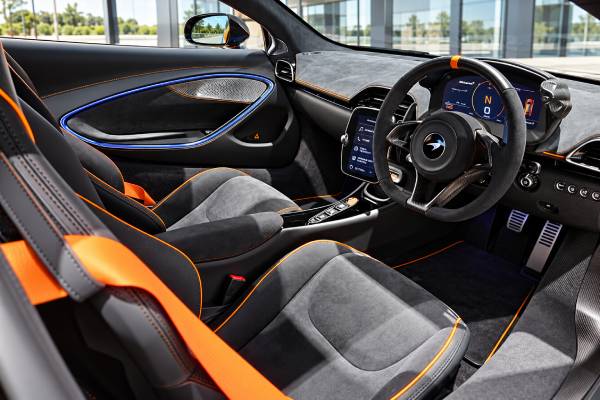
Inside, the driver-side Visual Carbon Fibre Extended Sill Cover is personally signed by Lando Norris and Oscar Piastri. That signed component is one of the most important authenticity items on the car because it is both edition-specific and vulnerable to cosmetic damage or later replacement. The headrest area carries a Champions’ Laurel, and the steering wheel receives a Papaya 12 o’clock marker.
Two plaques elevate the car above a normal cosmetic special edition. The MCL38 dedication plaque includes an authentic section of Formula 1 bodywork from an MCL38. A separate track-record plaque in the front storage area records the race car’s pole positions, victories, and fastest laps from 2024.
The combination makes originality unusually important. Repainting a damaged panel may restore appearance, but it can reduce the evidentiary value of an original MSO finish. Replacing a signed sill with a standard carbon component may fix damage, but it removes a defining part of the edition. Even routine detailing should therefore be approached with the preservation mindset used for a collectible rather than an ordinary used performance car.
Owners should also distinguish edition features from options that could appear on a regular Artura. Carbon trim, colored calipers, upgraded audio, specific seats, and many personalization choices can exist outside the Celebration Edition. The championship-specific combination and factory record are what matter.
MCL38 Artura specifications and technical data
The fixed-roof MCL38 Celebration Edition uses the updated Artura PHEV package: a 120-degree 3.0-liter V6, one axial-flux motor, refrigerant-cooled 7.4 kWh lithium-ion battery, 8-speed SSG transmission, and rear-wheel drive. The special edition does not carry a separately published performance tune, so the correct mechanical baseline is the 700 PS/690 bhp Artura Coupe specification.
| Specification | Value |
|---|---|
| Engine | M630 120° V6, 2,993 cc (3.0L) |
| Engine technology | Twin electrically actuated turbochargers, dry sump |
| Electric motor | Axial-flux traction motor |
| E-motor contribution | Up to 95 PS and 225 Nm (166 lb-ft) |
| Battery | Refrigerant-cooled lithium-ion, 7.4 kWh |
| Combined output | 700 PS (690 bhp / 515 kW) |
| Combined torque | 720 Nm (531 lb-ft) |
| Drive layout | Longitudinal mid-engine, rear-wheel drive |
| Measure | Factory figure |
|---|---|
| 0–100 km/h (0–62 mph) | 3.0 seconds |
| 0–200 km/h (0–124 mph) | 8.3 seconds |
| 0–300 km/h (0–186 mph) | 21.5 seconds |
| Quarter mile | 10.7 seconds |
| Top speed | 330 km/h (205 mph) |
| 100–0 km/h braking | 31 m (101.7 ft) |
| 200–0 km/h braking | 124 m (406.8 ft) |
| Specification | Value |
|---|---|
| Transmission | 8-speed + E-Reverse Seamless Shift Gearbox (SSG) |
| Reverse drive | Traction motor provides electric reverse |
| Differential | Electronically locking rear differential |
| Body structure | McLaren Carbon Fibre Lightweight Architecture (MCLA) |
| Front suspension | Double wishbone |
| Rear suspension | Multi-link |
| Damping | Proactive Damping Control |
| Steering | Electro-hydraulic power assistance |
| Specification | Value |
|---|---|
| Lightest dry weight | 1,395 kg (3,075 lb) |
| DIN kerb weight | 1,498 kg (3,303 lb) |
| Length | 4,539 mm (178.7 in) |
| Wheelbase | 2,640 mm (103.9 in) |
| Height | 1,193 mm (47.0 in) |
| Front track | 1,650 mm (65.0 in) |
| Rear track | 1,613 mm (63.5 in) |
| Front luggage capacity | 160 L (5.7 cu ft) |
| Specification | Value |
|---|---|
| Front brakes | 390 mm carbon-ceramic discs, 6-piston aluminum calipers |
| Rear brakes | 380 mm carbon-ceramic discs, 4-piston aluminum calipers |
| Front wheel size | 19 × 8.5J |
| Rear wheel size | 20 × 10.5J |
| Front tire size | 235/35 R19 |
| Rear tire size | 295/35 R20 |
| Tire families | Pirelli P Zero and P Zero Corsa McLaren applications |
| Specification | Value | Standard or condition |
|---|---|---|
| Official electric range | 33 km (21 mi) | EU WLTP |
| Fuel consumption | 4.8 L/100 km (58.9 mpg UK) | EU WLTP weighted figure |
| CO₂ emissions | 108 g/km | EU WLTP figure published by McLaren |
| Fuel tank | 65 L (17.14 U.S. gal) | Factory specification |
| Battery capacity | 7.4 kWh | Manufacturer-published pack figure |
The WLTP figures above are useful for comparing the official European specification, but they are not guarantees for a collector car driven infrequently. Temperature, battery state, tire choice, trip length, and powertrain mode can change real-world fuel and electric performance substantially.
The updated Artura hardware also matters because the Celebration Edition arrived after McLaren had revised the standard car in several ways. The extra 20 PS over the original 680 PS specification comes from combustion-engine calibration; the e-motor remains the compact 95 PS unit. The change is concentrated toward the upper part of the rev range, so the car keeps the same 720 Nm combined torque figure but pulls harder as the V6 approaches its power peak.
Transmission behavior was also sharpened on the updated Artura. McLaren introduced a hydraulic pre-fill strategy intended to reduce shift time by preparing the clutch and transmission pressure before the requested change. That is important in a collector context because a Celebration Edition should still be assessed as a functioning high-performance car: hesitant shifts, driveline warnings, or inconsistent engagement are not characteristics to dismiss simply because the example is rare.
The chassis calibration was revised alongside the powertrain generation used by the edition. McLaren increased the response rate of the adaptive damping system and refined engine and transmission mounting to make the car feel more connected without turning it into a harsh track-only derivative. The electro-hydraulic steering remains central to the driving experience, while the electronically locking differential manages rear-axle traction without converting the Artura to all-wheel drive.
The published dry and DIN weights are standard Artura Coupe figures rather than a separately homologated MCL38 Celebration Edition weight. Bespoke paint and trim can alter an individual car’s mass slightly, so it would be misleading to claim a unique edition curb weight without a factory figure for the exact chassis. The same caution applies to downforce, wheel weight, and acceleration: use the regular 700 PS Coupe values unless McLaren documentation for a particular car states otherwise.
How the championship details should be read
The MCL38 graphics are not random decorative elements; each one points to a specific part of the 2024 season or McLaren’s championship count. Understanding those details helps distinguish an authentic car from a later visual imitation.
The Papaya Orange and Anthracite palette echoes McLaren Racing’s contemporary identity. The chevron transition carries the visual language of the race livery into a road-car surface without attempting to reproduce every sponsor graphic. That makes the car recognizable as a championship tribute while still looking like an MSO road-car commission.
The Champions’ Laurel is a direct victory symbol. It appears on the bonnet stripe and in the cabin, tying exterior and interior together. The Nine-Star motif records the total number of Constructors’ Championships McLaren had won after the 2024 season.
The driver signatures are more personal. Norris and Piastri contributed the points that secured the title, so their signatures on the carbon sill connect the production car to the actual driver pairing. Because signatures can fade, scratch, or be damaged by aggressive cleaning, an owner should photograph them at delivery and avoid abrasive products.
The track-record plaque is effectively a season ledger. It is more informative than a generic “limited edition” badge because it describes what the MCL38 achieved. The genuine race-car carbon in the dedication plaque goes further: it places material from the competition car inside the customer car. For provenance, documentation showing that the plaque belongs to the specific chassis should remain with the vehicle.
Collectors should resist the temptation to “improve” these elements. Re-clearing a signed sill, refinishing a plaque, repainting a livery section without MSO documentation, or replacing an original component with a cosmetically better generic part can create uncertainty later. Conservation and traceability are usually more valuable than cosmetic perfection on an edition this small.
Driving, charging, and real-world use
On the road, the MCL38 Celebration Edition should drive like the updated 690 bhp Artura Coupe because McLaren did not publish edition-specific mechanical changes. That means its character comes from low mass, hydraulic steering assistance, adaptive damping, the e-differential, and a hybrid system designed for response rather than long EV range.
The 2024 update increased combined output from 680 PS to 700 PS through revised combustion-engine calibration. Maximum system torque remained 720 Nm. McLaren also introduced broader Artura updates, including faster transmission behavior and revised dynamic systems, so the Celebration Edition sits on the more mature mechanical specification rather than the first launch calibration.
The motor’s role is immediate torque fill. It helps the car respond before the turbocharged V6 reaches the strongest part of its rev range. Because all drive still goes to the rear axle, the Artura retains the traditional balance of a mid-engine rear-drive supercar instead of using an electric front axle to create all-wheel drive.
The 7.4 kWh battery supports short electric operation. A fully charged battery can make urban departure and arrival quiet, but the Artura remains a supercar first. Owners who preserve the vehicle as a collectible should still cycle it correctly rather than leaving it permanently static. Mechanical seals, tires, braking surfaces, cooling systems, and the high-voltage battery all benefit from appropriate use and maintenance.
Charging is best treated as part of storage routine. Use approved charging equipment, follow McLaren guidance for long-term storage, and avoid improvising with unsupported chargers or adapters. Before a long drive, starting with a healthy state of charge gives the hybrid system maximum flexibility.
A special edition also changes the psychology of use. Driving miles are not inherently harmful if servicing and cosmetic care are excellent. In fact, an ultra-low-mileage car with stale tires, weak batteries, old fluids, and unresolved campaigns may be less appealing mechanically than a properly exercised example. The goal is documented, controlled use.
Authenticity, provenance, and value factors
For this Artura, authenticity should be established before discussing price. A standard 2025 Artura can duplicate much of the performance and can be personalized with orange paint and carbon trim, but it cannot reproduce the factory MCL38 build history.
A serious inspection should verify the chassis against McLaren or an authorized retailer’s records. Ask for the original sales invoice, MSO specification sheet, build documentation, handover material, keys, charging equipment, books, service invoices, and any event or championship-related items delivered with the car.
Pay special attention to the following edition-specific evidence:
- The correct bespoke Papaya Orange and Anthracite painted livery.
- Champions’ Laurel and Nine-Star graphics in the expected locations.
- Driver-signed Visual Carbon Fibre Extended Sill Cover.
- MCL38 dedication plaque incorporating genuine race-car carbon.
- Track-record plaque in the front luggage compartment.
- Papaya 12 o’clock steering-wheel marker.
- Correct factory brake-caliper and trim specification.
- Documentation linking the MSO content to the VIN.
Condition should be judged differently from a regular used Artura. Paint-protection film can be a positive if it was installed cleanly and has not damaged the finish, but old film can discolor or lift edges. Check for cut marks from poor installation around hand-painted graphics. Inspect the lower body, splitter, sill edges, wheels, and carbon components for road damage without assuming every mark justifies refinishing.
Mileage is only one value factor. Originality, complete paperwork, championship provenance, number of owners, accident history, paint history, service continuity, storage quality, and market location may matter more. Because so few Artura Celebration Editions exist, conventional price guides are unlikely to capture transaction value well.
The nine-car Artura total also means body style must be documented precisely. Do not accept an advertisement claiming a production count that treats the Coupe and Spider as separate nine-car runs unless factory evidence supports that specific claim. The safest description is the one McLaren published: nine MCL38 Celebration Edition Arturas in the program.
A buyer should also establish whether any parts were removed for preservation. It is common for owners of limited-run cars to store original floor mats, sill protectors, license-plate hardware, or delivery accessories and use substitutes on the road. That is reasonable when it is documented, but every loose component should be inventoried and matched to the car before money changes hands.
Transport history can reveal useful clues. A Celebration Edition may have traveled to displays, dealer launches, concours events, or private collections. Enclosed transport is normal, yet repeated loading can mark splitters, jacking points, wheel rims, and undertrays. Ask where the car has been shown and compare that history with the physical condition. A nearly zero-mile odometer does not prove that a car has never been moved, loaded, or cosmetically repaired.
The paint deserves inspection under strong, diffuse lighting by someone familiar with hand-finished MSO cars. A paint-depth gauge can help, but readings on carbon and multi-layer bespoke finishes require interpretation; they are not a pass/fail test. Look for texture changes, masking lines, overspray, altered graphic edges, or inconsistencies around fasteners. If a panel was repaired by an authorized facility, documented high-quality work may be preferable to an untouched panel with unrepaired damage.
Ownership records should identify any software campaigns or mechanical updates performed after delivery. Because the underlying Artura is software-intensive, a factory update can be routine and desirable. What matters is traceability: the invoice should show what was done, when, and by whom. An undocumented “reset” of faults is far less reassuring than a properly diagnosed repair.
For insurance and agreed-value coverage, provide the insurer with the MSO build sheet and evidence of the edition’s rarity. A generic Artura valuation may not reflect the cost of replacing hand-painted or championship-specific components. Confirm how the policy treats diminished value, paint matching, genuine MSO parts, and transport to an authorized repair facility before a claim ever occurs.
Maintenance and preservation for a rare Artura
Maintenance should protect both the Artura’s mechanical systems and its irreplaceable MSO content. Skipping service because the car covers few miles can be a false economy; time-based fluid, battery, tire, and inspection needs still exist.
Use an authorized McLaren retailer or a specialist with current diagnostic capability. The PHEV system integrates a high-voltage battery, inverter electronics, motor, combustion engine, dual-clutch transmission, cooling circuits, and software-controlled chassis systems. Proper fault diagnosis requires more than a generic scan tool.
Before storage, clean the car carefully but avoid aggressive compounds on signatures, plaques, decals, or hand-painted transitions. Record the condition with detailed photographs. Keep all removed original parts if a reversible accessory or protective component is fitted.
Tires deserve special attention on low-mileage cars. Age hardening, flat spotting, sidewall damage, and loss of grip can occur long before the tread reaches its legal minimum. A collector who wants to preserve original tires for display should use a fresh approved set for actual high-speed driving and store the originals correctly.
Carbon-ceramic brakes need inspection for chips, heat damage, and wear. Wheels should be checked for impact damage, especially on cars transported frequently or driven on poor roads. A small cosmetic defect can be repaired, but any repair should be documented because future buyers will ask.
Battery management is equally important. Follow the official storage procedure for both the high-voltage system and the car’s low-voltage electrical supply. Avoid allowing the car to sit for months with unresolved warning messages. If a fault appears, document the diagnosis and repair rather than clearing codes and hoping they do not return.
Finally, preserve the paper trail. A binder or digital archive should contain invoices, campaign records, software work, tire replacements, paint-protection work, transport records, photos of the signed sill, and any McLaren correspondence. On a normal Artura, good records support resale. On one of nine MCL38 Celebration Edition Arturas, they help prove what the car is.
References
- Ultra-exclusive MCL38 Celebration Edition Artura and 750S supercars honour McLaren’s ninth Formula 1 Constructors’ Championship win 2025
- McLaren Special Operations (MSO) – Bespoke McLaren Cars 2026
- McLaren Artura Hybrid Supercar – Interior & Specifications 2026
- McLaren introduces the MCL38 Celebration Edition 2025
- McLaren Honors 2024 F1 Title with Artura and 750S Special Editions 2025
- McLaren MCL38 Celebration Edition Artura image gallery 2026
Disclaimer
This Celebration Edition overview is an informational reference, not professional mechanical advice, restoration instruction, valuation, or authentication. Vehicle specifications, fastener torques, service schedules, procedures, and edition-specific equipment can differ by VIN and market, so use current McLaren service records and official documentation for the exact example before work or purchase.
If the MCL38 provenance details were useful, feel free to pass the article along on Facebook, X/Twitter, or a collector community to support our work.