
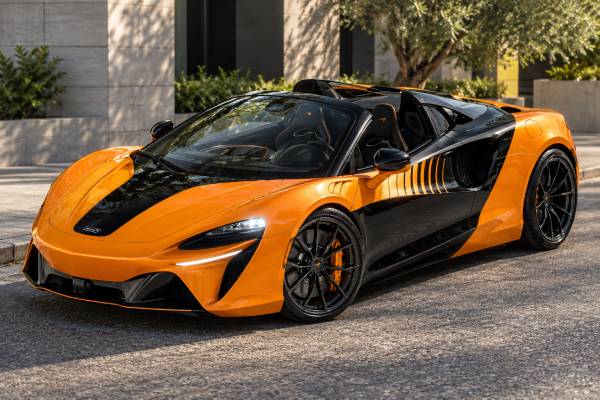
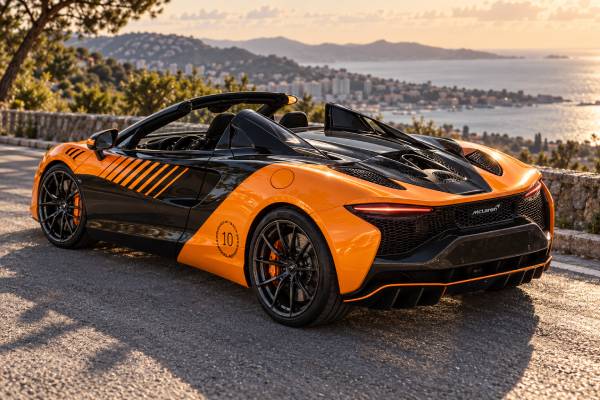
The 2026 McLaren Artura Spider MCL39 Championship Edition is built around the number ten. McLaren Racing’s 2025 season delivered its tenth Formula 1 Constructors’ Championship, and McLaren Special Operations responded with a run of only ten customer cars. The hand-painted Myan Orange and Onyx Black bodywork does more than borrow the MCL39 race car’s colors: each “10” motif contains ten stars and outlines representing McLaren’s Constructors’ Championship-winning Formula 1 cars. Signed carbon-fibre sill finishers, a season-record plaque, a custom console plaque, and a championship keepsake deepen the provenance. Mechanically, however, this is not a higher-output Artura. It retains the production Spider’s 700 PS (690 bhp) plug-in-hybrid powertrain, retractable hard top, carbon architecture, and 330 km/h maximum speed. That split between standard engineering and highly specific MSO craftsmanship is central to understanding the car. The sections below explain the championship story, exact special-edition features, technical specification, ownership needs, and authentication priorities.
Table of Contents
- A championship encoded in the bodywork
- Why ten cars, and what the MCL39 name records
- Technical specifications and unchanged mechanical package
- Spider engineering beneath the special edition
- Preserving signed, painted, and season-specific details
- Collector due diligence and buying checks
A championship encoded in the bodywork
The MCL39 Championship Edition is easiest to understand by reading its design as a record rather than as a color-and-trim package. MSO hand-painted the Spider in Bespoke Myan Orange and Onyx Black to evoke the 2025 MCL39 Formula 1 car, then layered in details that point to McLaren’s complete Constructors’ Championship history.
The most distinctive graphic is the painted “10” motif. Each instance incorporates ten stars and finely rendered outlines of the McLaren Formula 1 cars that won Constructors’ Championships. That makes the design retrospective as well as contemporary: the MCL39 provides the immediate inspiration, while the graphic reaches back through the nine earlier title-winning seasons.
McLaren’s ten Constructors’ titles were secured in 1974, 1984, 1985, 1988, 1989, 1990, 1991, 1998, 2024, and 2025. The MCL39 edition therefore follows directly after the nine-car MCL38 Celebration Edition tied to the 2024 title, but it is not simply the same idea with another number. The body style, paint concept, equipment, interior treatment, and production run are specific to the 2026 MCL39 Championship Edition.
Exterior hardware reinforces the darker orange-and-black theme. The specification includes a Black Pack, a Stealth Badge Pack, 10-spoke Super-Lightweight Dynamo forged alloy wheels in Gloss Black, Myan Orange brake calipers with black McLaren logos, and a Sports Exhaust with a Stealth finisher. Orange detailing also appears around the rear treatment.
| Feature | Edition-specific treatment |
|---|---|
| Exterior paint | Hand-painted MSO Bespoke Myan Orange and Onyx Black |
| Body graphic | “10” motifs with ten stars and title-winning McLaren F1-car outlines |
| Wheels | 10-spoke Super-Lightweight Dynamo Forged Alloy Wheels, Gloss Black |
| Brake calipers | McLaren Myan Orange with black McLaren logos |
| Exterior packages | Black Pack and Stealth Badge Pack |
| Exhaust | Sports Exhaust with Stealth Exhaust Finisher |
| Production | 10 customer cars |
The visual language is also unusually easy to misdescribe because several orange tones appear across McLaren products. The launch specification names MSO Bespoke Myan Orange, not simply “Papaya,” and pairs it with Onyx Black. That exact wording is useful in build records, insurance schedules, and later paint inspections. A seller who reduces the finish to “orange/black” may not be wrong in casual conversation, but a collector should preserve the factory color names because they identify the commissioned treatment.
The ten-spoke wheel choice reinforces the numerical theme without requiring a special wheel diameter claim. More important for authenticity is the combination of wheel design, Gloss Black finish, Myan Orange calipers, and black McLaren logos. If a previous owner fitted alternate wheels for road or track use, the original set should ideally accompany the car. The same applies to badges and exhaust finishers: reversible personalization is much easier to accept when the factory parts remain documented and available.
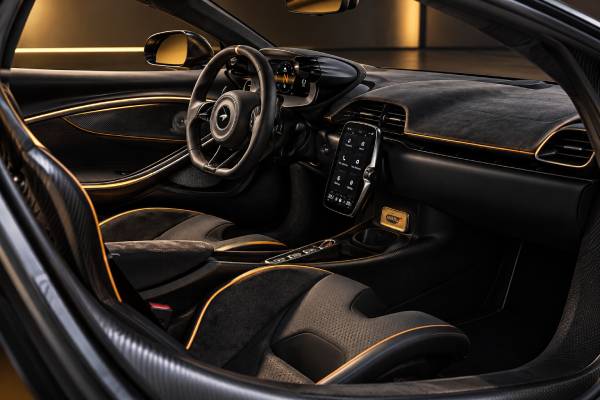
Inside, MSO chose Performance Carbon Black Alcantara and Jet Black Nappa leather with McLaren Vision Orange piping. The headrests carry orange “10” embroidery, and the Myan Orange 12 o’clock steering-wheel marker repeats the numeral. A custom plaque on the center console identifies the special specification.
The unusual elements continue beyond what occupants see while driving. Extended Satin Carbon Fibre Sill Finishers are hand-signed by Lando Norris and Oscar Piastri. A custom Track Record Plaque in the luggage compartment lists the wins, pole positions, and fastest laps McLaren achieved during the 2025 season. Each client also receives a 2025 Formula 1 Constructors’ Championship collector keepsake. For a future buyer, all of these pieces belong to the car’s identity.
Why ten cars, and what the MCL39 name records
The production number is a direct reference to McLaren’s tenth Constructors’ crown, secured in Singapore during the 2025 Formula 1 season. It was the team’s second consecutive Constructors’ Championship after the 2024 title and its first back-to-back run since 1990 and 1991.
McLaren clinched the 2025 Constructors’ title with six Grands Prix remaining. At that point the team had won 12 of the first 18 races, illustrating why the MCL39 became more than a one-race visual reference. The car carried Lando Norris and Oscar Piastri through a season in which McLaren established the points advantage needed to seal the team championship early. Norris then secured his first Drivers’ World Championship at the Abu Dhabi finale.
The road car’s name therefore has two layers. “MCL39” identifies the Formula 1 chassis associated with the 2025 titles; “Championship Edition” frames the Spider as a commemoration of that campaign and the broader ten-title Constructors’ record.
It is important not to inflate the production claim. The edition was announced as strictly limited to ten Artura Spider MCL39 Championship Edition cars. That figure is distinct from the ten titles represented in the graphics but intentionally mirrors it. Public material does not support describing it as ten cars per region or ten cars in each color.
The tenth title also gives the edition a clearer historical boundary than a generic “2025-inspired” specification. It refers to the MCL39 season after the 2024 MCL38 had already restored McLaren to the Constructors’ Championship. The 2025 campaign then made those titles consecutive. That sequence helps authenticate contemporary paperwork: invoices, press material, build correspondence, and delivery documents should describe the MCL39-era championship program rather than the earlier MCL38 Celebration Edition.
The two editions can look related at a glance because both use orange, black or anthracite themes and Formula 1 references, but their identifying details are not interchangeable. The MCL38 program used a Nine-Star theme and genuine MCL38 bodywork in a dedication plaque; the MCL39 Spider centers on the number ten, title-winning-car outlines, signed satin-carbon sills, a custom track-record plaque, and a championship keepsake. Mixing those feature lists is a warning sign in an advertisement.
The rarity also changes how ownership evidence should be judged. With ordinary production cars, a missing sales invoice may be inconvenient but not identity-defining. With a ten-car MSO edition, original paperwork can establish the exact relationship between chassis, bespoke finish, signed components, and delivery specification. A future seller should be able to show how those elements stayed together.
Technical specifications and unchanged mechanical package
The MCL39 Championship Edition keeps the standard Artura Spider’s current 700 PS (690 bhp) hybrid hardware. Independent launch coverage explicitly reported no mechanical changes, while McLaren’s special-edition material focuses on paint, trim, wheels, exhaust presentation, plaques, signatures, and provenance rather than a higher-output calibration.
That means the core powertrain remains the M630-family 3.0-litre, 120-degree, twin-turbocharged V6 working with an axial-flux electric motor and a 7.4 kWh lithium-ion battery. The official combined total is 700 PS (690 bhp) and 720 Nm.
| Specification | Value |
|---|---|
| Combustion engine | M630 3.0L 120-degree twin-turbocharged V6 |
| Engine technology | Electrically actuated turbochargers, dry-sump lubrication |
| Electric motor | Axial-flux motor |
| Combined maximum output | 700 PS (690 bhp) |
| Combined maximum torque | 720 Nm (531 lb-ft) |
| Battery | Refrigerant-cooled lithium-ion, 7.4 kWh |
| Transmission | 8-speed + E-Reverse Seamless Shift Gearbox |
| Drive layout | Rear-wheel drive |
The electric motor is integrated into the driveline rather than powering a separate front axle, so the Artura retains rear-wheel-drive behavior. Reverse is provided electrically, allowing the eight-speed gearbox to omit a conventional reverse gear.
| Measure | Factory figure |
|---|---|
| 0–100 km/h (0–62 mph) | 3.0 seconds |
| 0–200 km/h (0–124 mph) | 8.4 seconds |
| 0–300 km/h (0–186 mph) | 21.6 seconds |
| Standing 400 m / quarter mile | 10.8 seconds |
| Maximum speed | 330 km/h (205 mph), electronically limited |
| 100–0 km/h braking distance | 31 m (101.7 ft) |
| 200–0 km/h braking distance | 124 m (407 ft) |
The MCL39 edition’s Sports Exhaust changes the specification and sound presentation but is not published as a horsepower upgrade. A buyer should therefore be cautious of advertisements that assign an edition-specific output above the factory 700 PS system rating.
| Specification | Configuration |
|---|---|
| Body structure | McLaren Carbon Fibre Lightweight Architecture with aluminium hot-formed body panels |
| Front suspension | Double wishbone |
| Rear suspension | Multi-link |
| Damping | Proactive Damping Control |
| Differential | Electronically locking E-Differential |
| Brakes | Carbon-ceramic, 6-piston front and 4-piston rear aluminium calipers |
| Lightest dry weight | 1,457 kg (3,212 lb) |
| DIN kerb weight | 1,560 kg (3,439 lb) |
These weight values are the published Artura Spider figures. McLaren has not published a separate MCL39 Championship Edition dry weight, so the effect of its special wheels, trim, and exhaust should not be guessed.
| Specification | Published value |
|---|---|
| Electric range | 33 km (21 miles), EU WLTP |
| Weighted fuel consumption | 4.8 L/100 km, EU WLTP |
| Combined CO2 emissions | 108 g/km, EU WLTP |
| Fuel-tank capacity | 65 L (17.14 US gal) |
| Front luggage capacity | 160 L |
WLTP plug-in-hybrid figures are standardized values obtained with a defined battery-use assumption. Road consumption will vary substantially with charging frequency, trip length, temperature, traffic, and how often the 690 bhp system is used at high load.
Spider engineering beneath the special edition
The roof system is the part of the MCL39 edition that most clearly separates it from a fixed-roof Artura while leaving the championship hardware untouched. The retractable hard top opens or closes in 11 seconds and can operate at up to 50 km/h (31 mph). A solid panel is standard on the underlying Spider, with an electrochromic glazed panel available in the Artura Spider range.
McLaren could engineer the open car without adding the heavy structural bracing typical of a converted metal-bodied coupé because MCLA’s carbon-fibre passenger structure was conceived for stiffness from the start. The Spider still weighs more than the Coupé, but McLaren quotes a 62 kg difference in lightest dry specification.
An independently powered rear window gives the driver another way to tune the cabin. With the roof lowered, leaving the rear glass raised reduces turbulence. With the roof up, lowering the glass lets more powertrain sound into the cabin. Partly transparent rear buttresses also help rearward visibility and manage airflow around the open cockpit.
| Specification | Value or feature |
|---|---|
| Roof | Electrically operated retractable hard top |
| Open/close time | 11 seconds |
| Operation while moving | Up to 50 km/h (31 mph) |
| Optional panel | Electrochromic glazed roof |
| Rear glass | Independently powered |
| Front luggage volume | 160 L |
The hybrid system gives the Spider an equally broad range of character. Electric mode can handle short, quiet urban travel; Comfort balances combustion and electric use; Sport and Track keep the V6 ready more consistently. The battery also supports acceleration, so keeping it within the car’s intended operating window matters even for an owner who rarely uses electric-only driving.
For road use, the Spider’s extra mass is concentrated in hardware that changes the experience rather than the power figure. The roof mechanism, tonneau arrangement, and related body components add weight, yet the car keeps the same claimed 0–100 km/h time and top speed as the contemporary Coupé. The small difference appears farther into the acceleration run, where the Spider’s published 0–200 km/h time is 8.4 seconds rather than the Coupé’s 8.3.
That distinction is more useful than arguing about tenths in isolation. It shows that the open-roof conversion was engineered to preserve the Artura’s core performance envelope. In normal driving, roof position changes sound, airflow, visibility, and the sense of speed far more noticeably than it changes what the powertrain is capable of delivering.
Owners planning track use should remember that an edition-specific finish raises the consequence of cosmetic damage. Rubber pickup, gravel rash, heat near exhaust trim, and debris around the splitter can affect pieces that are far harder to restore faithfully than standard paint. Temporary track protection may be sensible, but it should not obstruct cooling openings or be applied in a way that risks the hand-painted surfaces.
The steering remains electro-hydraulic, a deliberate choice that prioritizes consistent feedback. Carbon-ceramic brakes provide the high-temperature capacity expected of a supercar, while the Artura’s brake feel avoids the aggressive one-pedal behavior common in many electrified vehicles. The result is that the championship edition still drives as an Artura first: the MSO work changes the sense of occasion, not the control architecture.
Preserving signed, painted, and season-specific details
The hardest MCL39 parts to replace may not be mechanical. A tire, service fluid, or ordinary wear component can be renewed using the correct specification. A hand-signed sill finisher, an edition plaque, or a section of hand-painted championship artwork carries an originality value that a new generic replacement cannot reproduce.
Start by recording the car in detail. High-resolution photographs should show the full exterior, each “10” motif, all wheel and caliper finishes, the Stealth badges and exhaust finisher, both signed sill pieces, headrest embroidery, steering-wheel marker, center-console plaque, and luggage-compartment Track Record Plaque. Photograph the collector keepsake separately and keep its packaging and documentation.
Paint-protection film can be sensible on a low, wide supercar, but it should be installed with the hand-painted finish in mind. Before application, document the paint under neutral lighting. Avoid unnecessary edge trimming on the car, and keep invoices that identify the installer and material. If film is later removed, use a specialist who understands the risk of lifting or marking bespoke paint.
Mechanical storage deserves equal care. A ten-car edition may accumulate little mileage, but time still affects tires, brake fluid, seals, lubricants, and the low-voltage battery. The plug-in-hybrid traction battery and 12-volt system serve different purposes, so neither should be judged solely from whether the car starts.
Roof exercise is also important. The mechanism uses powered movements, latches, sensors, seals, and drains. During inspections, operate it through a full cycle and watch for hesitation, asymmetric movement, abnormal noise, warning messages, water marks, or seal damage. Low use does not make a roof fault less real.
For scheduled service, rely on the current McLaren requirements for the exact VIN and market. The dry-sump V6, hybrid cooling, high-voltage electronics, gearbox, carbon-ceramic brakes, and roof system all require correct procedures. Do not transfer torque values or service intervals from a different Artura model year without confirmation.
A strong preservation file should include:
- original order and build specification;
- delivery documents and all supplied keys and accessories;
- service invoices and diagnostic reports;
- software-update and campaign records;
- tire replacement dates and exact fitment details;
- photographs before any paint correction or protective film;
- invoices for cosmetic work, wheel refinishing, or trim removal;
- proof that signed and plaque-related pieces remain with the chassis;
- the supplied championship collector keepsake and its packaging.
This paperwork may seem excessive for a normal car. For one of ten, it is part of the object’s history.
Collector due diligence and buying checks
Authentication should come before negotiation. The MCL39 Championship Edition is visually distinctive enough to inspire replicas, and a conventional Artura Spider can be refinished in orange and black. Factory provenance is what separates a tribute from one of the ten MSO cars.
Begin with the VIN and original specification. Ask an authorized McLaren retailer or an appropriate factory channel to confirm the build where possible. Then match the documentary record to the physical car rather than assuming that a rare-looking car must be genuine.
Check the special components methodically. The hand-painted Myan Orange and Onyx Black treatment should be consistent with the factory specification. The “10” graphics should contain the intended stars and car outlines. Verify the correct 10-spoke Gloss Black Dynamo wheels, Myan Orange calipers, Black Pack, Stealth badging, Sports Exhaust and finisher, orange cabin details, plaques, signed satin-carbon sill finishers, and supplied keepsake.
After identity comes condition. Commission a McLaren-qualified pre-purchase inspection with a diagnostic scan. Test roof operation, rear glass, charging, air conditioning, all drive modes, front lift if fitted, cameras and driver-assistance equipment, and every warning system. Inspect underbody carbon and aero surfaces for impact damage, and examine the wheels and carbon-ceramic brakes closely.
Tires deserve more attention than tread depth. Confirm matching approved fitment, manufacturing dates, sidewall condition, and evidence of heat cycling or prolonged underinflation. A ten-year-old tire with full tread would still be unsuitable for exploiting 690 bhp; rarity does not suspend normal material aging.
Review any cosmetic repairs with the same discipline. A documented repair by an appropriate specialist is easier to evaluate than unexplained paint readings or missing photographs. Because the livery is hand-painted, even minor corrections can matter to future originality claims.
A careful inspection should also reconcile mileage with the physical story. Very low mileage combined with heavily worn seat bolsters, stone-chipped sills, heat-marked brakes, or multiple sets of recently fitted tires deserves explanation. The opposite can also happen: a car may look untouched because it has spent long periods stored, while diagnostic logs reveal repeated low-voltage events or incomplete charging cycles. Neither pattern proves misuse, but both deserve context.
Ask whether the car has been displayed, transported frequently, or used at circuit events. Enclosed transport can still leave tie-down or wheel damage, and static display can expose paint to repeated detailing. If the collector keepsake or signed components were removed for security, obtain documentation showing where they were stored and confirm their condition before completion.
For valuation, comparable sales may be scarce enough that condition adjustments overwhelm simple mileage comparisons. A transparent repair history, intact original parts, and a verified factory specification can be more meaningful than a tiny odometer difference between two cars. The goal of due diligence is not to demand a museum artifact; it is to understand exactly what has changed since the car left MSO and whether those changes were handled competently.
Finally, arrange insurance based on the exact car rather than a standard Artura Spider valuation. Replacement of bespoke MSO elements, signed pieces, or special finish work may not fit ordinary repair-cost assumptions. Agreed-value or specialist collector coverage can be worth considering where available.
The MCL39 Championship Edition is valuable as a coherent package: a current-generation Artura Spider, a ten-car MSO commission, and a record of McLaren’s 2025 championship season. A buyer who verifies all three layers—mechanical health, factory identity, and intact provenance—will understand the car more accurately than one who focuses only on its mileage or the number printed on its bodywork.
References
- McLaren Special Operations (MSO) – Bespoke McLaren Cars 2026
- McLaren Artura Spider MCL39 Championship Edition 2026
- McLaren win the 2025 World Constructors’ Championship 2025
- McLaren Artura Spider – New Hybrid Convertible Supercar 2026
- McLaren Artura Spider MCL39 Championship Edition image gallery 2026
- New McLaren Artura Spider MCL39 Championship Edition is an ultra-rare F1-inspired roadster 2026
Disclaimer
This Championship Edition guide provides general technical and collector information; it does not replace a qualified inspection, repair diagnosis, provenance review, or valuation. Confirm all service procedures, tightening torques, intervals, software requirements, and exact equipment from the official McLaren records for the vehicle’s VIN and market.
Readers preserving the story of the MCL39 edition can help support our work by sharing the article on Facebook, X/Twitter, or a suitable collector forum.