
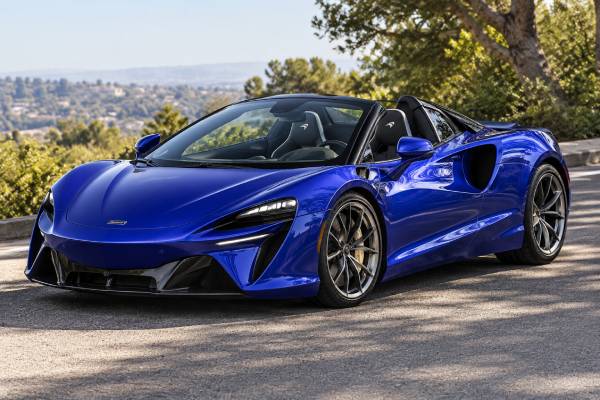
Removing a roof from a carbon-fibre supercar sounds simple until cooling, airflow, stiffness, mass, visibility, noise, and storage all compete for the same space. The McLaren Artura Spider solves that packaging problem while keeping the Artura’s plug-in-hybrid identity intact. Revealed in 2024 and commonly sold as a 2025-model-year car, the Spider combines a retractable hard top with the uprated 700 PS (690 bhp) Artura powertrain, revised damping, quicker transmission logic, stronger powertrain mounting, and improved brake cooling. Its roof opens or closes in 11 seconds at speeds up to 50 km/h, yet the carbon MCLA structure requires no extra body reinforcement and the Spider’s lightest dry weight is only 62 kg above the coupé. For an owner, though, the interesting questions extend beyond the roof trick: how the new aerothermal layout works, what the hybrid system is like in everyday use, which components need special care, and what should be inspected before buying a used example.
Table of Contents
- What Makes the Artura Spider Different
- Retractable Roof and Aerothermal Engineering
- Hybrid Performance and Driving Character
- Artura Spider Technical Specifications
- Charging, Cabin Use, and Everyday Practicality
- Maintenance and Inspection Priorities
- How to Buy the Right Artura Spider
What Makes the Artura Spider Different
The Artura Spider is not a coupé with its roof simply cut away; it is an open car whose body, cooling paths, rear deck, airflow management and roof mechanism were engineered around the existing carbon structure. That matters because the conversion preserves the basic stiffness of the MCLA tub without adding conventional structural bracing.
McLaren’s Carbon Fibre Lightweight Architecture carries the major loads through the passenger cell, so removing the fixed exterior roof did not require the type of reinforcement that can make many convertibles substantially heavier. The Spider’s lightest dry weight is 1,457 kg, compared with 1,395 kg for the updated coupé. The 62 kg increase is principally associated with the retractable roof system and the hardware needed to package and thermally manage it.
The launch timing can be confusing in listings. McLaren revealed the Spider in February 2024, with deliveries beginning later that year, while many markets and publications describe it as a 2025 model-year vehicle. Therefore, “2024–present” is useful as a production-era description, but the VIN and market documentation are more reliable than a registration year when confirming a particular car’s official model year.
The Spider arrived together with a broad Artura update. Its 3.0-litre twin-turbo V6 and axial-flux e-motor produce 700 PS (690 bhp) and 720 Nm in combination. The transmission received a quicker pre-fill strategy, the adaptive dampers gained revised valving and faster control, the engine mounts became stiffer, brake cooling was improved, and the exhaust was retuned. These changes were introduced across the updated range, so they are part of the Spider’s baseline character rather than Spider-only performance options.
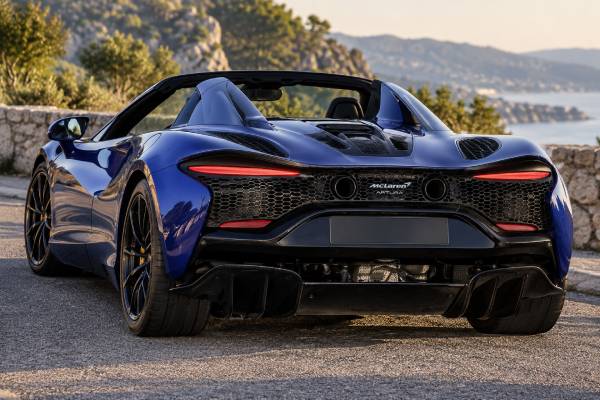
Where the open car becomes unique is behind the seats. The folded roof occupies space that the coupé can use differently for hot-air extraction, so McLaren relocated and reshaped cooling routes, changed the buttresses and created a roof stowage arrangement that does not consume the front luggage compartment. The heated rear glass is movable independently from the roof. With the top down, raising the glass can reduce turbulence; with the top up, lowering it admits more exhaust sound and outside air.
This combination makes the Spider unusually dual-purpose. It can leave quietly in E-Mode with the roof raised, cruise with the rear screen positioned for comfort, or open the cabin in seconds when conditions allow. The convertible hardware changes the sensory experience without turning the vehicle into a softer grand-tourer: steering remains hydraulically assisted, drive remains rear-wheel only, and the chassis still prioritizes low mass and direct response.
Retractable Roof and Aerothermal Engineering
The roof is the Spider’s defining mechanism, but the harder engineering problem is controlling heat and airflow after giving that mechanism space above a mid-mounted hot-V engine. McLaren addressed both jobs as one system rather than treating the roof as a separate convenience feature.
The Retractable Hard Top uses a carbon-fibre-composite panel as standard and is operated by eight electric motors. The sequence takes 11 seconds and can run while the car is moving at up to 50 km/h (31 mph). When stationary, the roof can also be operated from the vehicle key. Electric actuation allows several elements to move together, helping McLaren avoid a large hydraulic mechanism and keep the package relatively compact.
An optional electrochromic glass roof changes the cabin without changing the basic folding concept. Suspended-particle technology allows the panel to switch between a brighter and darker state. McLaren claims the dark setting blocks more than 99 percent of visible sunlight and more than 96 percent of solar energy, which is useful because a glass panel directly above the occupants can otherwise add substantial heat on a sunny day.
Cooling demanded more redesign. In the coupé, the area immediately behind the passenger cell can be devoted more directly to venting the powertrain. In the Spider, that zone must accommodate the folding roof and tonneau. The hot-air “chimney” and other cooling outlets are therefore positioned farther rearward, while the reshaped buttresses help guide air toward and away from the powertrain as required. Their glazed polycarbonate sections also improve the rearward sight lines that solid buttresses could obstruct.
Air passing over the open cabin was tuned as carefully as air passing through the engine bay. A small aerodynamic element at the top of the windscreen helps smooth the flow and reduce buffeting. The powered rear screen adds another tuning tool: leaving it raised with the roof down can make conversation and cruising more comfortable, while lowering it deliberately exposes the cabin to more airflow and mechanical sound.
Owners should treat the roof as a precision mechanism rather than a party trick. Do not interrupt its movement by placing luggage, clothing or loose objects around the tonneau and roof stowage area. Keep seals and drainage channels clean, and investigate changes in speed, synchronization or latch noise before they become a larger fault. If the car has the electrochromic panel, confirm that it changes state evenly and that there is no unexplained haze, damage or delamination.
A pre-purchase roof test should be done more than once. Cycle it from fully closed to fully open and back with the car stationary, observe the tonneau alignment, listen for uneven motor effort, inspect the seals after closure and operate the rear glass independently. A mechanism that completes one cycle does not automatically prove that every sensor, seal and moving panel is healthy.
Hybrid Performance and Driving Character
The Spider delivers nearly the same straight-line performance as the coupé despite carrying its roof mechanism. Its character comes from how the electric motor, high-revving V6, eight-speed gearbox and lightweight rear-drive chassis overlap rather than from any one component dominating the experience.
The M630 is a 120-degree 3.0-litre V6 with two turbochargers mounted inside the wide cylinder-bank angle. Its compact dimensions help packaging and lower the centre of mass, while an axial-flux motor in the transmission housing supplies immediate torque. The electric machine can propel the car by itself, assist the combustion engine, recover energy and provide reverse drive, eliminating the need for a separate mechanical reverse gear.
Combined output is 700 PS (690 bhp) with 720 Nm (531 lb-ft). McLaren quotes 0–100 km/h in 3.0 seconds, 0–200 km/h in 8.4 seconds and a 330 km/h (205 mph) top speed. The manufacturer’s quarter-mile figure is 10.8 seconds. Those numbers are only part of the story: the updated calibration gives the V6 stronger urgency high in the rev range, making it worthwhile to use the engine rather than relying on the electric motor merely to mask turbo response.
The eight-speed dual-clutch transmission uses a pre-fill function intended to shorten shift times by 25 percent. The motor sits within the gearbox architecture and handles reverse electrically, so all eight ratios are available for forward travel. In manual mode, the steering-column-mounted paddles let the driver keep both hands near the wheel while the hydraulic steering provides the detailed surface feedback that McLaren continues to favour over fully electric assistance.
Chassis behavior can be adjusted separately from powertrain behavior. Comfort is the sensible road default because it lets the adaptive dampers absorb imperfect pavement without making the body loose. Sport tightens control, while Track is intended for smoother, faster environments. The revised dampers and faster control electronics introduced with the Spider generation increase how quickly the system can react to wheel movement and driver inputs.
The brake pedal is deliberately different from many hybrids. The pedal operates the friction brakes rather than blending a large amount of regenerative braking into pedal travel, so its feel is closer to a conventional high-performance car. Energy recovery still occurs through the hybrid system in other conditions, but braking response is built around carbon-ceramic hardware and pressure at the pedal. Drivers coming from one-pedal EVs should not expect strong lift-off deceleration.
With the roof down, the exhaust and intake sounds become a larger part of the experience. The updated valved exhaust was designed to give a clearer sound as engine speed rises, while the optional sports exhaust uses a sound symposer that transmits authentic acoustic energy rather than synthesizing a soundtrack through the audio system. The independently moving rear screen lets the driver vary that effect even with the roof closed.
Artura Spider Technical Specifications
The Artura Spider is a two-seat, rear-wheel-drive PHEV built around the MCLA carbon-fibre structure. It combines a rechargeable 7.4 kWh battery, one transmission-mounted traction motor and the M630 twin-turbo V6 with an eight-speed transaxle; the tables below use current manufacturer figures for the 690 bhp Spider unless otherwise stated.
| Item | Specification |
|---|---|
| Engine | M630 120-degree 3.0L twin-turbocharged V6, dry sump |
| Powertrain type | Plug-in hybrid (PHEV) |
| Combined output | 700 PS (690 bhp) |
| Combined torque | 720 Nm (531 lb-ft) |
| Electric motor | Axial-flux motor |
| Motor contribution | Up to 95 PS (70 kW) and 225 Nm |
| Battery | 7.4 kWh refrigerant-cooled lithium-ion |
| Measure | Manufacturer figure |
|---|---|
| 0–100 km/h (0–62 mph) | 3.0 seconds |
| 0–200 km/h (0–124 mph) | 8.4 seconds |
| Quarter mile (0–400 m) | 10.8 seconds |
| Top speed | 330 km/h (205 mph) |
| 100–0 km/h | 31 m (101.7 ft) |
| 200–0 km/h | 124 m (406.8 ft) |
| Item | Specification |
|---|---|
| Body style | Two-seat retractable-hard-top Spider |
| Roof operation time | 11 seconds |
| Roof operating speed | Up to 50 km/h (31 mph) |
| Standard roof panel | Carbon-fibre composite |
| Optional roof | Electrochromic glass panel |
| Body structure | McLaren Carbon Fibre Lightweight Architecture with aluminium hot-formed body panels |
| Item | Specification |
|---|---|
| Transmission | 8-speed Seamless Shift Gearbox with E-Reverse |
| Drive | Rear-wheel drive |
| Differential | Electronically locking differential |
| Front suspension | Double wishbone |
| Rear suspension | Multi-link |
| Damping | Proactive Damping Control |
| Brakes | Carbon ceramic; 6-piston aluminium front and 4-piston aluminium rear calipers |
| Item | Specification |
|---|---|
| Lightest dry weight | 1,457 kg (3,212 lb) |
| DIN kerb weight | 1,560 kg (3,439 lb) |
| Fuel tank | 65 L |
| Front luggage compartment | 160 L |
| Wheel format | 19-inch front / 20-inch rear |
| Measure | Figure |
|---|---|
| WLTP electric range | 33 km (21 miles) |
| WLTP weighted fuel consumption | 4.8 L/100 km |
| WLTP CO2 emissions | 108 g/km |
| Charging benchmark | Approximately 2.5 hours to 80% using suitable AC charging equipment |
The WLTP figures are test-cycle results, not promises for every trip. Electric range falls with speed, climate use, temperature and driving style, while weighted PHEV fuel consumption assumes a defined amount of charged-battery operation. A driver who rarely plugs in should expect a very different fuel-use pattern from the official weighted result.
Charging, Cabin Use, and Everyday Practicality
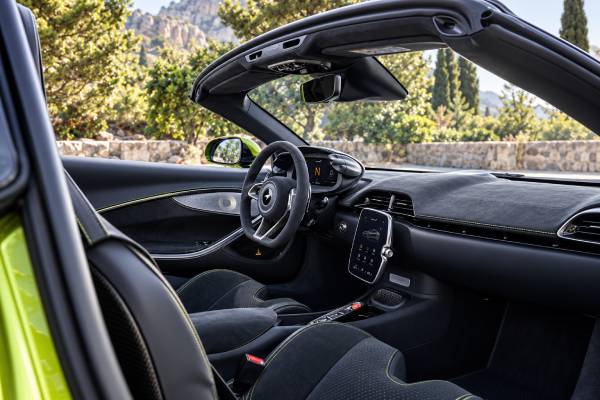
The Spider is practical enough for regular use if the owner accepts supercar-scale storage and builds charging into the routine. Its electric mode, 160-litre front luggage bay, compact dimensions and quick roof make short trips easier than the performance figures suggest.
The 7.4 kWh battery is intentionally small, and McLaren quotes approximately 2.5 hours to reach 80 percent with suitable AC charging equipment. There is no reason to plan ownership around high-power public DC chargers. The useful pattern is slow, predictable charging at home or at a regular destination so that E-Mode is available when it adds the most value.
McLaren’s WLTP electric figure is 33 km (21 miles), while U.S. EPA treatment has produced a shorter all-electric figure in some published data. The two numbers should not be mixed as though one disproves the other: different regulatory test procedures can report different ranges from the same hardware. For trip planning, the car’s actual consumption in local temperature and traffic is more useful than a laboratory number.
The front luggage compartment remains 160 litres because the roof folds behind the cabin rather than into the luggage bay. Soft-sided bags make better use of the irregular space than hard suitcases. Inside, storage is limited; the Artura’s cabin is designed around the driver rather than around large door bins and cubbies. If touring is part of the plan, test-pack the car before a long trip rather than assuming two airline cases will fit.
The roof itself expands the usable weather window. It can be closed quickly when conditions change, and the electrochromic option allows extra light without physically opening the car. That option is attractive in bright climates, but it adds another electrically controlled component to inspect and potentially repair. A conventional carbon-composite panel is simpler and still preserves the structural and weight advantages of the design.
With the roof open, wind management depends partly on speed and rear-screen position. Raising the glass can reduce the amount of turbulent air entering from behind the seats. Lowering it increases the sense of openness and makes the powertrain more audible. Drivers should experiment at moderate speed before assuming one position is best for every passenger or weather condition.
The car’s low front overhang and wide rear tires deserve planning in everyday environments. A front-axle lift option can be valuable for ramps, speed humps and underground garages, but it must be confirmed on the specific car rather than assumed. Parking cameras and sensors are similarly useful because carbon-fibre and painted composite panels are expensive places to collect low-speed damage.
Tire behavior also changes with weather. The Artura Spider’s performance depends on the correct McLaren-approved tire specification, pressure and temperature. Some configurations use Pirelli Cyber Tyre sensing technology, which can provide the vehicle with real-time tire information. Whatever the fitted system, age, tread depth and sidewall condition remain physical inspection items that electronics cannot replace.
Maintenance and Inspection Priorities
Preventive care on an Artura Spider has four distinct areas: the hybrid powertrain, conventional supercar hardware, retractable roof system and software-controlled electronics. Ignoring any one of them can turn a low-mileage car into an expensive catch-up project.
Use the owner handbook and service information for the exact VIN and market. McLaren publishes specific Artura/Artura Spider handbooks, and service intervals, fluid specifications and procedures can change by model year or region. Mileage alone is not a sufficient maintenance clock for a car that may sit for weeks at a time. Fluids, seals, 12-volt systems, tires and software can all need attention regardless of annual distance.
The high-voltage system is not an owner-repair area. Inspect the charging inlet and cable for damage and keep both clean, but leave battery isolation, orange-cable work, cooling-system service and power-electronics diagnosis to properly trained technicians. A persistent charging warning, reduced-power message or high-voltage fault should be scanned with appropriate equipment instead of being repeatedly cleared and ignored.
Roof maintenance should be quiet and methodical. Clean debris from seals and drainage areas, avoid pressure-washing directly into seal interfaces, and watch for moisture after heavy rain or washing. The roof, tonneau and rear glass should move smoothly without hesitation. Uneven panel gaps, rubbing marks or a new clicking sound can indicate an alignment, latch, sensor or actuator problem that is easier to address early.
Carbon-ceramic brakes deserve specialist inspection because replacement cost is high and remaining life cannot be judged by a casual glance alone. Track use, contamination, heat cycles and physical damage all matter. The same is true for tires: check inner shoulders, manufacturing dates and correct front/rear specification. A car that has spent time on circuit may be mechanically excellent, but its consumables should be priced according to their actual condition rather than odometer mileage.
Software and recall status belong on every service checklist. In the United States, NHTSA campaign 25V-216 identified a small population of McLaren vehicles across several models, including certain Arturas, for possible incorrect rear brake-pipe connections at the ABS/ESP module. The population was only 29 vehicles across the listed McLaren models, so the existence of the campaign does not mean every Spider is affected. VIN lookup and documented remedy completion are the correct way to handle it.
Finally, inspect the underside. The Artura’s aerodynamic floors and low ride height can hide evidence of ramp or curb contact. Look for damaged panels, fasteners, cooling ducts or impact marks near the battery enclosure and suspension mounting areas. Any meaningful strike around high-voltage protection zones should be evaluated professionally even if the dashboard shows no warning.
How to Buy the Right Artura Spider
A good Artura Spider purchase is based on configuration and evidence, not merely mileage and paint colour. Start with the VIN, then verify roof operation, software and campaign history, hybrid charging, brake and tire condition, and the options that actually matter to your use.
First, resolve the model-year description. Because the Spider was unveiled in 2024 but widely marketed as a 2025 model, advertisements can use different year conventions. Check the VIN, production record and registration documents rather than arguing from the month in which the car first appeared online or reached a customer.
Next, request a complete service record from an authorised McLaren retailer where possible. Ask specifically whether all software campaigns are current and whether any open recalls or technical actions remain. A stack of invoices is helpful, but a network check can reveal updates that are not obvious from routine service receipts.
Then test the roof as a system. Operate it twice, test the rear window separately, inspect the tonneau fit, examine the seals, and try the electrochromic function if fitted. Look for water staining around trim and carpets. A convertible can appear dry during a short showroom visit even if a drainage or sealing issue develops only after sustained rain.
Charge the car before the inspection if possible. Confirm that the charging session starts and completes normally, then drive in E-Mode and transition to hybrid operation. The goal is not to deplete the battery; it is to verify that the car recognizes the charger, accepts energy, displays state of charge sensibly and changes modes without persistent faults.
A professional road test should include low-speed maneuvering, rough pavement and a fully warmed drivetrain. Steering should feel consistent, the transmission should select gears cleanly, and the brakes should respond predictably as temperature changes. Listen for suspension noise with the roof both closed and open, because removing the roof can make ordinary cabin noises easier to hear and sometimes easier to locate.
Options should be valued according to function. Front lift is highly useful if the car will encounter steep driveways. The electrochromic roof changes the cabin experience even when closed. Cameras and parking sensors reduce risk in tight spaces. Seat choice can determine whether a two-hour drive is enjoyable. Decorative carbon is desirable to some buyers, but it should not outweigh a stronger history, fresher tires or better mechanical condition.
If the car has been used on track, do not reject it automatically. Instead, ask for evidence of preparation and post-event servicing, then inspect brakes, tires, alignment, underbody and fluids more closely. Enthusiast ownership with meticulous maintenance can be preferable to low mileage with long storage, weak batteries and missed service dates.
A pre-purchase inspection should end with a written list of findings and estimated correction costs. That turns small defects into negotiation data instead of surprises. The Artura Spider is technically dense, but its design is coherent: a rigid carbon core, a compact performance-hybrid drivetrain and a roof system engineered without sacrificing the luggage bay or requiring structural bracing. Buying one carefully means confirming that all of those systems still work together as designed.
References
- McLaren Artura Spider – New Hybrid Convertible Supercar 2026
- McLaren Ownership – Owner’s Handbooks | McLaren Automotive 2026 (Owner’s Handbook)
- 2025 McLaren Artura Spider Is the One to Be Seen In 2024
- McLaren Artura Spider, the new hybrid supercar en plain air | Pirelli 2024
- McLaren Artura Spider Hybrid 2024 Review: Performance Party | WIRED 2024
- Part 573 Safety Recall Report 25V-216 2025 (Recall Database)
Disclaimer
This Spider guide is an informational resource and cannot replace professional diagnosis, roof-system repair, or high-voltage service. Specifications, tightening torques, maintenance intervals, software, roof procedures, and equipment can differ with VIN and market; consult the current official McLaren documentation for the exact car before any service or repair.
If it helped with Artura Spider ownership or shopping, you are welcome to share the article on Facebook, X/Twitter, or a supercar community to support our work.