
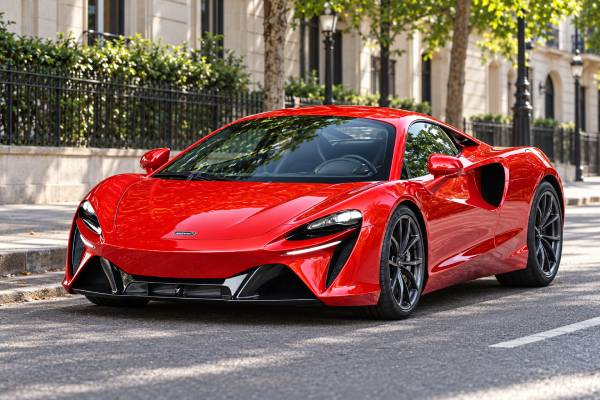
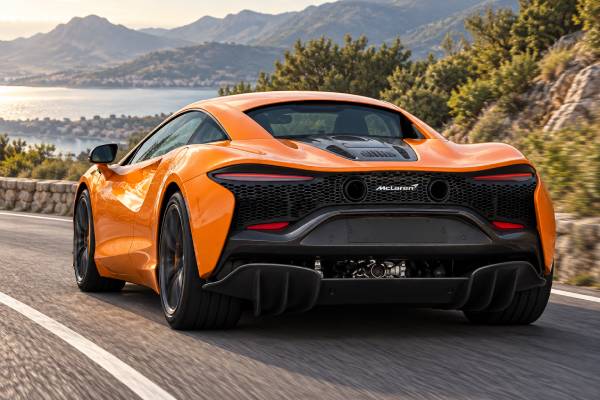
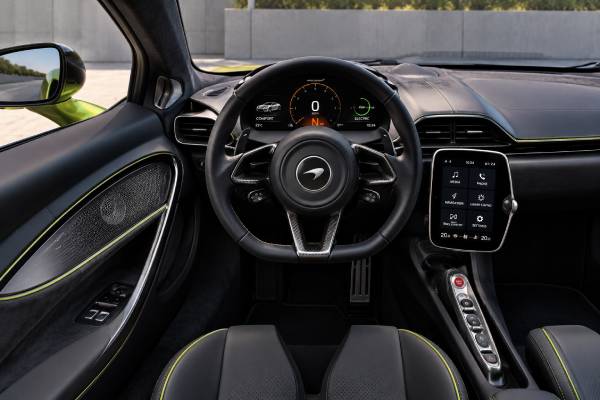
The 2022–2024 McLaren Artura is the original 671 hp version of McLaren’s first series-production plug-in hybrid supercar. It combines the M630 3.0-liter twin-turbo V6 with a compact axial-flux electric motor, an 8-speed dual-clutch transmission, rear-wheel drive, and a 7.4 kWh usable lithium-ion battery. The result is not an economy car with supercar styling; the hybrid system is mainly there to sharpen response, fill torque, enable short electric trips, and let McLaren reduce engine size without giving up serious performance.
This early Artura matters because it introduced the McLaren Carbon Fibre Lightweight Architecture, an electronic locking differential, a new electrical architecture, and a very different ownership profile from the brand’s earlier V8 cars. It is also the version most likely to appear on the used market at a substantial discount from new pricing. Buyers should therefore understand both its engineering strengths and the early-production recall history before focusing on color, trim, or mileage.
Table of Contents
- What the original 671 hp Artura is
- Artura 671 hp technical specifications
- How the hybrid system delivers performance
- Chassis, steering, brakes, and road behavior
- Charging, electric driving, and efficiency
- Maintenance, recalls, and ownership
- Buying a used 2022–2024 Artura
What the original 671 hp Artura is
The original Artura is a mid-engine, rear-wheel-drive two-seat coupe built around a carbon-fiber monocoque and a 680 PS system output, equivalent to 671 bhp. In North America it arrived primarily as a 2023 model, while McLaren’s broader launch and production timeline began earlier, so model-year labels can differ by market.
The central change from earlier McLarens is the move from a V8-only layout to a high-performance plug-in hybrid. The M630 engine is a 120-degree, 2,993 cc V6 with two turbochargers mounted in the V. Its wide bank angle lowers the engine and creates room for the turbochargers inboard, helping packaging and center-of-gravity control. The combustion engine produces 585 PS, while the electric motor contributes up to 95 PS. McLaren publishes the combined system figure as 680 PS rather than simply adding every peak torque figure, because the engine and motor reach their torque peaks under different conditions.
The electric motor sits in the driveline between the engine and the gearbox. That location allows it to provide immediate torque while the turbocharged engine builds speed, smooth transitions between electric and combustion power, and perform the reverse function. There is no conventional reverse gear in the transmission; the motor spins in the opposite direction to move the car backward.
The battery is mounted low and close to the passenger cell. That is important in a car where mass placement matters as much as absolute mass. The Artura’s hybrid hardware adds complexity, but McLaren offset much of it with the MCLA carbon structure, a compact V6, lightweight electrical components, and a short transmission package.
For buyers, the key distinction is simple: this section of the Artura family is the 671 hp launch specification. Later cars received a software and calibration update to 700 PS, or roughly 690 bhp, along with broader chassis and transmission revisions. Some earlier cars may also have received the factory-supported power update, so a used car’s present output may not match the number printed on its original order sheet.
Artura 671 hp technical specifications
The 2022–2024 Artura is a PHEV with a 3.0-liter twin-turbo V6, one axial-flux traction motor, a 7.4 kWh usable battery, an 8-speed dual-clutch transmission, and rear-wheel drive. Its technical story is less about one headline number than about how a compact hybrid system, low mass, and a carbon structure work together.
| Specification | Value |
|---|---|
| Engine | M630 120° V6, 2,993 cc (3.0L) |
| Induction | Twin electrically actuated turbochargers |
| Lubrication | Dry sump |
| Maximum engine speed | 8,500 rpm |
| Electric motor | Axial-flux motor integrated with the transmission |
| Motor output | 95 PS (94 bhp / 70 kW) |
| Motor torque | 225 Nm (166 lb-ft) |
| Battery | Refrigerant-cooled lithium-ion, 7.4 kWh usable capacity |
| Combined system output | 680 PS (671 bhp / 500 kW) at 7,500 rpm |
| Combined system torque | 720 Nm (531 lb-ft) |
| Specification | Value |
|---|---|
| Transmission | 8-speed Seamless Shift Gearbox dual-clutch transmission |
| Reverse | Electric reverse using the traction motor |
| Drive layout | Longitudinal mid-engine, rear-wheel drive |
| Differential | Electronically locking rear differential |
| Powertrain modes | E-mode, Comfort, Sport, and Track |
| Steering | Electro-hydraulic power assistance |
| Measure | Claimed figure |
|---|---|
| 0–60 mph | 3.0 seconds |
| 0–100 km/h (0–62 mph) | 3.0 seconds |
| 0–200 km/h (0–124 mph) | 8.3 seconds |
| 0–300 km/h (0–186 mph) | 21.5 seconds |
| Quarter mile | 10.7 seconds |
| Top speed | 330 km/h (205 mph), electronically limited |
| Electric-only top speed | 130 km/h (81 mph) |
| 100–0 km/h braking distance | 31 m (102 ft) |
Independent testing can be quicker than McLaren’s conservative launch claim. Car and Driver recorded 0–60 mph in 2.6 seconds and a 10.3-second quarter mile in a 2023 test. Treat such numbers as test results under specific conditions, not guaranteed performance for every tire, surface, temperature, state of charge, or vehicle.
| Specification | Value |
|---|---|
| Length | 4,539 mm (178.7 in) |
| Wheelbase | 2,640 mm (103.9 in) |
| Height | 1,193 mm (47.0 in) |
| Front track | 1,650 mm (65.0 in) |
| Rear track | 1,613 mm (63.5 in) |
| DIN kerb weight | 1,498 kg (3,303 lb) |
| Lightest dry weight | 1,395 kg (3,075 lb) |
| Weight distribution | 42% front / 58% rear |
| Front luggage capacity | 160 L (5.7 cu ft) |
| Specification | Value |
|---|---|
| Body structure | McLaren Carbon Fibre Lightweight Architecture (MCLA) |
| Front suspension | Double wishbone |
| Rear suspension | Multi-link |
| Damping | Proactive Damping Control |
| Front brakes | 390 mm carbon-ceramic discs, 6-piston forged aluminum calipers |
| Rear brakes | 380 mm carbon-ceramic discs, 4-piston forged aluminum calipers |
| Front wheels | 19 × 8.5J |
| Rear wheels | 20 × 10.5J |
| Front tires | 235/35 R19 |
| Rear tires | 295/35 R20 |
| Specification | Value | Standard or condition |
|---|---|---|
| AC onboard charging | 3.3 kW | Original launch specification |
| Charge time | About 2.5 hours to 80% | 240 V / standard EVSE condition cited by McLaren |
| WLTP electric range | About 30–31 km (19 mi) | Early launch specification |
| EPA electric range | 11 mi (18 km) | U.S. rating for 2023 model |
| EPA combined gasoline economy | 18 mpg | Charge-sustaining operation |
| EPA combined gasoline + electricity | 39 MPGe | 2023 U.S. rating |
| Fuel tank | About 66 L (17.4 U.S. gal) | Launch-market specification |
The differing electric-range figures are not a contradiction. WLTP and EPA use different test procedures, and McLaren also revised the Artura’s certified electric range during the model’s life. When comparing two used cars, compare their exact model year, software state, market certification, and battery condition rather than assuming every 671 hp Artura has the same displayed or real-world EV range.
How the hybrid system delivers performance
The Artura’s electric motor is most valuable as a response device, not as a long-distance EV power source. It supplies torque immediately, helping the smaller V6 feel strong before the turbochargers are fully delivering their peak airflow.
That changes the character of acceleration. A conventional turbocharged engine can feel softer below its boost threshold, then stronger as rpm rises. In the Artura, the e-motor fills that low-rpm gap while the V6 takes over more of the workload as revs build. The combined result is a broad 720 Nm system torque figure and very little sense of waiting for the powertrain.
The 120-degree V6 also contributes to packaging and response. Placing the turbochargers inside the V shortens gas paths, while the wide engine angle helps keep mass low. The dry-sump system lets the engine sit lower than a conventional wet-sump design and helps maintain oil control during sustained cornering.
The transmission is unusual because it has eight forward gears but no mechanical reverse. Removing the reverse gear helps shorten the gear cluster, and the electric motor simply reverses direction when the driver selects R. This arrangement works because the high-voltage system is an integral part of the car rather than an add-on assist motor.
In E-mode, the Artura can move without starting the V6. That is useful for leaving a garage quietly, crossing an urban low-speed area, or avoiding a cold-start burst of noise early in the morning. It is not intended to turn the Artura into a commuter EV. With an EPA-rated 11 miles for the U.S. launch car, electric range can disappear quickly in cold weather, at high speed, or under heavy acceleration.
Comfort, Sport, and Track modes alter the balance between efficiency, response, gear strategy, and battery use. A driver who arrives at a circuit with a low state of charge is not necessarily left with a weak car, because the powertrain can use the combustion engine to replenish the battery. Still, repeated maximum-output use depends on the hybrid system remaining in its intended temperature and charge window.
The original 671 hp car is already extremely fast. The later 690 hp calibration mainly adds power high in the rev range rather than transforming low-speed torque. That makes the launch car less obsolete than the headline numbers imply. A well-sorted early Artura on fresh tires can still deliver the acceleration, steering response, and braking performance expected of a modern McLaren.
Chassis, steering, brakes, and road behavior
The Artura’s strongest dynamic trait is that the hybrid hardware does not dominate the driving experience. The car remains relatively light for a PHEV supercar, and McLaren retained electro-hydraulic steering rather than moving to a fully electric steering rack.
That steering choice matters because it preserves a direct flow of information through the wheel. The driver can feel changes in front-tire loading without needing artificial steering weight. The front suspension uses double wishbones, while the rear changed to a multi-link layout. The rear geometry was designed to better control toe under braking and cornering loads, which helps stability as the car approaches its limits.
The electronic differential is another Artura first for a series-production McLaren. Instead of relying only on brake-based intervention or an open differential, the e-diff can actively manage torque across the rear axle. That improves traction on corner exit and gives the stability and Variable Drift Control systems another tool to shape the car’s behavior.
Carbon-ceramic brakes are standard in the core specification. Their size and thermal capacity suit track use, but owners should understand the practical trade-off: carbon-ceramic components are expensive, can feel different when cold or lightly loaded, and need careful inspection before purchase. Surface appearance alone does not tell you remaining life. A specialist should assess disc condition, pad thickness, heat history, and any damage from debris.
Tires are equally important. The Artura’s performance numbers assume correctly specified performance tires in good condition. Age, heat cycling, alignment, and uneven wear can change the car far more than a small horsepower difference. Pirelli P Zero and P Zero Corsa fitments were developed for the car, including Cyber Tire technology on certain configurations. Replacement tires should match the approved size, load rating, speed rating, and McLaren-specific specification where required.
The ride is more forgiving than the supercar appearance suggests. Adaptive damping lets the chassis breathe over uneven roads rather than using excessive spring stiffness to create a false sense of sportiness. That makes the Artura viable for long road drives, but the low nose, wide body, dihedral doors, and limited front storage still demand planning in normal parking environments.
Charging, electric driving, and efficiency
Charging the early Artura is simple but slow by modern EV standards because it uses a small battery and modest AC charging hardware. There is no need for DC fast charging in the way there is with a battery-electric car; plugging in at home is the natural use case.
McLaren quoted roughly 2.5 hours to reach 80% under a suitable 240 V charging condition. Because the battery is only 7.4 kWh usable, the purpose is to restore the small electric reserve between drives, not to support long electric road trips. Regular charging gives the car the best chance to start in E-mode with useful range available.
There is an important nuance around regeneration. McLaren prioritized consistent brake-pedal feel and did not design the Artura around strong, driver-selectable brake regeneration in the way many EVs are. The car can recover energy and can also use the engine to manage battery state, but drivers should not expect pronounced one-pedal behavior.
Real-world fuel consumption depends heavily on trip length and charging habits. A driver who plugs in frequently and makes short urban trips can complete meaningful portions of those trips electrically. A driver who never charges the car and spends most of the time using the V6 will see fuel economy much closer to a conventional high-performance car. That is why a single PHEV “mpg” number can be misleading without context.
For used-car inspection, charging should be tested rather than assumed. Confirm that the charge port opens and locks correctly, that the car accepts AC power without warnings, that the cable and portable equipment supplied with the car are present if they were part of the original delivery, and that the displayed state of charge rises normally. Any persistent high-voltage, isolation, charging, or battery warning deserves diagnosis before purchase.
Battery age matters, but calendar age alone does not tell you battery health. Temperature exposure, charging patterns, software state, and cell balance all matter. The most useful check is a McLaren-capable diagnostic scan combined with a road test in E-mode and hybrid operation.
Maintenance, recalls, and ownership
Early Artura ownership should be approached as ownership of a technically complex low-volume supercar, not simply as maintenance of a V6 coupe. Service history, completed campaigns, software updates, and the quality of past diagnostic work are especially important.
Two U.S. fuel-system recalls are particularly relevant to early cars. NHTSA recall 22V-908 covered certain 2023 Arturas whose high-pressure fuel-pipe nuts could loosen and allow fuel to leak near hot engine components. NHTSA recall 23V-796 covered certain 2023–2024 Arturas with a low-pressure fuel pipe that could disconnect, also creating a fuel-leak and fire risk. Recall applicability is VIN-specific, so the correct action is to check the VIN rather than assume a car is included or excluded based only on year.
A sensible ownership routine includes:
- Verify recall completion and outstanding campaigns through an authorized retailer and the relevant national recall database.
- Keep the 12-volt and high-voltage systems in healthy operating condition, especially if the car is stored for long periods.
- Use the correct fuel grade and fluids specified for the exact market and VIN.
- Inspect tires for age and inner-edge wear, not just tread depth.
- Check carbon-ceramic discs and pads with a specialist familiar with McLaren wear criteria.
- Confirm that the front lift, damping system, e-differential, transmission, charging system, and all drive modes work without warning messages.
- Preserve service invoices and campaign records; documentation materially affects resale confidence on a low-volume car.
The Artura’s software-defined systems make battery support during service or storage especially important. Low-voltage instability can cause a cascade of unrelated warning messages on modern performance cars. That does not mean every warning is harmless, but it does mean diagnosis should start with proper voltage support and fault-code reading rather than random parts replacement.
Owners who track the car should shorten their inspection cycle. Track use adds thermal load to tires, brakes, wheel bearings, fluids, and cooling systems even when the car remains mechanically healthy. A post-event check is cheap compared with a damaged carbon-ceramic disc, overheated tire, or missed fluid leak.
McLaren’s warranty terms have varied by market and date, and later ownership programs can differ from the original new-car package. A buyer should verify remaining coverage by VIN and obtain the terms in writing rather than relying on a used-car advertisement.
Buying a used 2022–2024 Artura
The best early Artura is the car with the clearest history, correct campaign work, healthy hybrid system, and strong specialist inspection—not necessarily the one with the lowest mileage. Low use can be attractive, but long storage and unresolved early-production issues can matter more than a modest odometer difference.
Start by confirming exactly what you are buying. Check the VIN, original build sheet, market specification, model year, option list, and current software level. Some 671 hp cars may have received McLaren’s later power upgrade, while others may remain at their original calibration. Neither status is automatically better; what matters is accurate documentation and proper execution.
Then inspect the expensive systems first. Carbon-ceramic brakes, forged wheels, tires, active damping hardware, hydraulic nose lift, body panels, carbon structure, and hybrid components can make a cheap example expensive quickly. Look underneath for impact damage from ramps or curbs, and examine the front splitter and floor edges for evidence of repeated grounding.
The body should be checked for paintwork and carbon repairs by someone who understands McLaren construction. A cosmetic repair is not automatically a reason to reject the car, but the repair method and structural condition matter. Misaligned panels, disturbed fasteners, inconsistent paint thickness, damaged mounting points, or poor-quality carbon repair should trigger deeper investigation.
During the road test, begin from cold if possible. Confirm that the car starts normally, enters E-mode when conditions allow, transitions smoothly between electric and combustion power, and shifts cleanly through the gearbox. Test reverse repeatedly because it depends on the electric drive system. Listen for abnormal drivetrain clunks, wheel-bearing noise, suspension knocks, and brake vibration. Exercise every handling and powertrain mode after the car is fully warm.
Check the infotainment, instrument display, cameras, parking aids, climate control, key operation, charging interface, and any driver-assistance options. Electronics are part of the buying inspection, not an afterthought, because intermittent faults can be time-consuming to diagnose.
A pre-purchase inspection should include a diagnostic scan, battery-system check, recall and campaign verification, tire date codes, wheel condition, brake assessment, underbody inspection, fluid-leak check, cooling-system review, and confirmation that scheduled servicing was performed on time. Ask the inspecting shop to separate immediate faults from normal future maintenance so you can price the car rationally.
The 671 hp Artura makes the most sense for a buyer who values the original specification, wants strong used-market value, and is willing to prioritize provenance over the newest calibration. The later 690 hp car has worthwhile improvements, but the early version still delivers the defining Artura experience: light-feeling controls, a compact electrified V6, real EV capability for short trips, and performance that remains extremely serious.
References
- McLaren Artura Hybrid Supercar – Interior & Specifications 2026
- McLaren unveils all-new, next-generation High-Performance Hybrid supercar – the McLaren Artura 2021
- Part 573 Safety Recall Report — 22V-908 2023 (Recall Report)
- Part 573 Safety Recall Report — 23V-796 2023 (Recall Report)
- Tested: 2023 McLaren Artura Is the Second Coming 2023
- Driving McLaren’s new plug-in hybrid supercar, the 2023 Artura 2022
Disclaimer
Use this early-Artura guide as general information, not as workshop diagnosis or a repair procedure. The correct specification, torque setting, maintenance interval, software action, or service method can change with VIN, destination market, and fitted equipment; confirm every job against the official McLaren documentation for the individual car.
Know another owner researching the original 671 hp Artura? Sharing this guide on Facebook, X/Twitter, or an enthusiast group helps our work reach them.