
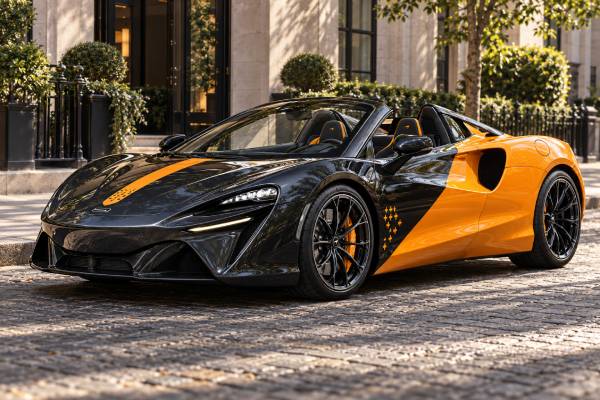
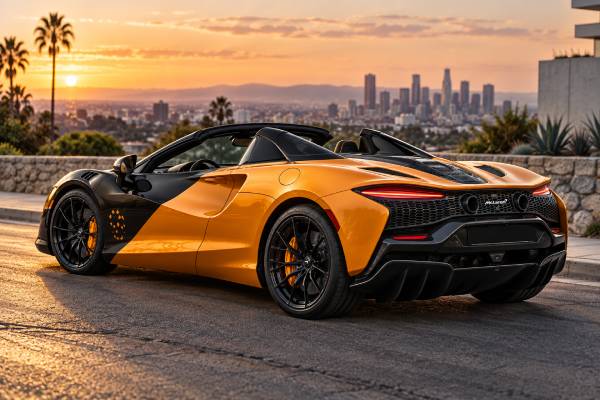
The 2025 McLaren Artura Spider MCL38 Celebration Edition turns an already unusual plug-in-hybrid convertible into a physical record of McLaren Racing’s 2024 Formula 1 Constructors’ Championship. Its distinction is not extra horsepower: beneath the MSO finish, it uses the updated Artura Spider powertrain with 700 PS, or 690 bhp, and 720 Nm of combined torque. What separates it is provenance. The Papaya Orange and Anthracite treatment recalls the MCL38 race car, the cabin carries signatures from Lando Norris and Oscar Piastri, and each Celebration Edition includes a dedication plaque containing genuine MCL38 bodywork. McLaren announced only nine MCL38 Celebration Edition Arturas globally, across the Artura program rather than nine Spiders alone. That makes correct identification especially important. This guide explains what is unique to the Spider, how its retractable roof and hybrid hardware work, the specifications that matter in use, and what a buyer should verify before treating one as either a road car or a collectible.
Table of Contents
- Rarity, production, and what the Spider designation means
- Retractable-roof engineering and packaging
- Technical specifications
- MCL38 design details and championship provenance
- Hybrid performance and road behavior
- Care, maintenance, and preservation
- Buying and authenticating an MCL38 Spider
Rarity, production, and what the Spider designation means
The safest way to describe the MCL38 Celebration Edition’s rarity is simple: McLaren announced nine Arturas and nine 750S models, not nine Artura Coupes plus nine Artura Spiders. The nine-car Artura total was chosen to mark McLaren’s ninth Formula 1 Constructors’ Championship, secured in 2024. Publicly available material confirms that the Artura Celebration Edition could exist as a Coupé or Spider, and McLaren Singapore specifically announced a single Artura Spider MCL38 Celebration Edition for its market. McLaren has not publicly published a complete body-style split for all nine Arturas.
That distinction matters because a special-edition badge can easily acquire a larger production story as cars move between markets and auction listings repeat one another. A prospective owner should separate three facts:
- Global Artura MCL38 production: nine Celebration Edition Arturas were announced.
- Body style: at least some cars were configured as the Artura Spider, while Coupé examples also exist.
- Regional allocation: a statement such as “one in Singapore” describes that market’s allocation, not worldwide Spider production.
The road car commemorates the MCL38 Formula 1 machine that carried McLaren to the 2024 Constructors’ title. Lando Norris and Oscar Piastri combined for six Grand Prix victories and eight pole positions during that championship season. The celebration package therefore has a very specific historical reference rather than being a general “racing-inspired” appearance pack.
The P16S code in the assignment identifies the open-roof Artura form. Mechanically, the Celebration Edition remains an Artura Spider. There is no published evidence of a unique engine calibration, higher combined output, different final drive, special suspension geometry, or altered battery for the MCL38 version. Its value proposition is the pairing of the updated 690 bhp Spider with MSO craftsmanship and unusually direct Formula 1 provenance.
| Item | Verified detail |
|---|---|
| Model year covered | 2025 |
| Underlying model | McLaren Artura Spider |
| Powertrain type | Plug-in hybrid, rear-wheel drive |
| Celebration Edition Artura production | 9 cars globally across the Artura Celebration Edition run |
| Companion model | 9 McLaren 750S MCL38 Celebration Edition cars |
| Reason for edition | McLaren’s ninth Formula 1 Constructors’ Championship, won in 2024 |
| Customization division | McLaren Special Operations (MSO) |
Retractable-roof engineering and packaging
The Spider’s defining engineering feature is its retractable hard top, and the carbon-fibre chassis allows McLaren to add open-air operation without redesigning the central structure around a conventional steel convertible reinforcement package. The Artura’s McLaren Carbon Fibre Lightweight Architecture, or MCLA, was conceived with both body styles in mind. McLaren quotes the Spider at 1,457 kg dry, 62 kg heavier than the corresponding Coupé.
The roof can open or close in 11 seconds and is operable at speeds up to about 50 km/h (31 mph). Its compact movement matters in ordinary use: the driver does not have to stop beside the road when weather changes, and the roof occupies a tightly managed space above the powertrain rather than consuming a conventional rear luggage compartment.
A solid composite roof panel is standard, while an electrochromic glazed roof has been offered as an option. The latter can alter light transmission electronically. The rear glass is separately powered. With the roof down, raising that glass can reduce cabin turbulence; with the roof up, lowering it gives the occupants a more direct path to the V6 exhaust note.
The Spider also differs around its rear deck. Its partially glazed flying buttresses improve rearward sight lines while helping guide airflow. Aerothermal ducting around the roof mechanism and engine bay manages cooling air, and McLaren added measures to control buffeting around the windscreen header. These details are more than styling because a mid-engined convertible must solve three problems at once: maintain airflow to hot components, keep high-speed air stable around the open cabin, and package moving roof hardware without compromising the carbon structure.
| Specification | Value |
|---|---|
| Roof type | Electrically operated retractable hard top |
| Roof operating time | 11 seconds |
| Roof operation while moving | Up to 50 km/h (31 mph) |
| Optional roof | Electrochromic glazed panel |
| Rear window | Independently powered |
| Body structure | McLaren Carbon Fibre Lightweight Architecture with aluminium hot-formed body panels |
| Lightest dry weight | 1,457 kg (3,212 lb) |
| DIN kerb weight | 1,560 kg (3,439 lb) |
For a Celebration Edition owner, the practical implication is that roof condition deserves the same attention as the bespoke finish. The hard top is not a detachable showpiece; it is a powered system with seals, latches, trim interfaces, electrical drives, and a tonneau mechanism that all need to work smoothly.
Technical specifications
The MCL38 Celebration Edition does not replace the Artura Spider’s core hardware, so its relevant performance figures are the standard updated Spider specifications: a 3.0-litre twin-turbo V6, an axial-flux electric motor, a 7.4 kWh lithium-ion battery, and 700 PS (690 bhp) combined output. McLaren pairs the system with an eight-speed Seamless Shift Gearbox and uses the electric motor for reverse, eliminating a conventional reverse gear.
| Specification | Value |
|---|---|
| Internal-combustion engine | 3.0L 120-degree twin-turbocharged V6, dry sump |
| Engine family | M630 |
| Electric motor | Axial-flux motor |
| Combined maximum output | 700 PS (690 bhp) |
| Combined maximum torque | 720 Nm (531 lb-ft) |
| Battery | Refrigerant-cooled lithium-ion, 7.4 kWh |
| Transmission | 8-speed + E-Reverse Seamless Shift Gearbox |
| Driven wheels | Rear-wheel drive |
The 120-degree V6 angle helps lower the engine’s center of mass and creates room within the V for the turbochargers. Electrically actuated turbocharger wastegates and the electric motor’s immediate torque support response while the combustion engine builds boost. The motor is integrated into the transmission area rather than driving a separate axle, so the Artura remains rear-wheel drive.
McLaren’s updated 700 PS tune was introduced alongside the Spider and also applied to the contemporary Coupé. The increase occurs chiefly at higher engine speeds. It should not be interpreted as a special MCL38 Celebration Edition tune: a standard 2025 Artura Spider has the same claimed system output.
| Measure | McLaren figure |
|---|---|
| 0–100 km/h (0–62 mph) | 3.0 seconds |
| 0–200 km/h (0–124 mph) | 8.4 seconds |
| 0–300 km/h (0–186 mph) | 21.6 seconds |
| Standing 400 m / quarter mile | 10.8 seconds |
| Maximum speed | 330 km/h (205 mph), electronically limited |
| 100–0 km/h braking distance | 31 m (101.7 ft) |
| 200–0 km/h braking distance | 124 m (407 ft) |
Those numbers show why the roof mechanism is not the defining performance compromise some buyers might expect. The Spider’s claimed 0–100 km/h time and top speed match the Coupé, although the Spider is marginally slower to 200 km/h.
| Specification | Value or test condition |
|---|---|
| Official electric range | 33 km (21 miles), EU WLTP |
| Weighted fuel consumption | 4.8 L/100 km, EU WLTP |
| Combined CO2 emissions | 108 g/km, EU WLTP |
| Fuel tank | 65 L (17.14 US gal) |
| Front luggage capacity | 160 L |
| Battery capacity | 7.4 kWh |
WLTP plug-in-hybrid consumption is a standardized weighted figure that assumes battery use. It is not a promise that a 690 bhp supercar will consume 4.8 L/100 km on every trip. Long motorway journeys with a depleted battery, repeated hard acceleration, cold temperatures, and track driving can produce very different results.
| Specification | Configuration |
|---|---|
| Front suspension | Double wishbone |
| Rear suspension | Multi-link |
| Damping | Proactive Damping Control |
| Differential | Electronically locking differential |
| Steering | Electro-hydraulic power assistance |
| Front brakes | Carbon-ceramic discs, 6-piston aluminium calipers |
| Rear brakes | Carbon-ceramic discs, 4-piston aluminium calipers |
| Front tire size | 235/35 ZR19 |
| Rear tire size | 295/35 ZR20 |
The standard road-tire family includes Pirelli P Zero fitments, with other approved choices offered for specific use. McLaren and Pirelli also employ sensor-based Cyber Tyre technology on the Artura platform. For replacement tires, the important point is not simply matching dimensions: use the correct approved specification and confirm the car’s exact factory fitment.
MCL38 design details and championship provenance
The MCL38 Celebration Edition is most convincing when viewed as a provenance package built by MSO rather than as a conventional trim level. The exterior uses Papaya Orange and Anthracite with the chevron-style color transition associated with McLaren’s 2024 Formula 1 identity. A Champions’ Laurel, a Nine-Star emblem, an orange bonnet stripe, and orange brake calipers make the championship reference explicit.
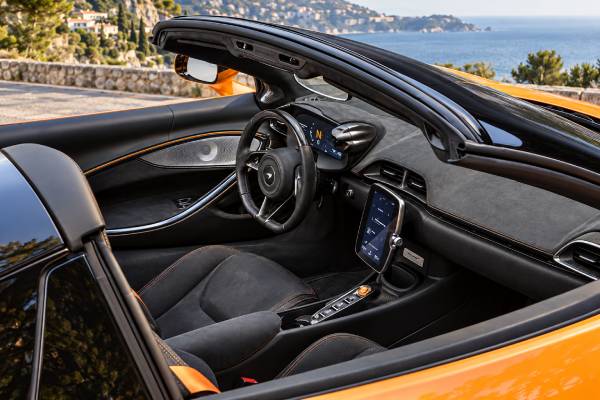
Inside, the treatment becomes more individual. The driver-side Visual Carbon Fibre Extended Sill Cover is signed by Lando Norris and Oscar Piastri and carries an MCL38 Formula 1 car line graphic. The seat headrest area receives the Champions’ Laurel, while a Papaya 12 o’clock marker gives the steering wheel another race-derived visual cue.
Two plaques deserve separate attention because they carry more evidentiary weight than ordinary decorative badges. One dedication plaque incorporates a genuine section of carbon-fibre bodywork from an MCL38 Formula 1 car. Another plaque in the front luggage area records the MCL38’s achievements from the 2024 season. This means a complete car is not merely identified by paint and embroidery; it carries edition-specific physical artifacts that are difficult to substitute convincingly.
The Spider shape changes how that livery is perceived. With the roof raised, the car has a dark upper volume that visually connects the windscreen, roof panel, and rear deck. With the roof stowed, the same graphics frame an open cabin and the flying buttresses become more prominent. A buyer who cares about originality should therefore inspect all painted and clear-coated transitions across panels and moving roof elements, not just the obvious side graphics.
A useful way to think about authenticity is to separate the car into three layers:
- Base vehicle: a genuine 2025 Artura Spider with the 700 PS powertrain and Spider-specific roof hardware.
- MSO specification: the correct MCL38 Celebration Edition paint, graphics, trim, signatures, plaques, and interior details.
- Documented provenance: factory order/specification records, delivery paperwork, servicing history, and evidence that the edition-specific pieces belong to that chassis.
A replica livery on a normal Spider could reproduce the first impression. It cannot create the same factory provenance.
Hybrid performance and road behavior
The Artura Spider’s main dynamic achievement is that roof-down driving does not turn it into a soft grand tourer. The carbon architecture retains the structural basis of the Coupé, the steering remains electro-hydraulic, and the suspension keeps a conventional McLaren emphasis on feedback rather than filtering every sensation through drive-by-wire tuning.
The powertrain has four principal operating choices: Electric, Comfort, Sport, and Track. Electric mode is useful for short urban sections and quieter departures. Comfort allows more automatic switching between electric and combustion operation. Sport and Track keep the V6 engaged more consistently and manage the battery so electrical assistance remains available for performance.
The 2025-era update also brought changes beyond the headline power increase. Revised powertrain mounts control movement more tightly. Transmission software can pre-fill the hydraulic system for faster shifts, and McLaren quoted shift times up to 25 percent quicker in the most aggressive circumstances. Revised damping hardware and control response sharpen the chassis without requiring a separate Celebration Edition suspension.
There is an unusual braking philosophy for a modern hybrid supercar. The Artura does not use strong lift-off regeneration as a one-pedal-driving feature, and its brake pedal emphasizes a consistent friction-brake feel. Energy recovery is handled without making the pedal behave like the heavily blended systems used in many electrified road cars. That choice suits a car in which repeatable pedal feedback under high deceleration matters.
Roof position changes the sensory experience more than the raw pace. With the top down and rear glass lowered, intake, turbocharger, exhaust, and road sounds reach the cabin with little isolation. Raise the rear glass and wind disturbance drops. Close the roof and the Artura becomes more suitable for long-distance use, particularly with the glazed panel in its darker setting where fitted.
Owners should still respect the difference between published acceleration figures and repeatable road performance. Battery state, tire temperature, road surface, ambient conditions, fuel load, and launch-control use all affect the result. A Celebration Edition does not gain a performance exemption from those basic conditions simply because it is rare.
Care, maintenance, and preservation
A low-production MSO Spider needs two kinds of care at once: ordinary Artura mechanical maintenance and conservation of components that may be difficult or impossible to replace in exact original form. The latter includes the signed sill, championship plaques, special paint treatment, and any genuine MCL38 material incorporated into the car.
For the hybrid system, service work should remain with technicians equipped for McLaren high-voltage procedures. The 7.4 kWh traction battery, motor, inverter-related electronics, cooling circuits, and high-voltage cabling are not areas for casual diagnosis. Warning messages, charging faults, isolation faults, or cooling-system concerns should be investigated through the proper diagnostic process rather than by replacing components speculatively.
The retractable hard top adds its own inspection points. Watch for uneven panel movement, hesitation, abnormal noises, seal deformation, water ingress, damaged drain paths, and disagreement between roof-position sensors. A roof that works only after repeated switch inputs is not “normal for an exotic”; it is a fault worth documenting before purchase or warranty expiry.
Preserving the MSO finish calls for restraint. Paint-protection film can be useful, but installation and removal around hand-finished graphics should be handled by a shop familiar with specialty finishes. Aggressive polishing can reduce clear-coat thickness or alter edges. Before correcting stone chips, confirm whether the affected element is paint, a graphic treatment, exposed carbon, or a replaceable trim component.
Storage also deserves planning. A car that spends weeks stationary should be kept according to McLaren’s battery-support guidance, with attention to both the high-voltage system and the 12-volt electrical system. Tire pressures should be checked before driving after storage, and the car should not be assumed road-ready simply because it has covered few kilometers.
Practical preservation priorities include:
- keep the factory documentation, build specification, handover material, keys, and supplied accessories together;
- photograph the signed sill and both edition-specific plaques at delivery-quality resolution;
- record any paint-protection film or cosmetic repair, including who performed it and what products were used;
- retain invoices for McLaren servicing and software work;
- operate the roof periodically according to normal-use guidance rather than leaving the mechanism untouched for years;
- inspect tires by age and condition, not tread depth alone;
- avoid replacing edition-specific trim for cosmetic preference unless the original parts are retained.
Because this is a plug-in hybrid convertible, seasonal use can expose weak points that ordinary mileage figures hide. A car repeatedly stored with poor 12-volt support may accumulate low-voltage faults even when its traction battery appears healthy. Likewise, a roof mechanism that has rarely moved still depends on flexible seals and synchronized sensors. During routine service, ask for fault history rather than accepting a warning-free dashboard as the whole story. For a collectible example, preserving diagnostic records can be nearly as useful as preserving cosmetic invoices because they show whether intermittent electrical or roof concerns were investigated correctly.
A collector-grade history is strongest when maintenance and originality support each other rather than one being sacrificed for the other.
Buying and authenticating an MCL38 Spider
The most important buying step is to authenticate the chassis and its MSO specification before discussing rarity premiums. Because the global Artura run is only nine cars and the public Coupe/Spider split is not fully disclosed, a seller’s unsupported claim that a particular Spider is “one of X worldwide” should not substitute for factory documentation.
Start with the VIN and ask a McLaren retailer or the appropriate McLaren support channel to verify the original build specification where possible. Then compare the physical car with the edition details. The signed Visual Carbon Fibre Extended Sill Cover, MCL38 line graphic, Champions’ Laurel, Papaya steering-wheel marker, dedication plaque with genuine race-car bodywork, and track-record plaque should form a coherent package. Examine fastening, finish quality, fonts, placement, and evidence of removal around rare parts.
The next check is condition, not mileage. A very low-odometer Spider can still have stale tires, weak low-voltage support, roof faults, cosmetic damage from storage, or deferred software campaigns. Conversely, a carefully serviced car with moderate use may be mechanically easier to assess. Obtain a pre-purchase inspection from a McLaren-qualified facility and request a full diagnostic scan as part of it.
Pay special attention to:
- roof operation through a complete opening and closing cycle;
- seals, drainage areas, rear glass, tonneau cover alignment, and evidence of water intrusion;
- carbon-fibre and painted surfaces under strong, diffuse lighting;
- wheel damage and the exact specification and age of all four tires;
- carbon-ceramic brake condition and any chips or surface damage;
- charging function and relevant hybrid-system warnings;
- service records, campaign completion, and software status;
- whether any original MCL38-specific pieces have been refinished, replaced, or are missing.
Insurance and repair planning should happen before the purchase is completed. A conventional valuation based on a standard Artura Spider may not reflect the difficulty of replacing hand-finished MSO elements or provenance pieces. An agreed-value or specialist policy may be appropriate depending on the market and intended use.
The central buying principle is therefore not “find the lowest-mileage one.” It is to find the car with the strongest chain from factory specification to present condition. On an MCL38 Celebration Edition Spider, the 690 bhp hybrid hardware makes it fast, but the combination of documented identity, intact commemorative components, correct maintenance, and an undisturbed MSO finish is what preserves the reason this particular Artura exists.
References
- McLaren Singapore celebrates McLaren’s ninth Formula 1 Constructors’ Championship win with ultra-exclusive MCL38 Celebration Edition Artura unveiled for the first time in Southeast Asia 2025
- Ultra-exclusive MCL38 Celebration Edition Artura and 750S supercars honour McLaren’s ninth Formula 1 Constructors’ Championship win 2025
- McLaren Artura Spider – New Hybrid Convertible Supercar 2026
- McLaren introduces the MCL38 Celebration Edition 2025
- 2025 McLaren Artura Spider Is the One to Be Seen In 2024
- McLaren Artura Spider, the new hybrid supercar en plain air 2024
Disclaimer
Treat this MCL38 Spider article as background information rather than a substitute for expert inspection, diagnosis, or repair. Roof procedures, specifications, torque figures, maintenance timing, software, and fitted components are VIN- and market-sensitive; verify them in the official McLaren service material for the car being examined.
For readers who follow rare McLaren Spiders, sharing this piece on Facebook, X/Twitter, or a relevant owners’ community is a welcome way to support our work.