
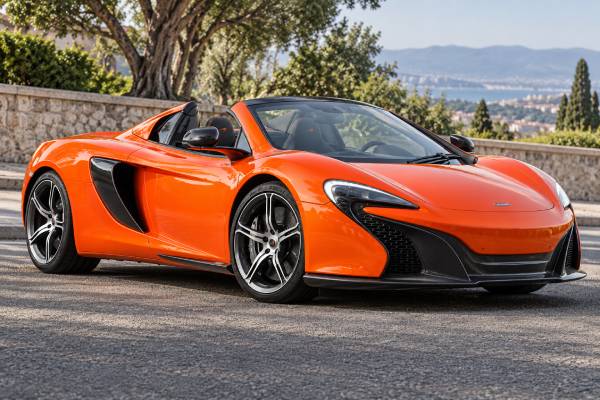
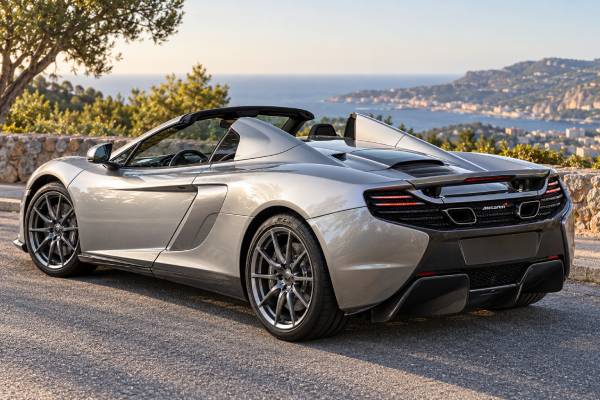
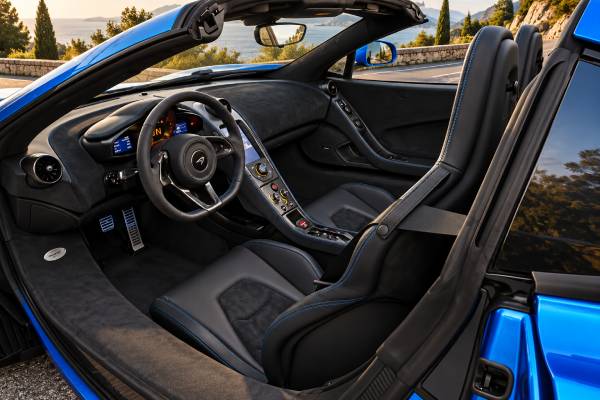
The McLaren MSO 650S Spider combines two ideas that were unusual even in the early modern McLaren era: a 204 mph retractable-hardtop supercar and a very small factory-bespoke production run. McLaren Special Operations announced only 50 MSO 650S cars globally across Coupé and Spider body styles, with the Spider serving as the production version’s public debut at the 2014 Goodwood Festival of Speed. Mechanically, it retained the standard 650S Spider’s 3.8-liter M838T twin-turbo V8, seven-speed Seamless Shift dual-clutch gearbox, carbon-fiber MonoCell, and ProActive Chassis Control. The distinction came from special MSO carbon-fiber body pieces, lightweight wheels with titanium bolts, exclusive finishes, and a more individualized interior. For owners and buyers, the retractable roof adds another layer of inspection beyond the usual 650S hydraulic, electronic, brake, and service checks. The best examples therefore need to be right in three ways at once: mechanically healthy, roof-system healthy, and verifiably complete as an MSO production car.
Table of Contents
- Why the MSO Spider Is More Than a Trim Package
- MSO 650S Spider Technical Data
- Retractable Roof and Open-Top Engineering
- Road Performance and Everyday Usability
- Maintenance for an Aging MSO Spider
- Pre-Purchase Inspection and Provenance Checks
- The Ownership Case for the MSO Spider
Why the MSO Spider Is More Than a Trim Package
The MSO 650S Spider did not gain extra horsepower, but it did gain an unusually concentrated set of factory-bespoke parts and finishes. That matters today because the model’s scarcity is tied to those original details, not to a different engine code or a unique chassis number sequence that is obvious at a glance.
McLaren Special Operations took elements first shown on its 650S Coupé concept and turned them into a 50-car production program covering both body styles. The Spider appeared publicly at Goodwood, where it demonstrated that the package was intended as a complete customer car rather than a static design exercise. Satin-finish carbon-fiber side blades, a more assertive rear diffuser, a special rear bumper center section, additional exposed-carbon treatment, and bespoke wheel design gave the car a lower and more technical appearance without changing the 650S’s fundamental proportions.
The wheel package is one of the most significant identifying details. Contemporary McLaren material and period reporting described a ten-spoke lightweight alloy design that reduced mass by about 4 kg (9 lb) per set compared with the normal wheels and used titanium wheel bolts. Those are the kinds of pieces that can disappear over a decade of tire changes, curb damage, refinishing, or owner customization. A Spider on aftermarket wheels may still be a very good car, but the absence of its MSO set should be documented rather than overlooked.
Three headline colors were associated with the production series: Papaya Spark, Agrigan Black, and Sarigan Quartz. The cabin could combine Carbon Black leather and Alcantara with carbon-fiber trim and a dedicated plaque, while customers also received special presentation items such as an MSO-branded holdall and a Frank Stephenson-signed design sketch according to period material. Because MSO existed specifically to personalize cars, buyers should verify the exact specification of the individual VIN rather than assume every car was built identically.
The Spider adds another source of identity: the roof itself. Unlike a traditional fabric convertible, it uses a two-piece powered hardtop that stores beneath the rear tonneau. The carbon MonoCell was conceived without depending on a steel roof for structural strength, so the conversion did not require the kind of heavy reinforcement common in conventional convertibles. The Spider’s additional mass was about 40 kg relative to the Coupé, yet 0–100 km/h remained 3.0 seconds.
MSO 650S Spider Technical Data
The MSO Spider’s mechanical specification is the standard 650S Spider specification beneath its bespoke body and trim package. It is a rear-wheel-drive ICE supercar with a mid-mounted 3,799 cc twin-turbo V8, a seven-speed dual-clutch transmission, hydraulically linked double-wishbone suspension, carbon-ceramic brakes, and a two-seat retractable-hardtop body.
| Specification | Value |
|---|---|
| Engine code | M838T |
| Layout | Mid-mounted 90° V8 |
| Displacement | 3,799 cc (3.8 L) |
| Induction | Twin turbochargers |
| Lubrication | Dry sump |
| Valvetrain | 32-valve DOHC, variable valve timing |
| Maximum power | 650 PS (478 kW; 641 bhp) at 7,250 rpm |
| Maximum torque | 678 Nm (500 lb-ft) at 6,000 rpm |
| Maximum engine speed | 8,500 rpm |
| Specification | Value |
|---|---|
| Gearbox | 7-speed Seamless Shift dual-clutch gearbox (SSG) |
| Drive | Rear-wheel drive |
| Differential strategy | Open differential with Brake Steer |
| Suspension | Double wishbones, ProActive Chassis Control |
| Handling settings | Normal, Sport, Track |
| Steering | Variable-rate electro-hydraulic assistance |
| Active aero | Rear Airbrake and drag-reduction function |
| Measure | Value |
|---|---|
| 0–60 mph | 2.9 seconds |
| 0–100 km/h (0–62 mph) | 3.0 seconds |
| 0–100 mph | 5.8 seconds |
| 0–200 km/h (0–124 mph) | 8.6 seconds |
| Maximum speed, roof closed | 329 km/h (204 mph) |
| 100–0 km/h | 30.7 m (101 ft) |
| 200–0 km/h | 124 m (407 ft) |
| Specification | Value | Practical note |
|---|---|---|
| Body style | 2-door, 2-seat Spider | Two-piece retractable hardtop |
| Roof operation time | About 17 seconds | Can operate at up to 30 km/h (19 mph) |
| Rear glass | Power-operated heated glass | Can be lowered independently of the roof |
| Structure | Carbon-fiber MonoCell with aluminum crash structures | No conventional roof bracing required for tub stiffness |
| Dry weight | 1,370 kg (3,020 lb) | 1,341 kg (2,956 lb) in lightest specification |
| DIN kerb weight | 1,468 kg (3,236 lb) | Fluids and 90% fuel |
| Weight distribution | 42% front / 58% rear | Published Spider figure |
| Specification | Value |
|---|---|
| Wheel size | 19 × 8.5 in front; 20 × 11 in rear |
| MSO wheel distinction | Special lightweight ten-spoke design with titanium bolts |
| Tire size | 235/35 R19 front; 305/30 R20 rear |
| Factory performance tire | Pirelli P Zero Corsa |
| Brake type | Carbon-ceramic discs |
| Front brakes | 394 × 36 mm discs, six-piston calipers |
| Rear brakes | 380 × 34 mm discs, four-piston calipers |
| Specification | Value |
|---|---|
| Official combined consumption | 11.7 L/100 km (24.2 mpg UK), NEDC |
| CO₂ emissions | 275 g/km, NEDC |
| Fuel tank | 72 L (19.0 US gal) |
| Engine oil capacity | 8.0 L (8.5 US qt) |
| Cooling-system capacity | 26 L (6.9 US gal) |
| Washer-fluid capacity | 4 L (1.1 US gal) |
These figures explain why the Spider never felt like a compromised convertible on paper. It gives away only 0.2 second to the Coupé from 0–200 km/h and 4 km/h at maximum speed, despite carrying the powered roof mechanism and associated hardware.
Retractable Roof and Open-Top Engineering
The roof is the defining functional difference from the MSO Coupé, and it should be treated as a system to inspect rather than a feature to demonstrate once. A healthy 650S Spider roof should complete its sequence smoothly, with the windows, tonneau, latches, and control logic all working together without hesitation or warning messages.
The two-piece hardtop folds beneath the rear tonneau in roughly 17 seconds and can be operated while moving at up to about 30 km/h. That low-speed capability makes the roof genuinely useful in changing weather, but it also means the mechanism depends on position sensors, electrical control, hydraulic actuation, and proper battery voltage. The independently operable rear glass is more than a novelty: with the roof raised, lowering the backlight lets more engine and exhaust sound enter the cabin without fully opening the car.
When inspecting a used example, cycle the roof from fully closed to fully open and back again on level ground. Watch each phase rather than only the final result. The windows should index correctly, the tonneau should open and close evenly, the roof panels should travel without sudden stops, and the final latching should not require manual persuasion. Inspect the weather seals for tears, flattening, dirt buildup, or signs of water tracking. Check the cabin behind the seats and the roof-storage area for dampness.
Battery condition is particularly important. Low voltage can create roof faults that look mechanical because the control modules and sensors may stop the cycle when voltage drops or calibration is lost. That does not mean every roof fault is “just a battery.” It means diagnosis should begin with battery health and stored fault codes before expensive components are replaced.
A roof that functions only intermittently is not acceptable simply because it completed one demonstration at the dealer. Ask whether the car has had pump, hydraulic-line, latch, microswitch, or calibration work and request invoices. An intermittent fault often becomes a permanent one at the least convenient time, and a limited-edition MSO car is not the place to learn the roof system by parts swapping.
The carbon MonoCell is the reason the Spider can remain so close to the Coupé dynamically. Traditional convertibles often need large sill and floor reinforcements to replace the structural contribution of a metal roof. McLaren’s carbon tub already carries the principal loads, allowing the Spider to add the folding mechanism without fundamentally redesigning the passenger cell. That engineering choice is central to the car’s identity and explains why the open model retains sharp steering and chassis response.
Road Performance and Everyday Usability
The MSO Spider is at its best when used as a road supercar rather than preserved as static sculpture. Its combination of hydraulic suspension, compact dimensions, excellent visibility for the class, and roof flexibility gives it a breadth that the performance numbers alone do not show.
In Normal mode, ProActive Chassis Control allows more wheel movement over broken surfaces while still controlling body motion hydraulically. That is useful in a Spider because open-air driving tends to expose occupants to road noise and impacts more directly. Sport and Track modes tighten the response for smoother roads, but the ability to separate ride compliance from roll control is what makes the 650S generation unusual.
The engine’s 678 Nm output means the car is already extremely quick without constantly chasing the 8,500 rpm ceiling. The seven-speed SSG can behave unobtrusively in traffic, then become far more immediate when the powertrain mode is raised. Turbo response is not perfectly instantaneous by modern standards, yet the building thrust is part of the 650S’s character and gives the driver a clear sense of the engine coming on boost.
Open-top use changes the experience more than it changes the objective pace. The turbocharger sound, wastegate noises, induction, and exhaust become easier to hear, especially with the rear glass lowered. At the same time, the car still has a proper hard roof for highway use and poor weather. This dual personality is the main reason to choose the Spider over the Coupé; if the roof will almost never be lowered, the fixed-roof car is mechanically simpler and lighter.
The active Airbrake should be visible in operation during a proper functional test. It deploys according to braking and aerodynamic conditions, contributing rear stability and downforce. Owners should resist the temptation to treat it as a showpiece to be repeatedly cycled for photographs while stationary; what matters is that the hydraulic mechanism and controls work correctly when commanded.
Ground clearance and visibility remain practical limitations. A front-axle lift, where fitted, is valuable around steep ramps, but it adds another hydraulic function that must be tested. The nose and exposed carbon pieces are vulnerable to low curbs and aggressive driveway transitions. For an MSO car, scraping a generic undertray is one thing; damaging an edition-specific satin carbon component is another.
Maintenance for an Aging MSO Spider
Time matters as much as mileage on a 2014–2015 MSO Spider. A car showing very little use can still need battery, tire, brake-fluid, coolant, hydraulic, seal, and roof-system attention simply because rubber, fluids, accumulators, and electronic connections age while the odometer stands still.
Use the official 650S owner handbook for operating procedures and obtain the correct service schedule for the VIN and market. For a limited-production car, a complete invoice history is preferable to service stamps alone because invoices show what was actually replaced and whether age-related work was addressed.
Key ownership priorities include:
- Battery and charging: Keep the car on the correct conditioner during storage. Investigate recurrent low-voltage events instead of repeatedly clearing faults.
- ProActive Chassis Control: A harsh ride, suspension warning, or inconsistent mode change can point to accumulator or hydraulic issues. Have the system pressure and faults assessed by a McLaren-capable specialist.
- Retractable hardtop: Clean seals, keep drains and contact areas free of debris, and cycle the roof periodically under the conditions specified in the handbook. Do not force a stalled mechanism.
- Cooling system: Pressure-test if there is any coolant smell, residue, or unexplained level change. Heat management is important around a twin-turbo mid-engine layout.
- Carbon-ceramic brakes: Assess disc condition and wear with the correct procedure. Do not assume low mileage means low brake wear if the car has seen circuit use.
- Tires: Replace on condition and age, not tread depth alone. Matching high-performance tires are essential on a 641 bhp rear-drive car.
- Roof and body seals: Look for water ingress after washing and after rain, especially around the rear deck and storage compartment.
Regular driving is usually better than repeated cold starts in storage. Bring oil and coolant to proper operating temperature, use the brakes enough to keep surfaces clean, and avoid shutting the car down immediately after repeated high-load operation. Conversely, “exercise” does not mean idling in a garage; short runs that never warm the fluids can increase condensation and provide little benefit.
If the car is stored seasonally, record tire pressures, battery condition, and any existing warning messages before layup. Clean and dry the roof seals, avoid leaving the parking brake applied if the manufacturer’s storage guidance advises otherwise, and inspect for fluid marks when returning the car to service. A collector car that is prepared for storage methodically is easier to diagnose later because you know its condition when it went away.
Pre-Purchase Inspection and Provenance Checks
A pre-purchase inspection should authenticate the MSO specification at the same time it evaluates the underlying 650S. The biggest mistake is to perform only one of those jobs: a mechanically excellent car with incomplete MSO identity and a beautifully preserved MSO car with deferred hydraulic work are both compromised purchases.
Begin with paperwork. Obtain the VIN, factory specification or build record, original invoice if available, service invoices, recall documentation, and evidence for body or wheel refinishing. The U.S. Takata recall population included certain 2014–2016 650S vehicles, so recall completion must be checked against the VIN rather than inferred from year or mileage.
Then verify the special hardware. Inspect the satin carbon side blades, rear diffuser and associated body pieces, the lightweight MSO wheels, titanium bolts, cabin plaque, trim combination, and any retained accessories. If parts were replaced after damage, ask for the repair invoice and photographs. A correct genuine replacement is far preferable to undocumented imitation carbon.
The mechanical inspection should include a true cold start, a full-system diagnostic scan, hydraulic suspension checks, nose-lift operation if equipped, Airbrake function, transmission behavior cold and hot, coolant pressure integrity, brake measurement, and an underbody inspection. Listen for rattles that change with heat and look for leakage around hoses, dampers, gearbox area, and the roof hydraulic system.
The roof inspection deserves its own time slot. Operate it more than once, test the rear glass separately, examine seals and drainage areas, and check that the tonneau closes flush. If possible, wet-test the car or inspect it after natural rain rather than relying on a dry showroom presentation. Damp carpets, musty odor, or water tracks around trim need explanation.
Body inspection should be performed by someone familiar with mixed carbon and aluminum construction. Paint-depth readings can help but are not sufficient by themselves. Panel alignment, fasteners, underbody structure, carbon weave, surface finish, and repair documentation all contribute to the picture. Stone chips are normal on a used supercar; unexplained structural repair is not.
Finally, evaluate the car’s pattern of use. A 2,000-mile example that has sat for years may need more reconditioning than a 15,000-mile car serviced annually and exercised regularly. Tire date codes, battery replacement history, hydraulic work, brake-fluid changes, coolant service, and roof operation tell you more about present readiness than the headline odometer number.
The Ownership Case for the MSO Spider
The MSO 650S Spider makes sense for a buyer who values open-air use and factory-bespoke rarity more than the last degree of simplicity or weight reduction. It is not the fastest derivative of the P11 family, but it offers a mix that none of the more focused cars exactly duplicates.
Against the standard 650S Spider, the MSO version adds scarcity, special carbon detailing, distinctive wheels, and stronger provenance interest, while leaving the core performance essentially unchanged. That means the premium should be supported by originality and documentation. Paying extra for a car missing the parts that define the edition defeats the point.
Against the MSO Coupé, the Spider gives up roughly 40 kg of dry weight and adds roof-system complexity, but it gains a second mode of use. The performance penalty is small: 0–100 km/h is identical, and 0–200 km/h differs by only two tenths. If the roof is used often, that trade can be worthwhile. If it stays closed, the Coupé is the more straightforward ownership proposition.
Against the 675LT Spider, the MSO 650S is less extreme. The LT has more power, much more extensive weight reduction, altered aerodynamics, and a sharper chassis brief. The MSO car is better viewed as a luxurious bespoke 650S with supercar pace rather than a road-legal track special.
For insurance and valuation, document the car as an MSO production example rather than simply a 650S Spider. Photograph its unique parts and keep copies of the build sheet, invoices, and accessories in separate storage. Agreed-value coverage may be worth considering because replacing MSO-specific trim after a claim can involve more than the cost of an ordinary 650S component.
A short test drive should also include low-speed maneuvering with the roof both open and closed. Listen for trim movement over diagonal bumps, confirm that the side glass seals cleanly against the roof, and check that wind noise is consistent rather than concentrated at one corner. These observations will not replace a leak test or diagnostic scan, but they can expose misalignment or previous roof work that deserves closer investigation.
The strongest purchase is therefore not automatically the lowest-mileage or most visually dramatic car. It is the one with a verified MSO history, properly functioning roof, healthy battery and hydraulics, recent tires and fluids, measured brakes, no unexplained damage, and a specialist inspection that matches the paperwork. In that condition, the MSO Spider remains one of the more interesting early McLaren road cars: genuinely usable, genuinely fast, and rare for reasons that go beyond a badge on the rear deck.
References
- McLaren 650S Spider – Interior, Specs & Performance 2026 (Manufacturer Specifications)
- 2015 McLaren MSO 650S Spider debuts at Goodwood – Kelley Blue Book 2014
- McLaren 650S MSO confirmed for production | evo 2014
- McLaren Owners 2026 (Owner’s Handbook Index)
- Takata Air Bag Recall Spotlight | NHTSA 2026 (Recall Information)
- Used car buying guide: McLaren 650S | Autocar 2020
Disclaimer
Roof operation and supercar maintenance both require vehicle-specific procedures. This article is informational only and cannot replace hands-on inspection, diagnosis, or repair by a qualified professional; use the correct official McLaren handbook and service information for the car’s VIN and market to confirm specifications, roof adjustments, fluids, torque values, service intervals, equipment, and recall applicability before work begins. Faults involving sealing, hydraulics, brakes, steering, or safety systems should be diagnosed professionally rather than from general guidance. If you found the article useful, consider sharing it on Facebook, X/Twitter, or another platform.